Tag: silicon valley bank
Boom? If AI Sales In The US Go South, Let's Not Bail Out Big Money Bettors

Boom? If AI Sales In The US Go South, Let's Not Bail Out Big Money Bettors

I was struck by a graph showing OpenRouter’s measure of AI usage this year. (It appears in a newsletter published by Deutsche Bank’s chief economist, Jim Reid.)

There are two striking features to the graph. The first is that usage of Chinese AI passed the usage of U.S. AI in the last week in May. This had also happened for the last week in March, but the U.S. went back into the lead in April. However, this time around, the Chinese models extended the lead through June so that for the first week in July, they look to be about 40% higher. That might be great news for Chinese AI, but not so good for U.S. makers.

The other feature to the graph that is even more striking is that usage of U.S. models actually fell in the most recent week. The story of a huge AI boom is usage increasing at an extremely rapid, and maybe even increasing, pace. A decline in usage is not supposed to be in the cards.

To be clear, this is just one week, and perhaps there were unusual factors that depressed AI usage in the first week in July, like the holiday. But even if the one-week fall can be dismissed, total usage was roughly back to where it was four weeks ago, as there was very little growth in the prior two weeks. That is clearly not a story of an AI boom, or at least a boom in U.S. AI. We have to wonder how many weeks of weak sales will it take before some of the big AI investors get worried?

If there is any possibility that the massive investments the AI companies will pay off, usage has to increase hugely from current levels. The fact that it levels off for even a short period should be concerning, as should the rapid growth in the usage of Chinese AI. The U.S. companies have to both be able to sell a huge amount of their AI, and they also have to be able to sell it at a high price. Chinese AI that is comparable in quality for most uses and sells for a fifth or even a tenth the price will pose a serious obstacle.

Can the Big Money Folks Really Be That Clueless?

It may seem hard to imagine that people who manage tens, or even hundreds, of billions of dollars in pension funds or hedge funds can be totally clueless about the market prospects for the companies on which they are placing big bets. But the housing bubble wasn’t that long ago.

Back then, huge funds were prepared to believe that securities that were backed by subprime mortgages, often made with no money down, were a safe bet. And AIG, the largest insurer in the world, was prepared to back up these bets with hundreds of billions of dollars in credit default swaps. When the bubble burst, its bankruptcy was a certainty had it not been for a massive government bailout.

And it was only four years ago that the geniuses who ran Silicon Valley Bank had to be taught that the value of bonds falls when interest rates rise. Of course, they also got a government bailout, so maybe that is the lesson the big money folks learned.

Anyhow, it would be good if we could get the rich to show a little respect for the market. If the AI bubble bursts, there should be some real career consequences for the folks who lost tens of billions for their clients, no “who could have known?” amnesties. And no government bailouts for the swashbuckling AI barons. Let them eat their losses.

Dean Baker is a senior economist at the Center for Economic and Policy Research and the author of the 2016 book Rigged: How Globalization and the Rules of the Modern Economy Were Structured to Make the Rich Richer. Please consider subscribing to his Substack.
The 'Anti-Woke' Right-Wing Bank That Promptly Went Bankrupt

The 'Anti-Woke' Right-Wing Bank That Promptly Went Bankrupt

What do you want your bank to be? I want mine to be nearby. I want it to have nice tellers. I want my deposits to be government insured in the event of a failure. Check, check, check.

Should I worry that my bank is too woke, whatever anyone means by "woke" these days? Right-wingers are peddling the argument, tailored for the rubes, that when financial institutions factor such concerns as the environment, social equity and governance (ESG) into their business, they are endangering themselves.

Donald Trump Jr. tweeted that the failure of Silicon Valley Bank "is what happens when you push a leftist/woke ideology and have that take precedent over common sense business practices." Wonder how he would explain his father's six bankruptcies. Leftist ideology was probably not behind them, but something must have taken precedence over "common sense business practices."

Wall Street Journal columnist Andy Kessler, noting that SVB's bank board was 45 percent women and had one Black and one "LGBTQ+" member, opined that SVB may have been "distracted" by diversity concerns. It happened that the board was over 50 percent white and male, but hey.

If a private company adopts policies and hiring practices antithetical to its business interests, then it suffers. That said, the executives and stockholders at Bank of America, JPMorgan Chase, and Citigroup — companies accused of wokeness — are doing quite well, thank you.

One of SVB's big customers was Peter Thiel's Founders Fund. Thiel is a multibillionaire entrepreneur and major backer of Donald Trump and other right-wing pols. SVB went under because of problems in risk management.

As for his banking acumen, Thiel had previously put millions in GloriFi, an "anti-woke" bank that collapsed in a spectacular manner. It seemed a group of super-rich investors thought they could make some bucks marketing a bank for "plumbers, electricians and police officers" who are "fed up with big banks that don't share their values." The idea of peddling patriotic banking to the little guys was born in some festive plutocratic gatherings held in the 16,000-square-foot Dallas home of investor Toby Neugebauer.

GloriFi was to offer the usual banking services: accounts, credit cards, mortgages and insurance. But the hook was the claim it would give good Americans the freedom to celebrate "love of God and country." It was offering "respect" for people they insisted "don't feel loved," Neugebauer said. Flags and pictures of blue-collar workers surrounded by family filled its website.

One thing GloriFi was not offering the plumbers, electricians or police officers was advantageous interest rates.

Having burned through $50 million, GloriFi shut down last November under a fusillade of anti-woke mismanagement. For example, it tried but failed to make credit cards out of the material used for shell casings(!). Neugebauer abused its employees when in his cups, which was a lot of the time, according to The Wall Street Journal.

GloriFi stiffed vendors. (Would that include electricians and plumbers?) It did provide work for police who were called to a P.F. Chang's in Dallas, when Neugebauer angrily threatened to ruin the life of a high-ranking employee who wanted to leave the company.

GloriFi must have had Bank of America quaking with fear.

The enterprise shut down last November, right after Thiel spent $32 million trying to elect a Congress to his liking. The super-patriot was also obtaining a passport from Malta. That gave him citizenship in four countries.

As Thiel apparently sees it, America is where you make your money, not where you pay taxes. (He used a chink in U.S. tax law to shelter $5 billion from federal taxes.) Paying taxes, after all, is a job for the plumbers, electricians and police officers.

Follow Froma Harrop on Twitter @FromaHarrop. She can be reached at fharrop@gmail.com. To find out more about Froma Harrop and read features by other Creators writers and cartoonists, visit the Creators webpage at www.creators.com.

Reprinted with permission from Creators.

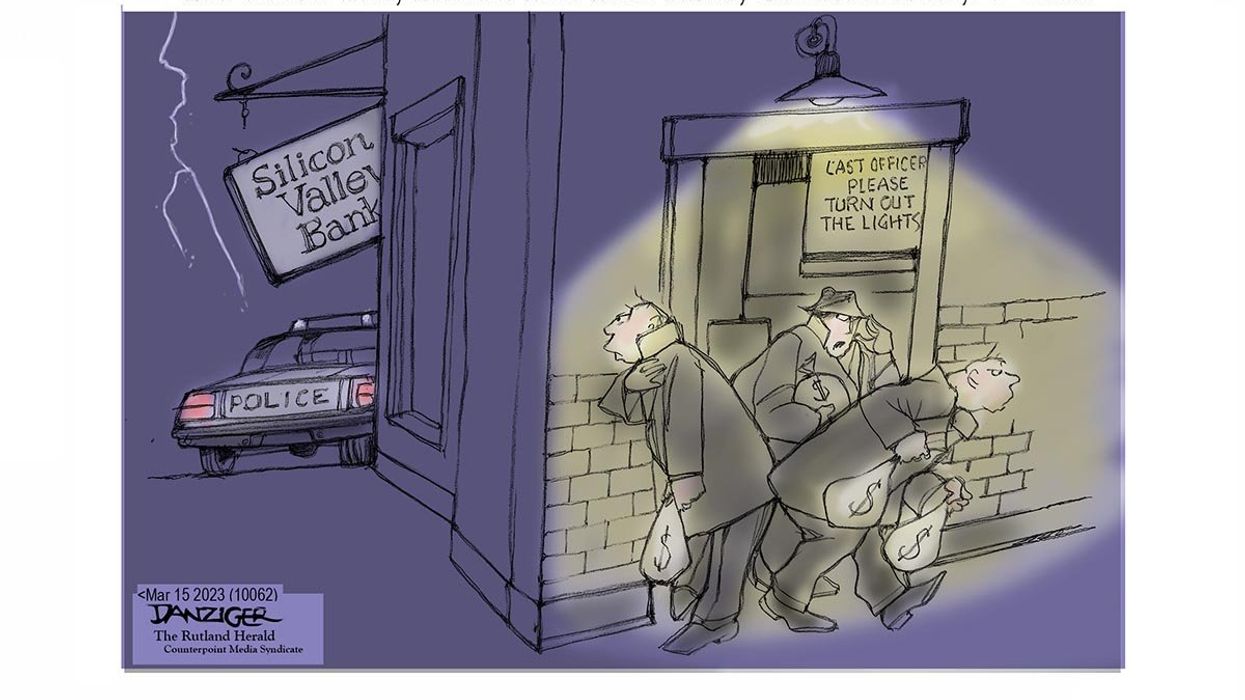
Danziger Draws

Danziger Draws

Jeff Danziger lives in New York City and Vermont. He is a long time cartoonist for The Rutland Herald and is represented by Counterpoint Media Syndicate. He is the recipient of the Herblock Prize and the Thomas Nast (Landau) Prize. He served in the US Army in Vietnam and was awarded the Bronze Star and the Air Medal. He has published eleven books of cartoons, a novel and a memoir. Visit him at DanzigerCartoons.
Bitcoin

How Crypto-Backed Ponzi Schemes Endanger Our Banking System

The collapse of Silicon Valley Bank (SVB) last week raises serious issues far more significant than the obvious ones cited by the financial press and a broad range of Washington politicians.

Chief among these are bank loans against dubious assets. That’s not getting much if any attention in the news or from Washington and is likely to soon be swept under the rug, allowing needlessly risky banking practices to continue.

Before its collapse last week, SVB made loans against Bitcoin and other cryptocurrencies.

The question: why is any bank anywhere allowed to accept crypto as collateral for loans?

Why do banking regulators allow our federally insured and regulated banks make loans using magic internet money as collateral? That’s a crazy policy, no different than allowing banks to accept buckets of ice cubes in winter as collateral, even though they melt come spring and evaporate in summer.

Bitcoin and its imitators are not money. They are not currency. They’re hardly used to buy and sell, an unsurprising fact given that by design the Bitcoin system can process only seven transactions per second compared to many thousands of transactions per second for credit cards.

Indeed, except for laundering proceeds from drug trafficking as well as hiding assets from creditors, estranged spouses, and the tax police, cryptocurrencies have no use.

High-tech Ponzi Scheme

Cryptocurrencies and their cousins, Non-Fungible Tokens or NFTs—are just a high-tech Ponzi scheme. Instead of Charlie Ponzi or Bernie Madoff personally running the con, the crypto scam relies on decentralized computer blockchain and “mining” of mathematical solutions.

Bitcoin’s supposed inventor, who went by the pseudonym Satoshi Nakamoto, has never been identified. He or she has since vanished, leaving holders with a digital string worth only as much as the next fool, or crook, will pay for this imaginary asset.

Early participants in Ponzi schemes profit mightily if they cash out while the gullible souls who get sucked in later wipe out. That is what happened to SVB, America’s 16th largest bank, which was big on crypto loans.

Many Bitcoin “investors” have already been wiped out as the “market cap” of Bitcoin plummeted from nearly $1.3 trillion in 2021 to about $389 billion on Friday, down almost 70 percent.

Why do banking regulators allow our federally insured and regulated banks to make loans using magic internet money as collateral? That’s a crazy policy, no different than allowing banks to accept buckets of ice cubes in winter as collateral, even though they melt come spring and evaporate in summer

Silicon Valley Bank is just one of many federally insured financial institutions that accept crypto currency as collateral for loans. Some banks will loan you 90 percent of the seeming value of your crypto, though 50 percent loan-to-value is more common and that appears to be the standard at SVB based on its web pages.

Zero Interest Crypto Loans

All sorts of financial news outlets offer advice on borrowing against crypto. These include NerdWallet, and the increasingly naïve and unreliable Forbes. People with crypto can even borrow at zero interest. Gadzooks!

For a sober look at the big risks of crypto loans read Investopedia’s essay.

In the wake of the second largest bank failure in history, you should be deeply concerned that for more than four decades we have failed miserably at regulating banks. That history contrasts with the period from 1935 until voters abandoned the moderating and successful New Deal banking rules in favor of Reaganomics.

We took a wrong turn when the prudent New Deal banking regulations in effect from 1935 were killed by Reaganomics, which re-regulated banks to reduce regulations and increase the risk of financial institutions failing. (There is no such thing as deregulation, only new regulation, which in our time on terms typically means regulations favoring corporations, including banks, over customers, financial prudence, and public safety.)

Congress’s Role Is Critical

What we need now are Congressional hearings to examine the reasons that cryptocurrencies can be collateral for bank loans.

Even if you don’t own Bitcoin or its growing list of alternatives, this story matters to you for multiple reasons.

Your money is only insured up to $250,000. Any money above that isn’t insured. That means if you’re a trustee of a nonprofit, for example, and it’s got $1 million in the bank, you or the organization you help lead is at risk of being wiped out in a bank failure.

The federal government is covering all deposits for SVB and at Signature Bank in New York, which failed Sunday. But that doesn’t mean it always will. During an earlier banking crisis nonprofits with more than the guarantee then in effect of $100,000 lost their deposits above that sum, which got very little news coverage at the time.

If people want to buy crypto, they should be free to do so. But they should not be allowed to put our bank deposits and investments at risk by using these digital tokens as collateral for loans. After all, it’s your, and my bank deposits, along with those of businesses, nonprofits, and our governments that the banks use to make loans, so it’s not like we don’t have a deep interest in blocking crypto of any kind as collateral for loans.

Reprinted with permission from DC Report.

Shop our Store

Headlines

Editor's Blog

Trending

World