Trump Lawyer: We Can Bulldoze The Statue Of Liberty Without Any Public Recourse
A single exchange in last Friday’s District of Columbia Circuit argument laid bare the Trump administration’s strategy in a series of recent cases: push through deeply unpopular and frequently illegal measures, disable Congress, and freeze out the public from being able to do anything about it.
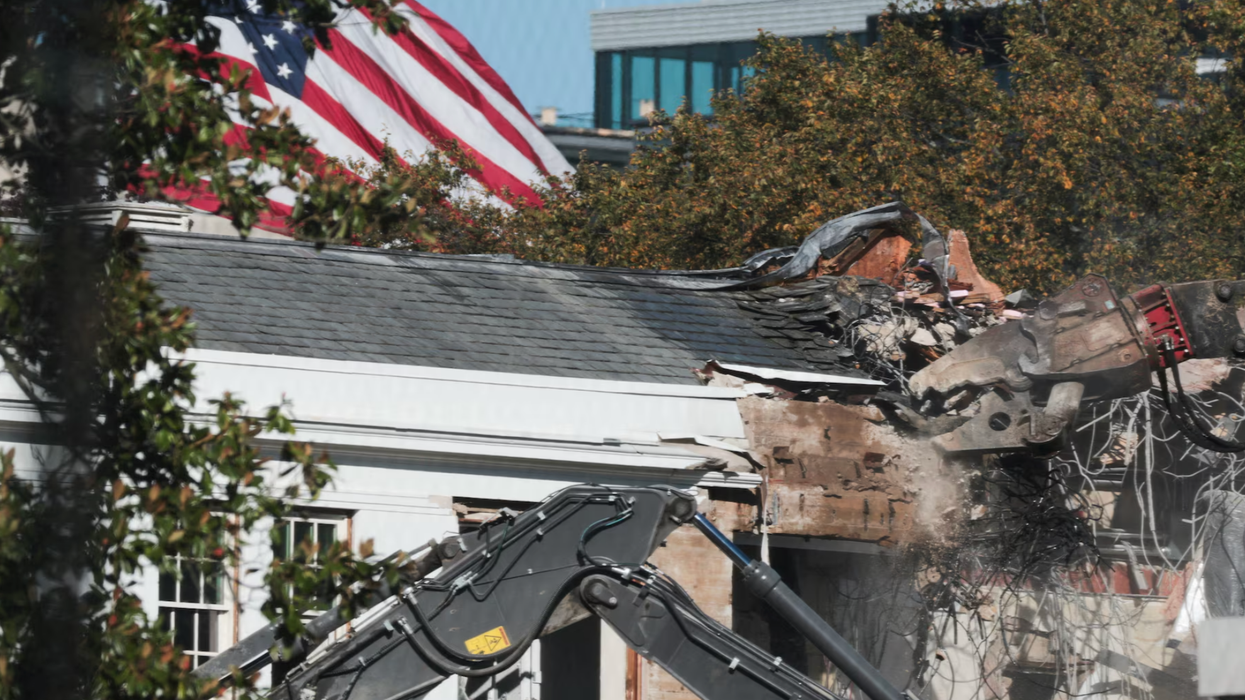
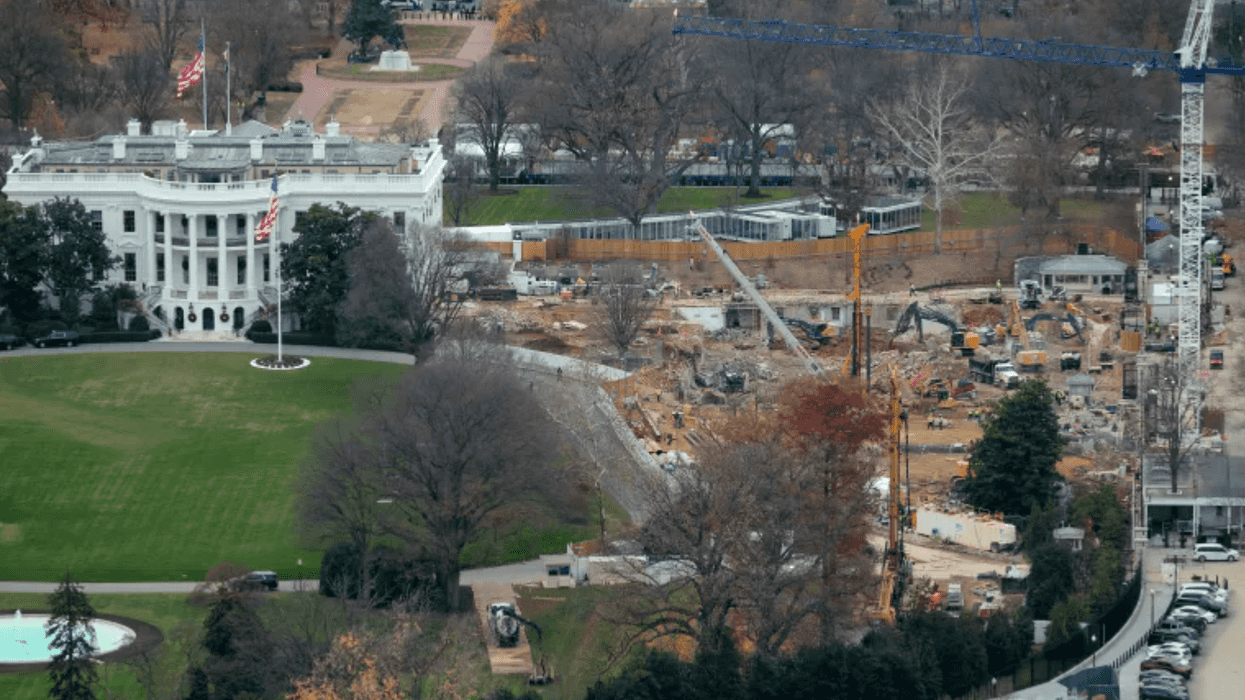
The exchange concerned Trump’s most cherished goal of remaking the White House—the people’s house—in his imperial and garish image.Recall how we got here. Last fall, with no congressional authorization and no completed legal process, the administration simply got up one day and started digging a huge hole where the East Wing had been. By the time the National Trust for Historic Preservation sued in December, the East Wing was gone, and large-scale excavation was well underway.
Judge Richard Leon initially rejected the Trust’s first two injunction requests because they rested on flawed legal theories. Then, in March, he granted a preliminary injunction on the Trust’s amended complaint, halting above-ground construction. The administration took an emergency appeal, and the DC Circuit administratively stayed the injunction the very next day, permitting construction to proceed while the appeal was expedited.
By the time of Friday’s argument, three million pounds of steel rebar were in the ground, and the structure was beginning to rise above it.That brings us to last Friday’s argument. The DC Circuit is commonly considered the second most powerful federal court in the nation. Given the court’s sophistication and the personal importance to Trump of the project, the administration sent its version of the A-Team. Yaakov Roth is a senior official in the DOJ’s Civil Division, as well as a lawyer with a gold-plated résumé that includes a clerkship for Justice Antonin Scalia and extensive appellate experience.
The most active questioner on the panel was Obama appointee Judge Patricia Millett. In the course of pressing Roth on the administration’s standing argument, Millett dropped the hypothetical that crystallized the Department’s position.
“If this were the Statue of Liberty,” Millett asked, “the people whose ancestors—that was the first thing they saw coming to this country, but the government moved too fast—nothing can be done by them to challenge it?”
Roth’s answer: “I think that’s right, yes.”Roth’s answer was not a mistake under pressure. He had thought through the implications of the administration’s position and understood that Millett would be quick to exploit any inconsistency and use it to unravel the administration’s case.
Millett simply followed the logic to its destination and asked him to confirm it. He did, as he had to. The only check, he allowed, would be Congress—which would have to pass a law that Trump could veto, requiring two-thirds to override.
Millett then named what she had gotten Roth to concede: “Move fast and break things and then nobody has standing.” Roth conceded that was essentially correct.
That is the administration’s playbook for a series of recent high-handed moves: the $1.8 billion slush fund for January 6 defendants; the systematic destruction of presidential records; the collusive settlements with Flynn and Bannon; and now the ballroom rising on the demolished White House East Wing.
In each of these examples, the administration follows the same two-step plan.
First, neuter Congress: anything requiring legislation to stop faces a certain presidential veto, and the two-thirds override is a mathematical fantasy as long as enough Republican members remain terrified of Trump’s one remaining real weapon, the threat to come after them.
Second, neuter the courts: argue that no one has legal standing to challenge what is being done, that the injury is too generalized, too abstract, too aesthetic to cross the Article III threshold.
The argument is not that they’re acting in the interests of the American people; it’s rather that the American people can’t do anything about it.
Congress can’t act. Courts can’t hear it. The bulldozer rolls with no brakes.
There is nothing inherently improper about an administration’s invocation of standing doctrine. The requirement that plaintiffs show a concrete, particularized injury before federal courts will take up their claim is a valid constraint, rooted in Article III, and courts across the ideological spectrum have enforced it against litigants of every stripe. The constitutional design is that federal courts are not a substitute for legislative action.
But the administration has taken its reliance on standing to a new low, and used it to bypass legal accountability for a series of issues of intense popular concern. It has combined aggressive standing arguments with bare-knuckle intimidation of Republicans in Congress. The result is a pincer movement that leaves the public—the people who overwhelmingly object to a $1.8 billion giveaway to January 6 defendants, who feel in their bones that the White House belongs to all of them, who do not want their government shredding documents that belong to the people–with no branch to turn to and no courthouse door that will open.
The power of the Millett hypothetical is that it smokes out where the administration’s argument leads. Can the executive lay waste to the Statue of Liberty? Damn right, says Roth—and even if it’s a rank violation of the executive duty to take care, nobody can stop it because nobody has standing.
It’s their game plan, anyway. But the administration’s retreat last week on the slush fund shows what can crack it: a combination of legal exposure and political pressure. The payout to January 6 insurrectionists was odious as well as unconstitutional, and the legal attacks and political pushback reinforced each other. That process is ongoing: Judges Williams, Brinkema, and Leon can still bring the legal hammer down, making it that much harder for the administration to work its will, and for Republicans in Congress to just acquiesce to Trump’s lawless action.
That is the 1-2 punch the moment calls for, and it is available for the ballroom as well. Roth told the court that the public has no voice in the Mar-a-Lago-ization of the people’s house. We can prove him wrong. The task is to raise the political stakes so that every Republican representative feels the heat for going along with Trump’s massively unpopular project.
The White House is the most universally recognized symbol of the national government. Its relatively modest, neoclassical structure stands in harmony with the Capitol and the Supreme Court up the hill. It is the building that millions of schoolchildren visit, that Americans call “the people’s house.” It’s the antithesis of the gaudy ornateness of Trump’s gold-plated imperial design.
There is a profound un-American quality to Trump’s ballroom makeover. He is, in effect, trying to crown himself Emperor—cowing Congress and parrying court action with aggressive standing arguments pressed all the way to the Supreme Court. It is a gesture of deep contempt for the country whose most beloved building he is trying to remake in his own image.
Many of my colleagues believe that he can’t be stopped. I see the force of their positions, but I don’t share them. My best guess is that Trump’s Xanadu monstrosity does not get completed, even though it has been engineered to parry every legal and political challenge the system can throw at it. Some combination of legal and political resolve will hold the line.
An administration lawyer told the judges in the second most powerful court in the country that no court can stop a president who moves fast enough from destroying the White House or the Statue of Liberty. The administration is counting on paralyzing the courts and the Congress, and ultimately on the public’s apathy. The slush fund showed that’s a losable bet. The formula is public pressure, judicial accountability, and Republicans made to own it at the polls. The first part is up to us.
Harry Litman is a former United States Attorney and the executive producer and host of the Talking Feds podcast. He has taught law at UCLA, Berkeley, and Georgetown and served as a deputy assistant attorney general in the Clinton Administration. Please consider subscribing to Talking Feds on Substack.
Reprinted with permission from Talking Feds.