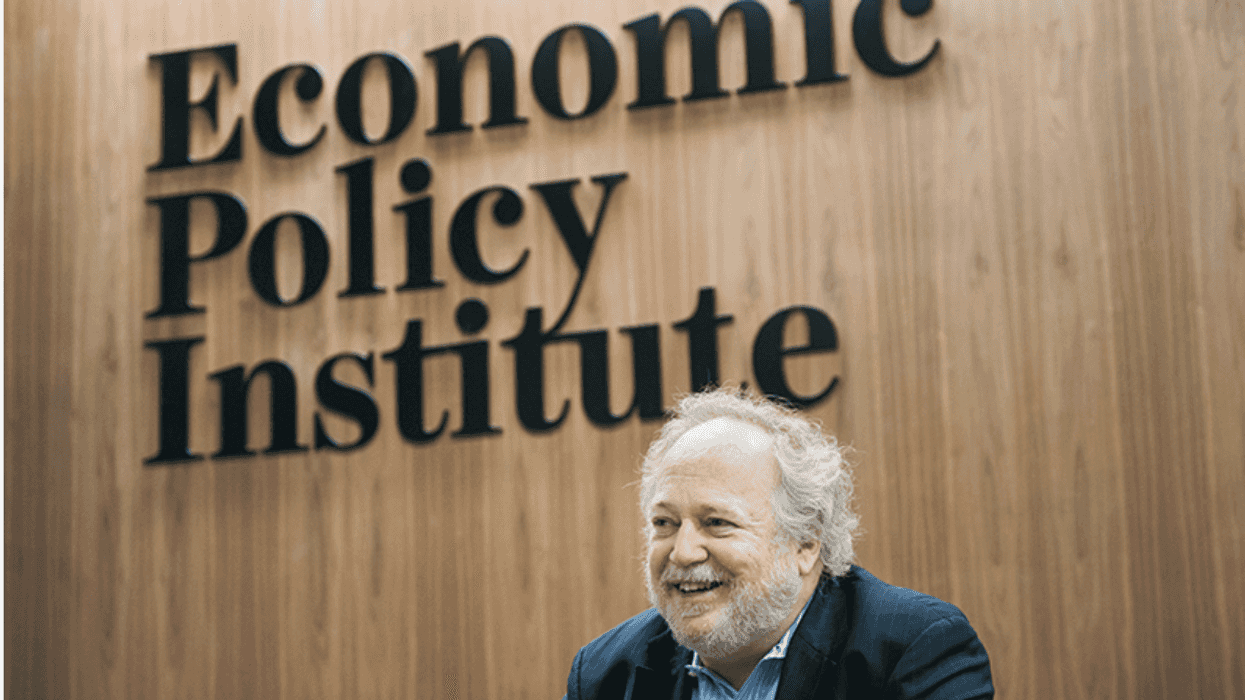
Larry Mishel at the Economic Policy Institute that he co-founded in 1985
When I think about labor and labor economics, I think Economic Policy Institute. So, my gift to you on this Labor Day is to briefly tell or remind you about EPI’s essential role in our economic debate and to get your butt over to their robust website, if you’re not there already—and not just on Labor Day, but everyday. The institute is a spry 40 year-old this year, and they’re at the top of their game.
It’s where I cut my teeth as a junior economist, working with EPI’s former president Larry Mishel and many co-authors on numerous volumes of The State of Working America.
There are three ways I’d summarize the foundations upon which the Institute is built.
—First and foremost, EPI puts bargaining power in the center of their analysis. It’s only slightly reductionist to argue that classical economics leaves this force out, yet it’s a key determinant of economic outcomes. Non-power-based analysis assumes you pretty much get what you deserve (your “marginal product”) though the liberal version allows for gender- and race-based discrimination.
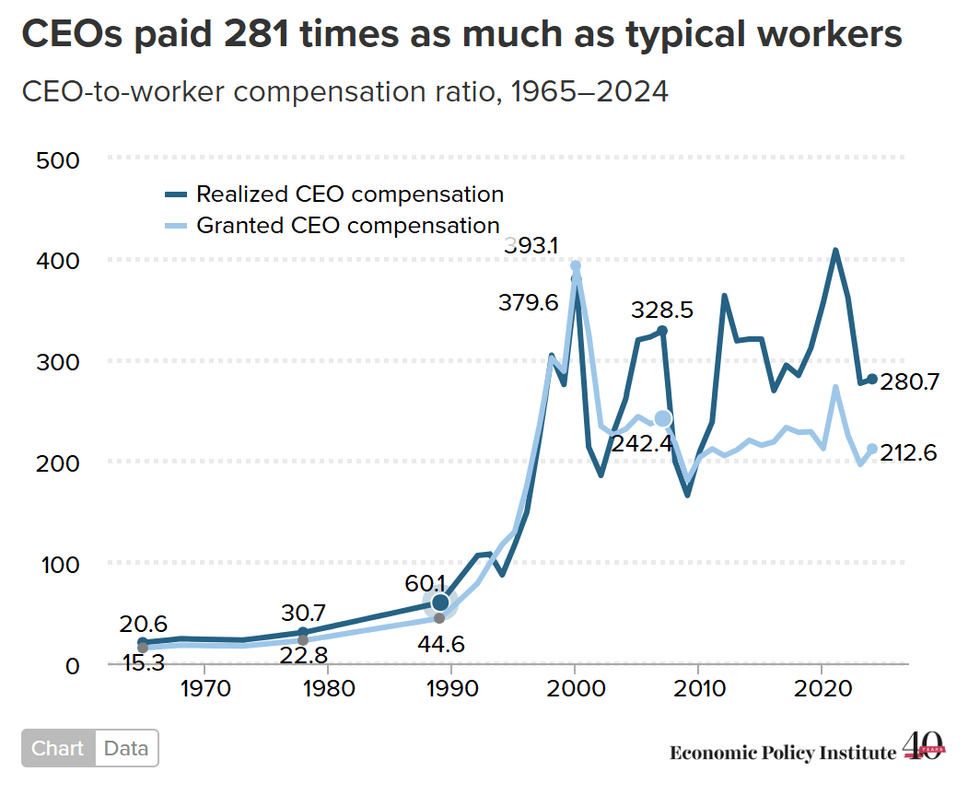
Power-based analysis doesn’t reject the importance of education and experience, but it recognizes that you can’t explain trends like the one shown below without placing power imbalances at the center of the model.
—Second, market failures lurk around more corners than you think. Working back from the fact that power plays a dominant role in economic outcomes, from access to opportunities to the distribution of income and wealth, EPI’s analytic perspective doesn’t accept that unfettered markets deliver optimal outcomes, with rare exceptions for classical externalities, like pollution.
This is why “Policy” is their middle name. We live in a world of “multiple equilibria,” wherein we can craft economic policy to stress fairness, broadly rising living standards that track productivity (this figure, first derived by me and Larry, launched many battles and remains as relevant as ever), and opportunities for all to realize their economic potential.
Or we can accept policies that do the opposite, that reward capital over labor, as do our current tax policies, that allow child poverty to exist when we know we can sharply cut it (see Biden-era impacts therein), that set a decent wage floor, that allow unions to grow to meet the demand for such representation (“56 million workers would join a union if they could”), and so on.
If you want, think of EPI as “The Institute for Promoting Policies to Achieve a Much Fairer Equilibrium,” though I submit that title’s a bit more cumbersome.
—Finally, and this dates back to Mishel and the other early founders, the work is of academic caliber. From its inception to this day, EPI’s researchers adhere to high empirical standards. We knew from the beginning that if you’re going up against the powers that be, who have far deeper pockets than you do, you’d better show up with your standard errors properly calculated.
No one’s saying facts win the day, of course, especially these days, with Trumpian alt-reality politics in control. But the reason EPI is still flourishing in middle-age is in no small part because they’ve got the rigorous research to back up their arguments.
So, enjoy the day, the cookouts, relaxing with friends, etc. But if you can, spend 20 minutes clicking through the EPI website. What you’ll see there is no less than a very different model of how the economy ought to work, along with a policy roadmap of how to get there.
Jared Bernstein is a former chair of the White House Council of Economic Advisers under President Joe Biden. He is a senior fellow at the Council on Budget and Policy Priorities. Please subscribe to his Substack, from which this is reprinted with permission.
- Democracy Needs A Stronger Labor Movement -- And Americans Can Build It ›
- Over 600 Economists Agree: It’s Time To Raise The Minimum Wage ›
- On Minimum Wage, Martin Luther King’s Dream Is Far From Achieved ›
- Study: Cutting Unemployment Benefits Didn’t Help Anyone ›
- Chart: Wage Inequality Has Dramatically Increased Over Past Three Decades ›
- Good Policy Meets Good Politics: It's Past Time To Raise The Minimum Wage ›