Market Plunge: How Trump's Inept 'Wealth Tax' Smacks His Billionaire Buddies

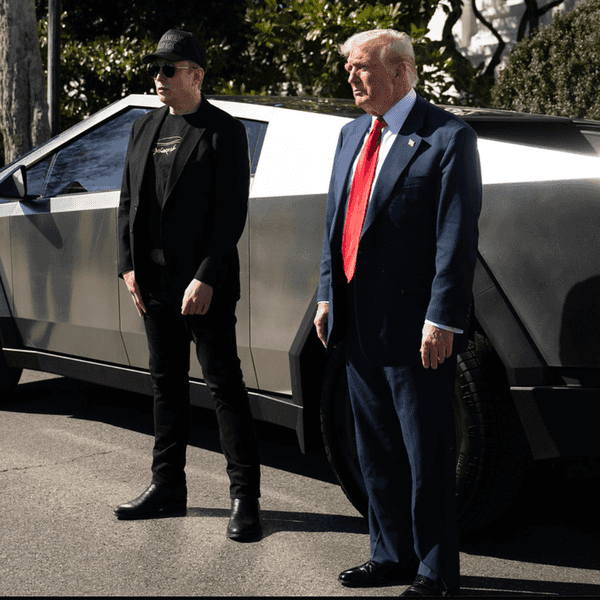
Elon Musk and President Donald Trump promoting Tesla at the White House on March 11, 2025
There is an effort by several progressive unions and other organizations to put a five percent wealth tax for the state’s billionaires on California’s ballot this fall. It’s not clear they will succeed in getting it on the ballot or how the initiative will do (I’m in), but Donald Trump has already one-upped them. Thanks to his management of the economy and his decision to go to war in Iran, he has reduced the wealth of the country’s richest people by far more than the sponsors of this initiative could ever hope.
In 2026 to date, the S&P 500, a broad measure of the stock market, is down by almost 7.0 percent. The NASDAQ, which is where the tech companies controlled by folks like Elon Musk and Mark Zuckerberg live, is down by almost 10 percent. That means Trump may have cost Musk $60 billion, and that’s in just three months. Who knows where he will be by the end of the year.
If anyone thinks I’m being perverse by celebrating a decline in the stock market, try thinking again, or just thinking for the first time. The stock market is not a measure of economic well-being. It is a measure of the wealth of people who own stock.
There are three basic reasons for the stock market to rise. The first is the expectation that the economy will grow more rapidly and that corporate profits will therefore rise more rapidly along with the rest of the economy. The second is that investors expect that after-tax profits will rise at the expense of wages or due to lower taxes. The third is due to a bubble, or “irrational exuberance” to use former Fed Chair Alan Greenspan’s great term.
Only the first reason reflects good news for the economy. The other two are negatives from the standpoint of the bulk of the population. There is no reason for the rest of us to be applauding a shift from wages to profits or a larger share of the tax burden to be left to ordinary workers. Nor should we be delighted about a bubble that distorts investment decisions and gives the rich even more disproportionate ability to command economic resources while it lasts.
I’ll leave it to others to speculate on the main causes of the decline in the market this year, but I would put my money mostly on number three, a bit less irrational exuberance, but also a bit of number one, more pessimism about future growth prospects. But regardless of the cause, the rich are considerably less rich because of Trump’s actions.
I know that even many progressives will find rooting against the stock market difficult to stomach, but let me urge using your head instead of looking at your 401(k). The rich own half of all corporate stock. When the market goes up, they get richer compared to everyone else. That is definitional. For progressives to both root for a rising stock market and then complain about wealth inequality is like the old joke about the kid who kills his parents and then begs for mercy because he’s an orphan. But serious economists do this for real.
To be clear, I have long emphasized focusing on income inequality rather than wealth inequality, partly for this reason. But no one cares what I say. I’ll also mention that the complaint that we should be worried about wealth buying political power is equally off base. Elon Musk, with $300 billion rather than $600 billion, still has far too much power. (And tell me your plan to cut his wealth in half with tax policy.) If we’re going to be serious, we have to address structural issues on controlling the media. (Sorry folks, it matters more what people see between the political ads than what they see in the ads.)
Just to be clear, I know many non-rich people (like me) also have money in the stock market. They will lose too when the market tumbles. I’ll make two points on this issue.
First, if you’re looking for a policy that doesn’t hit anyone you care about, you should go into a different line of work. Such policies do not exist in this world.
I recall working with a coalition pushing for a financial transactions tax that could raise close to $150 billion a year (0.5% of GDP), overwhelmingly at the expense of the financial industry. A major concern was that this could also hit middle-income people with their 401(k)s.
That was not altogether wrong, but what we were talking about was someone with $200k in their retirement account may have to pay $40 a year due to the tax.[1] Really, this is a big problem?
The other point is that if we are primarily lowering stock prices by getting rid of irrational exuberance, then the income flows from 401(k) stock holdings will be little affected. This means that $80k in stock may still provide the same capital gains and dividends as $100k did in a bubble-inflated stock market. I know that it will be hard for the folks who just lost 20 percent of their wealth to stomach, but I am an economist, not a psychologist.
Trump’s war in Iran is abhorrent for many reasons, first and foremost the needless loss of life, but it is imposing real costs on the world economy. His tariff and immigration policies are also horrible, as are his efforts to increase greenhouse gas emissions. But insofar as these have led to a loss of wealth for the rich jerks that have been buying favors from him, I will shed no tears.
Dean Baker is a senior economist at the Center for Economic and Policy Research and the author of the 2016 book Rigged: How Globalization and the Rules of the Modern Economy Were Structured to Make the Rich Richer. Please consider subscribing to his Substack.
Reprinted with permission from Dean Baker.