When JD Vance Calls Abdul El-Sayed 'Evil,' He Should Look In A Mirror
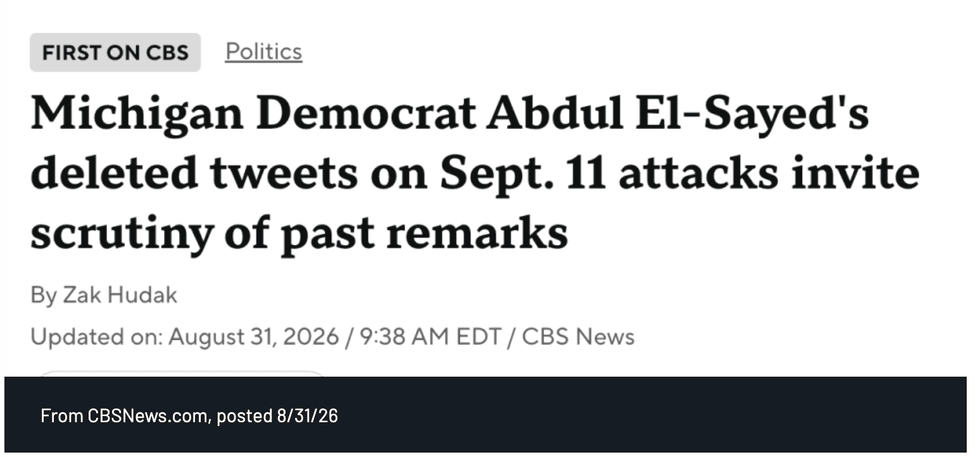
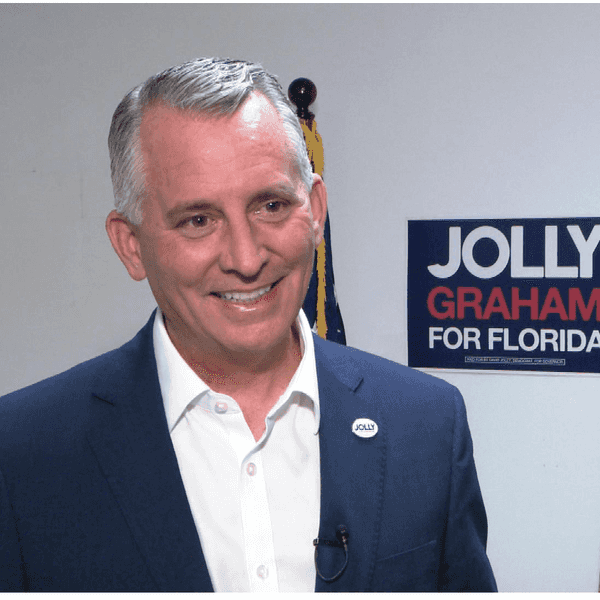
In a year when Democrats have the wind at their backs and a shot at winning even in Texas, primary voters in Michigan have chosen a Senate candidate in Abdul El-Sayed who needlessly alienates many voters. But of all the Republican politicians to criticize El-Sayed, JD Vance may be the least well suited, because when it comes to tolerance for extremism and antisemitism, Vance and El-Sayed are almost equally matched players in a dangerous, illiberal game. It's a mark of how far our guardrails have fallen that leading American political figures are engaging in more or less open race/religion baiting — and each is in high dudgeon that the other is doing it.
El-Sayed has waded into extremist waters a number of times, most prominently when he seemed to downplay the horror of an attempted attack on a Michigan synagogue. On March 12, Ayman Ghazali drove a truck, filled with fireworks and gasoline, into Temple Israel in West Bloomfield. The truck caught fire after it crashed through the doors. At the time, more than 100 students and some 50 staff were inside the religious school. One security guard was struck and injured, and more than 60 police and firemen were treated for smoke inhalation. Ghazali committed suicide by shooting himself.
El-Sayed condemned the attack, but a few days later, noting that relatives of the attacker had died in an Israeli air strike in Lebanon, El-Sayed equivocated, saying, "Hurt people hurt people."
If you think that Israel's actions in Lebanon justify or excuse in any way an attack on Jewish children in Michigan, you are missing something fundamental about liberal values. Would El-Sayed say the same if a Jewish American whose relatives had been killed by Hamas on Oct. 7 attempted to bomb a Muslim school?
In contrast to the MAGA style of politics, El-Sayed has apologized. Speaking to Michigan's Jewish Democratic Caucus, he said, "My comments may have been misconstrued to justify something I did not mean to justify. To anyone who feels like my comments might have been hurtful, I'm really sorry. That was not my intention."
Is he apologizing for the fact that others "misconstrued" his remarks? That is pretty weak tea as apologies go, but it's better than Vance's record, which we'll come to soon.
El-Sayed has a history of associating himself and his campaign with people who clearly cross the line, and has not apologized for doing so. What prompted him to invite Hasan Piker to campaign with him? Piker is an encyclopedia of offenses and idiocies. He thinks communist China and Cuba are great role models, excused Hamas for raping Israeli women, and invited a Vietnamese refugee who recounted her suffering to "Suck my d—k, old lady."
He calls critics "rabid, ultra-Zionist pigs," and lately has lapsed into the more-in-sorrow-than-in-anger mode of warning American Jews that if they "keep putting this idea out there that they are singularly invested in Israel, eventually someone is going to come around and take action — not against the state of Israel, mind you, but against American Jews."
That last one, in addition to holding Jews responsible for how others perceive them, is an invitation to antisemitic violence notionally veiled in concern. How would Piker react if someone were to warn that if Muslim Americans didn't stop supporting the Palestinians, "someone is going to come around and take action"?
El-Sayed isn't responsible for everything his supporters say, but Piker is a hateful extremist whose support El-Sayed sought — and he isn't the only one. El-Sayed also campaigned with Amir Makled, a progressive who has a history of pro-Hezbollah posts, and who has recirculated antisemitic memes — ironically, from right-wing figures Marjorie Taylor Greene and Candace Owens. Makled reposted a message from Owens calling Israelis "demons" who "lie, cheat, murder, and blackmail." There's nothing to unite extremists of the left and right quite like some undiluted antisemitism.
People often ask whether all criticism of Israel can be tarred as antisemitism. The answer is: Of course not. Israel merits condemnation for its unjust actions, as any nation does, and anyone who attempts to paint all criticism as antisemitism is doing no favors to Jews or to the truth. But when someone seems obsessed about Israel's sins but unbothered by those of China, Sudan, Hamas, Russia, or countless others, or when someone invites or excuses violence against American Jews, that clearly crosses the line.
Would that there were a responsible opposition to the Michigan Democrats who could, with integrity, rebuke El-Sayed. Alas, we have JD Vance. "I realize that there's something about Abdul El-Sayed that is very, very evil and on the rise in the United States of America today," Vance said last week. He's one to talk.
The company Vance keeps includes Tucker Carlson, whose obsession with Israel and Jews has become pathological. Even after Carlson's softball interviews with white nationalist antisemite Nick Fuentes (who also feuds with Vance, but that's a topic for another day) and Holocaust denier Darryl Cooper, whom Carlson praised as "the best and most honest popular historian in the United States," Vance refused to distance himself from Carlson.
Given the opportunity to do so at a White House press briefing Thursday, he demurred: "I'm not going to play the game where I throw friends under the bus because I have political disagreements with them. I think that is a terrible place for the U.S. to go."
Vance sees "pas d'ennemis a droite." So in October, when a bunch of Republican operatives were discovered to have exchanged texts calling black people "monkeys" and "watermelon people" and pronouncing "I love Hitler!" Vance was forgiveness itself. Appearing on the Charlie Kirk podcast, Vance explained that:
"The reality is that kids do stupid things, especially young boys. They tell edgy, offensive jokes. That's what kids do. And I really don't want us to grow up in a country where a kid telling a stupid joke, telling a very offensive, stupid joke, is cause to ruin their lives."
These "young boys" were in their 20s and 30s. Speaking of Kirk, after his assassination, Vance was unwilling to overlook youthful mistakes: "The First Amendment protects a lot of very ugly speech but if you celebrate ... Charlie Kirk's death, you should not be protected from being fired for being a disgusting person."
Some of the people whom the Trump/Vance administration targeted for punishment did not "celebrate" Kirk's murder but merely recalled that Kirk himself had offered to pay the lawyer who represented Paul Pelosi's attacker.
Even some on the right have pleaded with JD Vance to denounce the groypers and antisemites now proliferating in congressional offices and think tanks. Rod Dreher pinned his hopes on Vance to staunch the flow. Vance gave his answer at a Turning Point USA conference, when he denounced not antisemitism or bigotry but "endless, self-defeating purity tests."
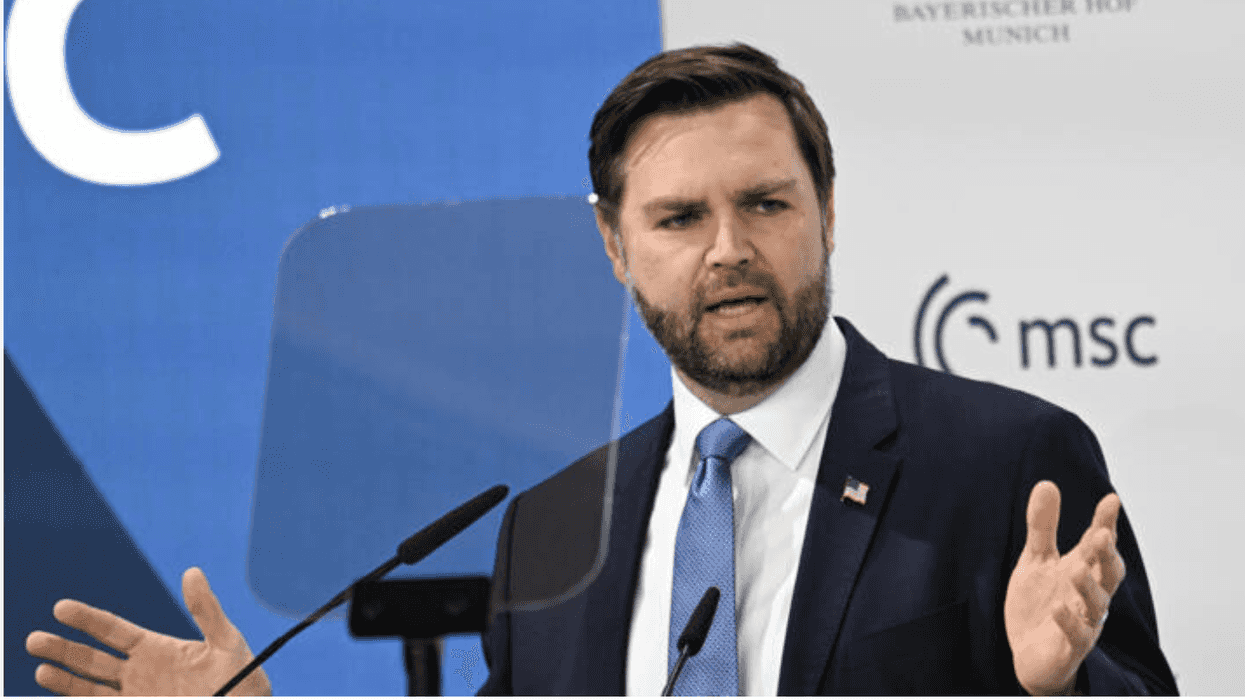
Recall that among Vance's first official acts as vice president was a speech to the Munich Security Conference, where he lectured Germany. The mainstream parties had an informal "brandmauer" (firewall) agreement not to enter into coalition with the Alternative fur Deutschland, a party that is pro-Putin, anti-Ukraine, anti-Muslim, and had roots in the Nazi Party. It was quite a moment. The United States has long taken pride in having defeated the twin totalitarian menaces of the 20th century: fascism and communism. Yet here was an American vice president lecturing the Germans about freezing out the ideological descendants of the Nazis.
That endorsement of extremism and betrayal of our values was at least open and direct, but Vance is capable of more insidious incitement of hatred. It was Vance who circulated the atrocious lie about Haitian immigrants barbecuing people's pets. He has trafficked in false statistics about immigrants and crime, suggested that the high cost of housing was attributable to immigrants, and alleged recently that immigrants were responsible for the recent surge in antisemitism.
When he was criticized for the failed Memorandum of Understanding with Iran, which he had taken the lead in negotiating, Vance responded by alleging that "certain elements within the Israeli government" were running a "discreet, extremely well-funded" campaign to manipulate American public opinion against the agreement. He cited a Time magazine article as proof, but the article didn't support his contention at all; it was about an Israeli effort to push back against antisemitism among young, right-wing men. In any case, the charge of Jews secretly manipulating anything — the media, the banks, Hollywood, foreign policy — is classic antisemitism.
Vance's contribution to American politics is to leave a trail of suspicion and hatred in his wake like snail slime. He is the logical inheritor of the MAGA mantle.
The best that can be said about El-Sayed is that an unsatisfying apology is better than none at all and that he belongs to a party that still enforces some moral red lines. The fear is that if his style comes to dominate, that will cease to be true.
Mona Charen is policy editor of The Bulwark and host of the "Beg to Differ" podcast. Her new book, Hard Right: The GOP's Drift Toward Extremism, is available now.
Reprinted with permission from Creators