Tag: blue state
Victimizing Blue State Taxpayers May Doom GOP House Majority

Victimizing Blue State Taxpayers May Doom GOP House Majority

At least six congressional Republicans are demanding a radical fix in the 2017 tax law targeting residents of high-income states. If they don't get it, they may sink Donald Trump's tax-and-spending package, his "one big beautiful bill."

And who can blame these reps from New York, New Jersey and California? At issue is the unfair cap on the state and local taxes (SALT) their constituents may deduct from federally taxable income. The SALT deduction, unlimited before 2017, was set at a maximum $10,000.

What made it sweet to other Republicans was that it paid for some of those tax cuts by milking taxpayers in wealthier Democratic states. And that has made voters in key suburban districts sore.

What makes this attack on the SALT deduction outrageous? For starters, it taxes income that Americans have already paid in taxes. Secondly, incomes in these states are higher because their everyday costs are higher. Teachers, road workers and other public employees must be paid more just to maintain the living standards enjoyed elsewhere.

Defenders of the cap argue piously — and wrongly — that the SALT deduction is a tax break only for rich people. It's true that taxpayers with higher incomes tend to get the most out of the deduction, but a cop married to a nurse in New York, New Jersey or California can easily have a combined income of $200,000 — and no one would call them rich given housing prices.

In decidedly middle-class Levittown, on Long Island, homeowners typically pay a property tax of about $16,000. Then there are state income taxes.

If Washington's objective is to raise more revenue from higher-income Americans, then fine. Just raise the federal tax brackets for high incomes everywhere in the U.S.

The most obnoxious argument for the SALT cap is that it forces "profligate" state governments run by Democrats to restrain their own taxes. What state and local governments levy in taxes should be no business of Washington's. Americans unhappy with their local tax regimes can move elsewhere, and some do.

But many regard superior education systems and other public amenities worth the higher taxes. Republicans should note that making it harder to pay good salaries to police is, in essence, a form of defunding the police.

Raising the cap on this deduction may require Washington lawmakers to find the revenues elsewhere. Well, that's too bad.

House Ways and Means Committee Chair Jason Smith represents the most rural district in Missouri. It's easy for him to say Republicans from high-tax states may have to settle for an "unhappy" compromise on the SALT deduction. By that, he means raising the cap to a meager $30,000.

Republican reps from these swing districts are having none of it, frankly, because their jobs are at stake. They know that the Republican brand has already fallen for their voters, given the toll tariff chaos has taken on their businesses.

There's a reason President Donald Trump retreated on naming New York Rep. Elise Stefanik as United Nations ambassador. He doesn't want to risk a special election that may replace her with a Democrat. After 2022, Republicans flipped at least four New York districts, without which they wouldn't now enjoy a House majority.

New York Republican Nick LaLota spoke for others when he told reporters that the SALT talks are far apart, on the 25-yard line with 75 yards to go. LaLota's district covers eastern Long Island.

If House Republicans think they can threaten these "SALT Caucus" members for killing one of Trump's top priorities, they need hearing aids. The general election, not primary challenges, is what these politicians should worry about most. Democrats already see opportunity, and the elected Republicans know it.

Reprinted with permission from Creators.
Why GOP Strategists Worry About 2020 Battleground Districts

Why GOP Strategists Worry About 2020 Battleground Districts

Reprinted with permission from Alternet

Much of the coverage of the 2018 midterms focused on how well Democrats performed in suburban areas of blue states or swing states: the suburbs of Philadelphia, Chicago, Detroit, Denver, and Boston — or Orange County, California, which was once a GOP stronghold but now has a Democratic majority.

But in a report for the Washington Post, Robert Costa focuses on another source of Republican anxiety: suburban areas in red states.

The fact that a state generally leans Republican doesn’t necessarily mean that it doesn’t have large urban centers that are more Democratic. In Texas, for example, major cities like Houston, Austin and El Paso lean Democratic — an abundance of rural counties are what have given the GOP an advantage in the Lone Star State. Similarly, Atlanta is heavily Democratic even though Georgia’s rural counties are heavily Republican.

A blue city, however, can have red suburbs, and according to Costa, the worry of GOP strategists is that those red suburbs will turn blue — especially if President Donald Trump says and does things to alienate suburban voters.

Scott W. Reed, senior political strategist for the U.S. Chamber of Commerce, told the Post that in the GOP, there is “so much angst” over some GOP congressmen in Texas deciding not to seek reelection in 2020 and “so much hope that President Trump would just talk about the economy for three days straight” — that is, as opposed to what Costa describes as “Twitter outbursts.” And Reed fears that Democrats could regain the U.S. Senate next year if Republicans don’t make an “aggressive effort” to win votes in suburbia.

In Georgia, Costa reports, Republicans view Democrat Stacey Abrams’ 2018 gubernatorial campaign as a troubling sign. Abrams narrowly lost the election to Republican Gov. Brian Kemp, but she performed well in the Atlanta suburbs. A heavy white rural turnout helped Kemp fight his way past the finish line in that competitive statewide race.

Another troubling sign for Republicans in Georgia: Democratic Rep. Lucy McBath’s 2018 victory over Republican Karen Handel in a congressional district that former House Speaker Newt Gingrich once represented. McBath, Costa notes, is an African-American woman and “gun-control advocate” who achieved victory last year in Atlanta’s northern suburbs “by building a diverse coalition that drew support from college-educated white Republicans who have drifted away from Trump.” In other words, Trumpism didn’t defeat McBath in a district that once voted for Gingrich — it got a Democrat elected to Congress.

Costa’s article drives home the point that Republican strategists and organizers are not only worried about the suburbs of northern cities — they are also worried about the suburbs of Dallas, Houston, and Atlanta. And if Democrats continue making inroads in those suburbs, it could be bad news for Republicans on Election Day 2020.

Analysis: Why Rubio, Bush, Walker, And Kasich Are Not As Purple As They Look

Analysis: Why Rubio, Bush, Walker, And Kasich Are Not As Purple As They Look

By Ken Goldstein, Bloomberg News (TNS)

WASHINGTON — There are now 17 announced, or soon-to-be-announced, Republican candidates for president. And to the degree that they’re serious about winning the White House (an open question in some cases) they’re all trying to accomplish contradictory, if not mutually exclusive things: They have to sell themselves to the passionately partisan voters and caucus-goers in the early primary states (Iowa, New Hampshire, South Carolina, and Nevada), while simultaneously making the all-important case that they would be the strongest candidate to defeat Hillary Clinton, before a very different electorate than that of the GOP primaries, in November 2016.

But what do we actually know about which of these 17 would be the strongest general election candidate? Which of these 17 could compete and win in the nine battleground states (Colorado, Florida, Iowa, New Hampshire, Nevada, North Carolina, Ohio, Virginia, Wisconsin) that will likely determine the 2016 election? Which of the 17 could expand the playing field into states like Michigan or Pennsylvania?

There’s a lot to take into account when answering that question — but the partisan composition of the electorate is the single most important factor in American elections. And accordingly, a straightforward way to assess the candidates’ prospects in November 2016 is to take a close look at the electorates they’ve faced in the past.

Six of the Republican contenders (Ted Cruz, Lindsey Graham, Mike Huckabee, Bobby Jindal, Rand Paul, and Rick Perry) are from states that are reliably red — and have never faced electorates that would have the partisan distribution they would encounter in purple states. Two of them (Ben Carson and Donald Trump) have never ever faced any electorate whatsoever and one (Carly Fiorina) ran and lost in a blue state.

Five (Jeb Bush, Jim Gilmore, John Kasich, Marco Rubio, and Scott Walker) have won statewide elections in purple states, and three GOP contestants have won statewide contests in blue states (Chris Christie, George Pataki, and Rick Santorum).

But, even for those purple and blue state winners, presidential year electorates are fundamentally different than midterm electorates. Presidential electorates are less white, younger, and more Democratic than midterm electorates. And only one of the eight candidates who have previously won in blue or purple states has ever run statewide in a presidential election year. Gilmore ran for Senate in Virginia in 2008 and lost by more than 30 percentage points. In fact, according to my calculations, of the 40 elections that the 17 announced or soon-to-announce GOP candidates have collectively run in at the state level (not all of them wins), only four of those contests were in presidential election years — Gilmore lost in Virginia in 2008, Graham won re-election in South Carolina in 2008, Cruz was elected in Texas in 2012, and Santorum was re-elected in Pennsylvania in 2000. None of the other 13 candidates has ever faced statewide voters in a presidential election year.

This means that even candidates who have won in battleground states face significant hurdles. For example, Rubio won election to the Senate in 2010 in an electorate which, according to the exit polls, was 71 percent white, and in which Republicans enjoyed a four percentage point (40 percent to 36 percent) advantage in party identification. In 2012, the Florida electorate was 67 percent white and Republicans suffered from a two-percentage-point deficit in partisan identifiers (33 percent to 35 percent). Looking at the voter file in Florida, of the approximately 4 million registered voters who vote in just about every election, Republicans have a five-percentage-point advantage. But among the 3 million-plus registered voters who vote only in presidential elections, Democrats have a six-percentage-point advantage.

There are two Americas when it comes to midterm year electorates and presidential year electorates and while Republicans have enjoyed great success in recent midterms, the eventual nominee will need to attract or disproportionally mobilize a significant chunk of those citizens who only cast their ballots in presidential election years. Who votes is the most fundamental question in understanding who wins, and none of the Republicans have faced the who that will decide the 2016 election — presidential election year only voters in purple states.

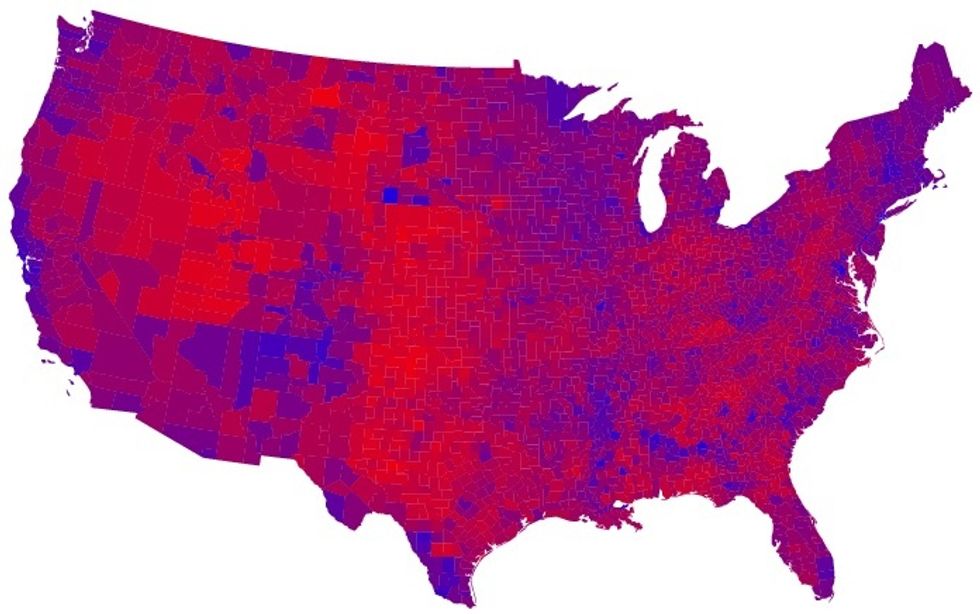
Image: Election map by county that shows electoral tendency by shade of purple via Wikimedia Commons

Shop our Store

Headlines

Editor's Blog

Corona Virus

Trending

World