Tag: charles payne
Data Center Battles Forcing Right-Wing Media To Cover Environmental Justice

Data Center Battles Forcing Right-Wing Media To Cover Environmental Justice

Less than a month after apologizing for unsupported claims that opponents of a proposed Utah data center were funded by China, Fox Business anchor Maria Bartiromo again suggested that opposition to data centers might be driven by foreign interests.

During the July 16 episode of Fox Business’ Mornings with Maria, Bartiromo noted that “hundreds of protests” were planned in “both red states and blue states” as communities demanded “a voice” in how data centers would “affect their daily lives.”

She then recast that opposition as Democratic pushback, asking who was “behind these protests” and “who’s paying for it.” Her guest, American Energy Institute CEO Jason Isaac, blamed “climate alarmist organizations” and claimed there was “clear CCP influence” behind opposition to AI infrastructure.

That allegation is in tension with Fox’s own coverage, which had already touched on the concerns driving opposition to data centers. Fox personalities and guests had questioned whether residents should subsidize new infrastructure through higher electric bills, whether developers should be allowed to consume local water and power without absorbing the costs, and whether communities had been given a meaningful role in decisions about projects that would reshape the places they lived. These are environmental justice concerns, even though the coverage elided the term.

Right-wing media had spent years dismissing, mocking, or racializing environmental justice as a concept. They attacked Biden-era climate and environmental justice provisions and cheered rollbacks of environmental and public health protections, helping the Trump administration recast environmental justice funding as waste, corruption, or left-wing patronage.

But in 2025 and early 2026, Fox Business personalities occasionally mentioned the burden data center projects would impose on residents. Fox Business personality Dagen McDowell cited rising electricity costs and said residents were pushing back against projects because of concerns about electricity, while co-host Brian Brenberg argued that communities could object to projects creating “negative externalities” and said that developers should not be able to “suck up all the energy and suck up all the water and then turn around and say, well, it’s for capitalism.”

Other right-wing outlets registered similar concerns. During the April 6 episode of Real America’s Voice’s War Room, American Principles Project President Terry Schilling warned that data centers would “drive up energy costs,” “drive up water costs,” and “drive down the value of the land.” And on May 27, Newsmax host Rob Finnerty challenged assurances that closed-loop systems resolved concerns about water consumption, asking whether those claims were “not exactly accurate.”

Right-wing media could acknowledge the costs imposed on residents when those concerns came from rural officials, conservative communities, or other figures legible to their audience. These outlets did not connect those complaints to the same environmental justice demands Black communities and organizers were already making elsewhere.

Amid growing opposition, some right-wing media figures have shifted their scrutiny from data center developers to the people and communities opposing them.

Opposition to data centers is an environmental justice fight

Before data centers became a flashpoint in right-wing media, communities near proposed and operating facilities were already warning about demands for land, water, and electricity, along with pollution and higher utility bills.

Capital B News reported that Black communities from Mississippi to Maryland were already fighting projects that would consume enormous amounts of land, water, and electricity in climate “sacrifice zones,” where residents “already face increased health and economic harm.” In Bessemer, Alabama, residents opposed a project that would clear 700 acres of forest, consume nearly 2 million gallons of water each day, and use enough electricity to power Seattle. City leaders signed nondisclosure agreements tied to the project and approved a zoning change that opened farmland to industrial development with limited public input. Similar fights were unfolding elsewhere: Baltimore residents connected data center power demand to rising utility bills; and communities in South Fulton, Georgia, raised concerns about dumping, land use, and exclusion from decisions about their future.

Fox Business also reported on rural residents’ concerns about data centers’ harmful impacts. During the May 22, 2025, episode of The Bottom Line, Davis, West Virginia, Mayor Alan Tomson warned that a proposed data center and natural gas power plant threatened the area’s “fresh air,” “open space,” and scarce water resources. Tucker United spokesperson Nikki Forrester, appearing in the same segment, said residents had been left “in the dark” about what would be built in their community.

The material burdens driving opposition also remained visible in wider conservative media. A December Blaze Media column warned that data center projects “devour land, drain water supplies, and strain already fragile power grids,” while utilities spread infrastructure costs across households and small businesses in the community. In May, the New York Post reported that residents in Fayetteville, Georgia, experienced weak water pressure after a nearby data center used nearly 30 million gallons of water that initially went unbilled. And, in July, Breitbart said that a contractor building Meta’s Cheyenne data center contaminated the city’s reclaimed-water system, prompting the local utility board to suspend wastewater from data center operations and revoke the company’s discharge privileges.

However, as opposition across different racial, geographic, and political demographics converges around the same environmental justice demands, Fox Business and other right-wing outlets have increasingly questioned the people trying to stop data center development.

Right-wing media moved to discredit a coalition crossing racial, political, and ideological lines

Data center development is accelerating even as opposition grows. Goldman Sachs has projected that U.S. data center power demand could more than double by 2027. Gallup found that 71 percent of Americans oppose building AI data centers in their area, including nearly half who strongly oppose them. Half of opponents cited excessive resource use, while others pointed to pollution, utility costs, land use, and broader effects on their communities. Globally, data centers already consume more electricity than all but 10 countries.

As more communities took up the fight against data centers, some right-wing outlets have begun to scrutinize the opposition instead of the companies seeking to build the projects. By early July, Fox hosts and figures had tied data center opposition to Sen. Bernie Sanders (I-VT), Rep. Alexandria Ocasio-Cortez (D-NY), anti-war activist group CODEPINK, and alleged China-linked funding networks. The New York Post republished a Fox News Digital article amplifying Power the Future’s calls for Congress to investigate what the fossil-fuel advocacy group described as a “coordinated, billionaire-funded, and potentially foreign-backed political campaign” against data center construction. Another Post column cast the backlash as a “moral panic,” arguing that data centers had become a “boogeyman” for broader fears about AI.

Then the focus was New York, where Democratic Gov. Kathy Hochul signed a July 14 executive order imposing the nation’s first statewide moratorium on new hyperscale data centers. The one-year pause was intended to give New York time to establish standards addressing rising utility costs and the industry’s demands on energy and water.

Two days later, Fox Business host Charles Payne appeared on Fox News’ America’s Newsroom and claimed that the moratorium was part of a Democratic “war on AI” whose “real agenda” was to “kneecap America’s ability to win the AI race.” Later that day, Fox Business’ The Evening Edit described Hochul as a “far-left blue state governor” who was getting data centers wrong and described the issue as “the fight against China.”

The July 21 episode of Fox & Friends again cast the broader opposition as a Chinese influence operation. Co-host Brian Kilmeade asked whether China was using TikTok and other platforms “to get America to turn on AI and data centers.” Heritage Foundation senior fellow Steve Yates answered “100%” and described the opposition as “astroturf protests” intended to make “Americans defeat Americans.”

The opposition that right-wing media has portrayed as left-wing or foreign-backed includes environmental justice organizers, MAHA activists, and local residents who do not always share politics but are challenging the same corporate claims on their communities.

In June, Fox News’ own polling found that two-thirds of registered voters opposed having a data center built in their area, including majorities of Democrats and Republicans. In fact, a majority of almost every group in Fox’s poll opposed data centers in their area — men, women, voters under 30, voters over 65, white voters, and Hispanic voters.

Data center fights have made environmental justice concerns legible to parts of the right-wing constituency. Right-wing outlets conceded the substance of those issues when they platformed concerns about who would pay higher bills, lose access to clean water, or be shut out of the decision-making process. Now, they are scrambling to defend the data center buildout, resorting to attacks and smears against a coalition whose grievances their own coverage has already validated.

Reprinted with permission from Media Matters
Fox Business Blames Media For Popular Rejection Of Trump Tariffs

Fox Business Blames Media For Popular Rejection Of Trump Tariffs

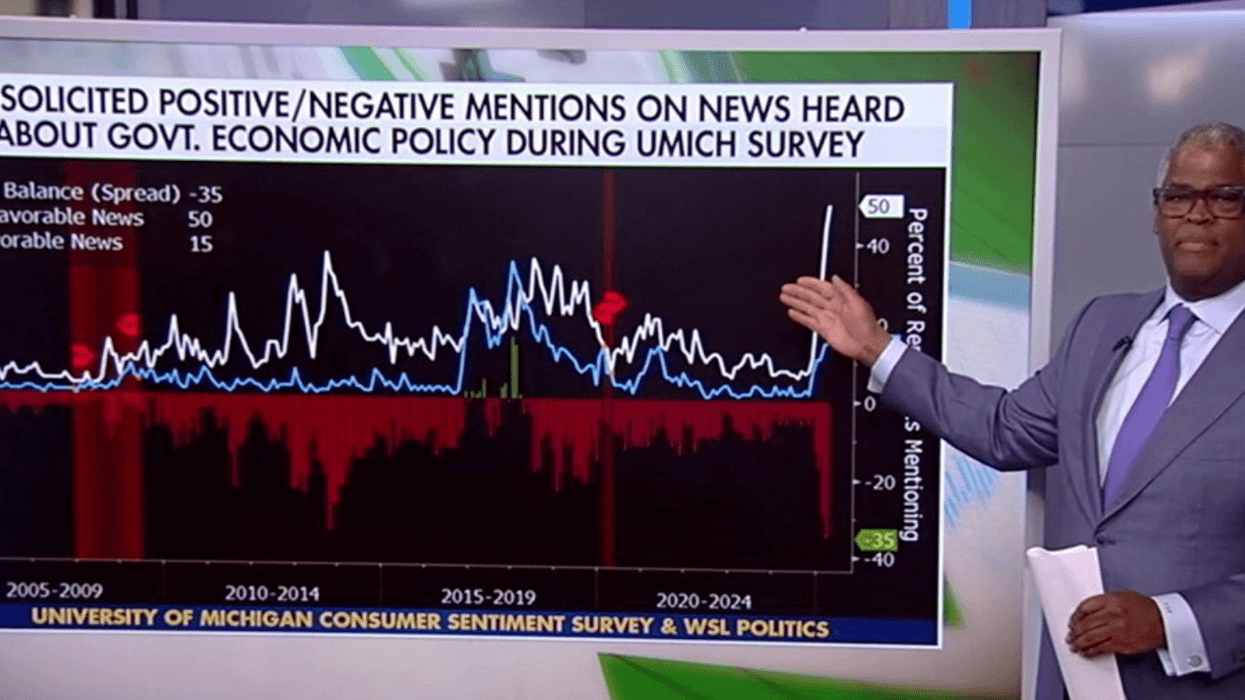
As President Donald Trump’s erratic tariff policies continue to take shape, multiple public opinion, consumer sentiment, and manufacturer and business surveys show that Americans generally disapprove of them. These surveys also show that Americans expect that the tariffs will raise prices and weaken the economy. With public support for Trump's economic interventions slipping, Fox Business has pivoted to attacking mainstream media coverage of Trump’s tariffs — even as experts warn that his policies will grievously harm the U.S. economy.

Surveys show widespread disapproval over Trump’s handling of tariffs and trade

  • A Fox News poll found that a majority of voters oppose tariffs on Canada (61 percent) and Mexico (56 percent). Fox News’ write-up of its poll stated that tariffs “are viewed mostly through a negative lens, with voters thinking they are more likely to harm the U.S. economy (53 percent harm vs. 28 percent help) and make products more expensive (69 percent more vs.sefven percent less).” [Fox News, 3/20/25]
  • An Echelon Insights poll found that when Americans were told that tariffs increased prices, 55 percent opposed them. [Twitter/X, 3/19/25]
  • A Morning Consult poll found 48 percent of voters oppose Trump’s tariffs on steel and aluminum, and the same plurality disapprove of his tariffs on imports from Canada and Mexico. [Morning Consult, 3/19/25]
  • Federal Reserve Chairman Jay Powell said “both market- and survey-based measures” are showing that “some near-term measures of inflation expectations have recently moved up,” with respondents “mentioning tariffs as a driving factor.” In Powell’s March 19 remarks, he also repeatedly used the phrase “tariff inflation” when describing how the Fed will account for price disruptions resulting from Trump’s tariff policies. [U.S. Federal Reserve, 3/19/25]
  • Cato Institute: Trump’s tariffs are causing an increase in small business’ uncertainty. A Cato Institute article explained: “The administration’s basket case approach to tariffs and global trade is fueling economic uncertainty. According to the February survey from the National Federation of Independent Business (NFIB), its uncertainty index rose to its second-highest recorded reading.” The article additionally displayed a chart from the FedEx Small Business Trade Index which “shows that American small businesses are highly dependent on imports.” [Cato Institute, 3/14/25]
  • Reuters: The March University of Michigan consumer survey showed that “U.S. consumer sentiment plunged to a nearly 2-1/2-year low in March and inflation expectations soared amid worries that President Donald Trump's sweeping tariffs, which have ignited a trade war, would boost prices and undercut the economy.” Reuters reported that this result “mirrors similar concerns in some business surveys” and added: “The uncertainty created by Trump's on- and off-again tariffs as well as an escalation in trade tensions risks derailing the economic expansion.” [Reuters, 3/14/25]
  • A Quinnipiac poll showed that 56 percent of Americans disapprove of Trump’s handling of trade with Mexico, and 58 percent disapprove of his handling of trade with Canada. Quinnipiac University polling analyst Tim Malloy said: “Icy exchanges on tariffs chill a longstanding friendship and voters make it clear they feel that's no way to treat our neighbors to the north.” [Quinnipiac University, 3/13/25]
  • A CNN poll showed that 61 percent of Americans disapprove of Trump’s handling of tariffs. [CNN, 3/12/25]
  • The first quarter 2025 National Association of Manufacturers outlook survey “reveals growing concerns over trade uncertainties and increased raw material costs.” According to the survey, “Trade uncertainties surged to the top of manufacturers’ challenges, cited by 76.2 percent of respondents, jumping 20 percentage points from Q4 2024 and 40 percentage points from Q3 of last year. Increased raw material costs came in second, cited by 62.3 percent of respondents.” [National Association of Manufacturers, 3/6/25]
  • The February Institute for Supply Management survey showed that “worries about duties on imports dominated commentary from manufacturers.” Reuters’ report on the survey further explained that “a measure of prices at the factory gate jumped to nearly a three-year high and it took longer for materials to be delivered, suggesting that tariffs on imports could soon undercut production.” [Reuters, 3/3/25]
  • The Federal Reserve Bank of Dallas’ February Texas Manufacturing Outlook Survey showed multiple complaints from manufacturers about tariffs. One business replied that “tariff threats and uncertainty are extremely disruptive.” Another explained that it has “lost business opportunities for production of goods that goes to other countries as a result of tariffs.” Another business cited tariff changes to announce its likely closure. Many other businesses expressed concerns about Trump’s tariffs as well. [Federal Reserve Bank of Dallas, 2/24/25]
  • A Reuters/Ipsos poll showed that 59 percent of Americans opposed Trump’s tariffs on Canada and 56 percent opposed his tariffs on Mexico. [Ipsos, February 2025]

Fox Business repeatedly attacked media coverage of Trump’s tariffs

  • Fox Business host Charles Payne: “The media lost its collective mind and began peppering Powell with nonstop questions about tariffs.” Payne added that the media had waged a “horrific campaign of horror” against tariffs. [Fox Business, Making Money, 3/20/25]
  • Payne: “The media has gone to war with President Trump and made tariffs the scariest thing in the world.” Payne added that widespread concern over tariffs is “a media creation,” and declared that “we have never had this much negative news associated with the economy outside of COVID, the peak of COVID.” [Fox News, America Reports, 3/18/25
  • Fox Business host Dagen McDowell: “There’s this media minion fixation on tariffs to foment fear, because they’re panic-peddlers at heart.” [Fox Business, The Big Money Show, 3/20/25]
  • McDowell: “All the media minion chicken scratchers can do is try and frighten the American people and report … the tariffs tantrums over and over and over again.” [Fox Business, The Bottom Line, 3/18/25]
  • Fox Business host and former Trump economic adviser Larry Kudlow: “This whole business about tariffs and the liberal media, ‘tariffs are inflationary, tariffs are recessionary,’ I think it’s all hogwash.” [Fox Business, Kudlow, 3/20/25]
  • Kudlow: “The Wall Street and liberal media hysteria over inflationary tariffs is a lot of hoo-ha.” [Fox Business, Kudlow, 3/19/25]
  • Kudlow: “The media is trying desperately to use tariffs to hammer Trump and say his policies are a failure.” [Fox Business, Kudlow, 3/19/25]

Experts have warned that Trump’s tariffs will hurt the economy


  • The Tax Foundation’s March 12 estimate of Trump’s various tariff policies found that they will “reduce US GDP by 0.4 percent and hours worked by 309,000 full-time equivalent jobs, before accounting for foreign retaliation.” These figures do not account for Trump’s separately announced so-called “reciprocal” tariffs, tariffs on the European Union, automobiles, agricultural products, or semiconductors and pharmaceuticals. [Tax Foundation, accessed 3/21/25]
  • Yale’s Budget Lab analysis of tariffs on Canada, China, and Mexico found that Trump’s policies would raise prices by “1.0-1.2%, the equivalent of an average per household consumer loss of $1,600–2,000 in 2024$.” The analysis also found that “real GDP growth is 0.6 lower in 2025. In the long-run, the US economy is persistently 0.3-0.4% smaller, the equivalent of $80-110 billion annually in 2024$.” [The Budget Lab, 3/3/25]
  • Yale’s Budget Lab director of economics Ernie Tedeschi on Trump’s “reciprocal” tariffs: Inflation will rise “1.7-2.1% depending on foreign retaliation and assuming the Fed doesn't react. That's the equivalent of an annual consumer loss averaging $2,700-$3,400 per household in 2024$.” The full study from The Budget Lab additionally explains that if American consumers substitute items for the higher prices, “the effect on prices settles somewhat, to 1.5-1.6%, still a $2,400-$2,600 average consumer loss per household.” [Twitter/X, 2/18/25; The Budget Lab, 2/18/25]
  • Nobel Prize-winning economist Joseph Stiglitz: The higher inflation rate from Trump’s tariffs means “central banks will raise interest rates,” possibly “leading to the worst of possible outcomes – interest rates going up with stagflation, interest rates going up in the face of a weak economy.” [The Guardian, 1/31/25]
  • Moody’s Analytics chief economist Mark Zandi: Trump’s tariffs “will result in higher prices for the things that we import. … It will add to inflationary pressures.” [CNN, 1/31/25]

Reprinted with permission from Media Matters.

'Fox & Friends' Just Couldn't Handle That Huge February Jobs Report

'Fox & Friends' Just Couldn't Handle That Huge February Jobs Report

A strong monthly jobs report from the Bureau of Labor Statistics (BLS) beat expectations last week, but Fox & Friends struggled to characterize it, absurdly claiming that the numbers reported by the government had missed expectations while arguing with no evidence that the data were unreliable.

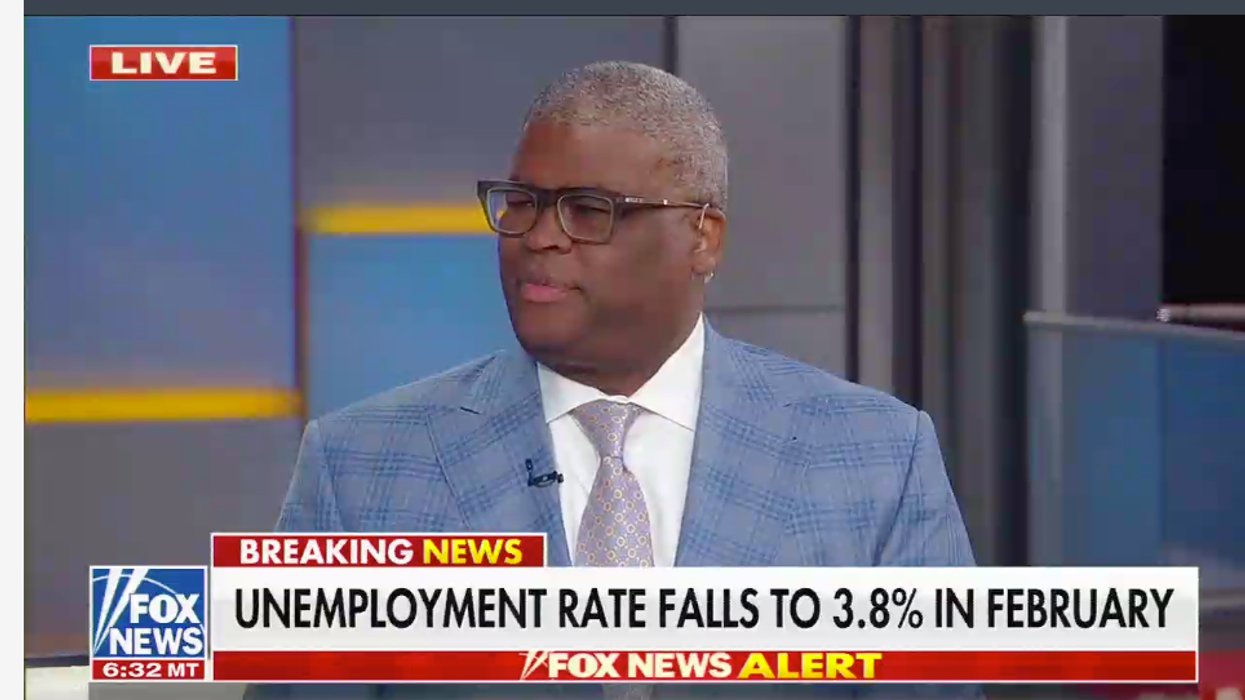
On March 4, the BLS released its initial jobs report for February 2022, which showed the economy creating 678,000 jobs last month as the national unemployment rate fell slightly to 3.8 percent. The report also included substantial positive revisions to the jobs estimates for December 2021 and January 2022, showing job creation over that period to be “92,000 higher than previously reported.” The topline job creation number for February easily exceeded expectations reported by MarketWatch and Reuters, which forecast 400,000-440,000 jobs created last month.

None of these facts were good enough for the team at Fox News, which honestly seemed almost unprepared to discuss the breaking news. The Fox & Friends studio at first struggled with audio issues when returning from commercial break, and then flashed a red upward arrow on screen seeming to indicate that the unemployment rate had climbed last month (the rate actually fell 0.1 points). After correspondent Carley Shimkus finished reporting the numbers, noting twice that the monthly jobs report beat expert expectations, all three co-hosts — Pete Hegseth, Brian Kilmeade, and Ainsley Earhardt — fumbled their transition to discussing the jobs report with Fox Business host Charles Payne.

The absurdity continued during Payne’s supposedly expert commentary, as he claimed without any evidence or reasoning that he “thought it was going to be a higher number,” saying the report was “really weird.” When pressed by co-host Pete Hegseth about the fact that the report actually beat expectations, Payne doubled down, falsely claiming “everyone thought it was going to be higher.” As Payne listed off made-up expectations and unnamed sources who thought the economy would add 770,000 or more jobs last month, a graphic again flashed on-screen demonstrating that the 678,000 jobs added last month were more than the 400,000 “predicted” by economists.


PETE HEGSETH (CO-HOST): Charles Payne is here, host of Making Money on Fox Business, who is going to help us break down these numbers. Your reaction, Charles?

CHARLES PAYNE (FOX BUSINESS HOST): I thought it was going to be a higher number, I really did. Now, this is not unusual that they missed, and this is really weird. Let me just explain to the audience.

HEGSETH: Okay now, higher number – this is a higher number than expected?

PAYNE: Than consensus, right. But, everyone thought it was going to be higher. I saw some folks on Wall Street at 770, and some even higher than that. Just so you understand how this consensus things [sic] works. Last month, it was 300,000 better, but the month before that they missed it by 200,000, the month before that they missed it by 340,000. In August of last year, they missed it by 515,000. Forget about it, go back to April 2020, and they missed it by 2.2 million. You know, so, the consensus thing, let's look past that for a moment.

We’ve got almost 11 million job openings, we’re still not at the participation rate we were at just before the pandemic. So, this is a good number, but it could have been even better than this. For me, what’s more important is participation, I don’t know what that is just yet, because we want people coming back to the labor force, right. Also, wages. Now, wages were expected to go up 5.8 percent. Normally that’s good, but we’re going to find out next week that inflation, during this same time period, probably up more than 8 percent. So that means any raise you got was evaporated.


Throughout Payne’s commentary, he seemed confused about how the BLS reporting process works, and he ignored a key component of the entire process by which numbers are revised over time. For example, Payne said that the previous jobs report for August 2021 had missed its expectations by 515,000 jobs, totally ignoring the fact that subsequent revisions had made up for half that gap.

Payne also struggled to explain how economic forecasters form “consensus” expectations, and complained about low labor force participation rates, even though the report he held in his hand showed an increase in that rate from month-to-month.

Eventually, the Fox & Friends team got their footing and returned to the bread and butter misinformation we’ve come to expect from Fox News. Unable to coherently describe the economic data in front of their eyes, the team pivoted to complaining about President Joe Biden’s energy policies and mocking teenage climate activist Greta Thunberg for somehow contributing to both increased gas prices and Russian aggression in Ukraine.

Fox’s almost comical hot takes on the routine data release stand as a reminder that the Fox News propaganda machine will never miss an opportunity to cast the economy in a negative light, so long as it reflects poorly on Democrats.

Reprinted with permission from Media Matters
Rick Perry Hits At Trump — And Trump Hits Right Back

Rick Perry Hits At Trump — And Trump Hits Right Back

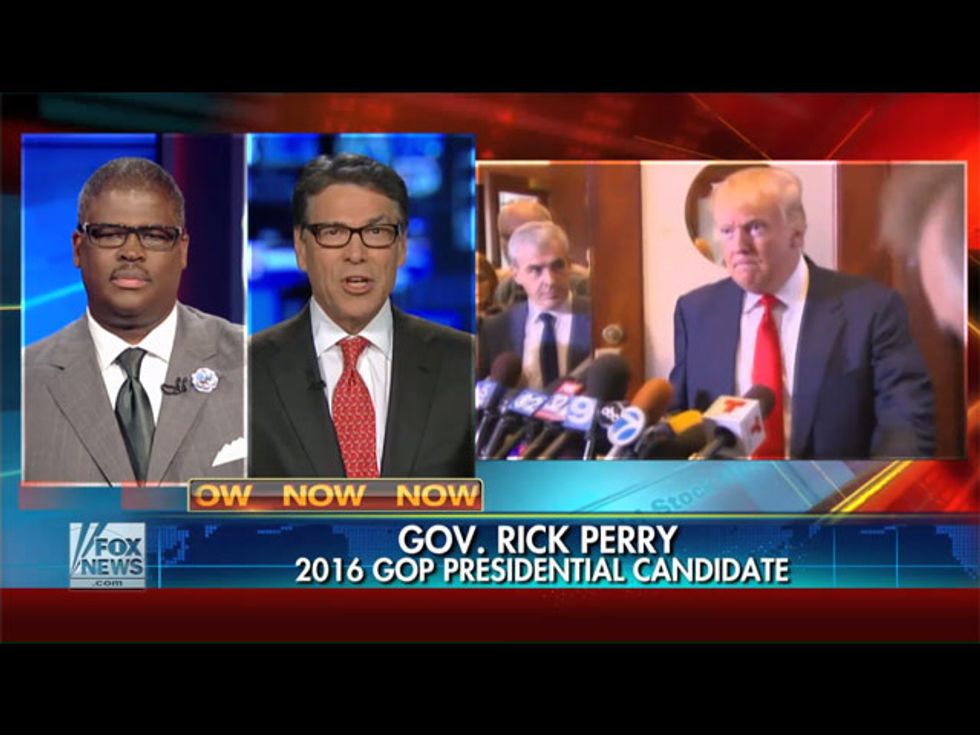
Rick Perry is one of the first Republican presidential candidates to seriously take on Donald Trump’s comments about Mexican immigrants being rapists and other types of criminals. And for his part, The Donald is answering right back — by trash talking Perry on Twitter.

“Well I don’t think he’s reflecting the Republican Party with his statements about Mexicans. I think that was a huge error on his part — and number one, it’s wrong,” Perry said Thursday, during an appearance on Fox News. “When I think about the Hispanics in Texas, and I think about the individuals who have paid a great price, whether they were Tejanos at the Alamo in 1836, or whether it’s been as late as the last wars that we’ve had — when you see Hispanics being killed, for America.”

Fox News guest host Charles Payne interrupted to say that Trump was referring to people who are here illegally. Perry replied: “But I will suggest to you — he painted with a very broad brush, and I think that’s the problem.”

Perry also touted his own experience with the southern border as governor of Texas.

“What I would say is that we want somebody that’s actually dealt with this before, not somebody that’s just gonna shoot from the hip,” he said. “And I will suggest to you, I know how to secure the border.

“And the border security is the real issue here —it’s not painting with this broad brush that, obviously, I think Donald Trump painted with where he tried to say, you know, Mexicans are bad people, they’re rapists and murderers. Yes, there are bad people that cross the border. But how about, let’s get a Commander-in-Chief that knows how to secure the border, and at that particular time we can have a conversation about how to deal with this immigration issue — but not until that border is secure.”

Payne asked Perry whether the many companies that are dumping their deals with Trump were right to do so. “Listen, that’s their call,” Perry said. “My way to address this is to talk about the contributions that the Mexican-American has made to this country.”

Later that night, Trump posted on Twitter:

Perry previously got in trouble with the GOP base during his campaign for president in the last cycle, when at a September 2011 debate hosted by Fox News he defended his state granting in-state tuition at public colleges to students who had been brought into the United States as children of undocumented immigrants.

But if you say that we should not educate children who have come into our state for no other reason than they’ve been brought there by no fault of their own, I don’t think you have a heart. We need to be educating these children, because they will become a drag on our society.

Within about a week’s time, however, he walked that comment back: “I probably chose a poor word to explain that. For people who don’t want their state to be giving tuition to illegal aliens, illegal immigrants in this country, that’s their call, and I respect that.”

Shop our Store

Headlines

Editor's Blog

Trending

World