Tag: commonwealth fund
New Report Sharpens Doubt About Medicare Advantage As Open Enrollment Begins

New Report Sharpens Doubt About Medicare Advantage As Open Enrollment Begins

Open enrollment for the over-65 crowd began yesterday with most analysts predicting there will be a sharp dip in the number of seniors who choose privatized Medicare Advantage plans for 2026.

That’s good news for people worried about the program’s fiscal health and the looming expiration of its trust fund, now slated for 2033. The Center for Medicare and Medicaid Services paid MA plans an estimated $84 billion more than it would have had the 54 percent of all beneficiaries choosing MA plans in 2025 — the most ever — remained in traditional Medicare, according to the Medicare Payment Advisory Commission.

Why do experts predict many people will opt out next year? In part, it’s because the three major insurers selling MA plans — UnitedHealth, Humana, and CVS Health’s Aetna — have eliminated hundreds of counties, and in some cases, entire states from their plans.

Despite the enormous profits they earn from MA, insurers complain rising prices and greater utilization are driving up their expenses (true) while the federal government is curtailing reimbursement (false). The Center for Medicare and Medicaid Services final MA payment rule, unveiled last April, showed private health plans will get an effective rate increase of nine pecent in 2026, which is several percentage points above inflation-adjusted economic growth rate.

Disappearing plans is not the only reason why people are abandoning MA. Consumer preference is playing a huge role.

Private insurers are increasingly using prior authorization to curb utilization. Prior authorization is where physicians are required to obtain insurer approval before making specialist referrals, prescribing certain drugs, tests and procedures, and, in some cases, ordering preventive care. This delay and deny strategy (the first allows insurers to earn money on the float; the second simply cuts expenses) is drawing enormous pushback from physicians and patients, so much so that the industry was forced to announce this past summer it would take steps to ease the approval process — by 2027.

The Centers for Medicare and Medicaid Services has also been revamping its “star” rating system, which is one of the few tools elderly consumers have for comparing the quality and outcomes of different plans. Insurers sometimes game the system by combining multiple counties from widely dispersed geographic areas into a single plan for star-rating purposes, which gives a false picture to beneficiaries who happen to live in poor-performing counties included in the plan. Insurers must have 94 percent of its MA members in plans rated 4-star or 5-star before getting a five percent bonus payment.

The revamp is having an impact. For instance, in 2024 Humana had 94 percent of its MA plan members in 4- or 5-star rated plans. The changes instituted by CMS (an agency which so far has escaped the scientific quackery and staff cutbacks Robert F. Kennedy Jr. and Martin Makary have imposed on the Centers for Disease Control and Prevention and the Food and Drug Administration, respectively) reduced its 4- and 5-star share to 25 percent this year, according to a story yesterday in Modern Healthcare. Earlier this week, the U.S. District Court in North Texas rejected Humana’s suit challenging the reduction.

Has Medicare Advantage improved quality?

There is still a substantive debate about whether MA has improved quality for its beneficiaries.

The original idea behind Medicare Advantage, which took off in the early 2000s, was that privatization of Medicare would lead to lower costs since the private sector was, allegedly, more efficient. Proponents of MA also argued that replacing fee-for-service reimbursement as deployed by the government in traditional Medicare with privately managed care would lead to higher quality, greater patient satisfaction and, most importantly, better outcomes.

The first argument is demonstrably false. As numerous MedPAC reports have shown, MA hasn’t saved the government a dime. In fact, over the years it has cost the government hundreds of billions of dollars more.

But have we at least gotten better results from all the extra taxpayer money shoveled out to the insurance industry through privatization? Dozens of studies have been conducted over the years testing that question. Proponents of MA, led by the Better Medicare Alliance, an industry front group, cherry pick the literature to claim MA enrollees have fewer hospital readmissions, fewer preventable hospitalizations and reduce the use of high-risk medications among seniors. Privatization opponents like the Center for Medicare Advocacy are equally adamant that quality in MA is at best no different than traditional Medicare, and in some cases worse.

A September 2022 Kaiser Family Foundation report examined 62 studies published since 2016 that compared MA and traditional Medicare based on measures of beneficiary experience, affordability, service utilization, and quality. The report found MA “outperformed traditional Medicare on some measures, such as use of preventive services, having a usual source of care, and lower hospital readmission rates. However, traditional Medicare outperformed [MA] on other measures, such as receiving care in the highest-rated hospitals for cancer care or in the highest-quality skilled nursing facilities and home health agencies.”

Today, the Commonwealth Fund offered a first-of-its-kind comparison study of Medicare performance in all 50 states and the District of Columbia. While comparing traditional Medicare to Medicare Advantage wasn’t its focus, and its authors caution against using its findings to highlight quality differences between the two approaches to paying for care, the scorecard’s findings did suggest (based on my analysis) that MA delivers outcomes on key quality measures that are at best equal to traditional Medicare, and sometimes worse.

The overall study looked at 31 measures of access, quality, affordability and population health, derived from the records of both traditional Medicare and Medicare Advantage plans. Two of the main quality indicators highlighted in the report were the statewide number of preventable hospitalizations per 1,000 beneficiaries, and what share of seniors on Medicare were prescribed drugs known to be risky or inappropriate for people in their age group.

For the overall score, the study’s authors ranked each state and the District of Columbia for the 31 measures, and then created a composite score. The results were predictable: Vermont, Utah, Minnesota, Rhode Island, Colorado, New Hampshire, Maine and Hawaii were, in order, the eight top-ranked states; starting from the bottom, Louisiana, Mississippi, Kentucky, Oklahoma, Arkansas, Texas, West Virginia and Alabama brought up the rear.

Those results show that the social determinants of health — statewide wealth and income, food and housing security, low unemployment and the like — drive overall health and therefore health care spending in Medicare. That’s not surprising. How well people fare during their working years will usually determine how well they fare in retirement, which in turn determines how much they will cost Medicare and, ultimately, how long they will live.

“Spending doesn’t always align with outcomes,” said Dr. Joseph Betancourt, president of the Commonwealth Fund. “The states that tend to do well in Medicare performance also tend to do well in our other surveys of broader populations.”

But in looking at the two quality indicators highlighted by the study, a different pattern emerges. I ranked the share of each state’s population in Medicare Advantage plans in 2024 (compiled by the Kaiser Family foundation) and compared that to the state’s performance on two quality indicators: preventable hospitalizations and inappropriate drug prescriptions. In the charts below, the numbers in red and purple (the worse five) are states with below average scores (which are higher numbers); the numbers in black are states that did better (lower numbers) than the national average.

These are important measures for evaluating Medicare Advantage performance since preventing unnecessary hospitalizations is precisely what MA managed care is supposed to achieve and inappropriate prescribing is precisely what MA prior authorization is supposed to prevent. The study also measured what share of MA plans in a state used prior authorization, which is shown in the second column in the chart.
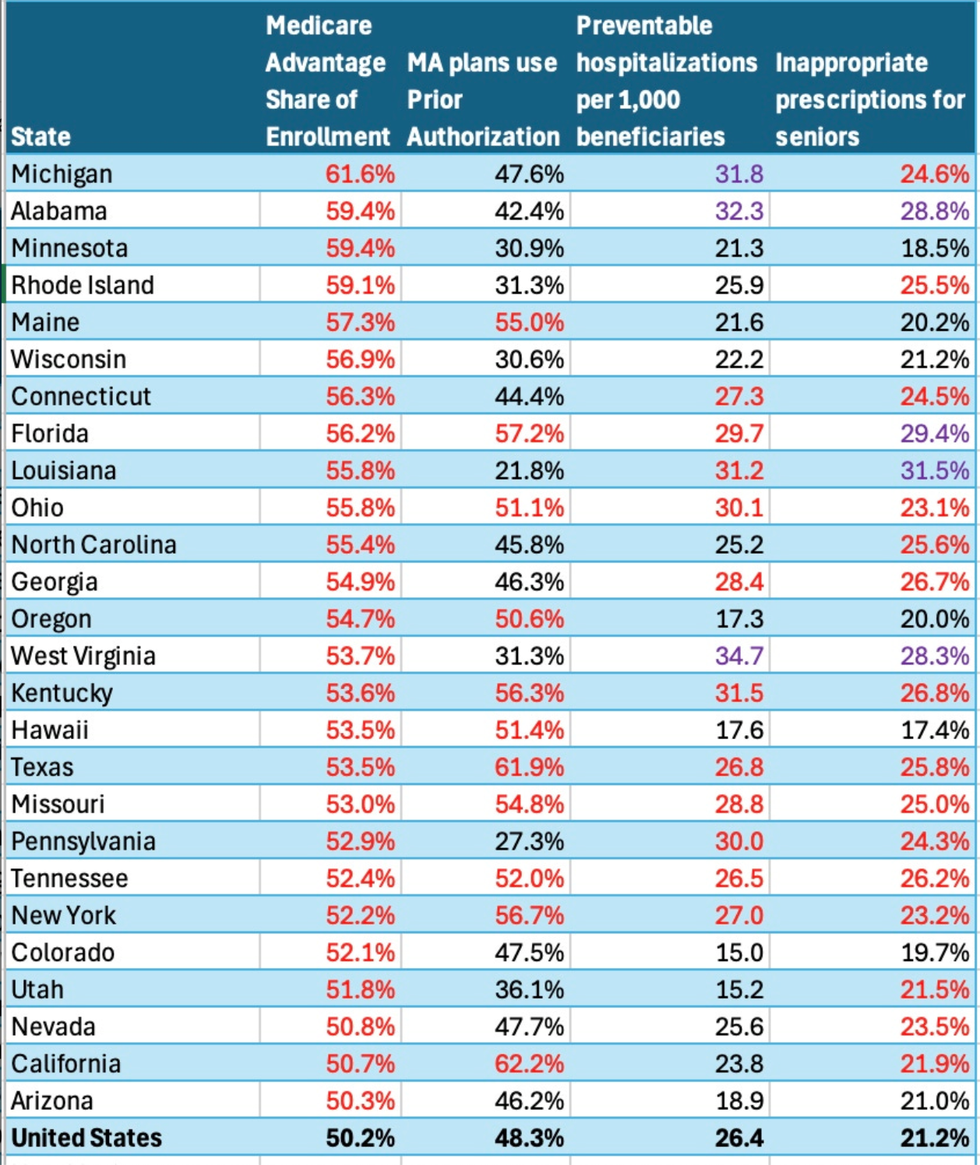
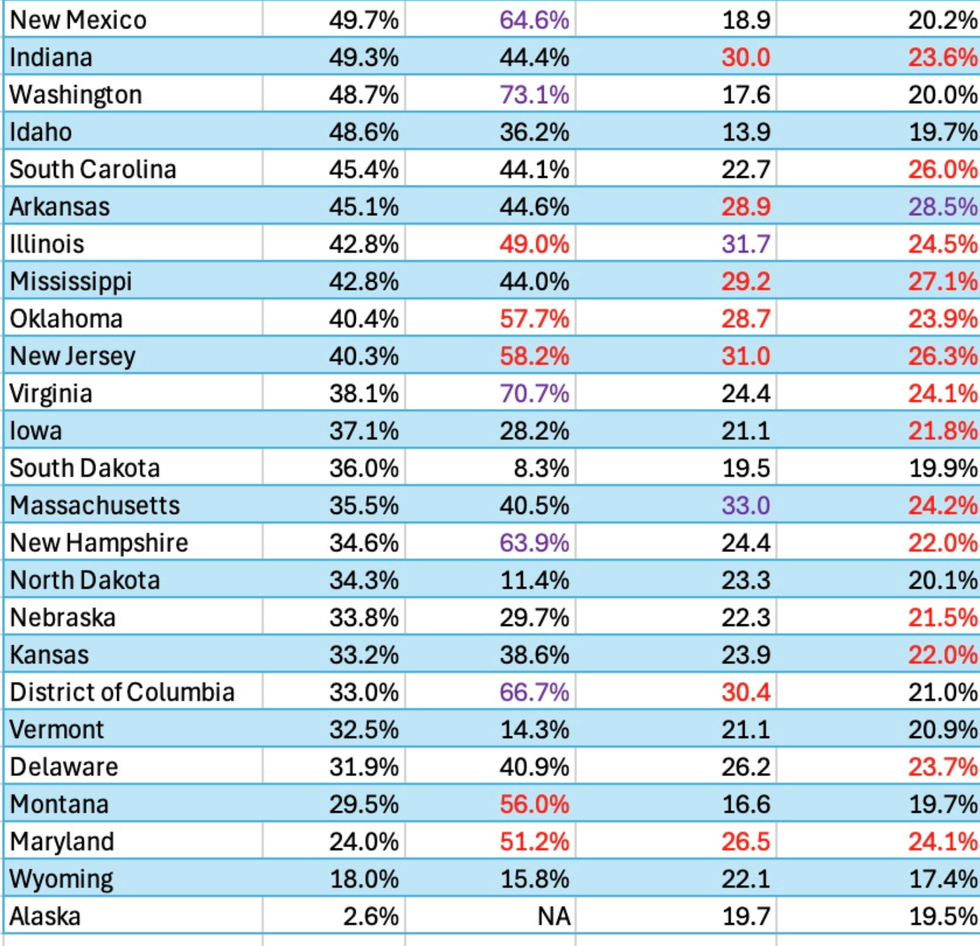
The bottom line: States with above-average enrollment in MA plans tend to have higher-than-average rates of preventable hospitalizations. There is no discernible pattern in the rates of inappropriate prescribing between states with above or below average enrollment in MA plans.

For instance, Michigan ranked in 25th or right in the middle of the pack in the overall rankings. It had the highest Medicare Advantage penetration (61.6 percent). Yet its managed care plans, nearly half of which used prior authorization, did not prevent the state from being ranked fifth worst in preventable hospitalizations and three percentage points above the national average in inappropriate prescribing. Ditto for Alabama, which had the second highest MA market penetration, yet ranked among the five worst when it came to preventing unnecessary hospitalizations and inappropriate prescribing.

On the other end of the spectrum, rural states like Vermont and Wyoming had very low MA market penetration and scant use of prior authorization. Yet they scored above average performance on both quality indicators.

Having read numerous studies over the years that compare Medicare Advantage to traditional Medicare, I think it’s fair to say at this point that all the extra money that’s been poured into Medicare Advantage has not delivered to beneficiaries higher quality care or better outcomes. It is, in fact, a waste of money.

I’ll leave the last word to Gretchen Jacobson, the Commonwealth Fund vice president for expanding coverage and access. When it comes to Medicare, the federal government should “set standards for private plans and participating providers” and “incentivize providers to apply best practices and reduce wasteful care.”

Merrill Goozner, the former editor of Modern Healthcare, writes about health care and politics at GoozNews.substack.com, where this column first appeared. Please consider subscribing to support his work.

Reprinted with permission from Gooz News

Study Finds DeSantis And Abbott Culpable In Nearly 5000 Excess COVID Deaths

Study Finds DeSantis And Abbott Culpable In Nearly 5000 Excess COVID Deaths

What happens when Republican governors institute policies that are 100 percent about showing their Trumpism, and zero percent about taking care of the people in their state? Here are two good examples.

In Texas, Greg Abbott has declared that no one can require proof of vaccination, As a direct result of this decision, the Texas Tribune reports that only half of workers at Texas nursing homes are vaccinated. And as a direct result of that, "The number of nursing homes across the state with at least one active COVID-19 case has shot up nearly 800% in the past month."

That's right. Remember all the work that was put into trying to protect people in nursing homes? The desperate scramble to buy protective gear from anywhere on the planet? All those tragic images of elderly family members isolated from their children and grandchildren for month after month? Yeah. Greg Abbott has sabotaged every moment of time and every ounce of effort by issuing a rule that any business that requires vaccination can't get a state contract — which directly impacts every nursing home in the state.

In Florida, Ron DeSantis has not just failed to institute mask mandates in the most COVID-riddled schools in the nation, but has spent the last weeks threatening any school that attempts to protect its students. As a direct result of that, hundreds of school boards have bowed down and sent kids off to classrooms they know are unsafe. That includes Pinellas County where, as the St. Pete Catalyst reports, the board sent kids back into classrooms without masks in spite of 204 cases of COVID-19 in just the first two days of school. That board directly cited DeSantis' order as the reason they couldn't take the simplest, cheapest, most effective step in protecting the children under their care.

Back in March, researchers calculated that the polices of Donald Trump were responsible for at least 400,000 deaths in the United States. But Trump's biggest contribution to the pandemic was having the federal government just sit it out—no national testing effort, no national lockdown, no rules on masks or anything else. When it comes to the individual states, it turns out there are some bonus deaths to be allocated to those governors who went above and beyond in placing their political ambitions ahead of their states—especially Greg Abbott and Ron DeSantis.

A study conducted by Yale researchers and published at Commonwealth Fund, looked specifically at how policies around vaccination converted into hospitalizations and deaths. For a cluster of Northeastern states—Vermont, Connecticut, Massachusetts, Maine, and Rhode Island—the rate of vaccination average 74 percent in residents over the age of 18 by the end of July. Those states have turned out to be among the lowest in the nation when it comes to new cases during the wave of delta variant cases. On Friday, every one of those states was in the bottom seven in terms of cases per capita.

On the other hand, Florida and Texas once again topped the charts. As of the same time those other states were hitting 74% of their adult populations vaccinated, Florida reported 59 percent and Texas 56 percent. Those aren't the lowest levels in the nation, but they're in the bottom half. Considering the size of Florida and Texas, it shouldn't be surprising that the combination of high population, low vaccination, and destructively bad policy has kept the pair at the top of the charts for new cases of COVID-19.

But what it if, in some alternate universe, Texas and Florida had been governed by competent people. Yes, it seems like science fiction, but hang in there. What if these two states had competent leadership; leadership that rather than fighting against vaccination, encouraged it. What if Texas and Florida had vaccination rates as high as those of states in the Northeast? What kind of difference might it have made?

It's not as outlandish as it may seem. Yes, both Florida and Texas have millions of deep red voters who have folded anti-mask and anti-vaxx into the general anti-science / anti-sense philosophy that has come to dominate the Republican Party. But it didn't have to be that way. At any point in the pandemic, either Abbott or DeSantis could have demonstrated leadership [ lee-der-ship ]. They might have chosen to stop bowing down to the demands of the worst in their party, spoken forcefully in favor of good public health practices, and differentiated themselves from the rest of presumed 2024 field by doing the right thing. The Republican embrace of anti-mask and anti-vaxx could have been changed had any of the party's "rising stars" chosen to go with saving lives instead of appealing to the worst.

That didn't happen.

Instead, Florida had 39,000 unnecessary hospitalizations and 2,806 more deaths than it would have if DeSantis hadn't championed every wrong policy. And across the Gulf in Texas, Abbott might have saved his state from 32,000 additional vaccinations and over 1,900 deaths. These are, of course, just estimates. But if anything, the numbers they represent are low for several reasons.

First, the study looked only at vaccination rates. That's certainly reasonable considering how both governors have persecuted businesses, schools, and governments that have tried to institute any kind of vaccine policy. Whether it's cruise ships in Florida, or universities and nursing homes in Texas, facilities that elsewhere would have insisted on vaccination have backed away. Because they had to. DeSantis and Abbott didn't just voice an opinion, they blackmailed these businesses and schools into either operating an unsafe environment, or going out of business.

These numbers don't include the number of hospitalizations or deaths generated because both governors have failed to institute mask mandates and blocked the use of mandates by schools and local governments. The numbers also don't include the damage done by forcing businesses to reopen and schools to conduct in-person classes even though conditions had pointedly not reached the guidelines each state had put in place. And these numbers only run through July, meaning they don't catch hospitalizations and deaths from the ongoing wave of delta variant cases.

It's not that Ron DeSantis caused 2,800 unnecessary deaths in Florida and Greg Abbott caused 1,900 deaths in Texas. It's that they caused at least that number. Oh, and no one should forget that 700 Texans who died because the power grid failed due to a design that makes it purposefully fragile. Greg Abbott deserves his share of those, as well.

Report: Obamacare Actually Works, Insures Americans

Report: Obamacare Actually Works, Insures Americans

While the right’s been busy denouncing the Affordable Care Act, the health care law has been working and benefiting millions of Americans. According to the Commonwealth Fund’s new tracking survey, the number of uninsured adults decreased from 20 percent in July-September 2013 to 15 percent in April-June 2014, which means that 9.5 million more people became insured during that period.

The survey states that the law is on track to meet the Congressional Budget Office’s projections.

The Affordable Care Act has especially helped young adults. The rate of uninsured people aged 19-34 dropped from 28 percent in July-September 2013 to 18 percent, which is the largest success rate for any age group—5.7 million fewer young adults are now without health insurance.

The percentage of uninsured Latinos also dropped significantly, from 36 percent to 23 percent. Latinos are more likely than any other racial or ethnic group to not have health insurance, but they increased their coverage at a better rate than any other group.

African-Americans are the only group whose coverage barely improved; those without health insurance only decreased by 1 percent, from 21 percent to 20 percent. Bloomberg View’s Christopher Flavelle points out that this lack in coverage isn’t down to misinformation about the marketplace, but that 62 percent of black respondents live in states with Republican governors who have rejected federal money to expand Medicaid. In states that didn’t expand Medicaid, 36 percent are still uninsured, a number that only declined by 2 percent from last year. For the law to actually work for everyone, more minorities will need to be able to sign up.

The Affordable Care Act is also helping the poor. The report says that insurance plans “targeted at low- and moderate-income Americans are having their intended effect.” The percentage of uninsured with incomes under 138 percent of the poverty level dropped from 35 percent to 24 percent, while the uninsured rate declined from 32 percent to 22 percent for adults who earn between 138 percent and 250 percent of poverty.

The survey also finds that 68 percent of adults eligible for new health coverage are aware that the marketplace exists, and that 43 percent of those people have visited one, compared to only 24 percent who did in December; 51 percent who visited the website signed up for a plan, and 62 percent would not have been able to afford health care without the Affordable Care Act—60 percent have already filled a prescription or visited a health care provider.

Of the newly insured, 78 percent said they were “very or somewhat satisfied” with their new plans, though only 54 percent said that their plans included all or some of the doctors they wanted; 81 percent said they were “very or somewhat optimistic” that Obamacare will make it easier for them to get the health care they need, and 58 percent said they were better off than before. Even 74 percent of previously uninsured Republicans are satisfied with their plans.

These positive numbers should make it harder for the right to argue that the law is hurting Americans. However, the Obama administration still needs to work on improving public opinion of the law, especially as it gets closer to the midterms. The latest Rasmussen Reports poll shows that 51 percent of Americans still oppose the individual mandate.

The Commonwealth Fund surveyed 4,425 people and was conducted from April 9-June 2.

AFP Photo/Karen Bleier

Interested in national news? Sign up for our daily email newsletter!

U.S. Healthcare Ranks Last Among 11 Developed Nations, Report Says

U.S. Healthcare Ranks Last Among 11 Developed Nations, Report Says

By Chad Terhune, Los Angeles Times

LOS ANGELES — Despite having the costliest care, the United States ranks last among 11 industrialized countries on health care quality and access, according to a new report.

The analysis by the Commonwealth Fund published Monday ranked the United Kingdom first overall, even though its per-capita health spending is less than half that of the U.S.

The other top-ranked countries were Switzerland and Sweden. France and Canada were just above the U.S. at the bottom of the rankings.

Researchers said the U.S. was hurt by a lack of access to primary care and inefficiencies in the health care system overall.

They said provisions in the Affordable Care Act may help boost the country’s standing.

“It is disappointing but not surprising that despite our significant investment in health care, the U.S. has continued to lag behind other countries,” said lead author Karen Davis.

“With enactment of the Affordable Care Act, however, we have entered a new era in American healthcare,” she added.

The U.S. spent $8,508 per person on health care in 2011 compared with $3,406 in the United Kingdom.

In addition to high costs, the U.S. fared poorly on several measures. It ranked last among the 11 industrialized countries on infant mortality.

Americans also experienced financial barriers. More than a third of U.S. adults reported skipping a recommended test or treatment because of cost, according to the report.

Forty-percent of U.S. adults who had visited the emergency room said they could have been treated by a regular doctor if one had been available.

The Commonwealth Fund is a private foundation that supports health policy research.

AFP Photo/Rick Gershon

Shop our Store

Headlines

Editor's Blog

Corona Virus

Trending

World