Fiscal Hawks Are Wrong, But We Should Still Reduce Deficits (Here's How)
When Democrats get in power and seem likely to try to spend taxpayer dollars on things like healthcare, childcare, and education, we can always count on the deficit hawks to come out of the woodwork. They may not be very visible when the Republicans want to pass tax cuts for the rich, but we can be sure to hear from them when Democrats propose spending money on things the billionaires don’t like.
There is one foolproof defense against the deficit hawks: logic. Logic can be used against deficit hawks in the same way that a cross can be used to keep vampires at bay.
In this case, the logic comes directly from the AI boom that is driving the economy. The only possible way that the massive buildout of data centers and the rest of the AI infrastructure makes sense is if it leads to a massive increase in the rate of productivity growth.
Productivity growth means that we can produce more output with the same number of workers or the same output with fewer workers. This is the story of AI taking all the jobs. But if AI leads to a massive surge in productivity growth, then we will be far richer than we ever thought possible. (Distribution is another question. The economy will be bigger, but Elon Musk may have all the money.)
The standard projections for the budget and the economy don’t assume any big surge in productivity growth from AI. If these projections are adjusted for even a modest boost in productivity growth, the economy will be hugely richer a decade out than is now projected.
The current projections from the Congressional Budget Office (CBO) assume that productivity growth averages 1.5% annually. Suppose that AI boosts productivity growth by 1.0 percentage point to a 2.5% annual rate. This is an impressive uptick, but still considerably less than the 3.0% rate of the tech boom from 1995 to 2005 or the 3.0% pace of the long post-World War II boom from 1947 to 1973.
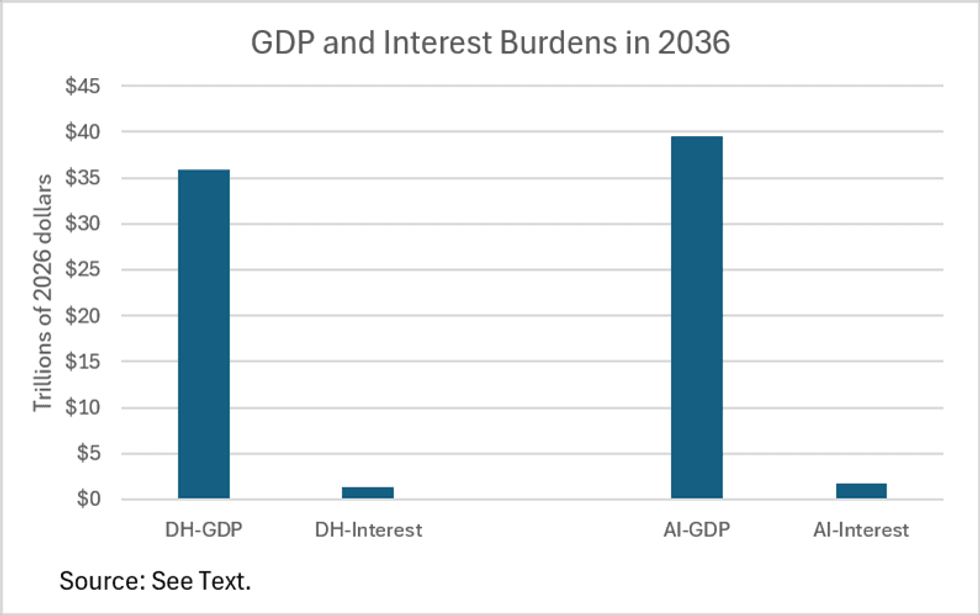
With a 2.5% average growth rate in productivity, the economy would grow to $39.5 trillion in ten years (in 2026 dollars) compared to the $35.9 trillion currently projected by CBO. This $3.6 trillion difference in GDP projected for 2036 comes to a bit more than $10,000 per person.
This is worth keeping in mind when the deficit hawks warn us about the massive debt and interest burden we will face in that year. CBO projects that in 2036 we will be paying roughly $1.7 trillion (in 2026 dollars) in interest, assuming we continue on our current fiscal path.
Suppose we listened to the deficit hawks and massively cut the budget deficit. If we reduced the annual deficit by $1 trillion a year, a bit less than 15% of current spending, it would reduce our interest burden in 2036 by a bit less than a quarter, or around $400 billion a year.
So, let’s compare two scenarios: suppose we assume CBO’s current baseline projections are accurate, and we are good boys and girls, and massively reduce our budget deficits. In that story, our GDP in 2036 would be $35.9 trillion, and we would be paying $1.3 trillion in interest (all in 2026 dollars). By contrast, if we see even a 1.0 percentage point boost to productivity growth from AI, GDP will be $39.5 trillion, but we will be paying $1.7 trillion in interest each year. What’s the problem?
To be clear, I’m being a bit fast and loose here. If the economy grows 1.0 percentage point more rapidly than currently projected, tax revenue will be larger each year, and deficits will be smaller, meaning our interest burden in 2036 will be considerably less than $1.7 trillion.
More importantly, the rate of productivity growth is not a policy choice. We will either be lucky on this one or not, but more rapid productivity growth is not something we can just choose to have. (I’m personally a skeptic.)
But suppose we don’t see the huge boost to productivity growth the AI promoters promise? In that case, we will see a collapse of the AI bubble. This is virtually certain to lead to a serious recession. In a recession, the last thing we want to do is cut the budget, which would only make the recession worse.
In short, we have a story where on the one hand we see an AI productivity dividend, and the deficit and debt are not a big problem. Alternatively, we don’t see the dividend, the bubble bursts and we get a serious recession, and we need to run large deficits to support the economy. So why should anyone listen to the deficit hawks? See what logic can do.
But We Should Reduce the Deficit Anyhow
And now I will do the ultimate cop-out and say we should reduce the deficit, not because we must, but because it would be good to tax the bad guys more and pay the bad guys less money. To steal from a past piece:
“At the top of the list is collecting the taxes people owe. The IRS estimated that we had a tax gap of more than $600 billion in 2022, the most recent year for which data are available.
“To be clear, this is not money lost to various loopholes in the individual or corporate tax structure. This is money that people actually owe after taking advantage of all the loopholes but are not paying. The vast majority of this gap is due to businesses and wealthy people not paying the taxes they owe, not a plumber not paying the taxes they owe for fixing a neighbor’s toilet.
“The tax gap would almost certainly be considerably larger today, both because the economy has grown, and also because Elon Musk and his DOGE crew fired many of the people at the IRS responsible for enforcing the tax code. The fact that the Trump administration is apparently also selling pardons for things like tax evasion, virtually guarantees that more rich people will opt not to pay their taxes.
“We can also alter the tax code, and especially the corporate tax code, to eliminate many of the tax avoidance schemes that cost the government revenue and support a useless tax avoidance industry. The obvious route on the corporate side is to replace the corporate income tax with a requirement that companies turn over non-voting shares to the government. This would mean that if the government is targeting a tax rate of 25%, companies would be required to turn over non-voting shares equal to 25% of the total.
“These shares would be treated just like voting shares, getting the same dividends and share buybacks. In this case, there is no way to cheat the government out of its taxes, unless the company also cheated its shareholders.
“A third way to reduce the deficit would be to get our healthcare costs in line with other wealthy countries. We currently pay twice as much per person as the average for France, Germany, and other wealthy countries. A big part of that story is that we pay hugely more for drugs and medical equipment. We could get the price of these items down by not giving them patent monopolies. In a free market, drugs and medical equipment are cheap. That both makes them affordable to people and reduces government payments for programs like Medicare and Medicaid.
“Since patent-protected drug prices provide an incentive for companies to lie about the safety and effectiveness of their drugs, free market prices likely also mean better healthcare. We do need to finance the development of new drugs, but this can be done through alternative mechanisms, like direct public funding, as we already do through the National Institutes of Health.
Anyhow, there are measures we can take that are simply good economic policy that will also have the benefit of reducing the deficit. But these steps should be taken because they are good policy. The lower deficits are frosting, not the main goal of the policy.
These steps can go far towards reducing the deficit. Since we don’t have to actually get the deficit down, the savings can go to items like universal Medicare, childcare, free college, and all sorts of other good things. But the key point here is that there is no reason to take the deficit hawks’ whining seriously. Let them go back into the woodwork until the Republicans have their next plan to cut taxes for the rich.
Dean Baker is a senior economist at the Center for Economic and Policy Research and the author of the 2016 book Rigged: How Globalization and the Rules of the Modern Economy Were Structured to Make the Rich Richer. Please consider subscribing to his Substack, from which this is reprinted with permission.