Tag: health insurance costs
'Great Healthcare': White House Delivers Trump's Concept Of A Non-Plan

'Great Healthcare': White House Delivers Trump's Concept Of A Non-Plan

One year into his second term, President Donald Trump on Thursday called on Congress to pass a health care plan that would do next to nothing to lower employer-based insurance costs or reduce out-of-pocket expenses for individuals and families.

The 20-paragraph “fact sheet” on the administration’s plan contained few specifics; no new ideas; had only one estimate of projected savings or costs. Its insurance reforms included either provisions already on the books or previously rejected Republican proposals that would make things worse and force more people into the ranks of the uninsured.

The stock market took notice. Insurance stock prices (IHF) rose almost 2% on the news.

Its lead provision called on Congress to enact a law forcing drug companies to set prices at international levels. Given the pharmaceutical industry’s widespread support on Capitol Hill (most of the GOP and a hefty share of Democrats have routinely opposed so-called international reference pricing), passage of such a law is highly unlikely.

Moreover, the administration could do this on its own if it really wanted to. The first Trump administration in its waning days proposed a far-reaching rule for international reference pricing, which was rejected by the Biden administration in favor of pursuing price negotiations with manufacturers. Last month, it proposed two pilot projects that would apply international reference pricing to only 25% of Medicare patients, and then for only five years. The plan unveiled today made no mention of either effort.

Nor has the administration moved to expand rules over the drug prices it already has some say over — those for Medicare. The Medicare drug price negotiations law affected only a handful of high-priced drugs. The plan makes no mention of expanding that authority.

Financial markets took notice. Drug company prices (XPH) fell by less than 1% after the announcement.

The health care trade press was duly skeptical about the plan, calling it “a hodgepodge of health care policies that would create new price-control power over pharmaceutical companies, but that otherwise wouldn’t fundamentally overhaul America’s existing system,” as StatNews report opined.

Here’s what one investment advisory firm told its clients: “We view this new document as a largely political exercise. We think it is intended to demonstrate that the White House is doing ‘something’ about affordability and healthcare prices, but we believe the policies either stand little chance of being enacted by the current Congress or will have a minimal impact if enacted.”

The ‘details’

For drugs:

Beyond asking Congress to codify international reference pricing, the plan calls for making more drugs available as cheap over-the-counter medications. While this could limit sales of a few prescription anti-acids and pain relievers, for which there are already plenty of cheap over-the-counter alternatives, it would have no impact on the high prices of biotech specialty drugs, which are the major drivers of escalating pharmaceutical spending.

Nor would it affect the slow progress in bringing biosimilars to market, or their pricing. Most biotech drugs are either injected or infused in clinical settings, which makes them inappropriate for over-the-counter sales.

The plan also calls for Congress to end the kickbacks pharmacy benefit managers receive from large drug companies for including their products on preferred drug lists. The CBO estimated the GOP bill that passed the House in December with this reform would save drug insurance plans about $15 billion a year, a tiny fraction of the more than $300 billion that patients and their insurers spend at retail pharmacies each year.

For health insurance premiums:

The plan calls for scrapping the existing subsidy system for Obamacare plans and replacing it with a voucher that allows people “to buy the health insurance of their choice.” This refers to the GOP-backed Lower Health Care Premiums for All Americans Act (H.R. 6703), which would expand association plans that don’t meet basic Obamacare requirements like providing essential benefits or setting limits on out-of-pocket expenses.

The White House fact sheet touts the Congressional Budget Office estimating the association plan proposal would save $36 billion for the federal government. It didn’t mention the CBO’s conclusion it would cause 100,000 people to drop existing coverage each year over the next decade while adding just 700,000 newly insured through inferior association plans.

The White House plan also calls on insurance companies to publish the percentage of their revenues paid out in claims versus overhead and profit costs. The Affordable Care Act of 2010 already limits insurers, both on the exchanges and in the private market, to paying out at least 85% of the revenue in medical costs for large company plans and 80% for small businesses.

If there’s a problem, it’s in enforcement, not the standard. Indeed, I would like to see a 90% medical loss ratio as the best way to limit insurance industry marketing spending.

For providers:

The plan includes nothing about limiting hospital pricing; enforcing antitrust rules in every health care sector; or rectifying pay inequities between primary care physicians and specialists. Instead, its sole approach to addressing provider sector pricing is greater price transparency, which is already required by a rule adopted by the Centers for Medicare and Medicaid Services in 2019.

That has been a bust for two reasons. First, hospitals post those prices on websites or in places where consumers can’t find them or in such complicated tables that the average person has no idea what they mean.

But more importantly, even if prices were published in an easy-to-read format and posted on a wall, as the plan proposes, what would mean to most people? An analysis by the Health Care Cost Institute of the 70 most shoppable services (routine procedures like colonoscopies or cataract surgeries, for instance) accounted for just 12% of health care spending.

To sum up: When it comes to health care, affordability is most Americans’ number one concern. The plan the Trump administration announced Thursday does almost nothing to address that problem.

Merrill Goozner, the former editor of Modern Healthcare, writes about health care and politics at GoozNews.substack.com, where this column first appeared. Please consider subscribing to support his work.

Reprinted with permission from Gooz News

Republicans Push Skimpy, Unaffordable Health Coverage As Costs Keep Rising

Republicans Push Skimpy, Unaffordable Health Coverage As Costs Keep Rising

The median cost of employer-based health insurance this year leaped ahead at nearly twice the rate of the consumer price index, according to the annual Kaiser Family Foundation employer survey released yesterday. Sadly, workers are bearing a larger share of the increased burden through rapidly rising co-premiums.

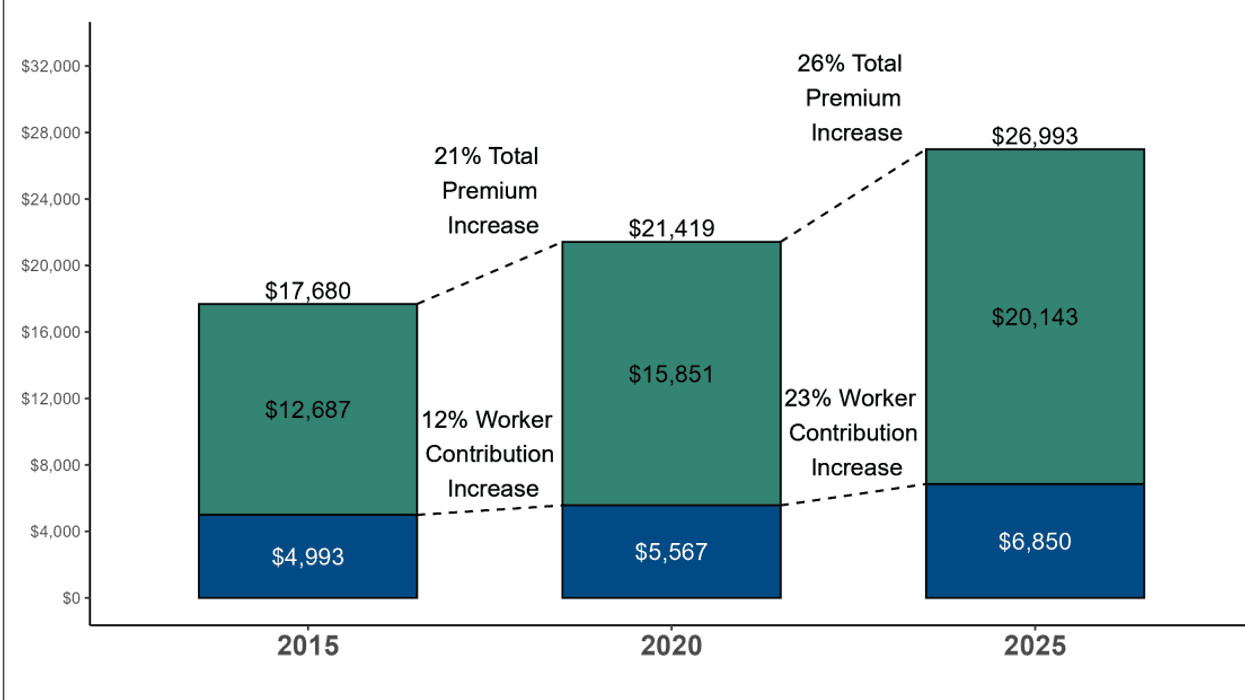
The press coverage this morning of the closely followed survey emphasized the combined top-line increase of 5.5 percent for a family plan, which now stands at a staggering $26,993 a year or about the price of a new compact car. The cost of an employer-based individual plan rose at the slightly lower rate of 4.6 percent to $9,325 a year.

But a deeper dive into the numbers provides a better understanding of why people are so upset about rising health care costs. Employee co-premiums for a family plan (the amount deducted from paychecks) rose 7.6 percent on average to $6,850. The employer share went up only 4.8 percent. The net effect was a downward shift in the share paid by employers and a corresponding upward shift in the share paid by their employees, which was a half percentage point more or 25.4 percent of the total.

This increased burden on workers comes after an eight-year period when the employer share of premiums rose fairly steadily (with a few years off early in the pandemic). Companies offset some of those increases by funneling more of their workers into plans that raised their out-of-pocket expenses for deductibles and co-pays.

Depending on the plan type (HMO, PPO, high-deductible), the average deductible from employer-based family plans now ranges from $3,118 to $5,095 a year. Fully a third of workers and their families enrolled in high-deductible plans for 2025, up from 28 percent the previous year and the most ever.

Put the two together, and the median family (half pay more, half pay less) now pays anywhere from $9,968 to $11,945 a year for health care or close to $1,000 a month. Given the median household income in 2024 stood at $83,730, that translates into anywhere from 12 percent to 14 percent of a typical family’s income.

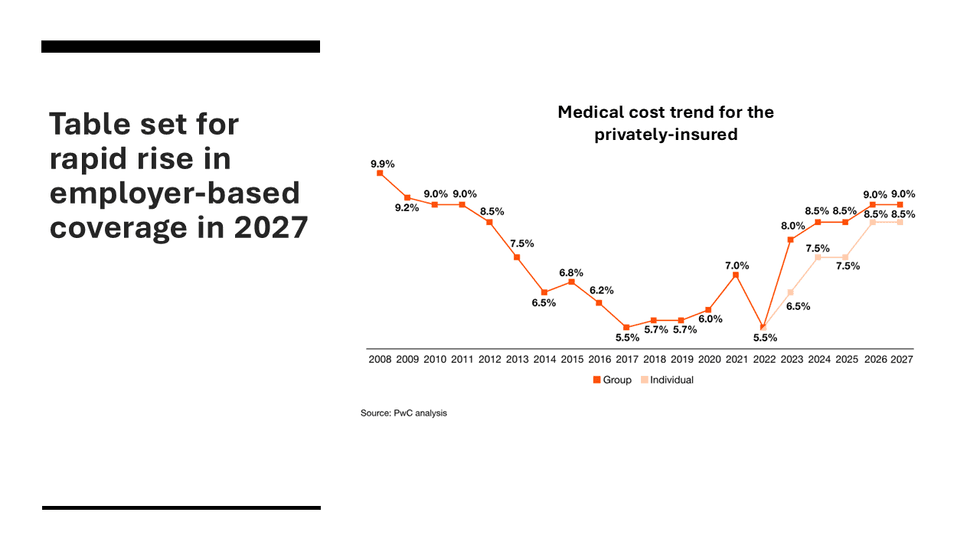
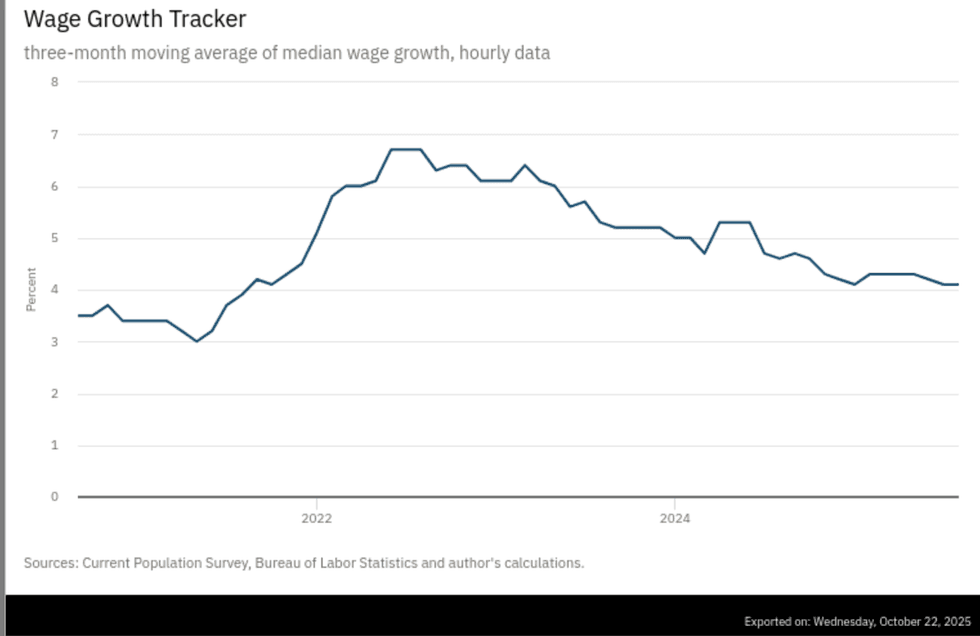
Things are about to get a lot worse. Next year’s premiums and co-premiums for employer-based plans, which cover an estimated 154 million people, are set to rise six percent to seven percent, according to a new survey by Mercer, a health care benefits consulting firm. If the split between employers and their employees remains the same, that will exceed wage increases by two to three percentage points. Wage increases have been trending down for the past three years, falling to just 4.1 percent this past August, the last month reported by the Bureau of Labor Statistics before the government shutdown.

Source: Atlanta Federal Reserve

No wonder health care costs now ranks as the second most important issue for inflation-weary Americans, just behind the deteriorating state of the overall economy. More than four in five of 1,300 adults surveyed in mid-October by the Associated Press and the NORC Center for Public Affairs said health care issues were extremely or very important to them personally. That was nine percentage points more than crime and 23 percentage points ahead of immigration — the next two biggest concerns.

The impact of ACA/Medicaid cuts on employer plans

The outlook for employer-based plans will also get a lot worse if Democrats fail to restore the Medicaid cuts and the enhanced subsidies for Affordable Care Act plans (which provides affordable insurance for tens of millions of low-wage workers, gig workers and sole proprietors). An estimated 7.3 million people who purchased subsidized exchange plans will drop ACA coverage, with more than half becoming uninsured, according to a Commonwealth Fund brief.

Many will look for cheaper, non-ACA compliant plans that don’t quality for listing on the exchanges because they provide skimpier benefits, are not required to provide free preventive care, can discriminate based on prior medical conditions, and often carry extremely high deductibles and co-pays. This summer, the Trump administration announced it wouldn’t enforce the rule approved by the Biden administration in mid-2024 that limited such plans to three months duration.

“Those who sell non-ACA plans … will absolutely see the coming open enrollment as an opportunity to push their plans as more affordable alternatives, without sharing full information with consumers about the limits of those plans,” said JoAnn Volk, a professor at Georgetown University’s Center on Health Insurance Reforms.

What happens when people who previously had Obamacare buy skimpy plans or become uninsured? They postpone care until their conditions require emergency room treatment — the most expensive place to obtain health care. When struck by serious illnesses like cancer, heart attacks and strokes, they often fail to pay their uncovered bills, or resort to Go Fund Me campaigns to pay off their high deductibles. Some will negotiate long-payoff periods and live the rest of their lives burdened by medical debt. Some will declare bankruptcy.

Hospitals and physicians, in turn, will raise their prices to cover the cost of uncompensated care, which will cause private insurance rates to rise even more. Rising prices, rising insurance premiums, and rising uninsured rates is an accurate description of what existed in the U.S. before passage of the ACA.

These health care economic fundamentals are of little interest to the modern-day Republican Party, which invariably includes some variation of bare-bones insurance as one of their answers to the affordability crisis. Early in the shutdown, they floated ideas like instituting new income caps on Obamacare subsidies, establishing minimum co-pays, and cutting off subsidies for new enrollees, none of which they would agree to negotiate until the government is reopened.

Then, last week, Politico reported they are also willing to beef up tax credits for investing in health savings accounts, which could be used to buy skimpy plans. Lower-income workers generally avoid HSAs since they can’t afford the voluntary deductions needed to fund them.

I can’t predict when or how the shutdown crisis will end. But I am pretty confident that I know what will happen to health care costs in the next few years given Republican control of Washington. They’re going up, up, and up.

Merrill Goozner, the former editor of Modern Healthcare, writes about health care and politics at GoozNews.substack.com, where this column first appeared. Please consider subscribing to support his work.

Reprinted with permission from Gooz News
Study Finds Sharp Rise In Health Insurance Costs

A new study by the Kaiser Family Foundation confirms the success of Obama’s health care overhaul in insuring millions of young adults, but it also reflects the need for further changes to the health insurance system as premiums are increasing much faster than workers’ wages.

After several years of relatively modest premium increases, annual premiums for employer-sponsored family health coverage increased to $15,073 this year, up 9 percent from last year, according to the Kaiser Family Foundation/Health Research & Educational Trust 2011 Employer Health Benefits Survey released today. On average, workers pay $4,129 and employers pay $10,944 toward those annual premiums.

Premiums increased significantly faster than workers’ wages (2.1 percent) and general inflation (3.2 percent). Since 2001, family premiums have increased 113 percent, compared with 34 percent for workers’ wages and 27 percent for inflation.

“This year’s nine percent increase in premiums is especially painful for workers and employers struggling through a weak recovery,” Kaiser President and CEO Drew Altman, Ph.D. said.

According to Maulik Joshi, Dr.P.H., president of HRET and senior vice president for research at the American Hospital Association, “survey findings related to the impact of early provisions in health reform provide valuable insight for employers, providers, consumers, and policymakers as they prepare for additional provisions to take effect by 2014.”

The 13th annual Kaiser/HRET survey of small and large employers provides a detailed picture of trends in private health insurance costs and coverage. This year’s survey also looked at employers’ experiences with several already implemented provisions of the 2010 health reform law affecting employer coverage.

In particular, the survey estimates that employers added 2.3 million young adults to their parents’ family health insurance policies as a result of the health reform provision that allows young adults up to age 26 without employer coverage on their own to be covered as dependents on their parents’ plan. Young adults historically are more likely to be uninsured than any other age group.

“The law is helping millions of young adults to obtain health coverage. In the past, many of these young adults would have lost coverage when they left home or graduated college,” said study lead author Gary Claxton, a Kaiser vice president and co-executive director of the Kaiser Initiative on Health Reform and Private Insurance.

The Obama Administration responded to this report by saying that the premiums will not be as expensive once more provisions of Obama’s health care overhaul are implemented. Nancy-Ann DeParle, the assistant to the president and deputy chief of staff, said, “Key Affordable Care Act policies are starting to take effect that make insurance more affordable. For example, insurance companies that want to raise premiums for 2012 by more than 10 percent will have to publicly justify their rate hikes. And a growing number of states have the power to reject unjustified premium hikes.” She also pointed out that the health care reforms have already helped millions, and that the data provides further evidence that Obama’s efforts are necessary.

“The Kaiser report is informative, but it’s a look backwards,” according to DeParle’s statement. “When we look to the future, we know that the Affordable Care Act will help make insurance more affordable for families and businesses across the country.”

Shop our Store

Headlines

Editor's Blog

Corona Virus

Trending

World