Tag: healthcare costs
On Election Eve, Worried Voters Face Staggering Hikes In Healthcare Costs

On Election Eve, Worried Voters Face Staggering Hikes In Healthcare Costs

In my final post before the mid-terms, here’s where things stand for Americans on health care costs, which voters rank as either their first or second most pressing economic concern:

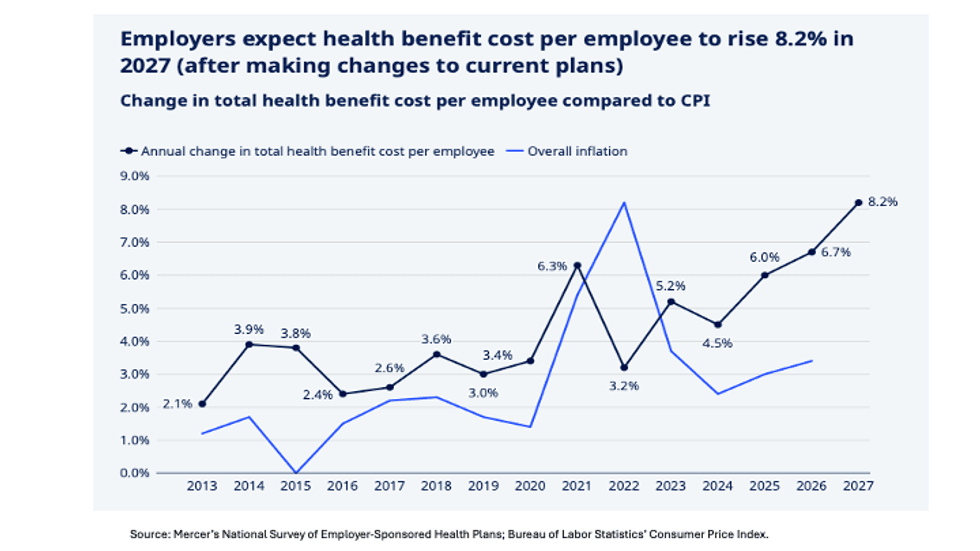
  • The cost of employer-sponsored health insurance will leap 8.2 percent in 2027, which will drive workers co-premiums up by a similar amount if not higher. (Worker co-premiums jumped nine percent last year.)
  • The average worker on a company-sponsored plan this year paid $8,460 in premiums and $3,564 in deductibles, co-pays and other out-of-pocket expenses. Combined, that’s 13.7 percent of the median household’s income.
  • The cost of individual and family plans sold on the federal and state exchanges, where open enrollment began this week, rose 15 percent for 2027. That’s the second straight year of double digit increases.
  • The uninsured rate rose to 11 percent this year after millions of people were thrown of Medicaid or lost their Affordable Care Act plans due to rising premiums and lost subsidies. That’s up from eight percent in January 2025 when President Trump took office for the second time.
  • While no one publishes reliable numbers, the price of seniors’ Medigap policies is also soaring. In New York State, for instance, UnitedHealth sought a 12.6 percent increase for its Medicare supplemental plans earlier this year. State regulators approved “only” a 5.6 percent increase, two percentage points higher than the overall inflation rate.
  • Seniors who purchase stand-alone drug plans will see a 50 percent increase in their average premiums in 2027, according to today’s KFF News. Trump’s response? “We have the lowest drug prices anywhere in the world,” he told a campaign rally in Ohio earlier this week.
  • I am traveling this week to San Antonio to attend the American Public Health Association’s annual meeting, where I will be moderating a panel discussion on Monday afternoon. The topic: Where the nation stands in its 100-year quest for universal coverage and where we go from here.

    Merrill Goozner, the former editor of Modern Healthcare, writes about health care and politics at GoozNews.substack.com, where this column first appeared. Please consider subscribing to support his work.

    Reprinted with permission from GoozNews

Nearly Every House Republican Votes Against Cap On Insulin Pricing

Nearly Every House Republican Votes Against Cap On Insulin Pricing

Nearly all House Republicans on Thursday night voted against a bill that would dramatically lower the cost of insulin, the life-saving diabetes drug that has skyrocketed in price in recent years.

The House passed the Affordable Insulin Now Act by a vote of 232-193, with every Democrat and just 12 Republicans voting for the bill. If enacted, the bill would cap the price for a month supply of the drug at $35, or 25 percent of the negotiated insurance price.

According to the website GoodRx Health, the average price for insulin spiked by 54 percent between 2014 and 2019, an increase that's led to insulin rationing, a dangerous and sometimes deadly tactic in which diabetics use less insulin than needed in order to avoid depleting their supply of the expensive drug.

"Insulin prices are outrageous! Diabetics, like me, pay almost $100 for a unit that costs $12 in Canada. It causes some to ration or skip days to survive," Rep. Donald Payne Jr. (D-NJ) tweeted. "Today, I voted for a bill to cap insulin prices at $35 per month. No one should have to choose between food or medicine!"

Republicans condemned the bill as government interference in health care.

"Today it's the government fixing the price of insulin. What's next?" Rep. Cathy McMorris Rodgers (R-WA) said during debate on the bill. "Gas? Food? History tells us that price-fixing doesn't work."

Rep. Matt Gaetz (R-FL), while calling the legislation "another big government bill that claims to serve the American people by subverting basic economic theory with the proposed codification of government price controls," blamed the rising cost of insulin on increased demand due to Americans getting fatter.

"The number of diabetes cases in the U.S. has nearly doubled. The demand for insulin has increased and the requisite price increase has followed suit. In other words, the price of insulin increases as waistlines increase," Gaetz tweeted.

However, polling finds that voters support capping the cost of the drug.

A Data for Progress survey in November 2021 found that 87 percent support capping the cost of insulin at $35 per month.

Provisions that would have lowered prescription drug prices were included in President Joe Biden's Build Back Better framework, which stalled in the Senate.

It's unclear whether the standalone insulin bill can pass in the Senate.

Democrats would need to convince 10 Republicans to allow the bill to come up for a vote to reach the 60-vote threshold needed to stop a filibuster of it.

Shop our Store

Headlines

Editor's Blog

Trending

World