Third-Quarter Growth Driven By AI Bubble Still Leaves Economy Vulnerable
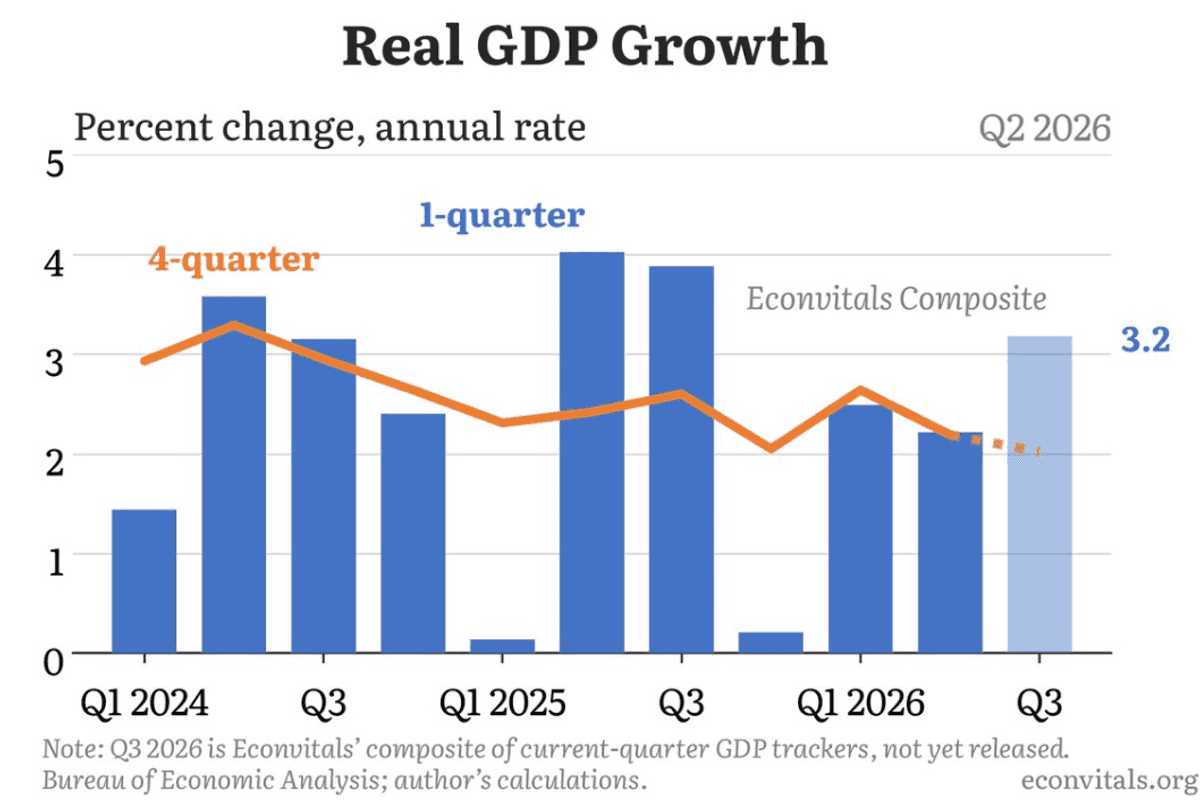
The 3.4 percent GDP growth for the third quarter was largely in line with expectations. The biggest factors driving growth were a 12.7 percent increase in investment and a 3.8% rise in consumption. Both were driven largely by AI. This leaves the economy vulnerable to a collapse of the AI bubble, but still, it was a good growth number.
Here are my five biggest takeaways from the report:
Thanks for reading! Subscribe for free to receive new posts and support my work.
1) Investment growth is almost entirely an AI story;
2) Consumption growth is strong, but is driven by stock gains;
3) The trade deficit is soaring due to AI-related imports;
4) Housing construction continues to fall;
5) The Iran War is leading to double-digit growth in military spending;
6) State and local government spending is stagnating.
Investment Is AI
It is fair to say that AI is crowding out investment in other areas. The generally accepted view is that the AI spending accounts for the bulk of the roughly 1.0 percentage point rise in the 10-year Treasury rate over the last year. (I’m not sure I agree with that. An alternative explanation is that investors now believe that the Fed will have higher federal funds rates for the near-term future.)
Interest rates are probably the less important factor in crowding out at this point. The AI boom is directly pulling away real resources from other forms of investment. In the case of structures, there are widespread reports of businesses being unable to get construction workers in different parts of the country. (The deportation of many workers has not helped.) Structure investment outside of data centers has been falling since the start of last year.
The demand for computer chips and related technology has sent prices for these items soaring. Prices for computers and related equipment rose at a 13.1% rate in the third quarter. They had been falling for decades until the AI boom. Real spending on other types of equipment investment has barely risen in the last two years.
Consumption is Growing, Wages Are Not
The 3.8% pace of consumption growth in the quarter is solid by any measure. But this growth is clearly not driven by wages. The nominal wage bill has risen just 4.2% over the last year, implying a real rise of 0.6% over this period. Real compensation has risen slightly faster, but still just increased 0.9% over the last year.
That sort of wage growth cannot support the sort of strong consumption growth we have been seeing. To some extent, people are dipping into savings, but more importantly, higher-income households are likely spending based on stock gains in the last few years.
By category, health care services continue to account for an outsized share of growth. Real spending rose at a 4.9% annual rate in the quarter while nominal spending rose at a 7.4% annual rate. Real spending on restaurants rose at an 8.8% annual rate. Real spending on prescription drugs and pharmaceuticals rose at a 12.2% annual rate. Some people apparently feel like eating out more, although even spending on fast-food restaurants rose in the quarter.
Spending on housing services increased at just a 1.1% annual rate, as vacancy rates increased in the quarter. Real beef consumption rose in the quarter but is still 13.6% below the level in the fourth quarter of 2024. Real spending by foreign tourists traveling in the United States fell at a 16.7% annual rate, despite the World Cup taking place in July. It is now 13.7% below its level in the fourth quarter of 2024.
The Trade Deficit Rose to Near Record Levels
The real trade deficit increased to $1,320.3 billion in the third quarter. This is only slightly below the record $1,352.7 billion deficit hit in the first quarter of 2025, as people were stocking up in anticipation of the Trump tariffs. (The nominal deficit was larger in the third quarter.)
Most of the story of the trade deficit is soaring imports of computer chips and related products, as real imports increased at a 19.7% rate in the quarter. However, a 5.4% decline in exports also contributed to the rise in the trade deficit. Exports declined in a number of categories, including agricultural products and motor vehicles, as well as the drop in foreign tourism noted earlier. (Foreign tourism is a service export.)
High Interest Rates Continue to Depress Housing Construction
Mortgage rates have risen by more than a percentage point in the last year, with most of the increase taking place in the last two months. As a result, housing construction fell at a 3.3% rate in the third quarter, more than offsetting a 2.8% rise in the second quarter. Housing construction has now fallen in six of the last seven quarters. It seems virtually certain that construction will continue to fall in the fourth quarter as builders adjust to the rise in interest rates in the last two months. That is not good news for people hoping for lower housing costs.
The Iran War is Causing Military Spending to Soar
Defense spending rose at an 11.7% annual rate in the third quarter, driven by war-related expenses. This increase mostly reflects an increase in supplies to service members. It is not a good measure of the cost of the war. Most of the economic cost to the military will take the form of depleted weapons systems, as well as base destruction, which will be replaced in future years.
There is not much publicly available information on the size of these expenses yet, although the Trump administration has requested an appropriation of $1,500 billion for the military for fiscal 2027. This would be almost a 70% increase from the spending levels in the last Biden budget.
State and Local Government Spending is Stagnating Due to Federal Cutbacks
State and local spending fell at a 0.1% rate in the third quarter. It has increased just 1.0% over the last year. This is a sharp slowing from the 4.0% rate in 2024. Most state and local government spending goes to education and health care. With health care costs far outpacing overall growth, this pace of spending growth implies large cuts in these areas.
Overall Picture: Positive, but Precarious Growth Story
The 3.4% growth number is solid by any standard, as is the strong investment growth. But it is clear it rests on the AI boom. If that continues, the overall economy will be reasonably strong, but workers are not getting their share of these gains.
It is worth noting that we will likely see a modest upturn in productivity growth for the quarter to a number slightly over 2.0%. That’s a good story, but far from the sort of massive increase advertised by the AI proselytizers. It’s still well below the pace of the 1990s tech boom or the long post-World War II Golden Age.
- Two Years On, We Can See What Trump Has Done To The U.S. Economy ›
- Spiking Oil Prices Will Damage Economy Even As US Keeps Pumping Crude ›
- Worrying About $40 Trillion In Debt? Trump's Corruption Is A Far Worse Threat ›
- Fresh Warnings In The Government's First-Quarter Economic Report ›
- No Contest: Under Trump, China's Growth Hugely Outpaced The United States ›
- US economy grows at brisk 3.4% pace in third quarter on strong consumer spending and AI investment ›
- Third-quarter U.S. GDP increases a better-than-expected 3.4% as September inflation accelerates ›
- US GDP accelerates to 3.4% in the third quarter, giving Trump a messaging boost on eve of midterms ›
- U.S. GDP Increased 3.4% in Third Quarter - The New York Times ›