Tag: immigration crackdown
How Trump's Immigration Crackdown And Growing Inequality Threaten Social Security

How Trump's Immigration Crackdown And Growing Inequality Threaten Social Security

On Tuesday the Social Security Trustees released their latest report on the system’s finances. The numbers didn’t change much: Unless something is done, the Old Age Survivors and Disability Insurance (OASDI) program, Social Security’s official name, will be unable to pay full benefits starting in either 2032 or 2034, depending on some technical issues. That’s not far away: If the Trustees are right, the prospect of a Social Security crisis will loom over the next presidential administration.

It’s important to understand, however, the nature of the looming crisis. It won’t be an economic crisis. It won’t even be a serious fiscal crisis. Whatever you may have heard, Social Security isn’t in danger of going bankrupt.

What we’re facing, instead, is potential political crisis. Congress and the White House could easily take action to sustain America’s retirement system. But given the current state of our politics, there’s no guarantee that they will.

There is a widespread misunderstanding of how Social Security works. While Social Security was designed to look like a pension fund, it isn’t. A pension fund pays benefits out of a stock of assets it has accumulated over time. In contrast, Social Security operates as a government transfer program, like food stamps or Medicaid.

Now, unlike food stamps — but like the highway trust fund — Social Security is on paper supported by a dedicated tax, the payroll tax, that is assigned to that program. But I say “on paper” because from an economic point of view assigning the payroll tax to Social Security is just an accounting convention. What matters for the U.S. economy is the overall balance between government spending and government revenue, not the difference between one type of spending and one source of revenue. So there’s no inherent economic significance to the fact that by 2034 payroll tax receipts will be insufficient to cover promised benefits.

There is, however, a legislative issue. As long as the Social Security Administration can pay benefits out of payroll taxes and its cash reserve, there’s no need for Congress to vote each year to authorize benefits — they just keep going out until further notice. However, once those resources become insufficient, benefits will fall —by 17 percent according to the Trustees — unless Congress passes new legislation that “tops up” Social Security’s finances.

Yet the current administration and Republican party are such extremists that there is a real risk that Social Security will be held hostage on behalf of their goals. If this should come to pass, the hostage-takers will claim that shoring up Social Security is unaffordable. Right on cue, Mike Johnson, the Trump-sycophant Speaker of the House, declared on Monday that “entitlement programs” like Social Security “have to be adjusted and fixed,” and that Republicans will introduce a plan to that effect next year.

But this is a ploy, because while the cost of maintaining Social Security benefits at their promised level isn’t trivial, it is in fact affordable. According to the Trustees’ report, the actuarial balance of OASDI up through 2050 — the amount of additional funds it would need to keep paying full benefits for the next 25 years — is 1.06 percent of GDP. To put that number in perspective, the Trump administration proposes increasing military spending next year by $420 billion, equivalent to about 1.4 percent of GDP – without any discussion of whether that’s affordable

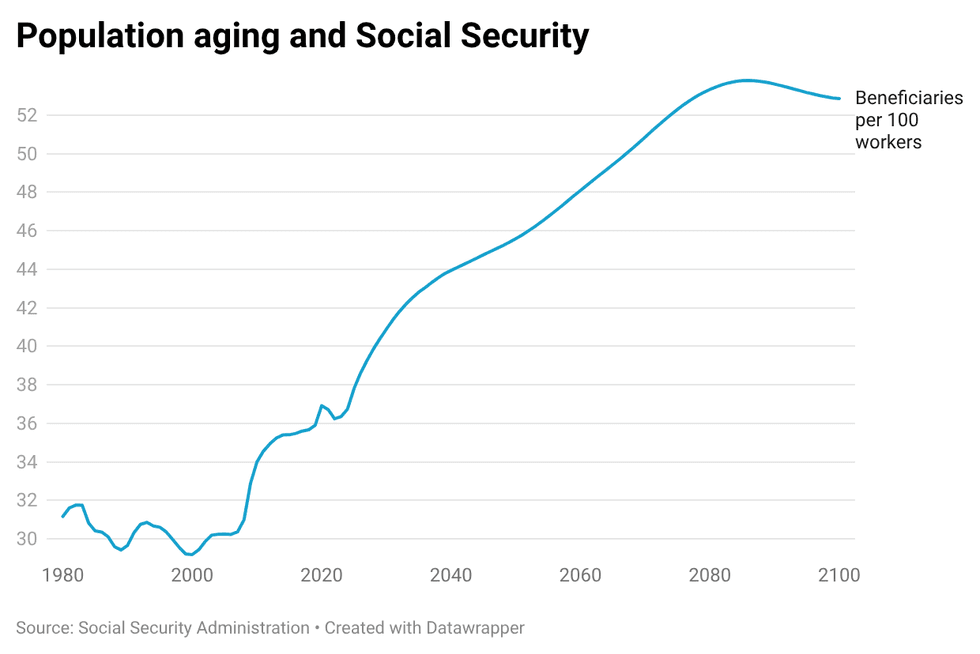
Yet how did we get to the point where Social Security will need to be topped up? The main answer is that we have an aging population, with a growing ratio of retirees collecting benefits to workers paying into the system:

Trump’s anti-immigration policies are making this problem worse. According to the Trustees’ report, lower immigration will deepen Social Security’s financial hole because many immigrants are working-age adults who will pay into the system for decades before they collect benefits. In fact, this problem may be much bigger than the report acknowledges: The report’s baseline assumption is that we’ll have net immigration of almost 1.2 million people a year, and even the pessimistic case assumes 750,000 a year. Meanwhile actual net immigration has already been cut far below that — and may now be negative.

Moreover, Social Security is being financially damaged by growing income inequality in America. Payroll taxes are levied only on wages up to $184,500, and they don’t touch capital income. With the distribution of income increasingly shifting from labor to capital, as well as becoming more unequal among wage-earners, revenue from the Social Security payroll tax has been falling as a share of national income. From 1990 to 2024, it fell from 5.02 percent of gross domestic income to 4.46 percent.

Which brings me to the question that, these days, we ask about everything: How might Social Security be affected by the advent of AI?

A short answer: If, as many of us fear, AI accelerates rising income inequality, it will further reduce the payroll tax receipts that currently pay for Social Security and further endanger its finances.

On the other hand, if AI, as its advocates promise, leads to faster economic growth, it will increase the potential tax base that could and should be used to support Social Security and other social insurance programs. But to take advantage of that larger base, we’ll have to get serious about taxing wealth and capital income.

Is Social Security in trouble? Yes, but only because of the way its financing is currently structured — a structure that no longer works well because our society and economy have become so unequal. Moreover, Trump’s immigration policies are further endangering its already deteriorating financial condition.

So don’t believe Republicans’ gaslighting that it will be necessary to cut Social Security benefits. All that is necessary to preserve Social Security is political will to raise taxes on the wealthy and a sensible immigration policy.

Inflation Rising As Trump's Confused Economics (And Iran War) Drive Costs Up

Inflation Rising As Trump's Confused Economics (And Iran War) Drive Costs Up

We know Donald Trump gets easily confused. During his campaign, he repeatedly insisted that he would keep us out of a war in Iran. Now, after being in office less than 14 months he started an unprovoked war in Iran. Trump obviously couldn’t remember whether he was supposed to avoid a war in the Middle East or start one.

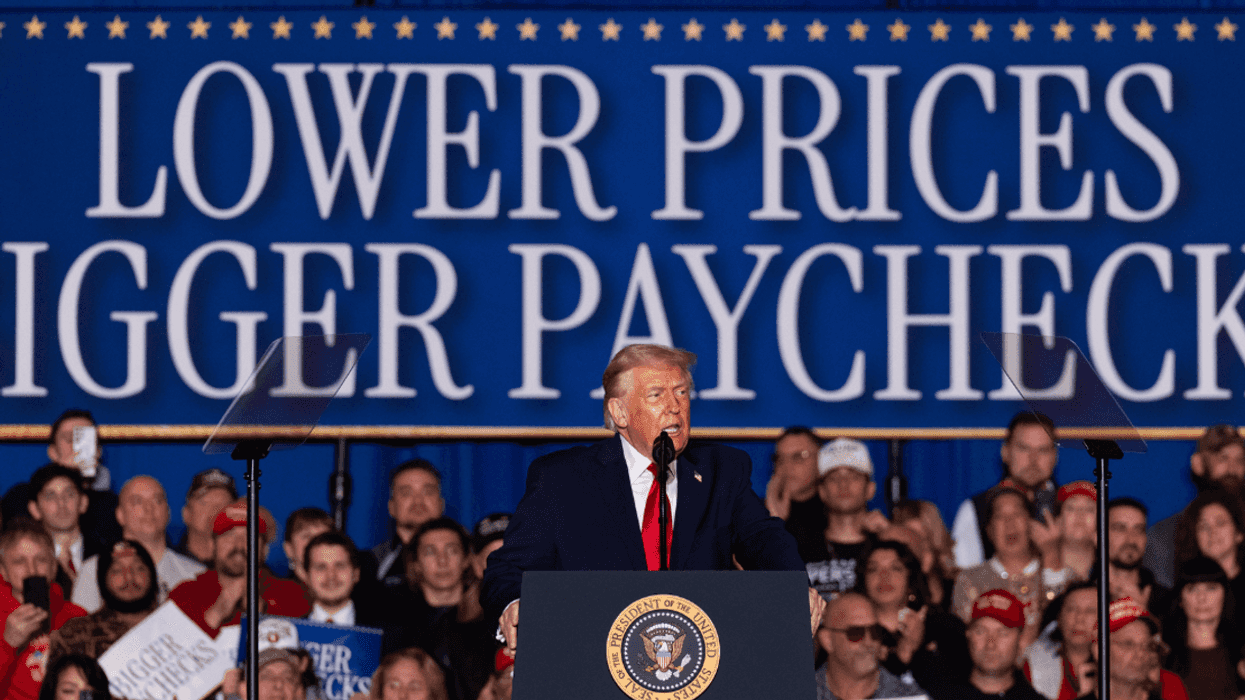
It seems he is facing the same problem when it comes to inflation and prices. He promised to bring prices down on the first day of his presidency. While inflation had been falling to the Fed’s 2.0 percent inflation target before Trump was elected, it is now close to 3.0 % and looks to be heading higher, and that was even before the impact of his war against Iran.

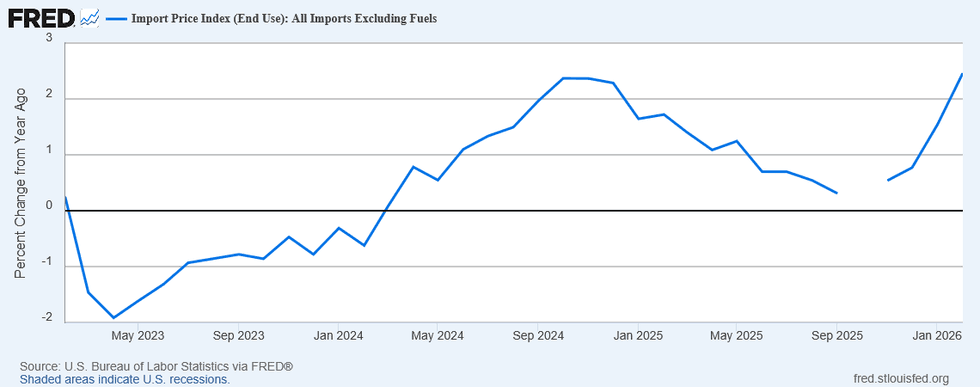
We got the latest news on this front yesterday when the Bureau of Labor Statistics released February data on import prices. Non-fuel import prices rose by 1.1 percent in the month. Import prices are erratic on a monthly basis, but this followed a 0.8% rise in January. Year-over-year non-fuel import prices are up 2.5 percent.

Prices of all imports excluding fuels since April 2023Source: US Bureau of Labor Statistics via FRED

There are two important issues to keep in mind when thinking about the impact this will have on the inflation households see. The first is that this index tracks prices before any tariffs are imposed. These are the prices charged when goods come off the boat. Trump’s tariffs are added onto these prices.

If exporters were eating the tariffs, as Trump promised us, then import prices would be falling. That is clearly not what we are seeing.

The other important item to note is that these data are for February. That is before the war on Iran sent the price of oil, natural gas, and many other commodities soaring. As bad as the February data look, March is virtually certain to be worse.

This reinforces the story we saw with the February Producer Price Index (PPI). The core PPI rose 0.5 percent in February and is up 3.5 percent over the last year. The relationship between inflation at the wholesale level (the PPI) and the retail level (the CPI) is not one-to-one, but it’s a safe bet that if we see higher inflation at the wholesale level, it will be coming out of consumers’ pocketbooks down the road.

The pickup in inflation is not a surprise; it is a completely predictable result of Trump policies of tariffs, mass deportations, and ad hoc dictates to private corporations (e.g., shutting down windfarms). It is not a story of hyperinflation, as some doomsayers may have forecast, but it is a story of higher inflation that eats into consumers’ purchasing power. That’s what you get when you turn the keys of government over to a confused old man.

Dean Baker is a senior economist at the Center for Economic and Policy Research and the author of the 2016 book Rigged: How Globalization and the Rules of the Modern Economy Were Structured to Make the Rich Richer. Please consider subscribing to his Substack.

Reprinted with permission from Dean Baker.


South Texas Latinos Who Voted For Trump Have Buyer's Remorse, Big Time

South Texas Latinos Who Voted For Trump Have Buyer's Remorse, Big Time

Amid President Donald Trump’s cratering poll numbers, it’s getting easier to find supporters of his now feeling burned by their 2024 vote. Here’s a clip that went mega-viral this week, thanks to this Trump backer’s blunt, self-aware honesty.

A voter in Pennsylvania shares her thoughts on the war with President Trump.

[image or embed]
— Yashar Ali 🐘 (@yasharali.bsky.social) March 17, 2026 at 7:04 PM

But beyond complaints about gas prices or inflation, there’s a deeper reality taking hold in parts of the country that swung to Trump. This isn’t about marginal cost increases—it’s about entire communities getting wrecked.

One example: South Texas.

The Rio Grande Valley—a predominantly Latino region that long leaned Democratic, if with low turnout—shifted toward Trump in 2024. His law-and-order message and economic promises landed. Republicans saw it as proof that their party was making real inroads with Latino voters.

That shift also reshaped the political map. It’s the kind of region Texas Democratic Senate nominee James Talarico now needs to win back decisively if he’s going to have any shot at flipping a Senate seat long assumed out of reach.

Now those same communities are dealing with the consequences, as Trump’s immigration crackdown has crushed the region’s largest industry: construction.

“I did vote for Mr. Trump. Deporting the criminals is a great policy,” Mario Guerrero, executive director of the South Texas Builders Association, told The New York Times. “These foundations are poured ready to go, and we can’t even start the construction on them. But we voted for the American dream. And unfortunately, right now, we’re not seeing that.”

There was never much ambiguity about what Trump meant when he promised mass deportation. He didn’t limit “criminals” to violent offenders or serious convictions. His position was explicit: Anyone in the country without legal status was a criminal and subject to removal.

That distinction mattered, because there was no controversy over deporting actual criminals. Democratic presidents like Barack Obama and Joe Biden never shied away from doing that.

In a region where entire industries rely on immigrant labor, that definition didn’t just target a narrow group. It put an entire workforce in the crosshairs.

But it was easy to pretend otherwise.

“I’ve supported Mr. Trump in every election that he’s been a part of,” Guerrero said. “We just never thought that this would come and affect us in the construction industry, but most importantly, affect our economy here in South Texas.”

That’s a typical conservative: He starts caring once it directly affects him, because it was fine when he thought it would just hurt someone else.

Instead, it’s hitting the workers who actually sustain the region’s economy. Job sites are stalled. Projects are delayed. Businesses are shrinking or collapsing. The ripple effects are spreading outward into the broader local economy.

But there is a political silver lining, and we saw the first signs of it in the Texas primaries two weeks ago.

“Texas Democrats more than doubled their turnout from 2024 during the primary elections on March 3 in the four counties that make up the Rio Grande Valley,” reported the Texas Tribune. “In the Valley, that energy could help spare two incumbent Democratic congressmen whose districts were redrawn to favor the GOP, and earn the state’s minority party a third congressional district as well as a statehouse district or two.”

The GOP’s 2024 gains here were treated as a realignment. Now it’s looking more like a detour.

Whether that translates into lasting political change remains to be seen. But in a region where Democratic voter participation is needed in order for the party to be competitive statewide, Trump’s malicious incompetence may have finally woken them up.

Markos Moulitsas is founder and editor of the blogging website Daily Kos and author of three books.

Reprinted with permission from Daily Kos
Challenged Over Minnesota Shootings, Wyoming Republican Flees Town Hall

Challenged Over Minnesota Shootings, Wyoming Republican Flees Town Hall

GOP Rep. Harriet Hageman of Wyoming literally chose to run away from her constituents rather than answer a very fair and basic question about why she won't speak out against the federal government killing U.S. citizens in the streets.

Last week Hageman held a town hall in Casper, Wyoming—as the GOP-controlled House was once again in recess because Speaker Mike Johnson is apparently allergic to work—in which she was repeatedly asked by constituents to speak out against the evil actions of President Donald Trump's immigration goons.

“Why have you not spoken out against the Fourth Amendment violations that ICE officers and Border Patrol officers are currently engaging in by breaking into people’s homes without a warrant?” one attendee asked.

But instead of answering, Hageman assailed the constituent’s character.

“I don’t know that I trust your facts,” Hageman responded.

Later on, another constituent asked Hageman why she had not spoken out against the killings of Renee Good and Alex Pretti in Minneapolis, both at the hands of Trump’s immigration goons.

“They are killing American citizens in the streets, and you are doing nothing. You are not saying a single solitary thing to support constituents or to support the American people,” they said. “As a constitutional lawyer, you should be infuriated. You should be incensed. Why are you not?”

But rather than responding, the cowardly Hageman left, as one constituent yelled “coward” and “chickenshit" as she walked off stage.

It’s truly so easy to speak out against obvious wrongs being committed by the federal government. In fact, GOP Sen. Rand Paul of Kentucky had no qualms with criticizing the killing of Pretti.

“After seeing this, if you call this a good shooting, you aren't watching the video. This was a real tragedy and a mistake. The man had been disarmed and then was shot 10 times,” Paul said. “If we say things that are obviously not true, the situation is going to get worse.”

But Hageman chose to walk away rather than do the right thing.

To be sure, a number of Hageman’s GOP colleagues have said disgusting things to not only defend the killings of Good and Pretti but to also disparage them.

While Hageman didn’t do that, her silence shows that she knows the killings of Good and Pretti were wrong, but she’s still too cowardly to speak out against it.

Chickenshit, indeed.

Reprinted with permission from Daily Kos
Shop our Store

Headlines

Editor's Blog

Trending

World