Tag: inflation rate
Cyclical Or Structural? Figuring Whether The World Is Stuck With Higher Inflation

Cyclical Or Structural? Figuring Whether The World Is Stuck With Higher Inflation

While everyone’s fishing with clickbait these days—it’s an e-jungle out there—the highly experienced economic journalist Neil Irwin doesn’t make bold claims without some backup. So, when I read this Axios headline from him on Monday, I said “hmmmmm.” I stroked the chin. I furrowed the brow. I asked myself, “is that right?” I answered, “it could be!”

I mean, the economic problem of the decade is surely what Trump is in the process of doing to global economics, but where I go with Neil’s assertion, as you’ll read below, is more about whether something structural (vs. cyclical, as in the business cycle) has changed in how inflation is generated in the U.S. and other advanced economies. In fact, there’s an interesting new Fed Note on the topic which I’ll also highlight below. Like I said, my read of the evidence is maybe (re upward, structural change) but the fact that inflation’s been buffeted by a series of identifiable shocks means that it still may settle back into something closer to its pre-pandemic pattern.

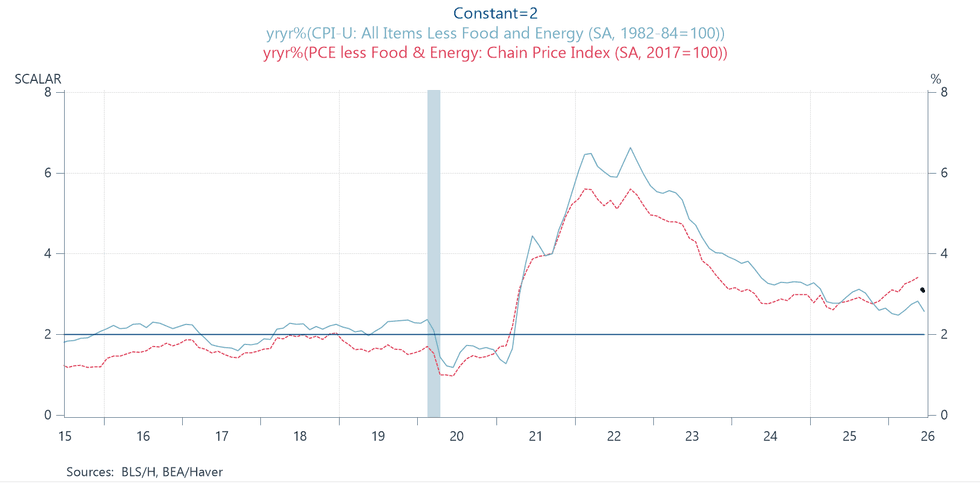
Lurking behind this is the observation that the Fed’s preferred inflation gauge, the PCE, has been above its 2% target since April of 2021, as in five years ago. I show the core PCE in the figure below, taking out energy/food spikes that the central bank can’t do much about. That persistent miss has gotta mean something, right?

A simple but not-too-far-off read of the figure above is that policymakers lost control of inflation in the 70s, Volcker lowered the boom, other inflationary forces, like oil shocks and wage-escalation clauses, became less common, and the central bank went in on “anchoring inflationary expectations,” i.e., convincing price setters it would do what it takes with its monetary policy tools to keep inflation around its 2% target.

But what then explains the not-the-70s-but-still-highly-noticeable rise at the end of the above series?

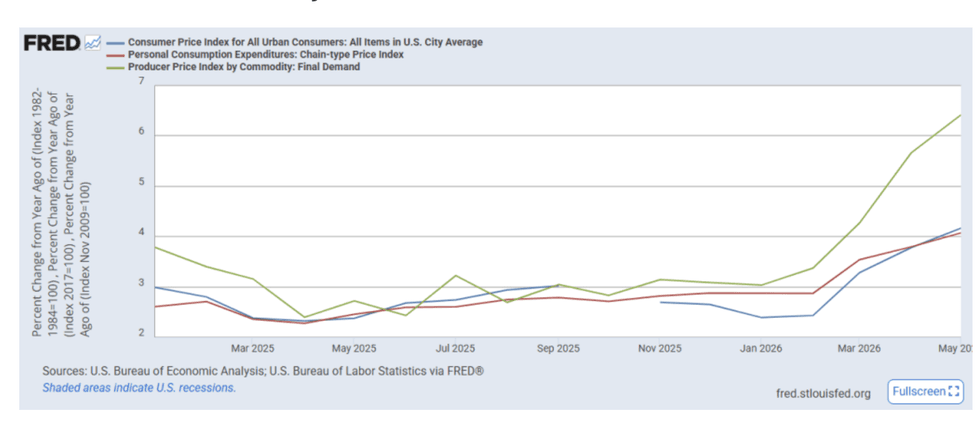
While it’s true that we’re less exposed to oil shocks, we’re clearly not immune, and we’ve had two in recent years, one of which is a big own-goal-kick by the Trump admin, in which we’re still ensconced. The other was Putin’s doing. (If you want to pause here and think about the causal linkages between authoritarian leaders and higher inflation, be my guest.) The figure shows the retail gas and oil prices (both indexed to 2019) on the left axis, and CPI yearly inflation on the right (the last data point there is the 3.3% March rate we learned of last week).

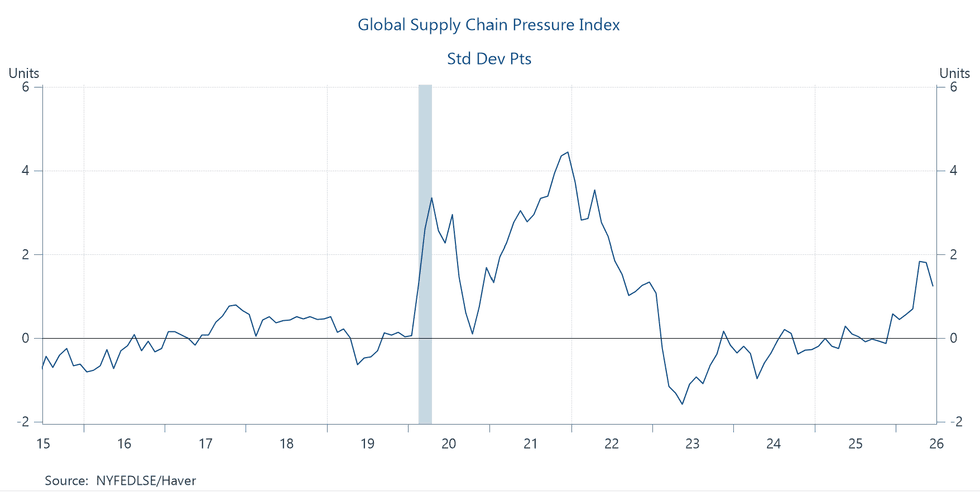
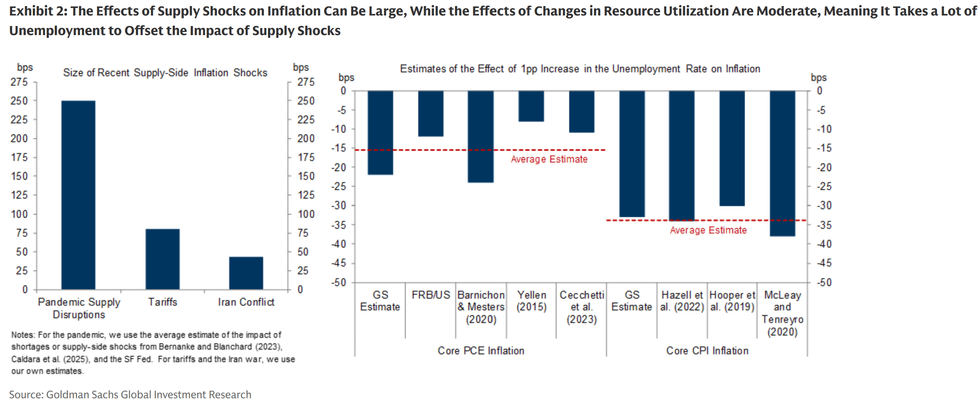
This is Neil’s piling-on point re supply shocks. Of course, the pandemic is on that list, which was a supply shock in many dimensions. Locked in by COVID, consumer preferences shifted sharply away from services and towards manufactured goods (see figure below), right at the time supply-chains were snarled, sending goods prices through the roof (I’m giving a talk this week on all this stuff, which is why I’m shoving all these slides down your throat).1

Next, enter the Orange Menace with a spate of supply shocks of his own. His and Stephen Miller’s anti-immigration actions have combined with aging boomers to take the growth of labor supply down to a drip. And again, his war is the latest supply shock, one that I do not believe will disappear anytime soon, regardless of the resolution of the ongoing negotiations.

On the demand side, I’d add Trump and Republicans' deficit-financed budget. The fact that historically large deficits stimulate the economy in both bad times (as they should) and good times (as they shouldn’t) doesn’t help in this regard.

Pushing the other way is the fact that productivity has accelerated over these very same five years, from about 1.5 percent to 2 percent—a big deal if it sticks—with potential further productivity juice to come from AI. This is a positive supply shock, typically associated with lower inflationary pressures. But that just means that half-mountain (or maybe just a foothill for now) at the end of the cumulative figure above would be steeper without this force pushing the other way.

I mentioned this Fed Note that asks: “Is the Inflation Process in Advanced Economies Different After the Pandemic?” It’s a quite clear and intuitive exposition; if all this interests you, give it a read. But here’s one of its key findings:

Each bar represents the share of components within the inflation indices of the different countries that are rising >3 percent (pretty fast), 0-3 percent (pretty normal), <0 percent (deflation). As you see, more market-basket components are growing faster, and especially in the US and UK, there’s less deflation (third panel).

Case closed, right? Nope. Tariff-induced goods inflation is in play in the U.S. and housing prices, which are heavily weighted in our data, were also on a tear but have recently eased. It’s an excellent note, but it doesn’t allow us to yet conclude that we’re in a new world re higher, stickier inflation versus we’re slowly getting back to something resembling pre-pandemic inflation dynamics.

Okay, that’s a lot of data points. What does it all mean? Here’s my take:

—Inflation has been elevated since the pandemic and is currently stuck well above the Fed’s target.

—But there are bespoke reasons for that: the spate of shocks and ongoing political-economy malpractice.

—That fact means we cannot conclude that something has changed in the economy’s inflation-generation function. For what it's worth, market-based expectations of where inflation is headed are only a bit elevated.

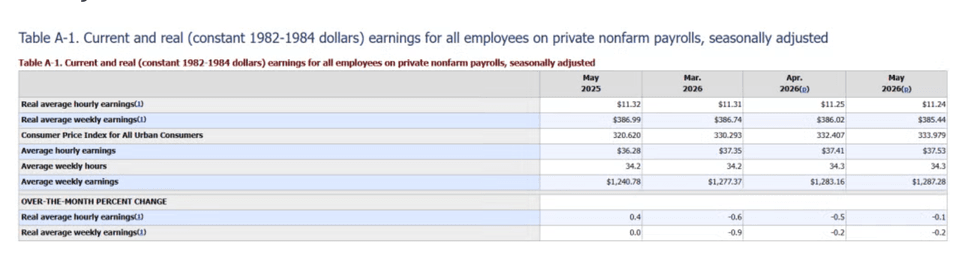
—But we should all be worried about this. It wouldn’t be terrible if inflation settled in at ~3% instead of ~2%, assuming real wages kept up. But if, instead, the businesses, investors, and employers that set the prices of goods, services, labor, and assets think inflation is on a roll, there’s a risk of de-anchoring expectations.

In that case, the little (half-)mountain/foothill above at the end of the cumulative slide could start to look uncomfortably like the bigger 70’s mountain.

Finally, as far as American humans are concerned, as I’ve argued ad nauseum, it’s not so much inflation—the rate of price changes—that’s gotten deeply under their skin. It’s the elevated price levels, which only grow higher whether inflation is at its two percent target or elevated due to shocks or structural shifts. That said, let’s not over-torque on this blazingly insightful insight of mine (that’s self-directed snark, to be clear; “people don’t like high prices” ain’t exactly the stuff of Nobel prizes). Faster inflation pushes the price level up faster, and, as we can observe in real time, that’s pushing our econ vibes from bad to worse.

[1There’s a different interpretation of this that is compelling: it’s not that supply chains broke; it’s that this demand shift required an almost immediate widening of the pipe through which goods flow, and that didn’t happen.]

Jared Bernstein is a former chair of the White House Council of Economic Advisers under President Joe Biden. He is a senior fellow at the Council on Budget and Policy Priorities. Please consider subscribing to his Substack.


Late Night Exposes Trump's Mad Tariff Plan As Mainstream Outlets Fail

Late Night Exposes Trump's Mad Tariff Plan As Mainstream Outlets Fail

A week after Republican presidential nominee Donald Trump proposed restricting food imports when asked how he’d lower the cost of food and groceries, many major newspapers, newswires, and broadcast news programs continue to ignore his proposal, which would lead to higher food prices for American consumers. And while broadcast news programs failed to report on the question and Trump’s long, rambling response, NBC late night host Seth Meyers and CBS late night host Stephen Colbert both highlighted Trump’s incoherence.

During a September 17 town hall in Flint, Michigan, an audience member asked Trump how he would “bring down the cost of food and groceries.” After Trump rambled about unrelated energy prices and Federal Reserve interest rates, he responded:

“We gotta work with our farmers. Our farmers are being decimated right now. They’re being absolutely, absolutely decimated. And you know, one of the reasons is we allow a lot of farm product into our country. We’re gonna have to be a little bit like other countries. We’re not gonna allow so much come — we’re gonna let our farmers go to work.”

Media Matters noted previously that several economists explained that Trump’s proposal would raise food prices, not lower them.

Some national news outlets, including Axios, noted that “Trump’s vow to lower grocery costs will backfire,” and writing in The Atlantic, the Cato Institute’s Scott Lincicome and Sophia Bagley described the folly of “Trump’s deranged plan to lower food prices by raising them.” MSNBC prime-time host Chris Hayes also mentioned Trump’s response to the food price question.

But many of the most prominent and influential major news organizations in the country failed to cover Trump’s comments at all.

Factiva searches turned up no coverage at all from The New York Times, The Washington Post, The Wall Street Journal, The Associated Press, and Reuters between September 17 and noon on September 24.

A SnapStream search of the same time frame also turned up no coverage from the broadcast morning and evening news programming of ABC, CBS, NBC, and PBS, along with the corporate networks’ Sunday political talk shows.

Instead, CBS’ Evening News and PBS' NewsHour covered Trump’s farming-focused September 23 event in Pennsylvania, during which he threatened farm equipment manufacturer John Deere with 200% tariffs.

NBC’s Nightly News and Today covered Trump’s prearranged visit to a Pennsylvania grocery store the same day, where he gave $100 to a potential voter as a campaign stunt (a possible federal crime).

And The Associated Press reported on both September 23 events. These reports, however, failed to mention Trump’s incoherent answer on food prices from the previous week, even though he specifically mentioned that he would restrict imports of “farm product.”

Meanwhile, two of these networks’ late night comedy shows did cover his rambling response.

Both NBC’s Late Night with Seth Meyers and CBS’ Late Night with Stephen Colbert drew attention to the incoherent nature of Trump attempting, and failing, to explain how he would lower food prices, while their networks’ news programs ignored it.

Seth Meyers even helpfully contextualized the actual reason that grocery prices spiked in the wake of the COVID-19 pandemic, highlighting both the incoherence of Trump's rambling response and the ease with which a news network could have informed its viewers about the topic.

Methodology

Media Matters searched print articles in the Factiva database from The New York Times, The Washington Post, The Wall Street Journal, The Associated Press, and Reuters for any of the terms “Trump,” “former president,” “nominee,” or “candidate” within the same headline or paragraphs as any of the terms “food,” “energy,” “interest” or “rate” or any variation of either of the terms “grocery” or “farmer” from September 17, 2024, when GOP presidential nominee Donald Trump answered a question about how he would lower food prices during a Michigan town hall, through noon on September 24, 2024.

We also searched transcripts in the SnapStream video database for all original episodes of ABC's Good Morning America, World News Tonight, and This Week; CBS' Mornings, Evening News, and Face the Nation; NBC's Today, Nightly News, and Meet the Press; and PBS’ NewsHour for for any of the terms “Trump,” “former president,” “nominee,” or “candidate” within close proximity of any of the terms “food,” “energy,” “interest” or “rate” or any variation of either of the terms “grocery” or “farmer” from September 17, 2024, through noon on September 24, 2024.

We included articles, which we defined as instances when Trump’s comments responding to a question about lowering the cost of food were mentioned in the headline or lead paragraphs in any section of the newspaper or newswire.

We also included segments, which we defined as instances when Trump’s comments responding to a question about lowering the cost of food were the stated topic of discussion or when we found significant discussion of the comments. We defined significant discussion as instances when two or more speakers in a multitopic segment discussed the comments with one another.

Reprinted with permission from Media Matters.

Joe Biden

Wake Up And Look At What's Really Happening In The Biden Economy

You may have noticed in recent weeks that alarming headlines about inflation – specifically, those ubiquitous stories about the cost of gasoline, or eggs, or other household goods – have vanished. Media outlets no longer feature those fearsome charts with arrows zooming skyward, or video loops displaying the latest eye-popping gas station signage.

Much as the mainstream media seemed to enjoy scourging President Joe Biden with the bad news about raging hikes in the price of everything, that depressing theme has disappeared because inflation is falling.

In October, what economists describe as “core inflation,” meaning the price of goods and services other than food and energy, declined to 2.0 percent – the target set by the Federal Reserve. And what they understandably call “headline inflation,” the more volatile measure of prices that include all consumer purchases, including groceries and gas, dropped on a monthly level to zero.

Got that? Zero. Year over year, the rise in personal consumption expenditures has plummeted to three percent.

So encouraging were those numbers to the financial sector – and presumably the central bankers at the Federal Reserve – that some now forecast a cut in interest rates. Dropping rates would likely prevent the recession that has been forecast (with glee) by many Republicans – and bring America in for a “soft landing” from the pandemic recovery.

Will Biden get any credit for this improvement? Not from most media organizations, nor from pundits who wrongly blamed him for the inflation spurt in the first place, when they knew that other countries were suffering much worse price increases in the pandemic’s wake. Indeed, too many outlets are barely even noting that inflation has collapsed.

At the same time, the president’s “Bidenomics” program has brought continued steady growth and strong employment, with the annualized gross domestic product topping 5.2 percent in October – and unemployment steady at 3.9 percent. Economists have long tended to view a four percent jobless rate as “full employment,” essentially the best that can be achieved in a capitalist system without spurring inflation. Our current unemployment level is among the lowest in the G-20 industrialized countries.

The reason is so simple that even a wingnut can understand: Under this president, the United States has seen an unsurpassed record of job creation, with 14 million new positions since he took office, far more than the last three Republican presidents combined. The social impact of high employment is profound, which is why traditional Democrats like Biden consistently promote infrastructure, education, environmental, and income support policies that boost jobs. As California Democratic Gov. Gavin Newsom explained during this week’s Fox News debate with Republican Gov. Ron DeSantis (whom he crushed), the nation is now seeing the lowest rate of poverty in our history, as employment among Blacks, Hispanics, and women have reached new peaks.

Are you starting to see a fuller picture here? Let’s add a few more features: Personal income rose over five percent in the first quarter of this year and contined to go up into the second and third quarters. Consumer spending rose 3.6 percent, while housing investment increased to 6.2 percent, almost half again what had been predicted.

You may well retort that polling consistently shows – and the media persistently emphasize – that most Americans say they are unhappy with the economy and blame the president, resulting in poor approval ratings and endangering Biden’s reelection prospects. And that’s undeniably true, as far as it goes. But more than one expert now wonders why, if so many of our neighbors feel pessimistic and even angry, they keep buying stuff as if everything is working out just fine.

Economist Dean Baker suspects the influence of slanted news coverage and can imagine a very different political scenario. “If we had the exact same economy, and Donald Trump was in the White House,” Baker says,”Trump would be endlessly saying ‘greatest economy ever.’ Every Republican politician in the country would be amplifying the claim and all the political pundits would be writing that the strong economy will make Trump almost a sure bet for re-election.”

Sooner or later, the majority of Americans will wake up and realize that Joe Biden has not only protected us from recession but has created the conditions for a generation of prosperity. Let’s hope they figure that out before it is too late – and vote to defend the future from Trump’s madness.

The Sudden And Remarkable Resurgence Of 'Sleepy Joe' Biden

The Sudden And Remarkable Resurgence Of 'Sleepy Joe' Biden

Meanwhile, back at the ranch…

To readers of a certain age who grew up watching cowboy movies on TV, that timeless phrase signals a major plot development. Maybe the scheming rancher with the mustache is ordering his henchmen to saddle up. Alternately, a hero in a white hat may be entering the fray.

Either way, somebody’s about to get a surprise.

Sometimes politics works that way too.

One year ago, I posted the following on my Facebook page: “Regarding Biden's speech about the Afghan collapse: I haven't seen such passionate unanimity among the DC commentariat since they went all-in on the absolute necessity of invading Iraq.”

Pretty much from that day, Joe Biden has been depicted in the national political press as the proverbial Dead Man Walking. “Sleepy Joe” as Donald Trump dubbed him, was headed for a mid-term shellacking.

Come November 8, 2022, resurgent Republicans would take over both houses of Congress and spend the remaining two years of Biden’s futile presidency investigating his troubled son, Hunter. Maybe Hillary Clinton too.

In retrospect, the Afghan retreat wasn’t such a catastrophe after all. After Trump surrendered to the Taliban, agreeing to leave Afghanistan without consulting its U.S.-backed government, the die was cast. Biden either needed to re-escalate or get out fast. One thing you won’t hear today is anybody keen to go back in. It’s both unthinkable and un-thought.

Then came sky-high gas prices and commodity inflation, making the president’s political future look dim. No matter which channel you watched, every TV news broadcast featured somebody griping at a gas pump or bitching about expensive eggs. On supposedly liberal CNN, Wolf Blitzer practically snarled “inflation” at every Democrat he interviewed.

And it was all Biden’s fault, particularly the parts he had absolutely no control over, such as the worldwide price of crude oil.

Let’s Go, Brandon.

Back at the ranch, however, Brandon got going. Or something. Due to additional circumstances beyond the U.S. president’s control, such as China’s sputtering economy, oil prices --and with them the cost of gasoline -- began to drop. And largely due to actions by the Federal Reserve, also outside Biden’s jurisdiction, inflation began to level off.

Syndicated columnist Froma Harrop noticed the supposedly liberal New York Times—sometimes I think that should be the newspaper’s official name—giving the president grudging praise: “Slowing inflation gave Biden a reprieve but high prices remain a political problem."

Still high, yes, but moving in the right direction.

Job growth, meanwhile, remained strong. Fully 500,000 Americans found new jobs last month. The news media started to notice that the national unemployment rate had reached a 50-year low. With gas prices dropping, how long before Americans noticed that the U.S. economy is actually quite strong? In politics, momentum counts.

And then came the Supreme Court’s decision overturning Roe v. Wade, essentially ruling that citizens in different states have different constitutional rights, and that women have fewer of them than men. Kansas voters turned out in record numbers to show what middle America thought of that—an electoral thunderbolt that imperils far-right Republicans.

“The situation has changed with astonishing speed," wrote New York Magazine’s Jonathan Chait. “In the span of a few weeks, Biden’s presidency is back from the dead and looking something close to triumphant.”

Even before the Democrats’ recent extraordinary legislative achievements —the Inflation Reduction Act, enacting higher taxes on profitable corporations, enabling Medicare to bargain down drug prices, giving the IRS resources to pursue wealthy tax cheats, and boosting green energy while supporting fossil fuel production in the meantime—polls had begun to show a marked shift in the Democrats’ direction.

Yes, a lot of it’s due to Sen. Joe Manchin’s extraordinary change of heart, but it was old Sleepy Joe who urged Democrats to understand where the West Virginian was coming from. Many progressive Democrats wanted to purge him. Fat lot of good that would have done.

Democrats have even gained a lead over Republicans nationwide in the so-called “generic ballot” asking voters which party they’re inclined to support in congressional elections. As the Washington Post’s Dana Millbank points out, it’s “the first time in the modern era" that “momentum has shifted toward an incumbent president’s party at this point in a midterm election year.”

Of course, polls are only polls, and anything can happen between now and November. The Biden administration has also gotten a lot of help from Republicans. Whatever possessed GOP Senators to vote against health care for veterans sickened by military “burn pits?” Or to kill legislation capping the price of insulin for diabetics?

Then there’s Old Unreliable, Donald J. Trump forcing himself into the spotlight again, the spittle-flecked face of Republican rage. So, what’ll it be, America? Steady Old Good-Government Joe or the Sideshow Ape Man, hooting and flinging feces?

America made this choice once, and decisively.

Must we really do it again?

Shop our Store

Headlines

Editor's Blog

Corona Virus

Trending

World