Tag: iran hawks
Iran Hawks Must Confront The Catastrophic Failure Of Trump's Leadership

Iran Hawks Must Confront The Catastrophic Failure Of Trump's Leadership

I am an Iran hardliner. But I'm struggling to understand how other hardliners can be so credulous about President Donald Trump's leadership of this war. It's as if you were stranded by the side of the road and accepted a ride from an obviously drunk driver.

Earlier this month, the Wall Street Journal editorial board scolded those of us who were not cheerleading for this war: "There's remarkable pessimism in the media and political class about the U.S. bombing campaign against the terrorist regime in Iran. Five days into the war, you'd think from the coverage and commentary that the U.S. is losing."

In the weeks since, the Journal, along with other unreconstructed hawks, has worried that Trump may not "finish the job" and have chided doubters by reminding us of the many depredations perpetrated by Teheran.

But here's the problem with the hawks' posture: You cannot separate the war from the people directing it.

Trump fans believe he always has a plan — that if he threatens, cajoles, or pivots, it's a sign of his unique ability to keep others off balance. To me, it looks like he's the one who's off balance. How do they account for Trump's pronouncements early in this now monthlong war that it was "won in the first hour"? Do they recall Trump's proclamation on March 6 that he would accept only "unconditional surrender"? What about the demand, five days into the conflict, that Trump have a say in choosing Iran's next leader? Did all of that suggest the smooth unfurling of a master plan or clear evidence that he expected a quick and decisive toppling of the regime and was surprised by reality?

The Iran hawks stress that the regime is one of the most dangerous and repressive on the planet and note that the region and the world would be so much better off without the mullahs in charge. Yes. But: Where is the evidence that a bombing campaign led by an impulsive narcissist can achieve that goal? Was there a Plan B if the bombing failed to ignite a popular uprising? How confident can we really be that Iran will, in the long term, be less dangerous, less hostile to the United States and Israel, less likely to support terrorism, less brutal to its own people thanks to Trump's "excursion"?

One of Trump's throughlines is the belief that other leaders and specifically his predecessors have failed to achieve goals due to "stupidity" and lack of will. Enraptured by America's military might, he imagines that threatening it and using it are the skeleton keys to pick any lock. There are no complex challenges requiring subtlety and discretion. There is no understanding that not every problem can be solved through the application of force. He disdains expertise, preferring to surround himself with lickspittles who bring only good news.

And when reality intrudes, as it did when his 2017 inauguration crowds were smaller than Obama's, or the COVID pandemic was not less harmful than the flu, or he lost the 2020 election, he chooses to believe lies and to insist that everyone else assent to the lies as well. Lies are his pacifier. When such a toddler is calling the shots in a war, it's acutely dangerous.

What Trump should be learning (though he isn't) is that previous presidents refrained from attacking Iran not out of fecklessness but because they weighed the risks. Yes, Iran is a weaker nation militarily than the United States (or even Israel), but it happens to own the high ground above the Strait of Hormuz.

Days into the war, Trump crowed that Iran had "no navy." But even as Trump spoke, Iran was in the process of disabling the Strait of Hormuz through the use of drones and fastboats and threatening to mine it. Meanwhile, they are charging a hefty toll for the ships they allow to pass, a new revenue stream for the regime.

Because Trump pulled the trigger without securing political or popular support, without allies (save one) and without considering how much damage to the world economy Iran could inflict, he is highly vulnerable to economic pain, and the Iranians know it. That's their asymmetric advantage. As a military matter, it doesn't matter that they have no navy. They don't have to hit a single ship in the strait. Their threats are hitting the insurance companies, and that's enough.

A large share of the world's supply of not just oil and gas but also helium, fertilizer and other chemicals now relies largely on the Iranian regime. We teeter on the edge of a worldwide recession and widespread hunger. Yet we are being led in this war by a fantasist who does not assimilate reality. "Trump is getting a little bored with Iran," an administration official indicated last week. "Not that he regrets it or something — he's just bored and wants to move on."

It's impossible to say which is more alarming, Trump's inattention or his engagement.

Mona Charen is policy editor of The Bulwark and host of the "Beg to Differ" podcast. Her new book, Hard Right: The GOP's Drift Toward Extremism, is available now.

Reprinted with permission from Creators

'Draft Lindsey Graham!' MAGA War Opponents Troll America's Loudest Hawk

'Draft Lindsey Graham!' MAGA War Opponents Troll America's Loudest Hawk

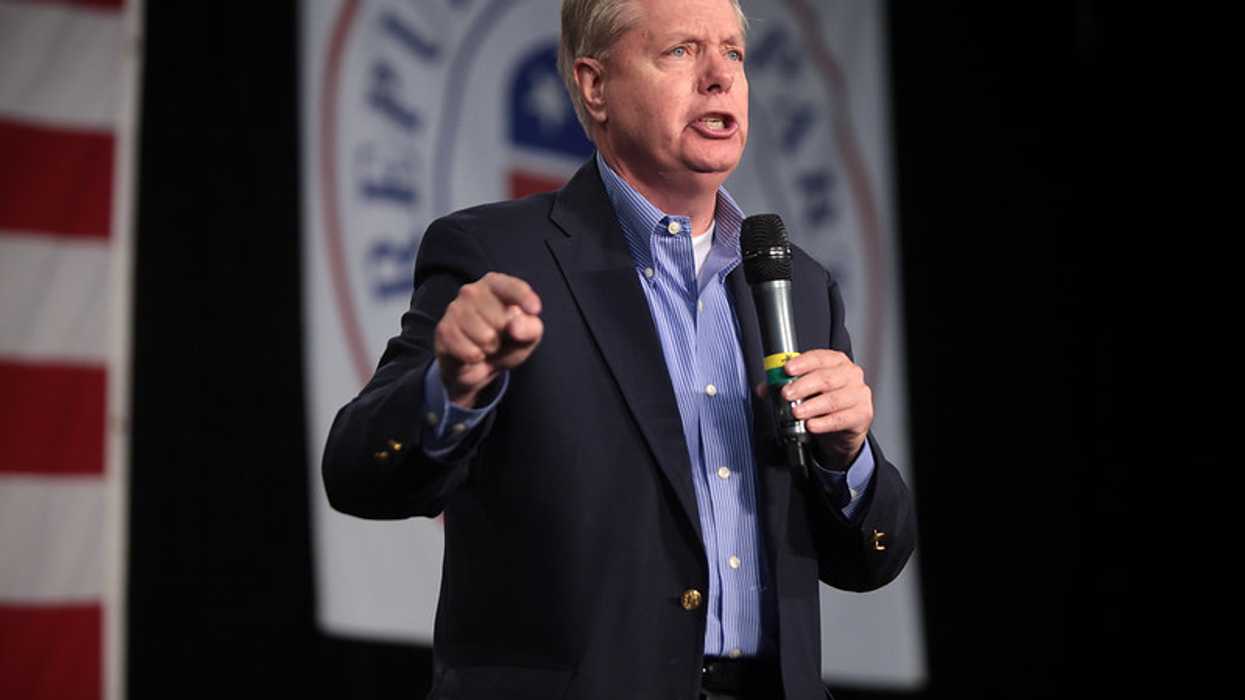
Conservative Sen. Lindsey Graham (R-SC) is not only a supporter of President Donald Trump's war against Iran — he also favors an expansion of U.S. troops in that conflict. But he is getting some pushback from other parts of the right.

In Montana, Tom Jandron, a Libertarian candidate running for the U.S. Senate, proposes subjecting the 70-year-old Graham to the military draft. Jandron, in a March 25 post on X, formerly Twitter, wrote, "I'm running for US Senate. If elected, the first bill I introduce will draft Lindsey Graham into any conflict he publicly supports while in office."

Republican opponents of the Iran war are speaking out against Graham as well.

On X, Rep. Nancy Mace (R-SC), tweeted, "Washington's war machine is hard at work. They are try to drag us into Iran to make it another Iraq. We can't let them."

The Hill's Sarah Fortinsky, in an article published on March 30, reports, "Graham, a longtime war hawk and close Trump ally, has drawn sharp criticism in recent weeks from fellow Republicans for urging the administration to ramp up military pressure on Iran and send more troops overseas…. Earlier this month, in an interview on Fox News' 'Hannity,' Graham floated sending more troops overseas as he urged U.S. allies in the Middle East to step up support."

Graham's "longstanding support for overthrowing the Iranian regime," according to Fortinsky, has "fueled backlash among an anti-interventionist wing of the GOP that is wary of a widening conflict and the scope of Graham's influence over Trump Administration policy."

On social media, GOP activist Meghan McCain — the late Sen. John McCain's (R-AZ) daughter — said of Graham, "Nothing like a single, childless, septuagenarian telling American mothers to send their children to go possibly die in a war."

On X, Rep. Anna Paulina Luna (R-FL) posted, "There are some in the Senate that advocate for war everywhere. Lindsey Graham is one of them. He does NOT tell the President what to do, nor does he control Congress. I have spoken with the administration a number of times, as well as other members of Congress over the last week or so, and nothing has changed regarding boots on the ground."

Luna also wrote that there should be "NO BOOTS on the ground" in Iran and that if Graham "wants to go fight in a foreign conflict, let him be the first to volunteer."

Reprinted with permission from Alternet


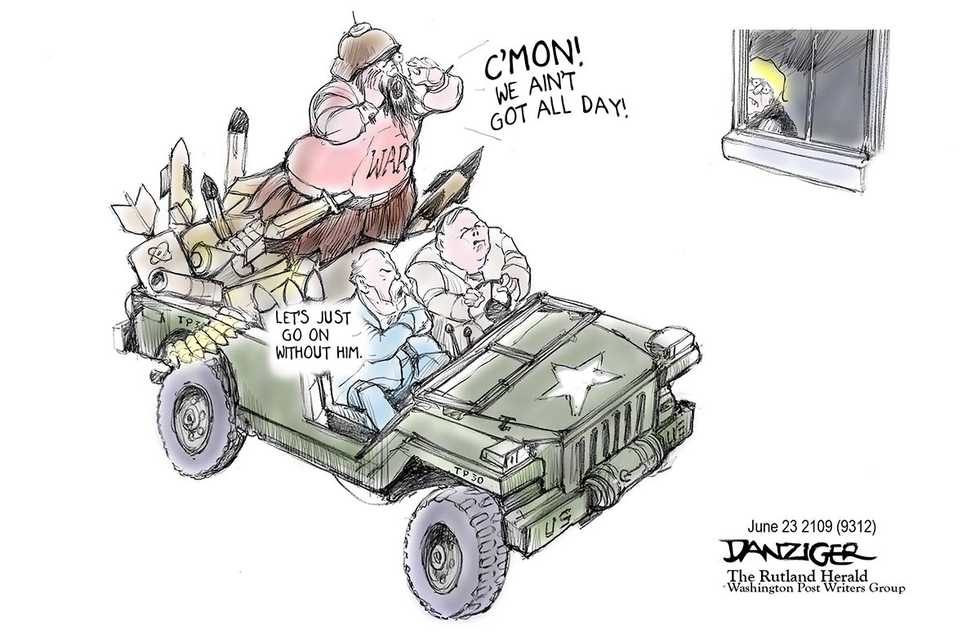
Danziger: War Of Nerves

Danziger: War Of Nerves

Jeff Danziger lives in New York City. He is represented by CWS Syndicate and the Washington Post Writers Group. He is the recipient of the Herblock Prize and the Thomas Nast (Landau) Prize. He served in the US Army in Vietnam and was awarded the Bronze Star and the Air Medal. He has published eleven books of cartoons and one novel. Visit him at DanzigerCartoons.com.

The $259 Million Incentive For Trump To Bomb Iran

The $259 Million Incentive For Trump To Bomb Iran

Reprinted with permission from LobeLog.

On Thursday, the United States came perilously close to a military confrontation with Iran after it downed a U.S. drone that may or may not have entered the country’s air space. President Donald Trump reportedly ordered a retaliatory military strike on Iran but called it off, according to Trump’s own tweets on Friday morning, because a general told him that “150 people” might die in the strike.

Much analysis of Trump’s slide toward war with Iran has focused on his hawkish national security adviser, John Bolton, who, reportedly requested options from the Pentagon to deploy as many as 120,000 troops to the Middle East and hit Iran with 500 missiles per day. Bolton is the loudest voice inside the White House pushing for a military escalation to the administration’s “maximum pressure” strategy.

Secretary of State Mike Pompeo, for his part, is staking out the position that the 2001 Authorization for Use of Military Force allows the administration to take military action against Iran without congressional approval, an unusual and broadly criticized interpretation of congressional oversight.

Yet, there’s another omnipresent influence on Trump: $259 million given by some of the GOP’s top supporters to boost his campaign in 2016 and support Republican congressional and senate campaigns in 2016 and 2018.

Those funds  came from Sheldon and Miriam Adelson, Paul Singer and Bernard Marcus, donors who have made no secret, both through public statements and funding think tanks that support military action against Iran, of their desire for the United States to destroy the Islamic Republic.

Adelson, who alongside his wife Miriam are the biggest donors to Trump and the GOP, contributed $205 million to Republicans in the past two political cycles and reportedly sent $35 million to the Future 45 Super PAC that supported Trump’s presidential bid. His role as the biggest funder of Republican House and Senate campaigns makes him a vital ally for Trump—who relied on Adelson’s campaign donations to maintain a Republican majority in the Senate and curb Republican losses in the House in the 2018 midterm election—and any Republican seeking national office.

Adelson publicly suggested using nuclear weapons against Iran and pushed for Trump to replace then-national security adviser H.R. McMaster with Bolton, partly due to the former’s perceived unwillingness to take a harder line on Iran. In 2017, the Zionist Organization of America, which receives much of its funding from the Adelsons, led a public campaign against McMaster, accusing him of being “opposed to President Trump’s basic policy positions on Israel, Iran, and Islamist terror.”

In 2015, Trump mocked his primary opponent, Sen. Marco Rubio (R-FL), for seeking Adelson’s financial support, warning that Adelson expects a degree of control over candidates in exchange for campaign contributions. Trump tweeted:

Sheldon Adelson is looking to give big dollars to Rubio because he feels he can mold him into his perfect little puppet. I agree!

And Adelson isn’t alone.

Billionaire Home Depot co-founder Bernard Marcus is the second largest contributor to Trump’s campaign, providing $7 million. He also champions John Bolton, contributing $530,000 to John Bolton’s super PAC over its lifetime. And he’s a major contributor to GOP campaigns, contributing over $13 million to Trump’s presidential campaign and GOP congressional campaigns in 2016 and nearly $8 million to GOP midterm efforts in 2018.

Marcus, like Adelson, makes no qualms about his views on Iran, which he characterized as “the devil” in a 2015 Fox Business interview.

Unlike Adelson and Marcus, hedge fund billionaire Paul Singer was a “never Trump” conservative until Trump won the election. Then he donated $1 million to Trump’s inauguration. Singer is far more careful with his words than Marcus and Singer, but his money supports some of the most hawkish think tank experts and politicians in Washington.

Singer, alongside Marcus and Adelson, has contributed generously to the hawkish Foundation for Defense of Democracies, whose experts have spent the past decade regularly promoting policies to pressure Iran economically and militarily, including most recently Trump’s “maximum pressure” approach.

According to donor rolls of FDD’s biggest supporters by the end of 2011, a year that saw a sharp rise in tensions and rumors of war by Israel against Iran, Adelson contributed $1.5 million, Paul Singer contributed $3.6 million, and Bernard Marcus, who sits on FDD’s board, contributed $10.7 million.

(FDD says that Adelson is no longer a contributor, but Marcus continues to give generously, contributing $3.63 million in 2017, over a quarter of FDD’s contributions that year.)

Employees of Singer’s firm, Elliott Management, were the second largest source of funds for the 2014 candidacy of the Senate’s most outspoken Iran hawk, Sen. Tom Cotton (R-AR), who urged Trump to conduct a “retaliatory strike” against Iran for purportedly attacking two commercial tankers last week.

Singer donated $26 million to Republicans in the 2016 election and $6.4 million to the GOP’s midterm campaigns.

The billionaire Iran hawks—the Adelsons, Singer, and Marcus—made combined donations of over $259 million to GOP politicians in the past two cycles, making them some of the Republican Party’s most important donors. That quarter-billion-dollars doesn’t include contributions to dark money 501c4 groups and donations to 501c3 nonprofits, such as think tanks like FDD.

News coverage of Trump’s slide toward war frames the discussion as a competition between his better instincts and a national security advisor and secretary of state who, to varying degrees, favor military action.

But the $259 million that helped elect Trump and Trump-friendly Republicans must loom large over the president.

As Trump evaluates his options with Iran and turns his attention to the 2020 election, he knows he’ll need to rely on the Adelsons, Singer, and Marcus to boost his campaign, maintain a narrow majority in the Senate, and attempt a take-back of the House.

These donors have made their policy preferences on Iran plainly known. They surely expect a return on their investment in Trump’s GOP.

Eli Clifton reports on money in politics and US foreign policy. He previously reported for the American Independent News Network, ThinkProgress, and Inter Press Service.

Shop our Store

Headlines

Editor's Blog

Corona Virus

Trending

World