Tag: supreme court vacancy
Republicans Signaling Fear That Midterm Will End Their House And Senate Majorities

Republicans Signaling Fear That Midterm Will End Their House And Senate Majorities

Republicans have expressed fears both publicly and privately that their congressional majorities are in serious danger in November, as voters angry with President Donald Trump’s war in Iran and the fact that it’s making life even more unaffordable in the United States threaten to punish the GOP at the ballot box.

But now they have moved on from merely talking about those fears to taking concrete steps that make it clear they know their prospects are dire and that they are on track to lose control of not just the House but the Senate, too.

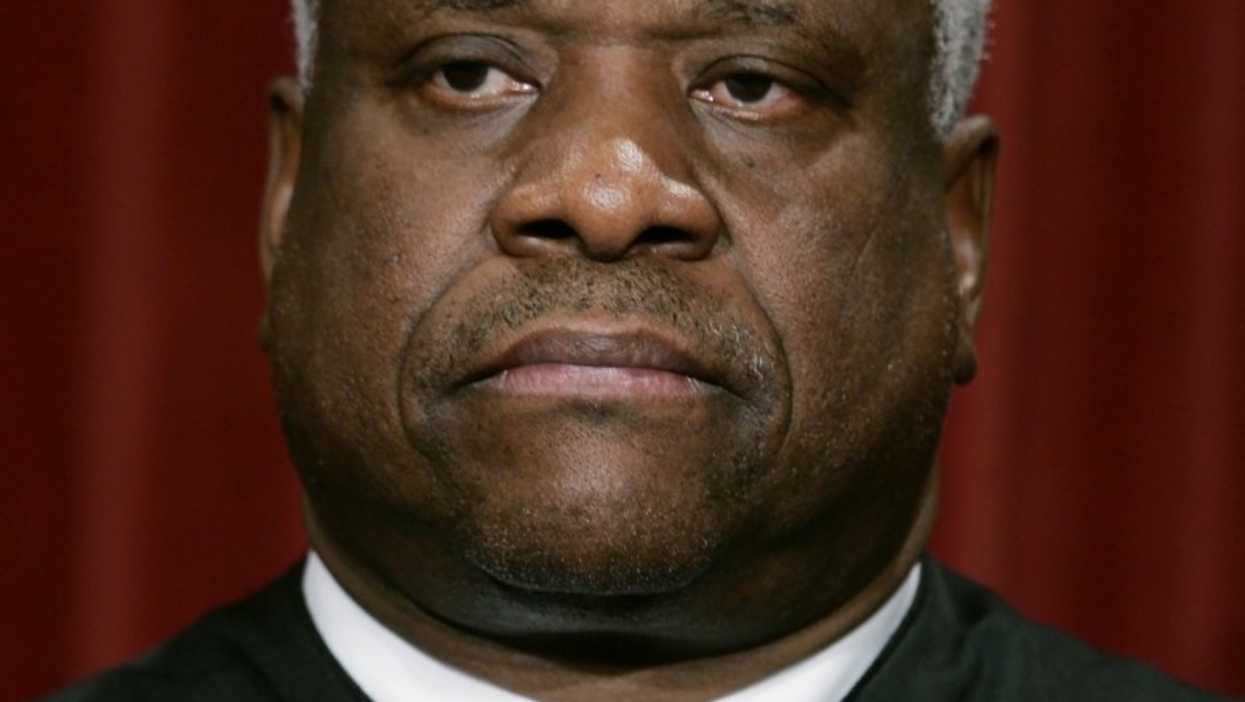
On Tuesday, Senate Majority Leader John Thune said he is taking steps to ensure that Republicans will be ready to replace Supreme Court justice Samuel Alito should he choose to retire this summer, giving a little hint-hint to the 76-year-old with a lifetime appointment who was recently hospitalized with an unspecified illness.

“That’s a contingency I think around here you always have to be prepared for. And if that were to happen, yes, we would be prepared to confirm,” Thune told a reporter from the Washington Examiner.

Even Trump himself brought up the possibility of Alito, as well as famously corrupt Justice Clarence Thomas, retiring before the midterms, telling Fox Business’ Maria Bartiromo on Tuesday that the late Ruth Bader Ginsburg made a mistake by not retiring earlier because he got to fill her seat on the nation’s highest court.

“She decided that she was going to live forever, and about two minutes after the election, she went out, and I got to appoint somebody,” Trump told Bartiromo, in what sounded like yet another nudge at Alito and Thomas.

Indeed, pushing out an aging Supreme Court justice before the midterms is a massive tell that Republicans are worried they will lose the Senate majority, and thus their ability to confirm Trump’s judicial nominees. (It’s also wildly hypocritical, as now-former Senate Majority Leader Mitch McConnell stole a Supreme Court seat by claiming the vacancy came too close to an election, but I digress.)

Back in January, political analyst Jacob Rubashkin, deputy editor of the nonpartisan political handicapping outlet Inside Elections, said that this very situation would be a tell that Republicans were scared of losing the Senate.

“We’re still a ways away from this so keep it saved in your bookmarks, but one way we will know if Republicans become truly concerned about losing the Senate is if there’s chatter or even pressure on Thomas and/or Alito to retire this summer,” Rubashkin wrote in a post on January 6.

Welp …

Meanwhile on Tuesday, Punchbowl News reported that Florida GOP Gov. Ron DeSantis is getting cold feet about rigging—uh, sorry, redrawing -- his state’s congressional map.

While the Trump lackey was previously bullish that Republicans could extract as many as five more House seats in the state, DeSantis is now worried that the midterm environment—including shifts in Florida—will be so bad for Republicans that creating more nominally Republican seats could actually backfire. Spreading out GOP voters could turn Florida’s map into a dummymander—a political term that means an intended gerrymander actually winds up benefitting the other party.

What’s more, Republicans are sending Vice President JD Vance to campaign in Iowa, yet another sign that this otherwise reliably Republican area is slipping away from the GOP as Trump’s tariffs and war in Iran decimate the agricultural backbone of the state. Iowa was also the first state Trump himself traveled to on his midterm campaign tour.If Republicans are having to campaign in a state Trump carried by double digits in 2024, they are in some serious doo doo this fall.

Of course, sending Vance to campaign for vulnerable Republicans is likely not the best idea, as he’s not only unpopular but has also turned out to be bad luck for other candidates he’s stumped for.

Yet desperate times call for desperate measures.

So the midterms are shaping up to be a disaster for the GOP? Good.
Reprinted with permission from Daily Kos

Poll: Americans Reject Senate Republican Assault On Judge Jackson

Poll: Americans Reject Senate Republican Assault On Judge Jackson

If you watched any of the Supreme Court hearings for Ketanji Brown Jackson and found yourself repulsed by Republicans, you weren't alone. In a Quinnipiac University poll released late last week, 52 percent of Americans disapproved of the way GOP senators were handling the historic confirmation process for Judge Jackson's nomination, while just 27 percent approved of it (21 percent didn't offer an opinion).

In contrast, a 42 percent plurality of Americans approved of the way Democrats handled the process, while 34 percent disapproved (23 percent offered no opinion).

Americans also support confirming Jackson to the high court 51 percent to 30 percent, according to the poll.

As The Washington Post's Aaron Blake pointed out, Republicans fared worse in their handling of Jackson's confirmation than Democrats did in their handling of the contentious hearings for Brett Kavanaugh—who faced a credible sexual assault allegation amid his confirmation.

Republicans received a 25-point net negative rating from the public (27 percent--52 percent) for the way they comported themselves during Jackson's process, while a CNN/SSRS poll in October 2018 found Democrats received a 20-point net negative rating from the public (36 percent--56 percent) during the Kavanaugh confirmation.

The public also opposed confirming Kavanaugh by 51 percent--41 percent. In fact, the place where Kavanaugh really excelled with the public was in the 33 percent who held a "very negative" view of him. For comparison, eight percent of Americans had a very negative view of Neil Gorsuch and seven percent held a very negative view of John Roberts in CNN polls during confirmation for the two eventual justices.

In any case, the main differences between the Jackson and Kavanaugh confirmations is the fact Jackson is substantially more popular and that during consideration of Kavanaugh, neither party fared particularly well in the public's estimation of their handling of the confirmation process. In fact, Republicans also received a 20-point net negative rating from Americans—35 percent--55 percent—for the way they handled Kavanaugh's confirmation, whereas Democrats won plurality support for their handling of Jackson’s confirmation.

But Republicans clearly aren't concerned one bit that a majority of Americans disapprove of the way they conducted themselves during consideration of a nominee who will likely become the Supreme Court's first Black female justice. In fact, Senate Minority Leader Mitch McConnell is currently pressuring his caucus to vote against Judge Jackson’s confirmation.

The only audience Republicans ever really care about—particularly in a pre-midterm environment—is the 27 percent who said they approved of how the GOP has handled the Jackson hearings. It's always about juicing the base for Republicans, who continue to be out of step with the majority of Americans on most issues concerning voters. But it's who shows up at the polls that matters, and Republicans will continue to ignore American majorities as long as they don't face any real electoral consequences for their extreme positions.

Reprinted with permission from Daily Kos

Supreme Court Won’t Comment On Hospitalized Justice Thomas

Supreme Court Won’t Comment On Hospitalized Justice Thomas

U.S. Supreme Court Justice Clarence Thomas entered the hospital last Friday, yet the court’s spokesperson is refusing to state whether or not the 73-year old conservative jurist remains hospitalized. On Sunday the Court first revealed Thomas had entered the hospital two days earlier but said he was expected to be released “in a day or two.”

According to a statement from the court, Justice Thomas was admitted with “flu-like symptoms,” which were described as an “infection.” He allegedly had not contracted COVID-19.

Yet by Wednesday, after being hospitalized for five days, “court spokeswoman Patricia McCabe said she had no update to provide,” the Associated Press reports, noting the high court “won’t say” if he remains in the hospital.

Thomas missed the third day of arguments Wednesday and did not participate virtually.

DeSantis spokesperson Christina Pushaw Wednesday afternoon urged prayers for the far right-wing jurist:

Reprinted with permission from Alternet

supreme court

Spreading Hate — And Hypocrisy — On Biden’s Supreme Court Choice

With Justice Stephen Bryer announcing his retirement, President Joe Biden is set to nominate a new justice, and the White House has reaffirmed his campaign promise in 2020 to nominate the first Black woman to the court. Going forward, there is a long list of judges in respected positions currently under public scrutiny.

Meanwhile, conservatives are now treating Biden’s campaign promise like an unprecedented affront against the country — while engaging in plenty of blatantly racist and misogynist rhetoric — even though it was nearly identical to a campaign pledge made by Ronald Reagan in 1980.

Biden isn’t the first president to have made such a promise

At a Democratic primary debate in South Carolina in February 2020, Biden said: “I'm looking forward to making sure there's a black woman on the Supreme Court, to make sure we in fact get every representation.” Biden further reiterated at another debate in March 2020: “I committed that if I'm elected president, have an opportunity to appoint someone to the courts, will be — I'll appoint the first black woman to the courts. It's required that they have representation now. It's long overdue.”

But nearly 40 years before, in the closing weeks of the 1980 presidential campaign, Republican nominee Ronald Reagan made a direct promise that he would nominate a woman to “one of the first Supreme Court vacancies in my administration,” saying that it was “time for a woman to sit among our highest jurists.”

The Washington Post reported at the time that while Reagan said he opposed “tokenism and false quotas,” he further added: “I am also acutely aware, however, that within the guidelines of excellence, appointments can carry enormous symbolic significance. This permits us to guide by example — to show how deep our commitment is and to give meaning to what we profess.”

Reagan kept that promise at the very first opportunity he got, nominating Sandra Day O’Connor in 1981 to be the first woman to sit on the court.

Conservatives now call Biden’s pledge “discrimination,” “unconstitutional,” and even “tribal warfare”

Early on Wednesday afternoon, in a conversation with law professor and Fox News contributor Jonathan Turley, Fox anchor Harris Faulkner suggested that Biden’s campaign pledge was “discrimination.”

Turley then published a guest column that evening in Fox News’ corporate cousin The Wall Street Journal, claiming that this Supreme Court nomination would be “different from any in history” due to Biden’s promise to nominate a Black woman. He also alleged that the presence of such a justice on the court would set up a historically “jarring” moment in the court’s proceedings:

Mr. Biden is now going to create one of the more jarring and incongruous moments in the history of the Supreme Court. This fall, in the Harvard and University of North Carolina cases, the justices will hear arguments that the use of race in admissions is unlawful discrimination. One of them will have gained her seat in part through exclusionary criteria of race and sex.

National Review also furnished some concern-trolling that afternoon, its editorial bemoaning that Biden had “disqualified dozens of liberal and progressive jurists for no reason other than their race and gender.”

On Wednesday night, Fox prime-time host Tucker Carlson alleged that Biden’s pledge for the Supreme Court nomination was equivalent to “giving up the spoils like carrot cake.” He further added, very ominously: “You can see where this is going. It always goes there — identity politics always ends with tribal warfare. It's funny the Biden people can't see that. Maybe they can see it and don't care or maybe it is the entire point of the exercise.”

Fox host Sean Hannity repeatedly questioned whether Biden’s pledge to nominate a Black woman was even constitutional. Alan Dershowitz and others made similar claims.

Fox Business anchor Maria Bartiromo declared Thursday morning: “What kind of qualification is that, being a Black woman? I mean is this our standards now, in terms of the highest court in the land?”

Turley appeared Thursday morning on Fox’s America’s Newsroom, during which co-anchor Dana Perino read a section from his Wall Street Journal column. Turley, at his own initiative, attempted to delineate the “subtle difference” between Biden’s promise in 2020, versus Reagan’s campaign promise in 1980 to nominate a woman to “one of the first Supreme Court vacancies” — claiming that Reagan “didn’t say he would only consider a woman.”


DANA PERINO (CO-ANCHOR): In your Wall Street Journal column today, though, you wrote this. “A college couldn't get away with Biden's high court criteria. His promise to appoint only a Black woman is the kind of quota the justices rejected in,” I believe it’s “ Bakke.” Tell me more about that.

JONATHAN TURLEY (FOX NEWS CONTRIBUTOR): Well, it's a great irony in that you’re admitting someone to the court based on an admission standard that the court itself has banned for schools. And indeed, the court just took two racial preference cases to add to its docket. So, those cases will be heard by a justice who was initially selected through the very type of racial preference rule. But in this case, it wasn't a preference rule — President Biden said he would not consider anyone who was not female or African American. That would not be allowed for a private company or a university.

Now, this may seem like a subtle difference. I mean, presidents like Ronald Reagan said that he wanted to put a woman on the court. But he said that he wanted to put a woman in one of his first vacancies, and he didn't say that he would only consider a woman. Ultimately, he did in fact select O’Connor — and Sandra Day O’Connor very much was a short list of one. So, the important thing here is just that presidents can emphasize diversity as an element the same way as universities can. But they don't go as far as Biden did, usually, and say, well, I'm not going to consider anyone who is male or not African American.

With or without a campaign pledge, the right would attack Biden’s pick as somehow being “lesser”

On Thursday, The Daily Wire’s Ben Shapiro claimed: “They can overtly discriminate against people, which is really an amazing shift. By the way, it’s an amazing tonal shift in American politics. You wouldn’t have heard [President] Bill Clinton doing this in the ‘90s — you just wouldn’t have.” (In fact, Clinton promised in his 1992 campaign that his administration would be diverse and “look like America.”)


Shapiro further claimed that the “more amazing thing” was that Biden didn’t have to make the campaign pledge: “He didn’t have to say it in 2020. He could’ve just selected a Black woman. He would’ve gotten the same credit.”

In fact, it is easy to prove that Biden would not have gotten the “same credit” for simply nominating a Black woman in the absence of any prior pledge. Ilya Shapiro of the Cato Institute, in a now-deleted set of tweets, claimed that “we’ll get a lesser black woman” on the Supreme Court while there are other more deserving candidates and that Biden’s nominee “will always have an asterisk attached.”

In fact, as Slate writer Mark Joseph Stern pointed out, Ilya Shapiro had previously written a piece for CNN in 2009 lambasting then-President Barack Obama’s first Supreme Court nomination: “In picking Sonia Sotomayor, President Obama has confirmed that identity politics matter to him more than merit. While Judge Sotomayor exemplifies the American Dream, she would not have even been on the shortlist if she were not Hispanic.”

In that instance, Obama had never made any similar pledge to nominate a Latina to the Supreme Court. But the right-wing ire rained down just the same. This entire narrative is based on the assumption that representation and merit are antithetical to each other — and that such a nomination is always in some way “lesser.”

Reprinted with permission from Media Matters

Shop our Store

Headlines

Editor's Blog

Corona Virus

Trending

World