Innovator In Grift: 'Trump Is The Picasso Of Corruption'
Trayon White, a member of the city council in the District of Columbia, just walked away from a hung jury in a bribery trial. The facts were kind of wild. Though White admitted to accepting $35,000 in cash from a city contractor (who turned out to be an FBI informant), and the prosecution presented evidence that he tucked white envelopes full of bills totaling between $5,000 and $15,000 into his jacket pocket on several occasions, the jury was deadlocked. Whatever. Juries are unpredictable.
The point is, this run-of-the-mill public corruption case got prosecuted in a D.C. courtroom when, just a few blocks away, the president of the United States is accepting bribes and favors that dwarf anything White could even dream of.
Journalists love expressions like "the most corrupt since Watergate" or the "worst official corruption since Teapot Dome." The trouble with those formulations is that they suggest that Watergate and Teapot Dome are the standards against which wrongdoing should be judged. If what we're seeing now is only the "worst since," then it means it isn't quite to that level. The truth is that nothing — no scandal, no graft in American history — comes remotely close to the level of corruption the Trump administration is perpetrating.
Every single day brings news of some flagrant conflict of interest, bribe, emolument, kickback, fraud or theft. Most of it involves Trump himself and his family. But just as a fish rots from the head, Trump's example has contaminated his administration. A glance at this week's papers reveals that former Homeland Security Secretary Kristi Noem, before she left office, finalized a government purchase of several aging Boeing jets from one of her campaign donors, paying way above market value. There's another ongoing probe of a Noem hire who was reportedly paid $19,000 a week.
When she wasn't busy slandering Renee Good as a "domestic terrorist" or posing in front of men locked up in El Salvador's CECOT megaprison, Noem was reportedly awarding no-bid contracts to cronies for a $220 million ad campaign that featured her on horseback at Mount Rushmore, among other things. Contracts totaling $143 million were allegedly given to an entity that was incorporated only 11 days before the solicitation.
The role of Corey Lewandowski seems totally on the up and up: He was, in effect, Noem's deputy, yet took no salary for nearly two years' work during a time when he was widely believed to be her romantic partner. A number of executives complained to the White House that they were being asked to funnel funds to Lewandowski's entities.
Everywhere you look, the pay-for-play nature of this government surfaces like herpes. The Campaign Legal Center keeps a running roster of donors who've received valuable posts, pardons, tariff waivers, regulatory relief or contracts from the White House. It runs to more than 40 pages of small print.
Nothing is untainted. Donald Trump Jr.'s wedding party in the Bahamas? You might suppose that the Trump family, after extracting $2.7 billion in wealth since the paterfamilias's reelection in 2024, could afford the weekend party at a private island. But no, it was bankrolled by a Russian oligarch with close ties to Vladimir Putin. The bride, Bettina Trump, was offended that small-minded people might object, explaining that Umar Kremlev is a "dear friend" who hosted the party as a gift "for which we were and remain incredibly grateful." As Sen. John Curtis (R-UT) put it: "A toaster is a wedding gift. A private-island party paid for by a Putin-connected oligarch is something else."
If someone, even a "dear friend," shells out several hundred thousand dollars to celebrate your wedding, is there any doubt in anyone's mind that he will want something in return? Is there any doubt that this is not a gift, but a bribe or a "stay sold" measure? Of course not. But beyond that, imagine being fine with accepting such gifts indirectly from a war criminal. Apples/trees. (Trump Jr. has since said he will reimburse Kremlev.)
Nothing the Trump administration does can be taken at face value. Just as judges can no longer expect Department of Justice lawyers to be telling the truth and acting in good faith (the "presumption of regularity" is moribund), citizens can no longer take it for granted that the government is acting in the public interest and not aiming to line the pockets of the Trump family and friends. Let's take three examples: kidnapping Nicolas Maduro and trying him, pursuing an aggressive deportation regime, and negotiating to end the war in Ukraine.
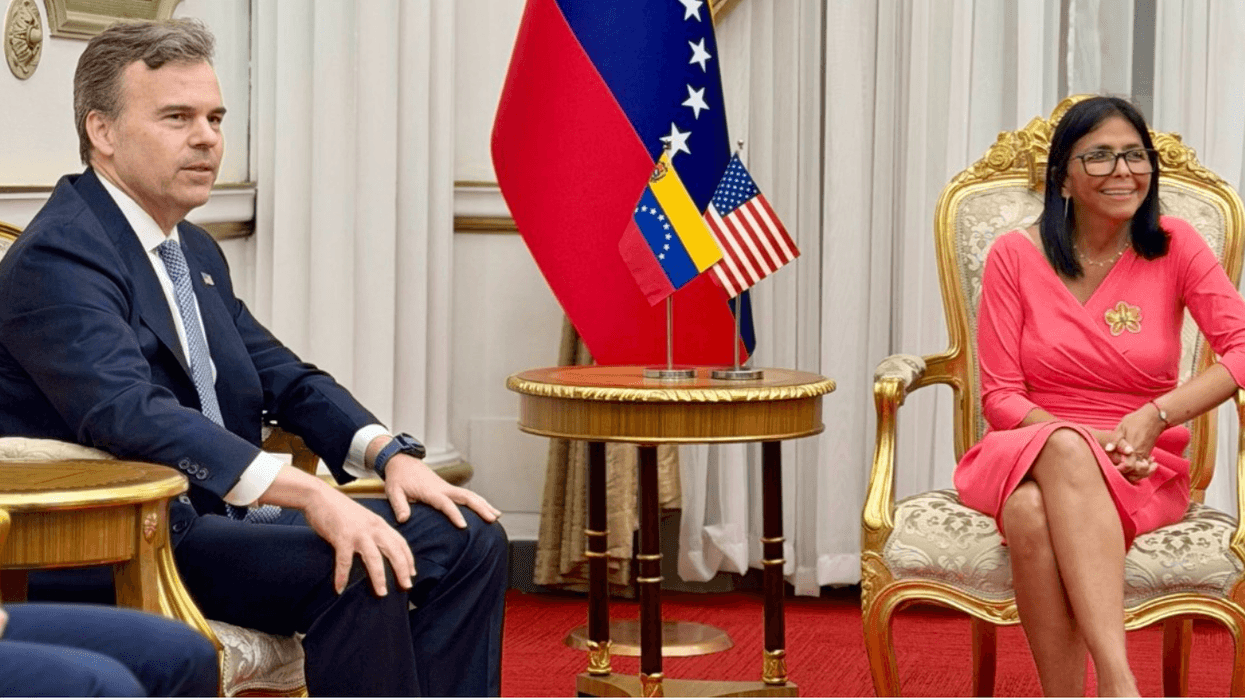
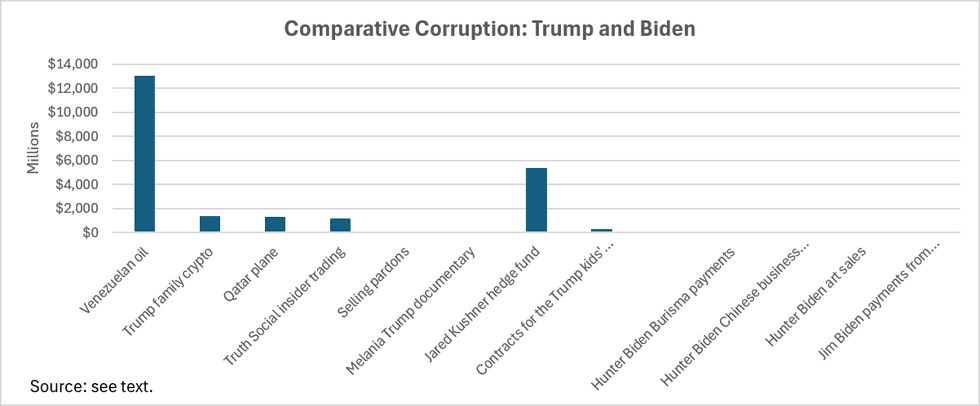
The Maduro capture, which convinced Trump that he could easily topple the Iranian regime the following month, was in no sense an effort to improve the lives of the Venezuelan people. It was plunder. Recall that Trump's criticism of Operation Iraqi Freedom was that we failed to "take the oil." No surprise, then, that taking Venezuela's oil was foremost on his mind after the Maduro snatch-and-grab. Trump's White House boasts that "In the biggest oil deal in world history, President Donald J. Trump has secured U.S. majority control of more than 65 billion barrels of proven oil reserves in Venezuela."
Some of Trump's personal and political allies are swooping in to take advantage of the Venezuela opportunities. Meanwhile, the funds from the sale of this oil have supposedly been moved to an account in Qatar, but the administration has not shared a detailed breakdown of these funds with Congress or the public. Trump has claimed that the oil windfall has paid for the Venezuelan military operation "many, many, many times over" but there has been zero transparency about how much oil has been sold, where the proceeds are and how they've been spent.
Doubtless the Trump administration is sincere in its demonization of immigrants and indifference to the suffering of those it wrongly rounds up, detains and deports (sometimes to third countries with which the immigrants have no ties, including countries with appalling human rights records). But if there's also a way to pay off big donors while enjoying all this human suffering and injustice, all the better.
The GEO Group and CoreCivic, two firms that operate private prisons and detention centers, donated $2.8 million to Trump's reelection effort and inauguration. Since then, GEO has been awarded more than $1 billion in ICE contracts. CoreCivic sold two facilities to ICE for $1.5 billion. Perhaps it was a coincidence.
"So, $1.5 billion just for the facilities," former senior ICE official remarked to CalMatters. "And how many migrants are ever going to come in and out of there who are national security and public safety threats? The people that we actually do need to keep off the streets."
Remember the attempted shakedown of Volodymyr Zelensky in 2025, when Trump and Vice President JD Vance teamed up to bully him in the Oval Office and Trump demanded access to Ukraine's rare-earth minerals? That spirit persists. According to New York Times reporting this week, Steve Witkoff and Jared Kushner, who are notionally negotiating to end the Russia/Ukraine war, have "expanded" their talks to include a multibillion-dollar oil deal that would benefit "Middle Eastern business executives with ties to" — guess who? Kushner and Witkoff.
While "there is no indication that Mr. Kushner and Mr. Witkoff themselves stand to profit," the Times writes with considerable understatement that it is "a striking intermingling of personal business ties with geopolitics."
The Trump sons are doing well, too. Companies in which Eric and Donald Jr. have invested have been awarded $3.2 billion in direct government business and secured another $3.1 billion in future contract options, according to a Washington Post analysis.
The list of corrupt, tainted transactions is virtually endless. On April 30, the tobacco company Reynolds American donated $5 million through a subsidiary to MAGA Inc. Executives were then invited to lunch at one of Trump's clubs. They complained about an FDA regulation of vaping cigarettes. Trump made a call then and there to Robert F. Kennedy Jr. and, voila, the regulation was changed a few days later.
Other than the $Trump memecoin, the most direct pathway for dollars to Trump's pocket has been the scheme to sell early access to Truth Social posts. For $100,000 a month, Trump will sell you his often market-relevant posts a few seconds before everyone else sees them. The funds would go directly to Trump Media, which Trump owns.
Attempting to defend this corrupt arrangement in a federal court on Wednesday, a Department of Justice lawyer compared it to Franklin Roosevelt's "fireside chats." The judge immediately interrupted him: "Well, President Roosevelt didn't charge money for his fireside chats, did he?"
As Brendan Ballou, the lawyer representing media organizations who are suing to stop Trump's Truth Social grift, put it, "In some ways, Trump is the Picasso of corruption. He comes up with schemes that just wouldn't occur to you or me, and the Truth Social one is an example of that."
The MAGA intellectuals — and yes, there are some — imagine that they are keeping the United States from decline by supporting Trump. They say things like "Import the Third World, become the Third World." But it is Trump's record-shattering corruption that is rushing us toward Third World status. Trayon White at least faced a jury. Trump's only reckoning can come from the ballot box, and while that may be encouraging, it's not nearly proportional to the destruction he is wreaking.
Mona Charen is policy editor of The Bulwark and host of the "Beg to Differ" podcast. Her new book, Hard Right: The GOP's Drift Toward Extremism, is available now.
Reprinted with permission from Creators
Remember the attempted shakedown of Volodymyr Zelensky in 2025, when Trump and Vice President JD Vance teamed up to bully him in the Oval Office and Trump demanded access to Ukraine's rare-earth minerals? That spirit persists. According to New York Times reporting this week, Steve Witkoff and Jared Kushner, who are notionally negotiating to end the Russia/Ukraine war, have "expanded" their talks to include a multibillion-dollar oil deal that would benefit "Middle Eastern business executives with ties to" — guess who? Kushner and Witkoff.
While "there is no indication that Mr. Kushner and Mr. Witkoff themselves stand to profit," the Times writes with considerable understatement that it is "a striking intermingling of personal business ties with geopolitics."
The Trump sons are doing well, too. Companies in which Eric and Donald Jr. have invested have been awarded $3.2 billion in direct government business and secured another $3.1 billion in future contract options, according to a Washington Post analysis.
The list of corrupt, tainted transactions is virtually endless. On April 30, the tobacco company Reynolds American donated $5 million through a subsidiary to MAGA Inc. Executives were then invited to lunch at one of Trump's clubs. They complained about an FDA regulation of vaping cigarettes. Trump made a call then and there to Robert F. Kennedy Jr. and, voila, the regulation was changed a few days later.
Other than the $Trump memecoin, the most direct pathway for dollars to Trump's pocket has been the scheme to sell early access to Truth Social posts. For $100,000 a month, Trump will sell you his often market-relevant posts a few seconds before everyone else sees them. The funds would go directly to Trump Media, which Trump owns. Attempting to defend this corrupt arrangement in a federal court on Wednesday, a Department of Justice lawyer compared it to Franklin Roosevelt's "fireside chats." The judge immediately interrupted him: "Well, President Roosevelt didn't charge money for his fireside chats, did he?"
As Brendan Ballou, the lawyer representing media organizations who are suing to stop Trump's Truth Social grift, put it, "In some ways, Trump is the Picasso of corruption. He comes up with schemes that just wouldn't occur to you or I, and the Truth Social one is an example of that."
The MAGA intellectuals — and yes, there are some — imagine that they are keeping the United States from decline by supporting Trump. They say things like "Import the Third World, become the Third World." But it is Trump's record-shattering corruption that is rushing us toward Third World status. Trayon White at least faced a jury. Trump's only reckoning can come from the ballot box, and while that may be encouraging, it's not nearly proportional to the destruction he is wreaking.
Mona Charen is policy editor of The Bulwark and host of the "Beg to Differ" podcast. Her book, "Hard Right: The GOP's Drift Toward Extremism," is available now.
Photo credit: Giorgio Trovato at Unsplash
Explore Morepowered byHeadlines Plus Trump's Corruption Could Be His Undoing, by Mona Charen | Creators Syndicate
 The Truth about the Forever War, by Susan Estrich
 Trump Avoiding Repeating History in Iran, by Michael Barone | Creators Syndicate
 Trump's War Psychology, by Mona Charen | Creators Syndicate
 Trump's Approval Rating: Where the Polls Stand Right Now Headlines Plus
 New Polls Spark Alarm Bells for Trump and GOP Ahead of Midterms Headlines Plus
ADVERTISING
The Maduro capture, which convinced Trump that he could easily topple the Iranian regime the following month, was in no sense an effort to improve the lives of the Venezuelan people. It was plunder. Recall that Trump's criticism of Operation Iraqi Freedom was that we failed to "take the oil." No surprise, then, that taking Venezuela's oil was foremost on his mind after the Maduro snatch-and-grab. Trump's White House boasts that "In the biggest oil deal in world history, President Donald J. Trump has secured U.S. majority control of more than 65 billion barrels of proven oil reserves in Venezuela." Some of Trump's personal and political allies are swooping in to take advantage of the Venezuela opportunities. Meanwhile, the funds from the sale of this oil have supposedly been moved to an account in Qatar, but the administration has not shared a detailed breakdown of these funds with Congress or the public. Trump has claimed that the oil windfall has paid for the Venezuelan military operation "many, many, many times over" but there has been zero transparency about how much oil has been sold, where the proceeds are and how they've been spent.
Doubtless the Trump administration is sincere in its demonization of immigrants and indifference to the suffering of those it wrongly rounds up, detains and deports (sometimes to third countries with which the immigrants have no ties, including countries with appalling human rights records). But if there's also a way to pay off big donors while enjoying all this human suffering and injustice, all the better. The GEO Group and CoreCivic, two firms that operate private prisons and detention centers, donated $2.8 million to Trump's reelection effort and inauguration. Since then, GEO has been awarded more than $1 billion in ICE contracts. CoreCivic sold two facilities to ICE for $1.5 billion. Perhaps it was a coincidence. "So, $1.5 billion just for the facilities," former senior ICE official remarked to CalMatters. "And how many migrants are ever going to come in and out of there who are national security and public safety threats? The people that we actually do need to keep off the streets."
Remember the attempted shakedown of Volodymyr Zelensky in 2025, when Trump and Vice President JD Vance teamed up to bully him in the Oval Office and Trump demanded access to Ukraine's rare-earth minerals? That spirit persists. According to New York Times reporting this week, Steve Witkoff and Jared Kushner, who are notionally negotiating to end the Russia/Ukraine war, have "expanded" their talks to include a multibillion-dollar oil deal that would benefit "Middle Eastern business executives with ties to" — guess who? Kushner and Witkoff.
While "there is no indication that Mr. Kushner and Mr. Witkoff themselves stand to profit," the Times writes with considerable understatement that it is "a striking intermingling of personal business ties with geopolitics."
The Trump sons are doing well, too. Companies in which Eric and Donald Jr. have invested have been awarded $3.2 billion in direct government business and secured another $3.1 billion in future contract options, according to a Washington Post analysis.
The list of corrupt, tainted transactions is virtually endless. On April 30, the tobacco company Reynolds American donated $5 million through a subsidiary to MAGA Inc. Executives were then invited to lunch at one of Trump's clubs. They complained about an FDA regulation of vaping cigarettes. Trump made a call then and there to Robert F. Kennedy Jr. and, voila, the regulation was changed a few days later.
Other than the $Trump memecoin, the most direct pathway for dollars to Trump's pocket has been the scheme to sell early access to Truth Social posts. For $100,000 a month, Trump will sell you his often market-relevant posts a few seconds before everyone else sees them. The funds would go directly to Trump Media, which Trump owns. Attempting to defend this corrupt arrangement in a federal court on Wednesday, a Department of Justice lawyer compared it to Franklin Roosevelt's "fireside chats." The judge immediately interrupted him: "Well, President Roosevelt didn't charge money for his fireside chats, did he?"
As Brendan Ballou, the lawyer representing media organizations who are suing to stop Trump's Truth Social grift, put it, "In some ways, Trump is the Picasso of corruption. He comes up with schemes that just wouldn't occur to you or I, and the Truth Social one is an example of that."
The MAGA intellectuals — and yes, there are some — imagine that they are keeping the United States from decline by supporting Trump. They say things like "Import the Third World, become the Third World." But it is Trump's record-shattering corruption that is rushing us toward Third World status. Trayon White at least faced a jury. Trump's only reckoning can come from the ballot box, and while that may be encouraging, it's not nearly proportional to the destruction he is wreaking.
Mona Charen is policy editor of The Bulwark and host of the "Beg to Differ" podcast. Her book, "Hard Right: The GOP's Drift Toward Extremism," is available now.
Photo credit: Giorgio Trovato at Unsplash
Explore Morepowered byHeadlines PlusTrump's Corruption Could Be His Undoing, by Mona Charen | Creators SyndicateThe Truth about the Forever War, by Susan EstrichTrump Avoiding Repeating History in Iran, by Michael Barone | Creators SyndicateTrump's War Psychology, by Mona Charen | Creators SyndicateTrump's Approval Rating: Where the Polls Stand Right Now Headlines PlusNew Polls Spark Alarm Bells for Trump and GOP Ahead of Midterms Headlines PlusExplore Morepowered byHeadlines Plus Trump's Corruption Could Be His Undoing, by Mona Charen | Creators Syndicate
 The Truth about the Forever War, by Susan Estrich
 Trump Avoiding Repeating History in Iran, by Michael Barone | Creators Syndicate
 Trump's War Psychology, by Mona Charen | Creators Syndicate
 Win, Lose or Draw, I Have No Regrets Over Supporting the Iran War, by Ruben Navarrette
 Trump's Approval Rating: Where the Polls Stand Right Now Headlines PlusNew Polls Spark Alarm Bells for Trump and GOP Ahead of Midterms Headlines Plus
 Donald Trump Latest: Breaking News and Video Updates Headlines Plus
 Trump Voters Losing Steam for Midterms as Approval Dips Headlines Plus
Like it? Share it!
opinion conservative government politics president money corruption republican numbers trump mona charen
About Mona Charen
Read More | RSS | Subscribe
YOU MAY ALSO LIKE...
Betsy McCaughey
Dennis Prager
David Harsanyi
Ken Buck


Designed and developed by New & Co.
Creators Syndicate, Inc. © 2026