Tag: social security cuts
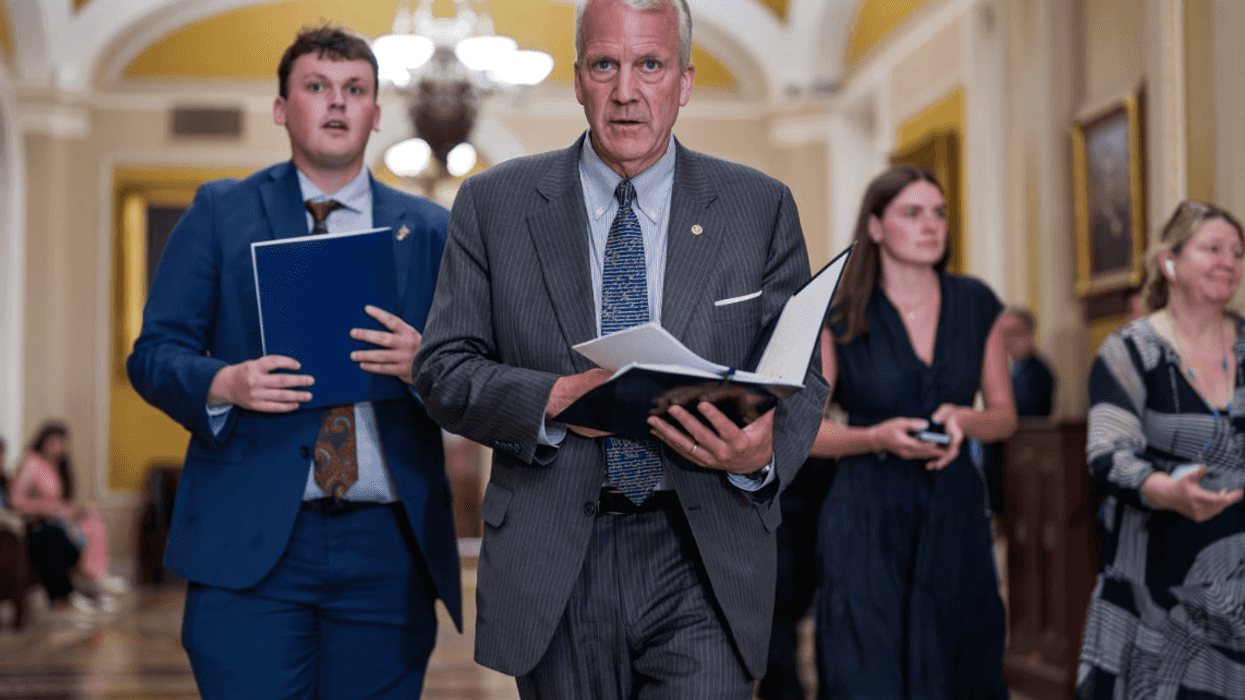
Dan Sullivan

Social Security Cuts? Republican Nominees Dancing On Political Third Rail

Nearly every Senate Republican facing a tough reelection fight this year has flirted with cutting Social Security, the federal program that keeps 58 million seniors out of poverty.

Polling suggests that cutting the program is deeply unpopular, which is why it is often referred to as “the third rail of electoral politics.” A recent AARP survey found that 82 percent of American adults view Social Security as “very important.” Half of those enrolled in the program say they would not survive financially if their benefits were cut.

The issue reemerged last year when Treasury Secretary Scott Bessent said the White House’s tax-deferred investment accounts for newborns, known as “Trump accounts,” were a “backdoor for privatizing Social Security.” The accounts were part of the One Big Beautiful Bill Act (OBBB), which passed the House and Senate with only Republican votes.

Alaska Sen. Dan Sullivan celebrated OBBB’s passage and falsely claimed that the law “doesn’t touch Social Security.” The law will cut $1 trillion from Medicaid over the next decade to fund tax breaks that primarily benefit wealthy people. Those tax breaks will create less revenue for the Social Security trust fund, speeding up the program’s insolvency.

In 2014, when he was first running for the Senate, Sullivan suggested raising the retirement age and delaying Social Security benefits for future generations. He said “a younger generation of Alaskans or Americans can accept” such a change.

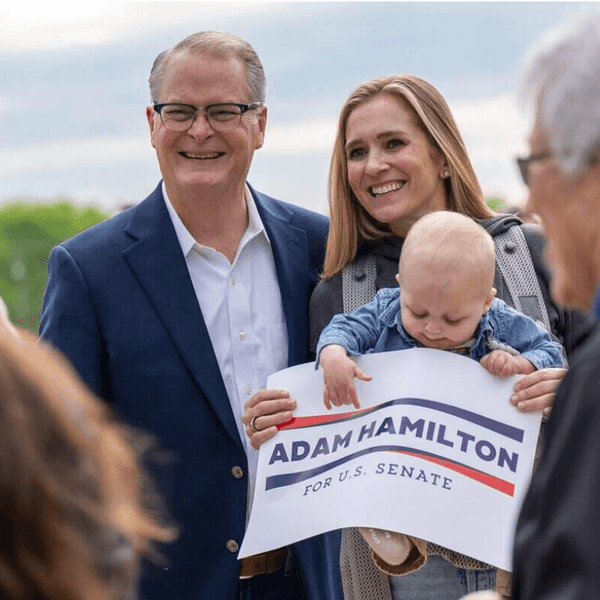
Sullivan is seeking a third term this year. His Democratic opponent is former Alaska Rep. Mary Peltola.

Florida Sen. Ashley Moody called OBBB “historic” when it passed and promised “this is just the beginning, and with President Donald Trump, we will not stop pushing forward.”

Moody was also a big fan of DOGE, the White House initiative that fired 14 percent of workers at the agency responsible for administering Social Security. This led to several Social Security field offices shutting down and longer wait times for those filing claims. Moody voted against multiple budget amendments to restore this funding.

More than five million of Moody’s constituents are enrolled in Social Security. She was appointed to the Senate last year to fill the seat vacated by Secretary of State Marco Rubio. She is now running for a full term against Democratic state Rep. Angie Nixon.

Like Moody, Ohio Sen. Jon Husted also voted for OBBB and against reversing DOGE cuts. He then went a step further by proposing a constitutional amendment that would compel Congress to balance the federal budget.

Currently, Social Security is mostly funded through payroll taxes. Those funds are held by the U.S. Treasury and disbursed to beneficiaries. Any surplus funds are invested in special Treasury bonds that are drawn on when tax revenues fall short.

A balanced-budget amendment would essentially make it illegal for the federal government to spend more in a given year than it collects in revenue. If tax revenues are insufficient to fund Social Security, the government would be prohibited from drawing on the bonds to make up the shortfall. The Center on Budget and Policy Priorities says this would inevitably lead to a cut in services.

The AARP says such a plan would be “devastating for millions.”

Husted will face former Ohio Democratic Sen. Sherrod Brown in this year’s election. Brown co-sponsored the 2024 Social Security Fairness Act that increased benefits for public workers.

Maine Sen. Susan Collins did not vote for OBBB, but she did vote to allow the legislation to be debated, clearing a key procedural hurdle and setting the stage for its eventual passage. North Dakota Sen. John Hoeven said Collins was a “team player” for doing so.

Collins has cast multiple votes weakening Social Security in her 29-year career, including a 2003 vote against creating a Social Security reserve account and a 2011 vote against tabling a budget bill that proposed cutting the program.

Collins is running for reelection this year against Democratic state Sen. Troy Jackson.

The Democratic Senatorial Campaign Committee (DSCC) plans to make Republican hostility toward Social Security a major issue in the midterms.

“In November, voters will reject Republicans’ attempts to put this critical program on the chopping block by electing a Democratic Senate majority that will stand up for seniors and protect Social Security,” says DSCC spokesperson Maeve Coyle.

Reprinted with permission from American Journal News

Billionaires Like Bezos Demanding Social Security And Medicare Cuts Are Not 'Moderate'

Billionaires Like Bezos Demanding Social Security And Medicare Cuts Are Not 'Moderate'

An extreme position does not become less extreme just because someone can put forward one that’s even more extreme. Massacring 100 children doesn’t become a moderate position just because someone is advocating killing 200 children.

This is how we should view the line being pushed by “moderate” voices that we have to deal with the $40 trillion debt with both spending cuts and tax hikes. The reality is that, apart from the military and Homeland Security, there is little fat in spending to be cut, as even Elon Musk inadvertently acknowledged. Insofar as we have a deficit problem, the issue is on the tax side, as can be easily shown. The rich have been taking an ever-larger share of national income over the last half-century, and they don’t feel like paying taxes on their winnings.

The major media outlets, which are all controlled by rich people, are pretending to be moderate by saying that we need to both raise taxes and cut spending. But there is nothing moderate about saying that we have to cut programs like Social Security, Medicare, and Medicaid because Republicans have given big tax breaks to their campaign contributors.

Republicans pushed these tax cuts, knowing they would increase the deficit, but did not make any corresponding cuts in spending because the cuts would be incredibly unpopular. Now they are using their control over the media to insist that these cuts are now absolutely necessary to offset all the lost tax revenue from tax cuts put in place by Reagan, Bush II, and Trump.

The Jeff Bezos-owned Washington Post gave us a great example of this fake moderate position in its editorial, “To get the national debt under control, start with the retirement state.” The piece makes its case by taking the example of a two-earner couple, with average earnings of $100,000 a year. It shows that the couple, turning 65 in 2025, can expect lifetime Social Security benefits of $739k compared with tax contributions of just $597k. A couple with the same income retiring in 2045 can expect lifetime benefits of $987k compared to tax contributions of $735k.

After laying out this disparity for Social Security (it has a similar story for Medicare, which I’ll come to), it then makes an argument for reducing Social Security for high-income people. This is three-card Monte level deception.

If the idea is that we should reduce the benefits of high-income workers, honest people would look at the relative taxes and benefits for high-income workers. Social Security is explicitly designed to have a progressive payback structure, which means that relatively moderate-income workers, like the ones highlighted in the WaPo editorial, have higher paybacks relative to their taxes.

If the editors were interested in doing an apples- to-apples comparison, here’s what the picture would look like. (This is taken from the exact same source.)

As can be seen, high-income people pay considerably more in taxes than they get back in benefits. For a high-income woman retiring in 2025, the gap is $263,000. For a high-income man, the gap is $336,000. (The gap is larger for men than women because their life expectancy is shorter.) For a high-income woman retiring in 2045, the gap is $259,000. For a high-income man, the gap is $346,000.

If the point is to make an argument for reducing the benefits of high-income retirees, then show the taxes and benefits for high-income retirees. No one disputes that Social Security looks like a pretty good deal for more moderate-income retirees, but these people don’t typically have much income in retirement. I guess Jeff Bezos’ paper would have been too embarrassed to argue that we have to reduce the average monthly Social Security benefit of $2,071.

The Post’s editorial makes the push that while cutting Social Security, we should expect people to be more reliant on private 401(k)s. In addition to increasing risk, this is also enormously inefficient. Private 401(k)s cost more than 40 times as much to administer per dollar of benefits as Social Security. It is understandable that Mr. Bezos would be happy to see more money going to his rich friends in the financial industry, but most of us would rather see the money going to ordinary workers.

Medicare Benefits: Big Bucks to Hospitals and Drug Companies Are Not Benefits to Workers

The Post’s graphs do show a huge imbalance between the taxes paid out for Medicare and the cost of the benefits received. This is also deceptive.

In the United States, we pay almost twice as much per person for healthcare as the average for other wealthy countries. This is not because we get more or better healthcare. Our life expectancy ranks near the bottom for wealthy countries.

The big bucks for healthcare go to the income of drug companies, insurers, hospitals, medical equipment makers, and doctors. In each case, we pay two times as much, or more, than people in other wealthy countries. A paper that was not answerable to one of the richest people in the world would suggest bringing our payments in line with the rest of the world. But instead, the Post wants to beat up on the country’s retirees.

No one should be confused: Cutting Social Security and Medicare benefits to reduce the deficit is not a moderate position. It’s one that attacks hundreds of millions of ordinary workers to avoid taxing the rich or reducing waste in our health care system. That is extreme, but the rich media owners pushing this position will do everything they can to convince us they are being fair and balanced.

Dean Baker is a senior economist at the Center for Economic and Policy Research and the author of the 2016 book Rigged: How Globalization and the Rules of the Modern Economy Were Structured to Make the Rich Richer. Please consider subscribing to his Substack.

Trump's Gargantuan Pentagon Budget And The Social Security 'Shortfall'

Trump's Gargantuan Pentagon Budget And The Social Security 'Shortfall'

The release of the 2026 Social Security Trustees Report got the usual suspects (a.k.a. “very serious people”) genuflecting about the large projected shortfall. As of 2034, the program is projected to be unable to pay full benefits. This would mean a 22% cut in benefits if no additional revenue is added.

There are three points worth making here.

1) As an economic matter, the projected depletion of the trust fund and resulting shortfall in the program means nothing;

2) The main reason for the projected shortfall is the upward redistribution of income over the last half-century;

3) The projected shortfall is far less money than the increase in military spending that Donald Trump is requesting for his 2027 budget.

Trust Fund Accounting

On the first point, the spending to repay the bonds held from the trust fund in 2033 comes from the Treasury. Its impact on the economy would be the same as the spending in 2034, when the trust fund no longer holds any bonds.

There is an issue that the law gives the program a claim to the funds needed to repay the bonds it holds. Social Security does not have a claim to the money needed to pay full benefits once the last bonds are sold and the trust fund is depleted.

This is an important legal point, but from an economic standpoint, it is money from the Treasury in both cases. If the country could afford to pay full benefits in 2033 when the trust fund held bonds. It can afford to pay full benefits after it has sold all its bonds, however the law would need to be changed.

Upward Redistribution Hurt Social Security’s Finances

In 1982, the last time the program had a major overhaul, just ten percent of wage income went to high wage earners whose income escaped taxation by being over the cap (currently around $185,000) for wages subject to the 12.4 percent Social Security tax. In the last quarter century, close to 17 percent of wage income went over the cap.

This upward redistribution of wage income, coupled with the redistribution from wages to profits in the last quarter century, has substantially reduced the amount of revenue going into the trust fund. It shouldn’t be surprising that the people who engineered the upward redistribution of the last half-century, through trade policy, stronger patent and copyright protections, bank bailouts, and tech policy, now want to reduce people’s Social Security benefits.

Trump’s Increase in Military Spending is Twice the Size of the Shortfall Projected for 2034

The media seem to take pride in reporting huge budget numbers without providing any context that would make them meaningful to their audience. The projected Social Security shortfall is a great example. The usual group of budget hawks is being brought out to tell us that it is a huge program, which we can’t afford, and requires cuts.

Yet, we did not hear the same chorus in response to Donald Trump’s proposed increase in the military budget from $864 billion in the last year of the Biden presidency to $1,500 billion in 2027. Even adjusting for inflation between the two years, the increase would still be close to $590 billion. There was no rationale given for why the country suddenly needs to spend so much more on its military. Trump certainly did not propose this sort of massive increase in spending in his campaign.

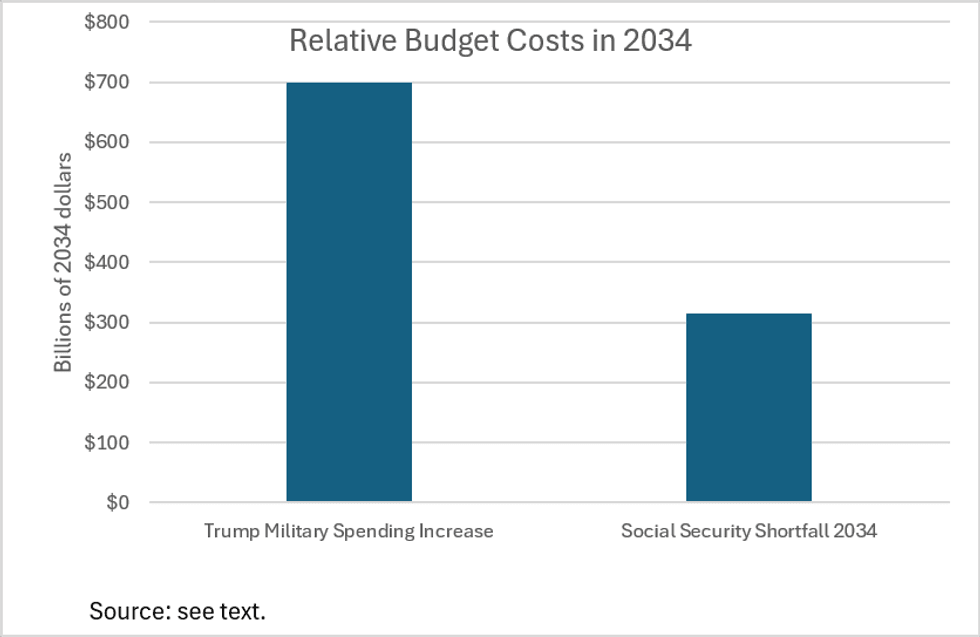
The proposed increase in military spending dwarfs the shortfall projected in the Social Security program for 2034.

Adjusting for inflation (assuming 2.5 percent annually), Trump’s requested increase would be just under $700 billion in 2034 dollars. By contrast, the Social Security Trustees project that the program will face a $314 billion shortfall in its annual budget in 2034.

We can argue about what should be considered big and what should be considered small, but there is zero doubt that Trump’s proposed increase in military spending is hugely larger than the projected shortfall in Social Security. If anyone thinks that Social Security poses a big problem for the budget, they must believe that Trump’s military spending poses a much bigger problem, since it is more than twice as large.

And, as noted earlier, we are already paying the money for Social Security; it is just coming out of a different pocket. The proposed increase in military spending, at 1.6% of GDP, will be newly committed funds coming from the Treasury, which will impose substantial demands on the economy. Any honest person who says funding Social Security poses a serious budget problem must believe that Trump’s military spending poses a far bigger problem.

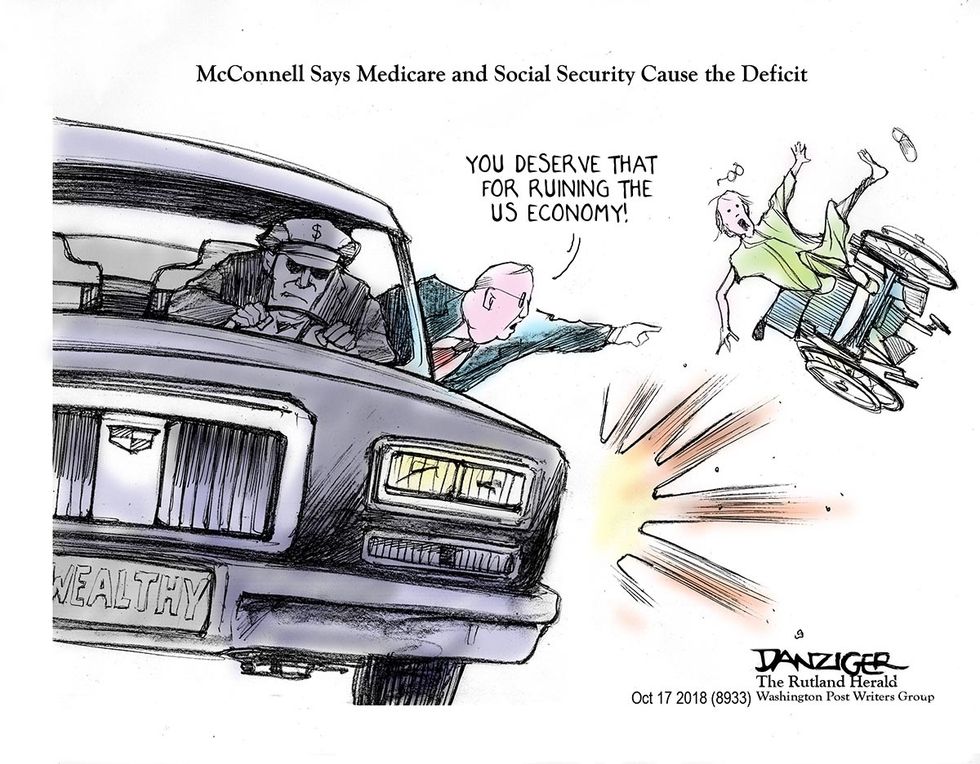
Danziger: His Moral Deficit

Danziger: His Moral Deficit

Jeff Danziger lives in New York City. He is represented by CWS Syndicate and the Washington Post Writers Group. He is the recipient of the Herblock Prize and the Thomas Nast (Landau) Prize. He served in the US Army in Vietnam and was awarded the Bronze Star and the Air Medal. He has published eleven books of cartoons and one novel. Visit him at DanzigerCartoons.com.

Shop our Store

Headlines

Editor's Blog

Trending

World