COP31: While The World Goes Green, Trump Hinders American Progress
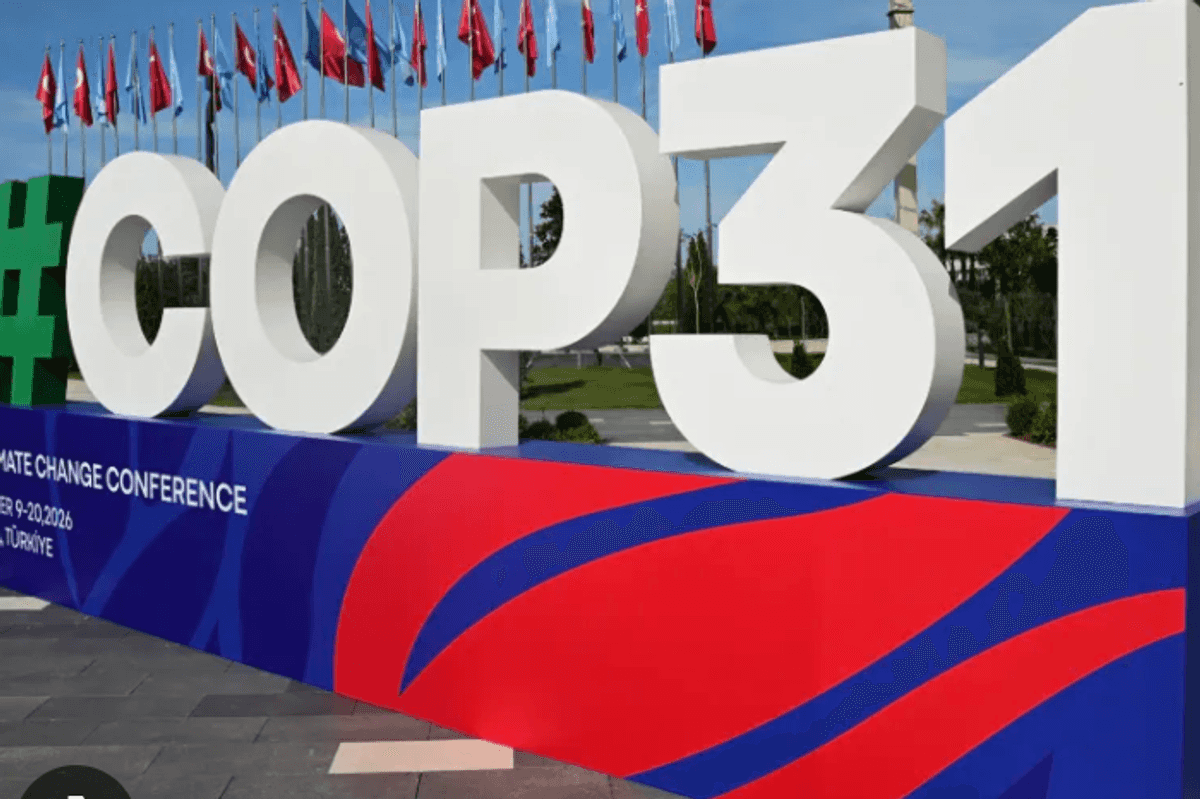
COP 31 conference location in Ankara, Turkiye
With the start of the international climate conference, it’s a good time to see how the world is doing on the green transition. It is important to look at the world rather than just the United States. This is not only because we know that in the battle against global warming, Donald Trump is on the other side, but also because it is what the world as a whole does that matters, not just the United States.
In pretty much every area the world is making great strides toward moving towards clean energy, driven largely by innovations in China and its massive manufacturing capacity. But innovation in clean technology is a worldwide phenomenon and there is still manufacturing capacity outside of China. More of this is also shifting towards clean energy.
As I’ve noted before, Trump’s War on Iran has been a big plus in this respect, both because it sent oil prices soaring and also because it drove home clearly the instability of oil supplies. Wind or solar energy looks much better in this context.
Electric Vehicles
EV sales are projected to hit roughly 23 million in 2026. (This includes plug-in hybrids.) This is roughly 27% of the world’s car market. Many countries have far higher shares. In Norway, it’s close to 100%. In China, by far the world’s largest market, it has been close to two-thirds in recent months. The growth over the last two years has been almost just under 37%.
With China’s EV exports doubling year over year, at least in part as a result of the war, and new EV factories being constructed or converted, this sort of growth is likely to continue. At this pace, it is plausible EVs will be close to half the world car market by the end of the decade.
Solar Power
The growth in solar power capacity has been somewhat slower in 2026, because China has slowed its domestic construction, even as its exports have soared. The vast majority of new energy capacity being installed in Africa is now solar. That is also true in many countries across South Asia, notably Pakistan.
Wind Power
Wind power installation slowed in 2026, primarily because of a slowing in China. It is still expected to reach 173 gigawatts for the year, enough to power more than 120 million homes.
Battery Storage Capacity
Perhaps the biggest development in recent years has been the plunging price for storing electricity. The cost of storing energy has fallen more than 99% over the last three decades. This has made the intermittent power offered by solar and wind energy a far smaller issue, as electricity can be stored in peak hours and then produced by storage at night or in periods where the wind is not blowing. The world is expected to add more than 350 gigawatts of storage capacity in 2026, twice the pace of 2024.
The price declines for the cost of storage are likely to continue, as the technology for producing sodium-based batteries has developed rapidly. Sodium batteries are far cheaper than lithium batteries. More importantly, sodium is far more plentiful and much less environmentally destructive to mine. Sodium-based batteries are likely to rapidly replace lithium ones for grid storage, although the weight advantage per unit of electricity may mean that lithium batteries continue to be widely used in EVs.
Clean Energy is Cheaper: Are People Willing to Sacrifice to Destroy the Planet?
For decades, environmentalists have been dealing with the question of how much people are willing to sacrifice in terms of higher costs to limit the damage that we are doing to the environment for future generations. The development of technology has flipped this question.
EVs are now cheaper to buy than gas-powered cars (not in the U.S. because of tariffs). They are far cheaper to operate. The same is true for electricity from wind and solar compared to electricity from coal or natural gas. And the gap is growing as storage costs continue to decline.
It would still cost money to speed the transition, for example, by the early retirement of coal plants that are cheaper to operate than installing new solar or wind, but even that gap is falling. It is unfortunate that so much of the progress in developing and producing clean energy products is taking place in China and not in the United States, but it is essential for the world that it takes place somewhere. And maybe when we again have a reality-based president in the United States, our country can again play a leadership role.
Dean Baker is a senior economist at the Center for Economic and Policy Research and the author of the 2016 book Rigged: How Globalization and the Rules of the Modern Economy Were Structured to Make the Rich Richer. Please consider subscribing to his Substack, from which this is reprinted with permission.
- We Can Attack Global Warming Without Donald Trump ›
- At COP 28, Nations Reach Historic Agreement To End Reliance On Fossil Fuels ›
- Hey Kids! Meet 'Coalie,' New Mascot For The Trump Team's Climate Deniers ›
- Cop31 must deliver climate progress that people can see is real, host says | Cop31 | The Guardian ›
- Cop31: what is at stake at the UN climate summit and what can it achieve? | Cop31 | The Guardian ›
- COP31 opens in Antalya: Can climate promises finally deliver results? | UN News ›
- Cop31 as it happened: world leaders gather for crucial climate crisis talks | Cop31 | The Guardian ›
- COP31 climate summit begins after disastrous year of extreme weather | PBS News ›