Tag: ai boom
Dario Amodei

The AI Boom Will Arrive When Everyone Has To Buy New Antivirus Software

Before the Internet, no one needed antivirus software. That’s a stupidly true statement. The Internet created enormous possibilities. But yeah, it also created the possibility for people to transmit viruses that could infect hundreds of millions of computers around the world. Now we all need antivirus software to keep our computers from getting infected and shutting down on us.

I kept thinking about this when I was reading Anthropic’s registration statement for its initial public offering. The statement promises great things that the company can do for the economy and humanity, such as hugely increasing productivity and developing cures for previously incurable diseases. But it also lists some of the potential harms that its AI can cause.

Among these harms is the fact that it will radically increase the ability of evil doers to hack the websites of companies and governments all around the world. This can totally transform the business of ransomware in the same way that the printing press revolutionized the publishing industry.

Unless Anthropic CEO Dario Amodei and his gang have some preventive plans they have not disclosed (I mean the type of defense, not the specifics), it’s hard to see why we would not have hundreds or thousands of ambitious young men (I’m assuming most will be men) using the latest Anthropic AI to attack all sorts of websites. This could be the quickest way to become the next billionaire in the AI age. After all, there is no shortage of people in Silicon Valley with the moral compass of an Elon Musk or Mark Zuckerberg.

At the very least, this risk will likely force businesses and governments to spend enormous sums on new security measures to defend their systems. Maybe this is where Anthropic and the rest of the industry see the big demand for the AI that they expect to earn them trillions. Defense against malicious AI attacks should also create plenty of jobs, for those concerned that AI will take all the jobs.

It also doesn’t help that the government agencies that are charged with preventing these sorts of assaults, most notably the FBI, have dumped many of their most experienced people. And those who remain seem more involved in trying to compile dirt on Donald Trump’s political enemies than preventing and uncovering real crimes.

And even in the case where a crime is successfully detected and prosecuted, Donald Trump has made it clear that the pardon window is always open. As long as the AI attackers are smart enough to stash a few tens of millions of their “earnings” away in a safe account, they will be able to buy their way to freedom, along with a declaration from the president about how they were treated “very unfairly.”

So, when you hear people being skeptical about what AI can do, tell them they don’t know what they are talking about. The potential is unlimited.

Dean Baker is a senior economist at the Center for Economic and Policy Research and the author of the 2016 book Rigged: How Globalization and the Rules of the Modern Economy Were Structured to Make the Rich Richer. Please consider subscribing to his Substack, from which this is reprinted with permission.
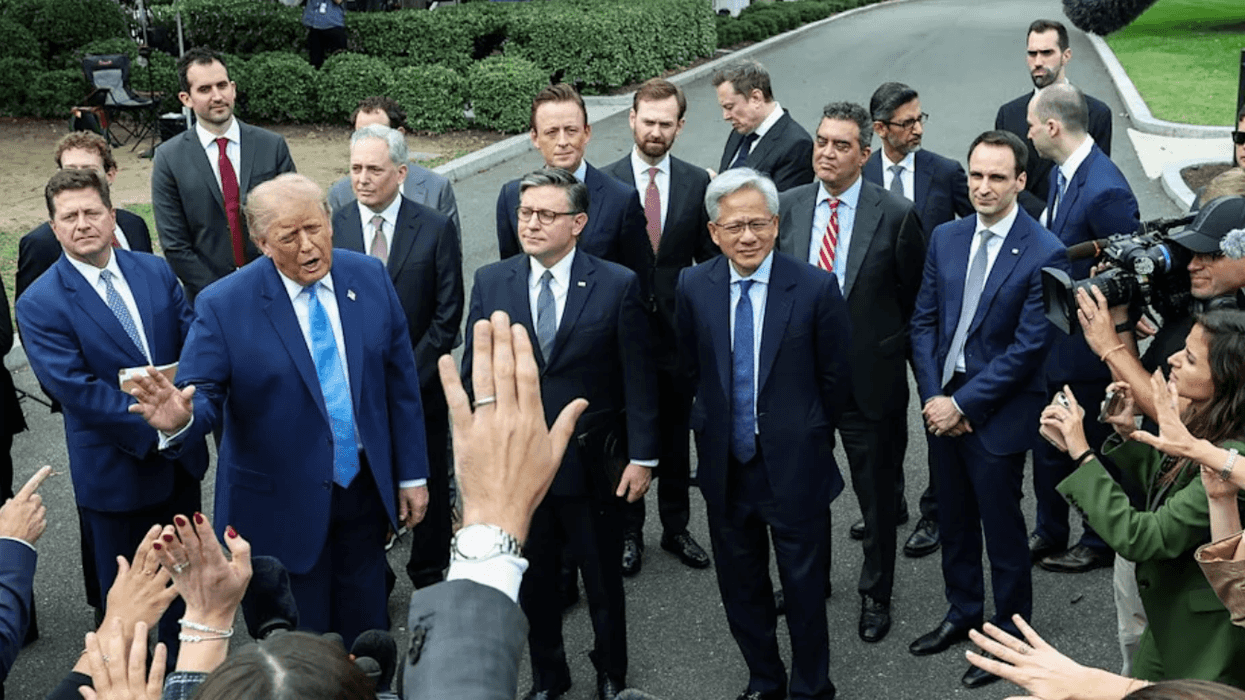
Trump at superintelligence press conference

One More Reason Why Americans Hate Oligarchs' AI: It Does Nothing For Us

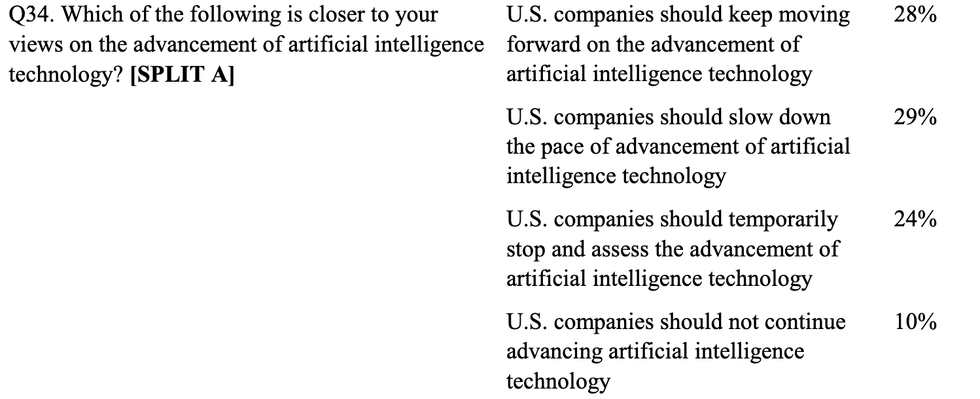
One unifying dynamic in America today: Americans really, really hate artificial intelligence. What began as a form of NIMBYism — no one wants a data center in their neighborhood — has broadened into severe doubts about the technology as a whole. For those of us who remember the giddy optimism that greeted the tech boom of the 1990s, the widespread negativity toward AI is astonishing. Here are the results of a new Wall Street Journal poll:

Only 28 percent of Americans believe that AI technology should move full speed ahead. Everyone else wants it slowed down or stopped, temporarily or permanently.

Of course, Donald Trump remains a huge booster. He believes that the public’s antipathy towards AI is just a marketing problem — and that he can solve that problem by forcing everyone to call it “super intelligence”. But the Journal poll also says that only 7 percent of Americans trust Trump’s leadership in regulating AI. Given Trump’s abysmal approval ratings, his advocacy of AI — err, super intelligence — probably taints the technology even further in the eyes of Americans.

Historically, Americans have been technology enthusiasts. As a nation, we’re not Luddites. So what explains Americans’ dislike of AI?

Obviously, there are near-daily prominent warnings that AI will destroy the human race or, failing that, destroy everyone’s job. And these warnings aren’t coming from left-wing cranks — they’re coming from the AI industry itself.

And we should be afraid – very afraid. The power of AI models to hack into supposedly secure systems — and to do so on their own, without prompting and against their owners’ intentions, and to lie to the humans about it — is truly shocking. Moreover, there is surely an element of financially motivated hype: “Our technology is so powerful that it can destroy the world, so you’d better invest in our IPO.” And there is more than a little bit of karma here: the race by the AI giants to reach the holy grail of AGI – artificial general intelligence – was surely a strategy to make vast riches from Wall Street, in contrast to the much more modest (and probably more successful) Chinese strategy of building modest, cost-effective models.

There is also, however, a more prosaic reasons for the public’s dislike of AI: This is a technology of, by and for oligarchs, with hardly any of the benefits trickling down to regular Americans.

Or to put it a different way, never before in history have corporations spent so much money — playing a major role in soaring interest rates — to create so few jobs.

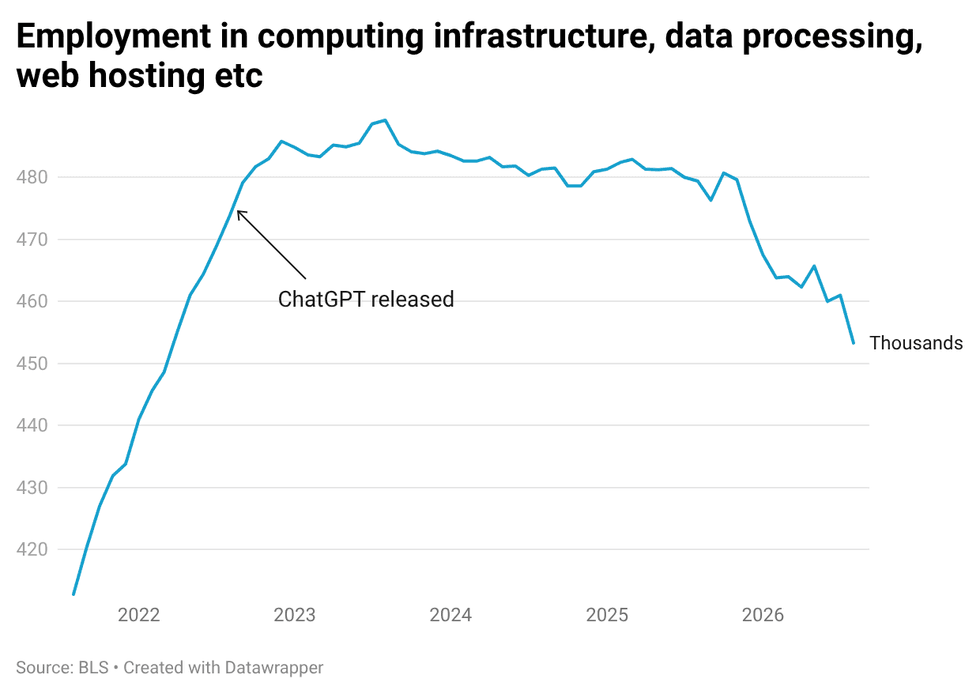
Data centers themselves are basically banks of blinking servers that employ hardly any workers. Here’s data from the Bureau of Labor Statistics on a category that includes data centers as well as a number of other activities. Employment in that category has declined since November 2022, often cited as the start of the AI boom because it’s the month ChatGPT was released to the public:

Source: Bureau of Labor Statistics/Created with Datawrapper
Still, won’t the AI boom at least temporarily create a lot of construction jobs? It will create some, and Jared Bernstein has a good post on how to ensure that these are good jobs. But all indications are that AI investment will create far fewer jobs, even in construction, than expected.

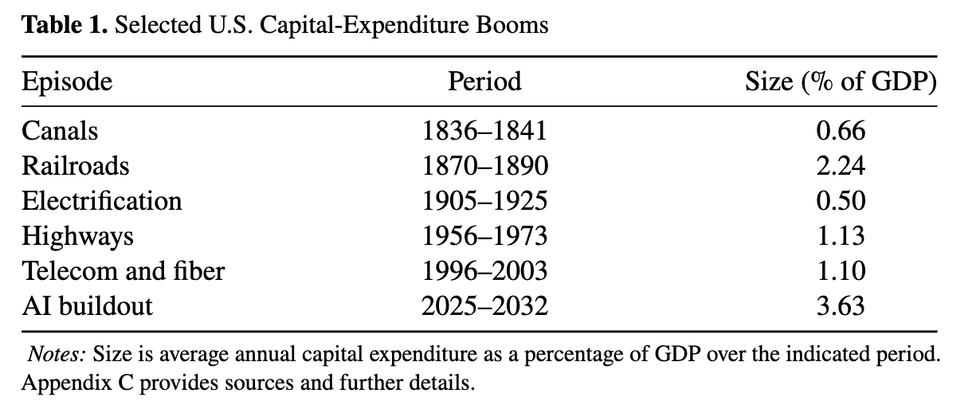
Bear in mind that we are talking about a truly huge investment boom. In Sunday’s primer I cited estimates by Stijn van Nieuwerburgh suggesting that we’re entering by far the biggest capital-expenditure boom in U.S. history, dwarfing even the huge railroad boom that followed the Civil War:

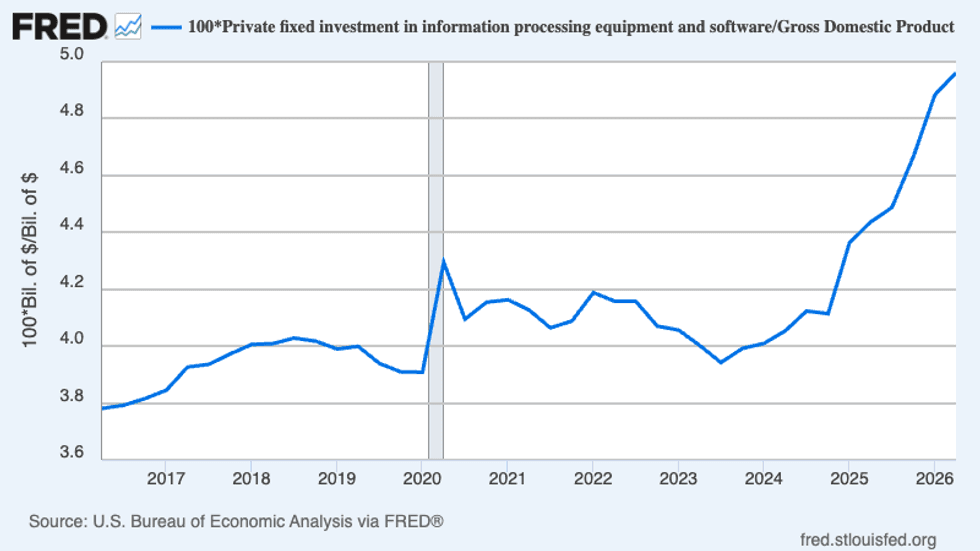
These are projections rather than spending that has already happened. But the AI investment boom is already well underway. Here’s IT investment as a percentage of GDP, which really took off in late 2024 and is already well above its level during the 1990s tech boom:

Source: US Bureau of Economic Analysis via St. Louis Federal Reserve (FRED)
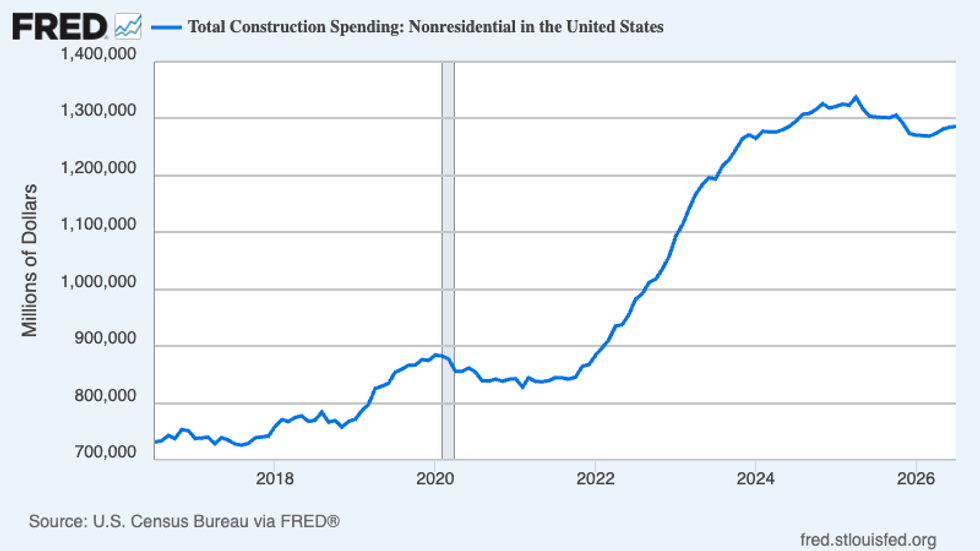
Given this spending surge, one should expect a sharp rise in nonresidential construction spending — basically construction for businesses rather than housing.

But that’s not what we actually see. Nonresidential construction rose rapidly during the Biden years, largely thanks to that administration’s promotion of clean energy. But nonresidential construction has basically flatlined under Trump, despite the immense AI investment boom:

How is this possible? Because even the physical construction of a data center involves relatively little construction. According to Van Nieuwerburgh, when a multi-billion-dollar AI training campus is built,

About one-third [of the investment spending] reflects the facility and power infrastructure, while roughly two-thirds consists of compute hardware and related IT systems.

So not a lot of conventional construction. And most of the “compute hardware” etc. is imported!

Overall, then, the deep unpopularity of AI isn’t hard to explain. Here we have a technology that is enriching a small number of people, but whose creators warn may destroy millions of jobs if not the world. And even the usual argument for pro-oligarch policies — job creation! — falls flat because hardly any jobs are being created even in the short run.

Will AI’s unpopularity matter? Indicators are that it will. So many things are going wrong for Republicans right now that it’s hard to single out any one issue, but Chris Caldwell has an interesting recent article arguing that the deep unpopularity of data centers may be the tipping point that turns Ohio blue this year, possibly deciding control of the Senate.

Thus there are good reasons, even beyond possible apocalypse, for the public backlash against AI. And that backlash is so strong, and has emerged so quickly, that it may have important political consequences.

Isn’t that super?

Paul Krugman is a Nobel Prize-winning economist and former professor at MIT and Princeton who now teaches at the City University of New York's Graduate Center. From 2000 to 2024, he wrote a column for The New York Times. Please consider subscribing to his Substack.


Shop our Store

Headlines

Editor's Blog

Trending

World