Clinicians in hospital intensive care unit
This past June, GoozNews forecast the uninsured rate would soar to 11 percent this year due to changes contained in the One Big Ugly Bill passed by the Republican-controlled Congress and signed into law by Donald Trump in July 2025. That would be a 37 percent increase from early 2025.
While official numbers won’t be released by the Census Bureau until next year, a new survey from the Commonwealth Fund confirms that back-of-the-envelope estimate. Not only did a poll of 9,360 adults conducted this past summer find this year’s uninsured rate rose over three percentage points from last year’s eight percent, but the share of working-age adults with inadequate coverage still stands at 35 percent, bring the total with no or inadequate coverage to 46 percent.
What constitutes “inadequate” coverage? It’s people who can’t afford their insurance premiums, deductibles and high out-of-pocket costs when accessing care. It’s people facing gaps in their coverage, which must be paid out-of-pocket. The survey found 31 percent of adults insured throughout the year are paying off medical bills or debt.
“Our survey shows that most Americans are struggling to get the health care they need, and things are getting worse,” said Dr. Joseph R. Betancourt, president of the Commonwealth Fund.

Americans have repeatedly told pollsters that health care affordability ranks as either their first or second most important issue this year. Despite this being an election year, not a single mainstream media outlet — print, broadcast or online — covered yesterday’s release of the Commonwealth Fund survey.
Cause and effect
It’s no mystery why both unaffordable coverage and the uninsured rate are rapidly rising. They are, respectively, cause and effect.
The Republican Congress refused to renew the expanded Obamacare subsidies for low-income workers that were passed during Covid. That non-act sent premiums on the exchanges soaring and forced millions of people without employer-based coverage to drop their individual and family plans.
The One Big Ugly Bill’s new work rules for Medicaid recipients and the requirement that state agencies conduct twice-a-year recertifications won’t go into effect until January. But expiration of the recertification waiver passed during the Covid pandemic has already forced 25 million people from the program, not because they weren’t still eligible, but because they failed or didn’t have the documents needed to fill out the necessary paperwork. After the new Medicaid rules go into effect in January, another four to five million poor people are expected to lose coverage.
The resulting massive increase in the uninsured rate has sent uncompensated care costs at the nation’s hospitals and physician practices soaring. That in turn has led to rapid price increases as providers look to the still insured to pick up those additional costs.
Insurers are glad to pass those costs along since it raises their profits. Whether they are selling their own plans or acting as third-party administrators for self-insured employers, insurers generally reap about five percent of top line revenue as profit. The larger the top line, the larger the bottom line.
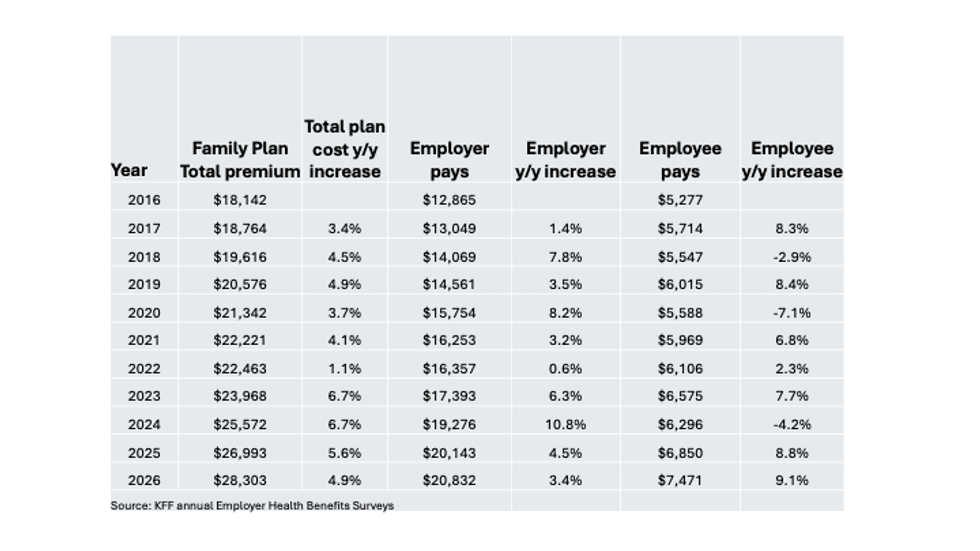
The annual KFF survey of employers, also released this week, confirmed those soaring top-line costs. It reveals how employers are responding this year by shifting more of the total cost onto their employees. The average cost of a family plan rose five percent to $28,303. But the average amount workers pay in premiums rose nine percent to $7,471 while the average cost for the employer share rose only 3.4 percent.
But to be fair, these numbers jump around a lot year over year (see the chart below). Over the past decade, rising health care costs have imposed a greater burden on employers. They saw their share of the average family plan rise 62 percent over the past decade compared to their workers’ share rising “just” 42 percent (or twice the rate of inflation on average).
But employers have an out that their employees don’t have. They can grab a larger share of total income (which they have), and they can limit workers’ wage increases (which they have).
As every health care economist will tell you, in the end, health care benefits are a form of wages. Workers wind up paying one way or the other. It is no mystery why health care costs have become many families’ most pressing economic concern.
Merrill Goozner, the former editor of Modern Healthcare, writes about health care and politics at GoozNews.substack.com, where this column first appeared. Please consider subscribing to support his work.
Reprinted with permission from GoozNews
- Medicare For All Can Be Simple And Efficient -- If We Embrace Real Reform ›
- As Republicans Devastate Healthcare, Industry Keeps Financing GOP ›
- Before The Fall: What American Healthcare Lost After Trump Took Over ›
- Erupting Crisis Of Uninsurance, Created By Republicans, Will Soon Engulf US Families ›
- Stressed Out? You've Endured A Year Of Spiraling American Health ›
- Millions Could Lose Health Coverage When Medicaid Emergency Ends ›
- Medicaid Cuts Have Already Shuttered A Hospital In Rural Nebraska ›
- Where Affordable Care Act insurance coverage has dropped most in WA • Washington State Standard ›
- Healthcare Insights: As Millions Lose Health Coverage, Those Who Provide Care Suffer | The ILR School ›
- Steep drop in number of people with Affordable Care Act health coverage, analysis finds : NPR ›
- About 3 million people have dropped Obamacare health coverage after subsidies expire and costs rise | PBS News ›
- Health Coverage Tracker: Millions of People Are Losing Coverage Following 2025 Republican Policy Changes | Center on Budget and Policy Priorities ›
- National Health Crisis Looming As Health Coverage Rates Plummet, New Report Warns ›