Tag: ben sasse
Osborn: Not A Face In The Crowd, But A Real Working Class Candidate

Osborn: Not A Face In The Crowd, But A Real Working Class Candidate

A Face in the Crowd is the prophetic 1957 movie about a charismatic drifter "discovered" in an Arkansas jail. The face belongs to "Lonesome" Rhodes, a scoundrel whose folksy act catapults him to national prominence. "Lonesome" (Andy Griffith) abuses women, but the crowd only sees a lovable spinner of down-home yarns. He deflates after getting caught on an open mic mocking his followers as idiots and fools.

Maine's Graham Platner was a face in the crowd, sold to Democrats as a salt-of-the-sea oysterman who actually came from a privileged background. The senatorial candidate survived his sordid history of mistreating women until a plausible accusation of rape finally did him in.

American politics feasts on stories of candidates from humble backgrounds who know what it means to be a working stiff. Some such contenders are uncovered as bums or phonies. But some are the real thing.

They would include Dan Osborn of Nebraska. He is the steamfitter and former union organizer from Omaha running for the senate as an independent against Republican Sen. Pete Ricketts.

Osborn now has a decent chance of prevailing in November. His is not a new face. He had run in 2024 as an independent who did surprisingly well against Republican incumbent Deb Fischer. Osborn lost by only 7 points in a state that Donald Trump carried by about 21 points. Osborn clearly has appeal.

After the election, Osborn launched a PAC called the Working Class Heroes Fund. Its stated mission is to support candidates like him, regardless of party label. With Ricketts an heir to a family fortune exceeding $1 billion, Osborn has predictably framed the race as between the "billionaire class" and the working class.

One of his challenges, though, is to minimize the extent to which Democrats openly want him to win. Nebraska Democrats are not running their own candidate and urge their contributors to back Osborn.

To prevail in a conservative state like Nebraska, Osborn needs support from disaffected or moderate Republicans. If elected, he vows not to caucus with either party. And he criticizes Democrats for their focus on white-collar professionals.

Working in his favor is the fact that many Nebraska Republicans are not hard right. Omaha Rep. Don Bacon, for example, is a Republican moderate known for often criticizing Trump. His is a swing district, nationally known as the "blue dot." Seeing himself at a disadvantage among MAGA Republicans and Democrats desperate for a win, Bacon decided not to seek another term.

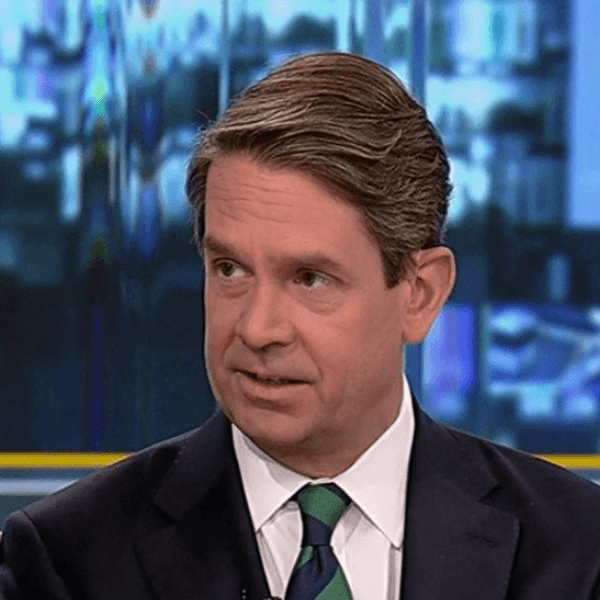
Former Nebraska Sen. Ben Sasse is a traditional conservative known for his intellect and courteous manners. Sasse was one of only seven Senate Republicans who voted to convict Trump for inciting the Capitol riot. He is now bravely confronting Stage 4 pancreatic cancer.

Trump's job approval rating in Nebraska is evenly divided or slightly underwater. And so a working man fixed on pragmatic solutions would seem a serious challenger.

Arizona Democrats have Katie Hobbs running for reelection as governor. The product of a middle-class family, Hobbs put herself through college. While secretary of state in 2020, she earned national renown for defending Arizona's election results against phony claims of voter fraud.

As governor, she has lured business to her state, which explains her directing ads toward Republicans and independents. Many Arizonans, meanwhile, remain incensed at Trump's shabby treatment of the late Republican icon John McCain.

McCain's widow, Cindy McCain, has publicly endorsed Hobbs against her Republican opponent, Andy Biggs. Tied hand and foot to Trump, Biggs tried to overturn the results of the 2020 election.

Moderate Democrats do have a good shot at winning this November. Electorates may have grown weary of faces in the crowd, entertainers offering colorful tales and little more.
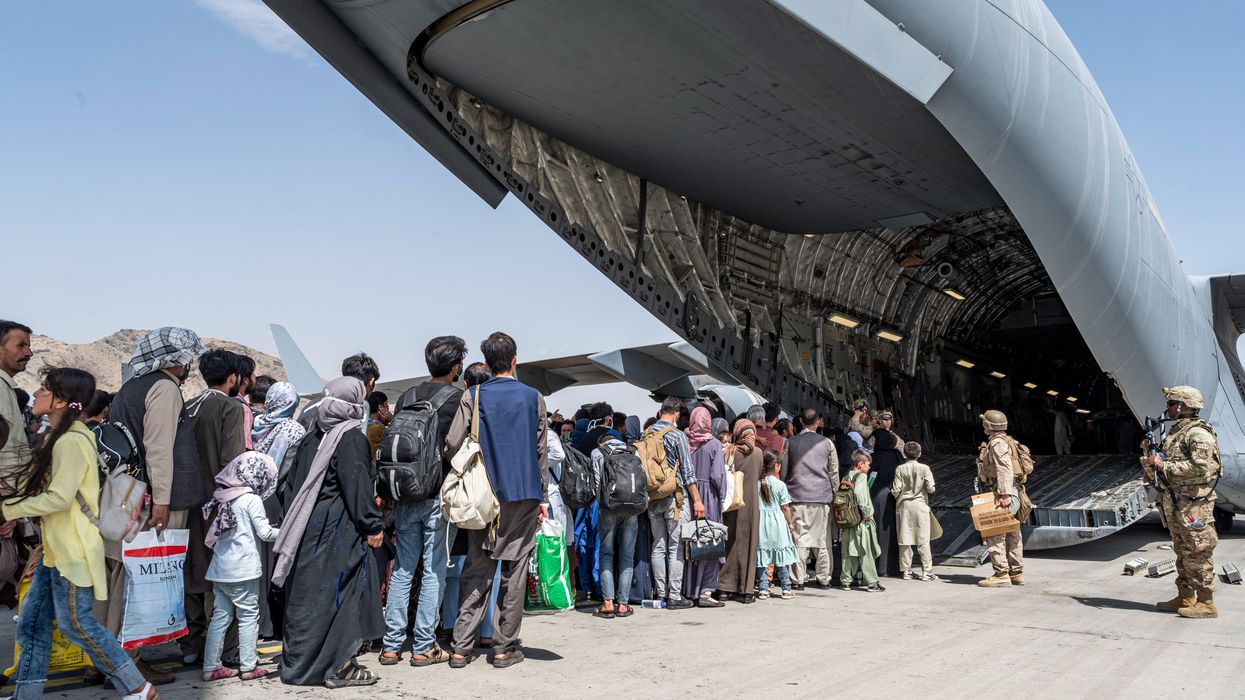
Afghan evacuees at Hamid Karzai International Airport in Kabul.

Leaving Afghanistan Shows Wisdom, Not Weakness

The suicide bombing that killed 13 U.S. service members and at least 169 Afghans was an atrocity that evoked horror in Americans of every political persuasion. But among those who want to continue the war, the loss was taken as proof that the U.S. should have persisted in a mission that had previously claimed the lives of more than 2,400 Americans.

Had we been willing to go on spilling American blood to stay in Afghanistan, we would not have had to spill blood leaving it. The logic is peculiar.

But the hawks always find a way to justify endless war. They can't very well pretend that we could win in Afghanistan, now or ever. So they find boundless reasons to criticize the manner of our withdrawal, which was bound to be a messy, dangerous process.

They also resort to hollow cliches. Former Secretary of State Mike Pompeo accused the administration of "weakness." Sen. Ben Sasse (R-NE), asserted that "China and Russia will look to capitalize on Biden's weakness." Council on Foreign Relations President Richard Haass said the outcome "will reinforce questions about U.S. reliability."

Some of our European allies joined the chorus. A Conservative parliamentary leader in Britain said the withdrawal is "the biggest foreign policy disaster since Suez" — as though the wars in Afghanistan and Iraq were not gargantuan catastrophes.

Carping about alleged displays of weakness and loss of credibility is the familiar fallback of those trying to sustain a pointless military undertaking. They insist that ending it will have harmful effects on how others perceive us — a claim so vaporous it is impossible to disprove.

Their logic is that if we do something stupid, we have to keep doing it no matter what, because, you know, only weak people repent of their stupidity.

But if committing 20 years — as well as nearly 25,000 American casualties and more than $2 trillion — didn't persuade other governments of our resolve and staying power, it's hard to believe that Year 21 would be a game-changer. Foreigners might instead marvel at our willingness to lavish so much for so long on a mission that did little or nothing to enhance our security. They could deduce that when genuine U.S. interests are at stake, the sky is the limit on what we'd be willing to do.

Biden has shown a dedication to strengthening our alliances that his predecessor did not. President Donald Trump showed much fonder feelings for Russian President Vladimir Putin than for German Chancellor Angela Merkel or French President Emmanuel Macron.

Trump, in fact, bitterly resented our support of NATO. He even raised the possibility of refusing to honor our obligation, under Article 5 of the alliance treaty, to come to the defense of any member of the alliance who was attacked. Privately, he repeatedly expressed his desire to pull out of NATO.

Biden, by contrast, proudly wore a NATO lapel pin to a summit with European leaders in Brussels and declared: "Article 5 we take as a sacred obligation. I want NATO to know America is there." His principal difference with Merkel and Macron at that meeting lay in his desire to take a tougher line against China.

History offers additional evidence that ending a foolish, costly war will not degrade our international standing. Hawkish types said our 1973 withdrawal from Vietnam would speed the march of communism throughout the world. But it somehow failed to prevent the collapse of the Soviet Union, the liberation of Eastern Europe, or the capitalist transformation of China.

Our adversaries have good reason not to test the proposition that the Biden administration is weak. Our military spending, after all, amounts to more than that of the next 11 countries combined. Our Navy has a dominant worldwide reach that no other country can come remotely close to matching.

Our ground forces have decades of combat experience that Russian and Chinese troops lack. Our peerless air power is a deterrent to adversaries from Tehran to Pyongyang.

Ending our involvement in Afghanistan doesn't weaken our posture against our adversaries. It strengthens it, by letting us direct our resources and attention to matters that directly implicate our national security. Biden, for better or worse, is not presiding over a retreat from our role in the world — merely a sensible reshaping of it.

Thursday's bombing was a disaster. But staying in Afghanistan would only have guaranteed more like it.

Follow Steve Chapman on Twitter @SteveChapman13 or at https://www.facebook.com/stevechapman13. To find out more about Steve Chapman and read features by other Creators Syndicate writers and cartoonists, visit the Creators Syndicate website at www.creators.com

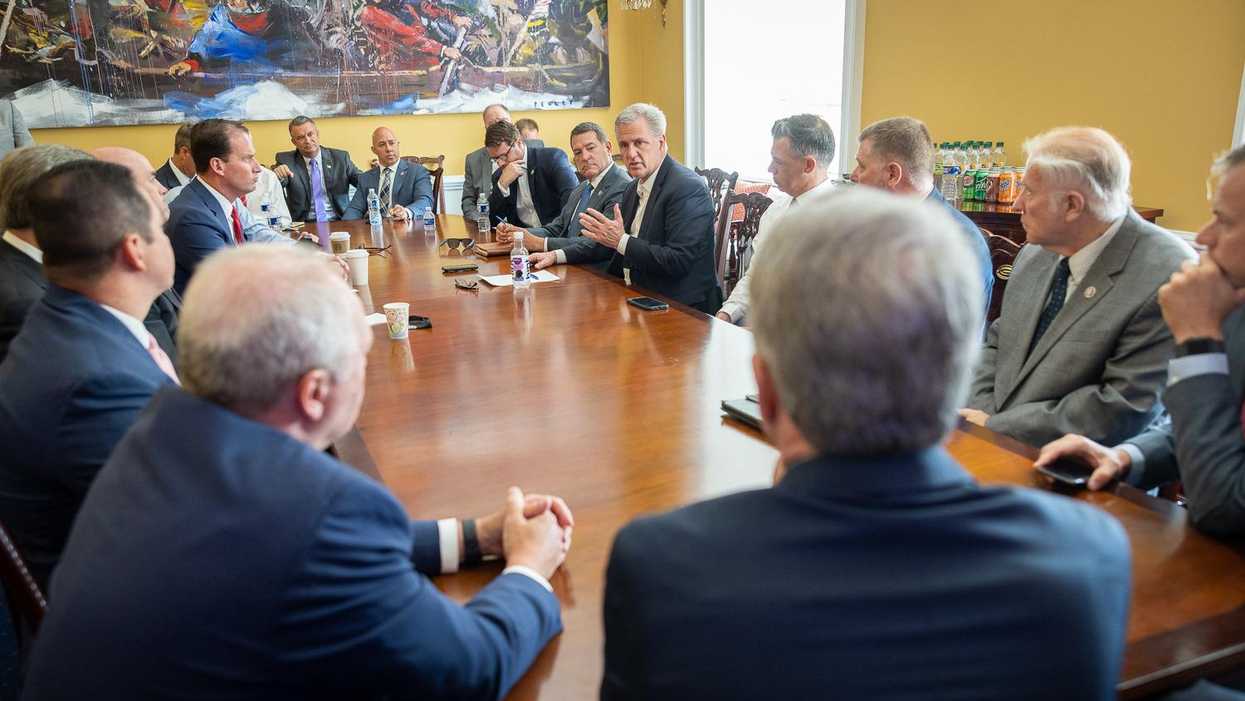
Rep. Kevin McCarthy leads an Afghan discussion with Republican Congressmen.

For Republicans, Afghanistan Is Merely Another Way To Damage Biden

Reprinted with permission from Daily Kos

On Thursday, President Joe Biden addressed the nation after an explosion outside of Hamid Karzai International Airport took the lives of 13 American service members. In that speech, Biden sent condolences to the families of those lost, promised to track down the terrorists behind the attack, reaffirmed his commitment to carry on with the evacuation in Afghanistan, praised the sacrifice and dedication of the all-volunteer military, took full responsibility for his decisions, and doubled-down on bringing the 20-year conflict to a close.

In response, Republicans made it clear that they have a strategy of their own. That strategy won't get one more person out of Afghanistan. It won't save the lives of a single service member. It's not concerned with finding the ISIS-K terrorists behind the explosion. It isn't concerned with taking any responsibility. It most certainly doesn't want the war to end. Nope. The Republican plan for Afghanistan is blindingly simple: With the help of the media, use it to damage Joe Biden.

As CNN reports, the only thing bothering Republicans about Afghanistan is a divide over just how they can leverage the death of American service members as political fodder.

In 1982, President Ronald Reagan sent 800 U.S. Marines into Lebanon to help push leftist Palestinians out of the country and protect gains made by the Christian Phalange militia in a long-running civil war. Afterward, a Marine was killed by a bomb, snipers killed several more Marines, 63 people were killed when a suicide driver cruised an explosive-laden van into the U.S. embassy, and 241 service members were killed when another terrorist drove a sophisticated truck bomb into the central Marine barracks. It was the most significant single-day number of American Marines lost since the Battle of Iwo Jima.

Post-bombing reports showed that the Marines had not been allowed to maintain a secure perimeter for pollical reasons. Still, Reagan went in front of the nation and vowed that the Marines would stay until the mission was complete. Except they didn't. After four months of no progress, Reagan pulled the Marines out. The identities of the terrorists who drove a van into the U.S. embassy and the terrorists who drove a truck into the Marine barracks were never established. It was never clear where they came from or what group they supported.

Following this, Reagan was reelected by a record margin in November 1984. But that, of course, was a different time. Also, Reagan managed to squeeze a whole second war into the time between pulling out the Marines and Election Day. And in that second little war—which even Margaret Thatcher thought was ridiculous—only 20 Marines got killed. Reagan ran on these examples of his willingness to expend American lives.

Currently, there's a civil war in the Republican Party between those who want to impeach Joe Biden (or call on him to resign right now ) and those who are willing to wait until Republicans gain an expected House majority in the 2022 election.

Few things could illustrate the total lack of concern that Republicans hold for the actual situation in Afghanistan better than a press briefing McCarthy held on Friday morning. As NBC News reporter Jake Sherman reported, McCarthy didn't bother with checking to see if he had a coherent statement concerning what was actually happening. Instead, the Republican leader called for every troop to come out of Afghanistan while simultaneously insisting that Bagram Airbase be reoccupied. Then he said that America should keep some troops in Afghanistan, but we shouldn't be negotiating with the Taliban. And when it was pointed out that Trump negotiated with the Taliban, McCarthy just moved on to debate the best time to impeach Biden. McCarthy doesn't have a position on that, either, because McCarthy's position is never more than what the crowd is calling for at that exact second.

When it comes to developing an actual proposal on what to do in Afghanistan, Republicans have one clear position: Why?

Why should they? Why bother when, as Huff Post pointed out on Thursday, Republicans can simultaneously make calls for actions that would require Biden to reinvade the entire country, and at the same time, criticize him for not getting every single person out of the nation without a scratch. The media won't challenge the lack of reason or consistency. Why do anything more? As long as Republicans can see that networks will gladly put them on the air and echo their statements about "chaos" and "failure," having an actual strategy on Afghanistan would only be a liability.

That frees Republicans to concentrate on the one thing that genuinely concerns them: 2022. Untethered from either the necessity of governing or the need to have a coherent platform, Republicans can be all-attack all the time. That allows statements like this from Republican Rep. Mark Green, "I'd put more military in there, I'd get every single American out, and I'd start killing bad guys." Or Sen. Ben Sasse writing a note in which he declares that America needs to "reverse course" and occupy most of Afghanistan because ending the war shows "weakness."

None of it makes sense. It doesn't have to make sense. Because Republicans don't consider their enemy to be either the Taliban or ISIS-K, they don't consider their goal to be getting Americans out safely. They certainly aren't interested in ending the war.

They're only interested in evacuating Democrats from the House, Senate, and White House. And in that scheme, they seem to have plenty of allies.

Man with QAnon t-shirt

Poll Shows Devout Evangelicals More Likely To Join QAnon Cult

Reprinted with permission from Alternet

Although QAnon isn't a religious movement per se, the far-right conspiracy theorists have enjoyed some of their strongest support from white evangelicals — who share their adoration of former President Donald Trump. And polling research from The Economist and YouGov shows that among those who are religious, White evangelicals are the most QAnon-friendly.

The Economist explains, "One prominent theory is that Americans who have no religious affiliation find themselves attracted to other causes, such as the Q craze. Another, posited by Ben Sasse, a Republican senator from Nebraska, is that modern strains of Christian evangelicalism which 'run on dopey apocalypse-mongering' do not entirely satisfy all worshippers — and so, they go on to find community and salvation in other groups, such as QAnon. Using The Economist's polling with YouGov, an online pollster, we can test both of these theories."

Sasse's willingness to call out "dopey apocalypse-mongering" among some white evangelicals shouldn't be taken as a criticism of religion in general. The conservative Nebraska Republican draws a distinction between extremists and non-extremists within Christianity. And the Economist/YouGov poll underscores the fact that among Christians, one finds a variety of opinions where QAnon is concerned.

"From July 10 to July 13, 2021, YouGov asked Americans their racial and religious affiliations, whether they thought of QAnon favorably or unfavorably and whether they believed in a variety of popular conspiracy theories," The Economist notes. "Those theories included old stand-bys, such as whether the moon landing in 1969 was faked."

The Economist continues: "According to YouGov's recent polling, which we combined with an earlier survey from March to obtain a larger sample size, Americans who attend church the least are also the least likely to have a favorable view of QAnon. Among those who say they 'never' go to church, just nine percent who have heard of the QAnon conspiracy view it favorably. Fully 92 percent of these respondents view it unfavorably — a net favorability of minus 83 percentage points."

According to The Economist, "The rating among people who attend church the most — once a month or more — is minus 52 points."

"We ran a statistical model to control for potential links between attitudes towards QAnon and other demographics — such as race, age, gender, education, party affiliation and vote choice in 2020," The Economist notes. "Our model confirmed that the relationship between church attendance and QAnon was not a statistical fluke: adults who attended church at least once a month were eight percentage points more likely than we predicted to rate QAnon favorably."

The Economist didn't find that QAnon is universally loved within Christianity by any means, but it did find that among Christians, white evangelicals are the most likely to be QAnon-friendly.

"White evangelicals, the most religiously devout group among those surveyed by YouGov, are particularly susceptible to supporting QAnon and believing other conspiracy theories," The Economist reports. "They also tend to attend church frequently. Twenty-two percent of evangelicals who know about QAnon view it favorably, according to YouGov's numbers — compared with 11 percent among the rest of the adult population. At the other end of the spectrum, 24 percent of evangelicals rate QAnon as 'very unfavorable,' compared with 58 percent among other people."

QAnon believes that the U.S. government has been infiltrated by an international cabal of child sex traffickers, pedophiles, Satanists and cannibals and that Trump was elected president in 2016 to fight the cabal. And as extreme as QAnon's beliefs are, some of their supporters are serving in Congress. Republican QAnon supporters who have been elected to the U.S. House of Representatives include Rep. Marjorie Taylor Greene of Georgia and Rep. Lauren Boebert of Colorado — and Michael Flynn, who briefly served as national security adviser under Trump in 2017, was a featured speaker at a QAnon event in Dallas.

Among white evangelicals, The Economist observes, a fondness for conspiracy theories isn't limited to those promoted by QAnon.

"White evangelicals are 34 percentage points more likely than other Americans to believe that 'millions of illegal votes' were cast in the 2020 election," according to The Economist. "These adults also tend to be more conservative, and vote for Republican politicians more often than non-whites and members of other religious groups do. Evangelicals are influenced by the official party line on issues of the day — even if they are conspiratorial. And adoption of one wild theory, perhaps made more persuasive by a politician's avowals, tends to lead to the adoption of others."

Shop our Store

Headlines

Editor's Blog

Trending

World