Tag: robert mueller
How 'Epstein Class Supervillain' Bannon Still Prospers As A Fake Populist

How 'Epstein Class Supervillain' Bannon Still Prospers As A Fake Populist

No Epstein class supervillain has paid any meaningful public or legal price for his crimes, other than throwing around cash settlements in exchange for silence. Evading justice is, of course, one element of supervillainy.

But there are gradations of evasion – from shamed hiding to gleeful skating.

This week, we want to take another look at one Epstein fanboy still smirking under the radar. The self-described “Leninist” strategist Steve Bannon masterminded one of the greatest political tricks in years: convincing poor whites that the Republican party – the party of the moneyed, the corporations and the borderless oligarchy, led by a nepo-baby fake businessman – is the faction that really cares about the welfare of “low propensity” voters.

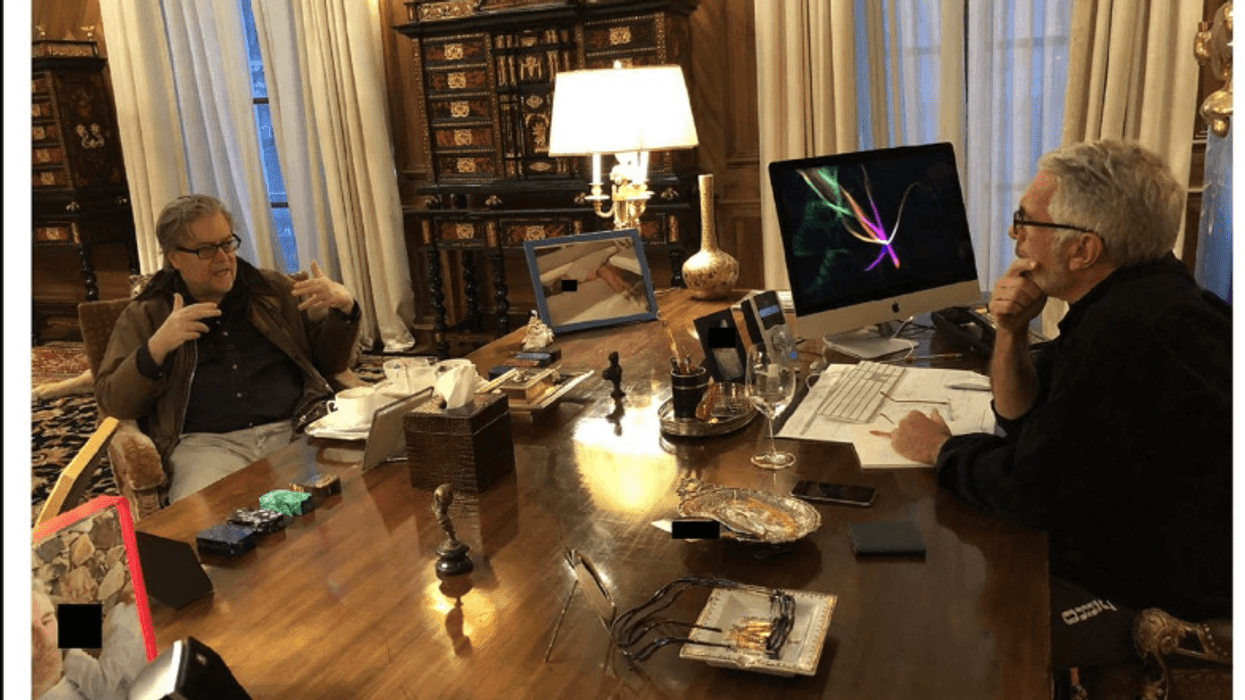
But the guy who made “elites versus working people” and “smash the administrative state” into right-wing rallying cries was also one of Epstein’s coziest pals in Trumpworld. In fact, DOJ records suggest that Epstein was the pivotal man in Bannon’s transformation from right-wing American douchebag with a string of failed marriages and a simmering resentment at Hollywood libs into an international man of mystery with a Bernard-Henri Lévy hairdo (maintained, on Epstein’s recommendation, with “simply silver” shampoo), cutting deals across Europe, the Middle East and Central Asia.

Bannon has so far not only avoided Epstein-related subpoenas or testimony of any kind, he has also managed to escape scrutiny from the very audience he spent years ginning up with Deep State pedo theories – an audience that Trump won over, in part, by promising to expose Epstein’s pals. He remains such an influential figure in MAGA world that he is poised to play a major role in Trump’s plan to cheat the midterms.

Besides Trump, Bannon is almost alone among exposed members of the Epstein class in remaining in good odor with the MAGAs who, a mere year ago, were demanding public shaming and legal action against all of Epstein’s pals.

The DOJ files reveal Bannon to be not just a pal of Epstein, but someone single-mindedly keyed into Epstein’s access to the global elite. Within weeks of their first meeting, Epstein connected him with influential UN diplomat Terje Rød-Larsen, who helped ease Bannon’s entry into geopolitical and financial hunting grounds like the Gulf monarchies and Mongolia, of which Bannon told Epstein, “we can make that place a crypto capital.”

Epstein seems to have advised Bannon as he broke away from Trump and set out to build his own “grassroots army.” He conferred with Bannon on launching his own dark money organization, “Citizens of the American Republic,” with $100 million in bitcoin, discussed with MIT’s Joi Ito the idea of helping Bannon finance his movement with a crypto “deplorable coin,” and encouraged Bannon to create a new “world bank of the people” for his “workers party.” Before long, Steve was hooked up with the director of Davos and moving and shaking with the sheiks.

Epstein called him “lambchop.”

The Epstein-Bannon bromance began around the fall of 2017, a few months after Bannon bottomed out of the White House. At the time, he claimed he had been liberated: “I feel jacked,” he told The Weekly Standard, “I’ve got my hands back on my [media] weapons.”

He fell even further out of favor with Trump by early 2018, when Michael Wolff quoted him calling Donald Trump Jr. “treasonous” for meeting with Russians at Trump Tower during the 2016 campaign. Bannon soon lost not just Trump but also the critical, lavish support of his eccentric billionaire patroness, Rebekah Mercer.

Enter Jeff.

The first mentions of Bannon and Epstein getting together appear in October 2017, when Wolff tells Epstein that Bannon “wants a secret meet.” Epstein was, of course, fine with secrets. He instructed Wolff to “suggest to SB that my meeting with him is just he and me. better to have total privacy on certain issues [sic].” A few days later, he cast another lure, advising Wolff, “you can tell SB , I have some ideas for him [sic]”.

The beautiful friendship kicked off with this February 2018 exchange:
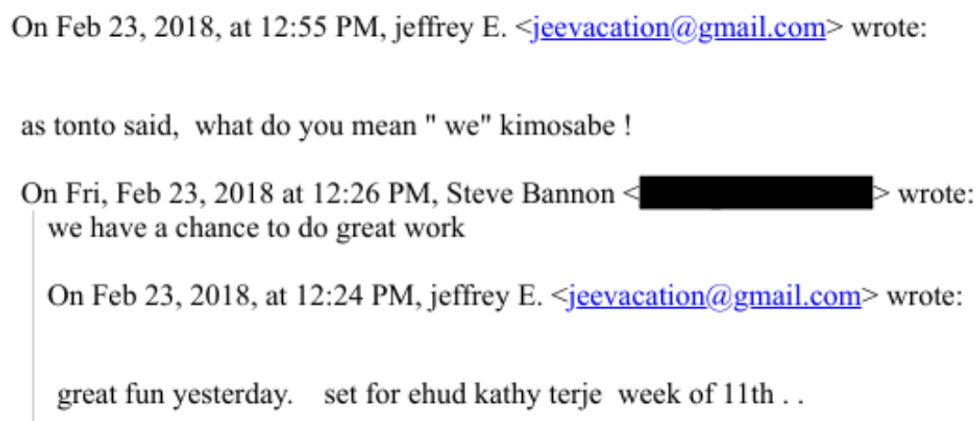
Soon, Wolff was reporting that Bannon was “all hepped up on Saudi stuff.” “I told him you were the man,” Wolff wrote Epstein. “He seemed to know that.”

Within a few months, Epstein was jetting Bannon over to the Middle East to meet some of his other special friends among the Gulf oil monarchies. “All the boys are celebrating ramadan but will see you if you want,” Epstein wrote in a May 2018 text exchange. “Only there for 2 days and going out in desert with mbz [sic],” replied Bannon, referring to the leader of the United Arab Emirates.

Epstein also played sideline cheerleader as Bannon got dragged into the various 2018 congressional probes into Trump’s sleaze, urging him to “stay mentally tough” in the face of subpoenas from the House Intelligence Committee and the Mueller investigation. He even offered Bannon the surveillance-resistant safety of his mansion, which, he bragged in one email, “is similar to a SCIF.”

Bannon ultimately agreed to cooperate with Mueller, just days before his first in-person meeting with Epstein in early 2018.

Epstein’s lawyer and pal Reid Weingarten (who we covered last week) was excited about bringing Bannon into the Epstein claque. “Try to make the bannon [sic] meet happen with me there,” he wrote Epstein in early 2018. “There is play here…”

Epstein was also consulting his feminist “arch defender,” superlawyer Kathy Ruemmler, about Bannon, while looping him in on the activities of her client, Lebanese businessman George Nader. Coincidentally – or not – Ruemmler was representing Nader, a convicted pedophile, who, like Bannon, was cooperating with the Mueller investigation.

Bannon’s communications with Epstein reveal more about the behind-the-scenes geopolitical activities that involved national security, great game rivalry with China over tech, and, presumably, money.

In one lengthy May 2019 exchange – as Bannon was planning a trip to Kazakhstan arranged by Epstein – they discuss Saudi Arabia using China’s Huawei for 5G, which the U.S. felt would give China a surveillance edge in the Middle East. “You saw where they begged us to give 90 day reprieve on huawai [sic],” Bannon writes. “Yes of course,” Epstein responds. “The real game is in the shadows … as usual.” Their “game” somehow involved the Kazakh government: “kazakh daughter the key,” Epstein advised before telling him, “Im asking for a meeting with the pres and intelligence chief [sic].”

Bannon was no stranger to the dark side. He actually got his new friend Jeff quite worried about his relationship with Chinese fraudster Guo Wengui, on whose private jet Bannon flew around the country stumping for Republicans in summer 2018, possibly violating campaign finance laws. Two years later, Bannon was lolling aboard Guo’s $28 million yacht when he was arrested for defrauding small “big beautiful wall” donors. (Trump later pardoned him.)

Last week, Guo was sentenced to 30 years in prison for massively defrauding investors. But for several years, Bannon had a million-dollar consulting contract with him.

In their emails, Bannon and Epstein refer to Guo as “Kwok” – “Miles Kwok” being another name Guo used. Epstein seems to have become wise to the real Kwok/Guo before Bannon did, and he warned him repeatedly.

“Do u know my man miles kwok [sic],” Bannon texts in one thread.

Epstein cautioned that the Chinese businessman was going to get them both in trouble. “Careful,” he warned Bannon.

In the same thread, they joke about the movie Chinatown and the famous scene in which Roman Polanski slices Jack Nicholson’s nose. Jeff writes: “my very close friends as a favor , also would like you safe … if either one of us , in different investigations will need to testify publicly, it would be preferred to do it with two nostrils instead of one [sic].”

It’s not clear which of Epstein’s “very close friends” wanted Bannon “safe” – or what exactly they thought Guo could do to them.

Later in the same exchange, Epstein writes, “re kwok , honybear ok. icarus not [sic]”. “Will explain kwok later-- like trump an instrument,” Bannon responds, to which Epstein replies, “I am very well informed there. , didn’t know it was him [sic]”. (Epstein’s “honeybear” remark is a reference to Bannon’s favorite nickname for himself: “Honey Badger.”)

By December 2018, six months before Epstein’s arrest, the two men were such close buds they were yukking it up about the #MeToo movement – “so many guys caught in the me too . reaching out to me [sic],” Epstein wrote – and joking about organizing a “million man march” on Washington where everyone would wear “pink dick hats.” Another favorite target was their mutual acquaintance Donald Trump. “If you Google the word idiot, a picture of Donald Trump comes up …” Epstein texted. “Pop-up picture ---signed,” Bannon quipped back.

Bannon has recovered from his fall after Trump 1.0. His pardon in the fraud case and his stint in jail for blowing off a congressional subpoena only burnished his legend as a rebel against the Deep State. He remains extremely influential through his War Room media platform, the same platform he used for years to juice the Epstein Deep State conspiracy.

This Epstein class insider has remained a leader of the “deplorables” – perhaps not so shockingly, given that a million of them recently let Trump fleece them with his crypto coin for a reported $3.8 billion.

Bannon’s War Room doesn’t have the reach of Fox. But it is available across a wide range of platforms, including Real America’s Voice, Apple Podcasts, Rumble, Spotify, as well as X and email lists. It now functions as a powerful political organizing tool. Bannon always gives his listeners something to do: show up at school boards, pressure members of Congress, flood phone lines, organize local conventions, challenge elections, and support specific candidates.

He has kept the pedal to the metal on the 2020 election lies.

If anything, his influence is greater in the second Trump administration than it was in the first. War Room is now a key stop on the right-wing DC media circuit. And it is gearing up to serve as a critical node in the alliance between influencers, right-wing media and the White House as they prepare the vote suppression and election fraud plot to subvert the midterms.

There is one reliably incendiary topic, though, that Bannon has jettisoned along the way to his current position as the King of Fake Populists.

It begins with the letter E.

Nina Burleigh is a journalist, author, documentary producer, and adjunct professor at New York University's Arthur L. Carter Journalism Institute. She has written eight books including her recently published novel, Zero Visibility Possible.

Katie Chenoweth is associate professor of French at Princeton University and an investigative researcher.

Reprinted with permission from American Freakshow
Why Trump Viciously Celebrated The Death Of Robert Mueller, American Patriot

Why Trump Viciously Celebrated The Death Of Robert Mueller, American Patriot

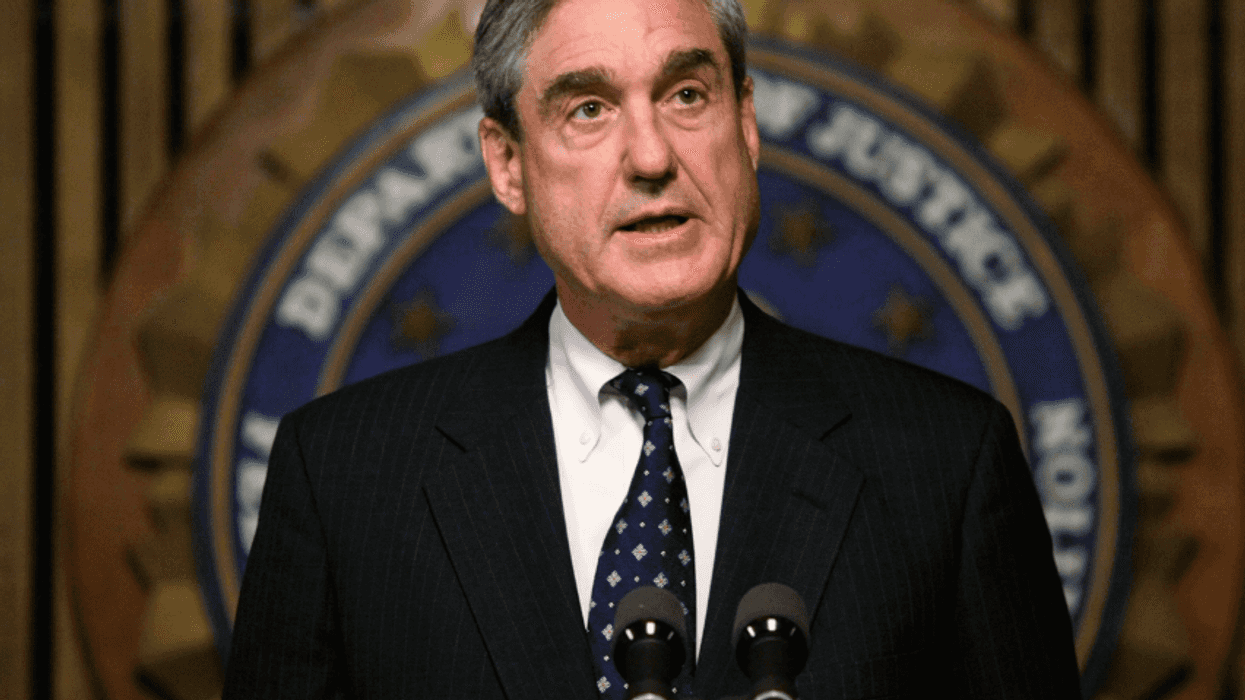
On Friday night, March 20, Robert Mueller -- a former Department of Justice (DOJ) special counsel, ex-FBI director and former deputy U.S. attorney general —passed away at 81 after a long struggle with Parkinson's disease. President Donald Trump was quick to celebrate Mueller's death, posting, on his Truth Social platform, "Good, I'm glad he's dead. He can no longer hurt innocent people. President DONALD J. TRUMP."

Mueller was a conservative Republican and decorated Marine veteran, appointed deputy U.S. attorney general by President George H.W. Bush and FBI director by President George W. Bush (although Democratic President Barack Obama kept him as FBI director throughout his first term and into his second). But Trump resented Mueller bitterly because of his work as DOJ special counsel for the investigation of Russian interference in the United States' 2016 presidential election.

Mediaite's Colby Hall looks back on the Mueller Report in an article published on March 23, arguing that its findings still serve as a warning about Trump.

"Start with what Mueller actually established," Hall writes. "Russia carried out a coordinated intelligence operation to influence the 2016 election. Russian military intelligence hacked Democratic e-mails and released them through WikiLeaks in strategically timed waves…. The Trump campaign did not simply exist alongside that effort. It engaged with it in ways that are difficult to dismiss…. None of this resulted in a charged criminal conspiracy."

Hall continues, "Mueller concluded the evidence did not meet that threshold. That finding became the foundation for the claim that the entire investigation was a hoax. But that claim only works if you collapse a legal judgment into a factual one — and if you ignore the sustained effort to make that collapse feel inevitable."After DOJ released the Mueller Report, Hall notes, Trump repeatedly used the phrase "no collusion" — which "does not describe the investigation Mueller conducted."

"The reaction to his death shows how complete that transformation has been," Hall explains. "A lifetime of public service is reduced to a punchline. A documented foreign intelligence operation is recast as a partisan invention. The facts are more stubborn than that."

Hall adds, "Russia interfered. The Trump campaign was not a passive bystander. And calling the investigation a hoax requires ignoring not just Mueller's findings, but those of the Republican-led Senate committee that confirmed them — and then watched quietly as they were erased."

Reprinted with permission from Alternet

Santos Saga Features Russian Oligarch, His Bagman, And Paul Manafort

Santos Saga Features Russian Oligarch, His Bagman, And Paul Manafort

I love writing these columns. Do you love reading them? You can out by becoming a paid subscriber or giving someone a gift subscription to my Substack for New Years!

Folks, it’s never a good sign when two county prosecutors and the federal government are looking into your undies drawer. The Queens County District Attorney's office announced today that they are looking into any potential crimes committed by serial liar and erstwhile representative-elect from New York’s Third Congressional district, covering northern Nassau County and parts of the Borough of Queens. The offices of the Nassau County District Attorney and the U.S. Attorney for the Eastern District of New York have also announced investigations into whether Santos has committed any crimes.

It also became known yesterday that Santos lied about his mother’s death. He had already lied about his mother’s birth and possibly her name, but this time he claimed that his mother was working in the South Tower of the World Trade Center on September 11, 2001, and survived the terrorist attack that day but died a few days later. No one has been able to find any records of his mother’s passing in 2001, but Santos himself helpfully tweeted on December 23rd of last year that the date marked the five year anniversary of his mother’s death, which would put her passing in 2016, a year there were no terrorist attacks on the World Trade Center or anywhere else in the United States for that matter, unless you include November 8, when Donald Trump won an election he claimed was “rigged” for the presidency.

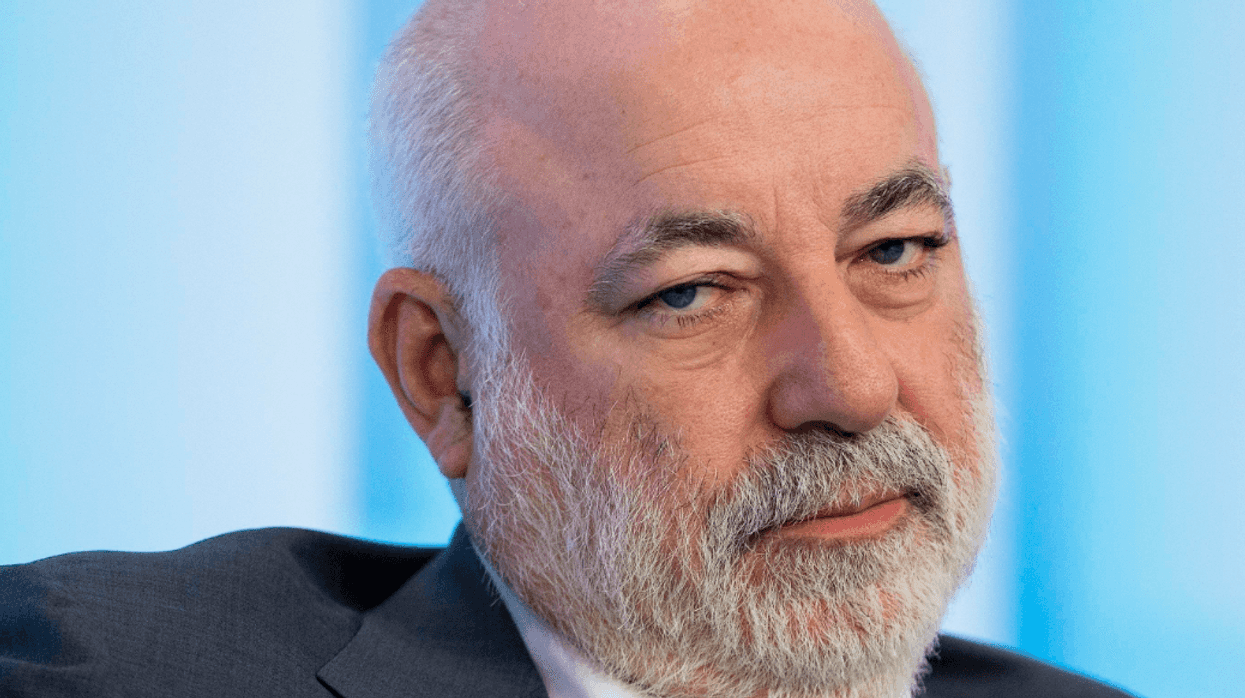
And it emerged this week that Santos was the recipient of some $56,100 in various campaign contributions from Andrew Intrater and his wife. Intrater is or has been an investment adviser to his cousin, Russian oligarch Viktor Vekselberg, who is close to Russian President Vladimir Putin. Vekselberg was sanctioned by the U.S. government in 2018 for his ties to Putin and the Russian computer hacking group indicted by Special Counsel Robert Mueller for interfering in the 2016 election. Vekselberg was stopped by FBI agents at Teterboro Airport in 2018 and questioned about his ties to the Russian government. His cell phone was also seized.

Vekselberg also attended Trump’s 2016 inauguration and was present at the infamous dinner in Moscow in 2015 when Michael Flynn sat next to Putin and was the featured speaker. Flynn was then employed by the Trump campaign as its chief foreign affairs advisor and would go on to become Trump’s first national security adviser. His term in office lasted just over two weeks before he was fired for lying to the FBI about his contacts with Russian Ambassador Sergey Kislyak about lifting sanctions imposed by the Obama Administration on Russian officials and certain oligarchs for their involvement in trying to influence the 2016 election.

Vekselberg was the single largest shareholder in the Bank of Cyprus, a bank which was involved in funneling money to Trump’s campaign chairman, Paul Manafort, when he was working for the right-wing government of Ukraine. Manafort was indicted, tried, and convicted of financial crimes involving his time as a political adviser to pro-Russian candidate for the Ukrainian presidency, Viktor Yanukovych, who won the office but was later ousted by Ukrainian demonstrators in a “soft” revolution seeking closer ties to NATO and the European Union. Yanukovych fled Ukraine, leaving behind a gaudy palace he had built for himself, along with a private zoo of exotic animals.

Here is where it gets more and more interesting. In February of this year, in the weeks before Putin’s illegal invasion of Ukraine, Santos was busy tweeting pro-Russian garbage and attacking President Biden: “Joe Biden is willing to start a war in Eastern Europe and send American soldiers to a deadly combat zone to protect Ukraine’s border, but fails miserably to protect the American southern border,” was one tweet on February 2, just three weeks before the Russian invasion. Ten days later, on February 12, Santos tweeted: “We are going to enter a war in the middle of the Eastern Europe winter against Russia, to defend the sovereignty of Ukraine. Meanwhile this is the sight at the US southern border, where our sovereignty is no longer a priority.” Both tweets were accompanied with photos of immigrants crossing the border between the U.S. and Mexico.

At the time Santos made these tweets, his campaign had already received $32,800 from Intrater, the cousin and money manager for Vekselberg, friend of Putin and owner of most of Russia’s aluminum industry. Later this year, in the midst of his campaign for Congress, Santos told the Washington Post that Ukrainians had “welcomed the Russians into their provinces.” He went on to tell the paper, “It’s not like Ukraine is a great democracy. It’s a totalitarian regime. They’re not a great bastion of freedom.”

After the Russian invasion of Ukraine began, Santos went on Fox News and claimed that his grandfather was Ukrainian. On the date of the invasion, Santos tweeted, “Pray for Ukraine!”

As I reported yesterday, The Forward located genealogy records proving that Santos’ grandparents were born in Brazil before World War II, shooting down his claims that they were Holocaust survivors who escaped Europe through Brussels.

The Daily Beast reported this week that the lying sack of shit only began using the name Santos after his association with a Ponzi scheme in Florida that collapsed, costing investors in the scheme more than $17 million. Before that, “Santos” was calling himself George Devolder. When he first ran for Congress in 2020, he began calling himself George Devolder-Santos, and then this year ran as plain old George Santos. It is unclear what names his purported Ukrainian grandparents used.

It is clear, however, that Santos received one hell of a lot of money from Andrew Intrater and his wife. The Daily Beast reported that Intrater poured $20,000 into something called GADS PAC, “a leadership political action committee bearing the candidates initials, plus $12,100 to Devolder Santos Nassau Victory, a joint fundraising committee formed with the Nassau County Republican Party.” The Nassau County Republican Party announced this week that it would not back Santos if he runs for reelection in 2024.

Everyone has been wondering where this character Santos, who only recently was being evicted from rundown apartments in Queens and stiffing friends who loaned him money, got the cash to run for Congress this year. He “loaned” $700,000 to his own campaign using money no one can find the source of, other than the company he set up and dissolved within a single year called the Devolder Organization.

Santos, who used the name Devolder when he was fleecing Floridians out of their hard-earned savings, is now claiming that’s his middle name. But who knows? He also claimed that his company “lost four employees” at the Pulse nightclub massacre in Florida. That was before he claimed in a radio interview that they weren’t exactly employees but were potential employees “in the process of being hired.”

But that was before he was taking money from friends of Putin and accusing Ukraine of being a “totalitarian regime,” which was before he was taking the side of Ukraine in its war with Russia…but who knows? Maybe tomorrow he’ll claim his Brazilian heritage and jump on a jet and move into his non-existent apartment in Rio worth “between $500,001 and $1 million.” That is, if he hasn’t faced yet another eviction by then.

Lucian K. Truscott IV, a graduate of West Point, has had a 50-year career as a journalist, novelist, and screenwriter. He has covered Watergate, the Stonewall riots, and wars in Lebanon, Iraq, and Afghanistan. He is also the author of five bestselling novels. You can subscribe to his daily columns at luciantruscott.substack.com and follow him on Twitter @LucianKTruscott and on Facebook at Lucian K. Truscott IV.

Please consider subscribing to Lucian Truscott Newsletter, from which this is reprinted with permission.

Can The January 6 Hearings Save Our Democracy From 'Institutionalism'?

Can The January 6 Hearings Save Our Democracy From 'Institutionalism'?

Well before the House Select Committee’s January 6 investigation began, trust in the classic American system of checks and balances as reliable protection against executive (or, more recently, Supreme Court) abuses of power had already fallen into a state of disgrace. A domestically shackled Biden presidency, a Congress unable to act, and a Supreme Court that seems ever more like an autocratic governing body has left American “democracy” looking grim indeed.

Now, those hearings are offering the country (and the Justice Department) what could be a last chance to begin restoring the kind of governance that once underlay a functioning democracy. There is, however, a deeply worrisome trend lurking just under this moment’s attempt to garner accountability — namely, the way loyalty to institutional Washington (even outside the law) perpetuates a flight from accountability that’s become a crucial part of American political life.

So far, the January 6 hearings have inspired a cascade of takeaways. With each televised session, new evidence about the acts of Donald Trump and crew have come to light, among them that the former president was all too tight with the far right and that he knew the crowd approaching the Capitol on January 6, 2021, was armed and dangerous. So, too, those watching have learned about witness tampering and also the lengths White House lawyers and others went to in trying to restrain the former president’s engagement with the January 6th rioters. Overall, many Americans (though not so many Republicans) have learned that January 6th was part of a far larger Trumpian effort to negate the results of the 2020 presidential election, no matter the facts or the law.

Beyond chronicling what happened and assigning blame, something else in those hearings is worth noting: namely, they are exposing the ever-growing contradiction between Washington institutionalists, whose first loyalty is to the agencies and departments they served or are serving, and the supposed purpose or mission of those very institutions. And all of this will take the U.S. even further from the democracy it still claims to be, if those who have served in them and in the White House can’t be held accountable for their abuses of power and violations of law.

Over The Cliff Of False Institutionalism

For a long time now, the mechanisms of our democratic system of government meant to ensure accountability have been at the edge of collapse, if not obliteration. Who could forget how — something I’ve written about over the years at TomDispatch — the government officials who, in the wake of the 9/11 attacks, led us into the Global War on Terror found myriad ways to evade or defang the checks and balances of the courts and Congress? In the process, they managed to escape all accountability for their crimes. To offer a striking example: the top officials in the administration of President George W. Bush lied about Iraqi autocrat Saddam Hussein having weapons of mass destruction, which was their main excuse for their assault on his country in 2003.

According to the invaluable Costs of War Project, a year and a half after invading Afghanistan in 2001, the top officials of the Bush administration took this country into a war in Iraq that would cost the lives of more than 4,500 American service members and nearly as many U.S. military contractors. Almost 200 journalists and aid workers would also die in that conflict, not to mention hundreds of thousands of Iraqis.

The Costs of War Project estimates that the overall war on terror those officials launched will, in the end, have a price tag of nearly eight trillion dollars. Add to that the impossible-to-calculate costs of their acts to the rule of law, since they dismantled individual liberties and made a mockery of human rights. After all, the top officials of that administration oversaw the secret rewriting of the law to make torture at CIA “black sites” legal, while imprisoning individuals, including Americans, without access to lawyers, due process, or the courts at a prison they built in Guantánamo Bay, Cuba, a system distinctly offshore of what until then had been known as American justice.

When Barack Obama took over the White House in 2009, his administration failed either to mount a course correction or punish any of the torturers or jailers and those who gave them the green light to do so. As the president put it then, he chose to “look forward as opposed to looking backwards.” He refused even to hold an investigation into the misdeeds of Bush administration policymakers and lawyers who had rendered us a nation of torture, while secretly implementing warrantless surveillance policies on a mass scale, keeping Guantánamo open, and failing to bring the disastrous American presences in Afghanistan and Iraq to an end.

Ironically, in explaining his reasons for not shining a light into those CIA black sites or so much else that preceded him, Obama pointed to the importance of honoring institutionalism. It was crucial, he argued, for the Agency to be able to continue to function in ways that an investigation might impede. “And part of my job,” the president explained, “is to make sure that, for example at the CIA, you’ve got extraordinarily talented people who are working very hard to keep Americans safe. I don’t want them to suddenly feel like they’ve got to spend all their time looking over their shoulders and lawyering.”

Consider that an early sign of a toxic default to the version of institutionalism that threatens us today.

In the Trump years, Special Counsel Robert Mueller’s report on the 2016 presidential elections stopped short of indicting the former president. Mueller’s task was to investigate potential Russian interference with that election and possible coordination with Trump in that endeavor. Mueller ultimately backed away from indicting the president for obstruction of justice, despite the evidence he had, citing an obscure 1973 Department of Justice memo from the Watergate era (reaffirmed in 2000). The memo argued that such an act would distract the president from the pressing affairs of his office.

“The spectacle of an indicted president still trying to serve as Chief Executive boggles the imagination,” the memo said, and Mueller’s mind was evidently still boggled when it came to Donald Trump and the coming 2020 election.And then there was the failure to investigate the institutional problems that accompanied the country’s initial handling of the Covid pandemic. There has never been the slightest accountability for the denialism that greeted its initial stages, nor any attempt to document what went wrong then.

In June 2021, Sens. Bob Menendez (D-NJ) and Susan Collins (R-ME) called for the creation of “an independent 9/11-style commission” to understand how the public had been left so unprotected by the Trump administration in those early pandemic months and to discuss what lessons should be drawn from it for a future pandemic. Senator Dianne Feinstein (D-CA) sponsored such an approach in the Senate, but nothing ever happened.

Such a narrative of accountability and blame might have exposed “the vulnerabilities of our public health system and issue[d] guidance for how we as a nation can better protect the American people.” But no such luck. The institutionalists prevailed and the bills are still lying dormant in Congress.

In these years, a continual distaste for self-examination and institutional reform has eviscerated notions of accountability, while leaving the nation unprepared and unprotected not only from future pandemics, but from abuses of power aimed directly at our democracy. So far, Donald Trump, in particular, has paid no price for his attacks on democracy, as the January 6th committee has made all too clear.

Institutionalists Vs. Accountability

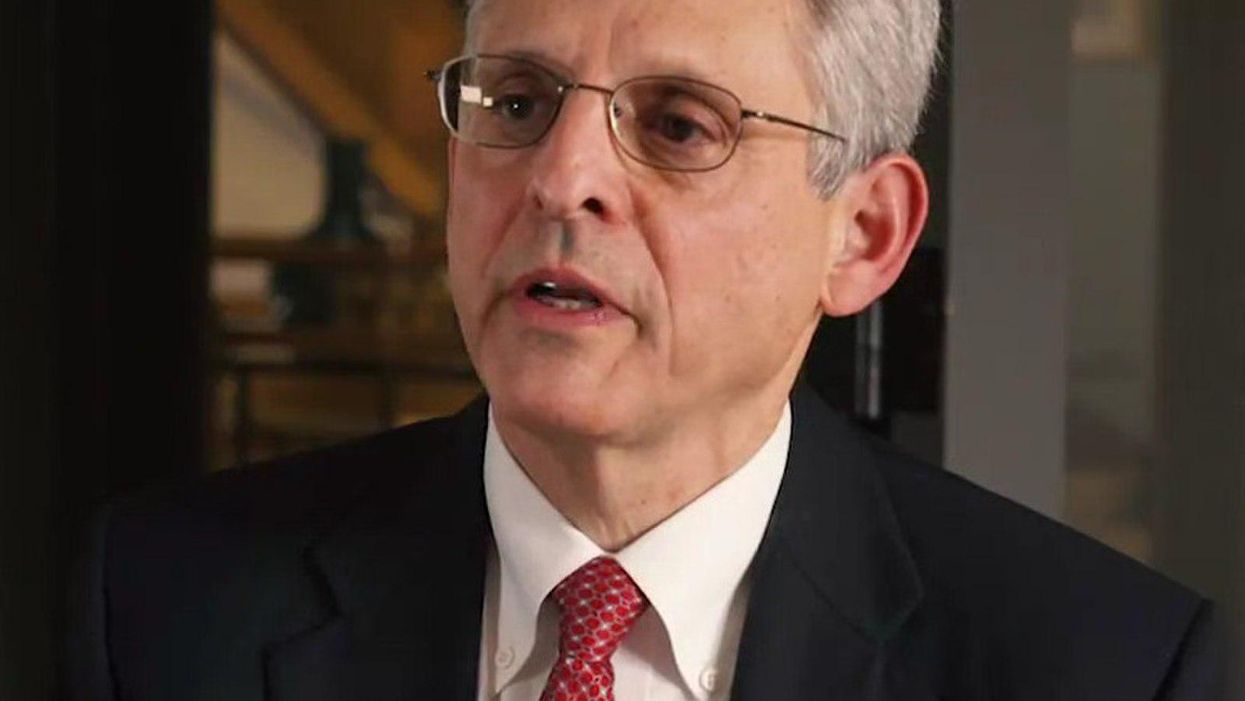
The January 6 hearings have only underscored the reticence of Attorney General Merrick Garland when it came to mounting a case against Donald Trump or any of his top officials. As former Acting Solicitor General Neal Katyal has written, “[W]e’ve seen no signs of such an investigation. Ordinarily, 17 months after a crime, one would expect to see some signs of an inquiry.” And yet Department of Justice (DOJ) veterans continue to attest to their faith that the institution and Attorney General Garland will rise to the occasion.

Harvard law professor and former DOJ official Jack Goldsmith recently asked readers to sympathize with the difficult decisions the attorney general has to deal with. Garland “arguably faces a conflict of interest,” Goldsmith wrote. He then added that Garland would not only have to be convinced that he had enough evidence to get a conviction in federal court, but would have to ask himself “whether the national interest would be served by prosecuting Mr. Trump.” Goldsmith does recognize that a failure to indict could send a message that the president, even Donald Trump, “is literally above the law.” Yet he still ends his piece with a plea for trust in the AG’s decision-making.

And Goldsmith is anything but alone in putting his faith in the institution above the dire necessity of holding top officials accountable. Eric Holder, Obama’s attorney general, a 10-year DOJ veteran, has, in the end, weighed in similarly. “I’m an institutionalist,” he told Margaret Brennan on Face the Nation, signaling his credentials as a trusting servant of that department. “My initial thought was not to indict the former president out of concern [for] how divisive it would be. But given what we have learned, I think that he probably has to be held accountable.” A mere two weeks later he, too, had backtracked, saying “we should have faith” in Garland and the prospect of future indictments of Trump and top members of his administration.

In reality, this embrace of institutionalism, far from being a badge of honor, has become a millstone around the neck of the Department of Justice and the nation as a whole. Throughout the tenure of William Barr as Trump’s attorney general, veterans of that department and career officials there assuaged the fears of those worried that he would contribute to its further politicization. As department veteran Harry Litman reassured Americans on NPR, “That would never be Bill Barr. He’s a[n] institutionalist. He understands the important values of the Department of Justice. He has integrity. He has stature. He’s nobody’s toady.”

As it turned out, until the very end of Trump’s presidency, Barr proved to be an institutionalist bent on twisting the definition to fit his needs. His numerous stints in the White House, going back to the early 1990s, turned his form of institutionalism into an embrace of loyalty to the president over any form of accountability. Before the report of Special Counsel Mueller was even released, Barr provided his own spin, contrary to its findings. As he told NPR:

“After carefully reviewing the facts and legal theories outlined in the report… the deputy attorney general and I concluded that the evidence developed by the special counsel is not sufficient to establish that the president committed an obstruction of justice offense.”

This, despite the fact that, as Mueller testified, he had concluded otherwise.

Such shout-outs to institutionalism have become an essential part of the post-Trump political scene as well, extending to the very nature of America’s governing principles. For example, institutionalists who oppose expansion of the Supreme Court argue that such a move would constitute “serious violations of norms” and ultimately “undermin[e] the democratic system” and “diminish [the court’s] independence and legitimacy,” or so a report on potential Supreme Court reform, commissioned by Biden in 2021, concluded. And even after the disastrous Supreme Court decisions repealing abortion rights and expanding gun rights, President Biden, the consummate self-declared institutionalist, indicated that expanding the court “is not something that he wants to do,” as if the traditions of our institutions are more important than fairness, the representation of the majority, or even justice itself.

Biden has similarly shown an impassioned reluctance to challenge Congress, refusing, for instance, to lead the way when it comes to ending the filibuster in the Senate. Earlier this year he did finally (and unsucessfully) support a carve-out from the filibuster in order to try to get a voting rights bill passed and more recently in support of passing abortion-rights legislation. But his belated and tepid words were at best mere gestures and utterly without effect.

Can The January 6 Hearings Change The Game?

The House Select Committee has been making its case directly to a remarkably substantial audience (mainly of Democrats and independents) — 20 million viewers for its opening evening session and 13 million for the daytime testimony of former White House aide to chief of staff Mark Meadows, Cassidy Hutchinson, who attracted the largest daytime audience yet for the hearings, far exceeding even the most watched cable news shows at that hour. And keep in mind that those viewers are, of course, potential voters this November.

In addition to the public, the Department of Justice has been a target audience for those hearings. As Rep. Liz Cheney, the committee's vice-chair, said: “The Justice Department doesn’t have to wait for the committee to make a criminal referral. There could be more than one criminal referral.”

There’s another target audience, too: American history and the possibility that the integrity of our institutions can someday be restored. The hearings themselves project the hope that, despite the disastrous failures of American democracy and institutional Washington in this century, there are still guardrails capable of protecting us and fortifying the mechanisms of accountability.

Rep. Adam Schiff (D-CA), a member of the select committee, has summed up the matter this way:

“[F]or four years, the Justice Department took the position that you can’t indict a sitting president. If the Department were now to take the position that you can’t investigate or indict a former president, then, a president becomes above the law. That’s a very dangerous idea that the founders would have never subscribed to.”

Given Washington’s reliance in these years on loyalty to institutions rather than to democracy, it’s little wonder that polls of Americans show a waning trust in those very institutions. A recent Gallup poll typically “marks new lows in confidence for all three branches of the federal government — the Supreme Court (25 percent), the presidency (23 percent) and Congress, which ranked at a truly dismal seven percent.

The question is: Can a revival of accountability as a cherished element of governance help to rebuild those institutions and trust in them, or are we headed for a far grimmer America in the near future?

The January 6 hearings offer a certain hope that accountability might put institutionalism in its place. Restoring it (and so the faith of the American people in our democracy) should be the sine qua non for a post-Trumpist future. Whatever virtues our institutions may have, their true value can only persist if they are accountable to the principles of democracy they were created to uphold.

Copyright 2022 Karen J. Greenberg

Karen J. Greenberg is the director of the Center on National Security at Fordham Law School and author most recently of Subtle Tools: The Dismantling of Democracy from the War on Terror to Donald Trump (Princeton University Press). Lindsey Sullivan contributed research for this article.

Reprinted with permission from TomDispatch

Shop our Store

Headlines

Editor's Blog

Trending

World