Tag: snap cutoff
I Was Wrong: Democrats Won A Dunkirk Victory In Shutdown Defeat

I Was Wrong: Democrats Won A Dunkirk Victory In Shutdown Defeat

In 1940, Winston Churchill ordered the evacuation of 338,000 troops facing annihilation on the beaches of Dunkirk. Churchill called the successful operation "a miracle of deliverance." Historians portray it as a perfect example of victory in defeat.

Democrats raging at eight members of their caucus for ending the government shutdown might take a few lessons from the master of morale and strategy. What some hotheads framed as "capitulation" is, in the long run, the wisest plan.

Right after Dunkirk, Churchill famously said, "Wars are not won by evacuations." That is so, but stopping a potential disaster lets your side fight another day. Ending the shutdown prevented negative outcomes that had begun chugging the Democrats' way.

Shutdowns almost always bite the party that starts them. The record for this is so strong that I thought Democrats had erred from Day One.

I was wrong. Democrats effectively used the headlines to highlight the issue sure to haunt Republicans come the midterms: the soaring cost of health care.

Democrats prevailed in the recent elections, partly on threats to their health coverage, partly on rising food prices, tariff chaos and in-your-face corruption. But at a certain point, the news started turning from the fight to extend the Obamacare subsidies to flights being canceled and the poor losing food assistance.

With Thanksgiving approaching, the sight of family members sitting on suitcases in airports is not optimal. As many more Americans feel shutdown pain at the personal level, Democrats are harder pressed to avoid blame, even if the public liked certain items they were fighting for.

Now some firebrands just want a fight. But their contention that reopening the government caused a loss of leverage is based on illusion. Democrats never held meaningful leverage because they don't have the votes. Republicans control the White House, the House, and the Senate.

To quote Barack Obama, "Elections have consequences."

The election of Trump and a mostly pliant Republican Congress created such consequences as attacks on Obamacare and, more ominously, our democratic institutions. Democrats can offer a prettier set of consequences, but they can only deliver them if they retake control.

The Democrats' winning message should be, elect us and we will restore health care security. Even the temporary loss of it will hit home. As another great American, Joni Mitchell, sang, "Don't it always seem to go that you don't know what you've got till it's gone?"

Now, if the shutdown worked in avoiding even some pain, that would be an argument in favor. But it wasn't.

Speaking for Democrats who voted to reopen the government, Maine Sen. Angus King, an independent, posed the right question: "Does the shutdown further the goal of achieving some needed support for the extension of the tax credits?" (He's referring to credits that were temporarily increased during the pandemic, making coverage cheaper for millions.)

These senators come from the swing states of Nevada, Virginia, Pennsylvania, New Hampshire and Maine. They are key to Democrats obtaining and keeping a majority in Congress. Without them, Democrats have no hope of obtaining real power. And without real power, their politics are just performance.

As noted, the shutdown did succeed in putting the specter of lost health coverage front and center. That mission has been accomplished. Trump's now railing that Obamacare is a "scam" to get the insurance companies filthy rich. Democrats should thank him for calling this revered benefit a "scam."

Assessing the dire situation at Dunkirk, Churchill chose not to make a heroic yet suicidal stand. But he followed closely with his immortal "We shall fight on the beaches" speech — a rally to the nation for continued resistance.

The midterms are the beaches that Democrats should be storming.
'The Ideas Are There': Shutdown End Signals Renewed GOP Assault On Health Care

'The Ideas Are There': Shutdown End Signals Renewed GOP Assault On Health Care

First they came for the federal employees. Then they slashed food stamps. And now that the Democrats have surrendered in their fight to preserve expanded Affordable Care Act subsidies and Medicaid funding, expect to see a full-blown attempt by the GOP to gut the individual market in December.

Fresh off their overwhelming victories in last week’s off-year elections, a handful of Democratic centrists decided the possibility of delayed Thanksgiving travel plans was the bridge too far when it comes to protecting millions of people from losing their health insurance.

I put the odds of the Democrats winning concessions in the promised December negotiations — if they actually take place — at about five percent. Why would the Trump-owned GOP agree to even a one-year extension of expanded subsidies when they are planning to offer their own plans for “lowering premiums” during next year’s mid-term election campaigns?

This morning’s Modern Healthcare reports GOP leaders are planning to reintroduce many of the same policies they floated but failed to pass in their many efforts to repeal Obamacare during Trump’s first term in office. They include rejiggering the original ACA subsidies so that people buying plans on the exchanges pay lower premiums but have higher co-pays and deductibles.

Also under consideration is expanding the amount of money people can put into health savings accounts to defray their out-of-pocket expenses. This is meaningless for most lower-wage workers — the ones hurt most when thrown into high-deductible plans. They can’t afford to take money out of their paychecks to put into a health care rainy day fund. Such policies are a gift to the well-insured upper middle class, not people in the bottom half of the wage distribution.

GOP efforts to pose as defenders of health care will also include a push to eliminate restrictions on short-term plans, which the Biden administration had limited to three-months duration. Such plans, which have none of the guaranteed coverage or cost controls included in ACA plans, were originally conceived as a bridge for people between jobs.

The Trump administration announced in August it wouldn’t enforce the Biden rule. At the time, it said it plans to promulgate new rules giving such plans a one-year duration and allow people to stay on them for three consecutive years. Passing a law would get that job done more quickly.

They also want to bring back association plans, where industry, religious, or other groups can set up cooperative insurance schemes that meet none of the consumer protections in the ACA. Those include guaranteed issue (where you can’t be denied coverage if you have an existing medical condition); caps on out-of-pocket expenses; and requirements that plans offer benefits deemed essential like mental health and substance abuse treatment; pregnancy, maternity and newborn care; and preventive and wellness services.

A suite of changes like that will give young, healthy workers without employer-based coverage numerous low-cost options that enable them to bypass the exchanges when seeking coverage. Brokers will gladly push such plans since they make huge and repeated commissions through their sale. This will drain the insurance pool of healthy workers, leave behind a sicker insurance pool, and thus raise premiums for everyone who needs more comprehensive insurance.

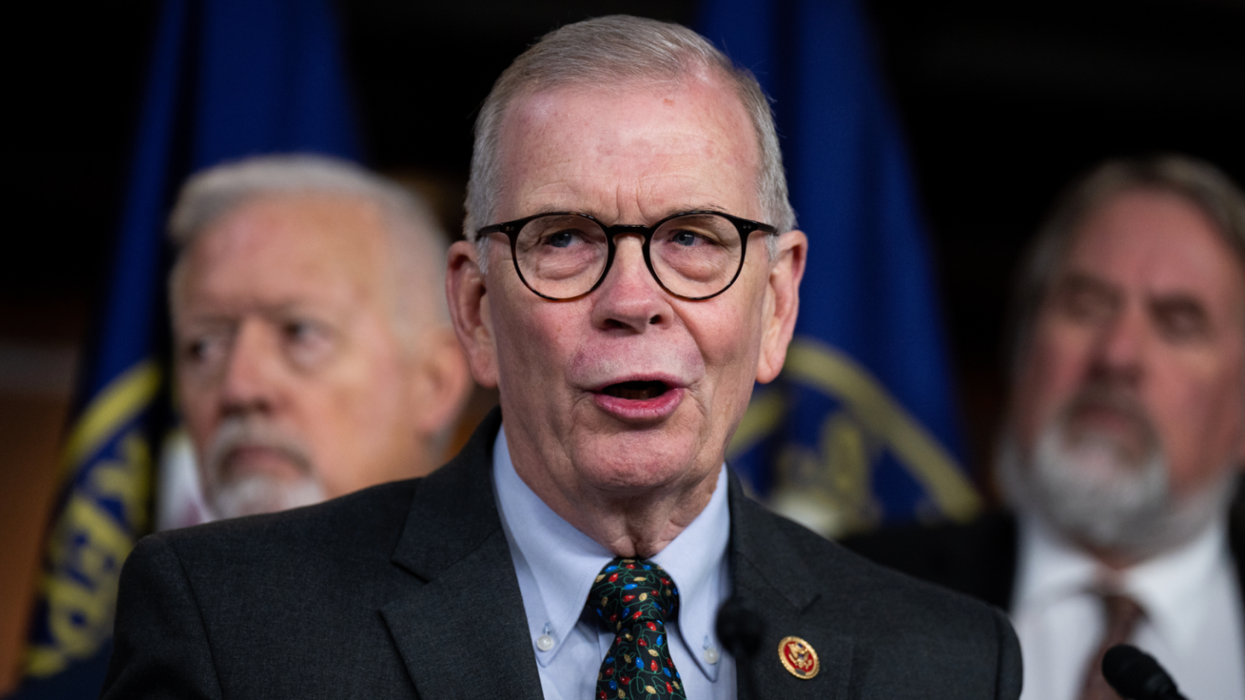
“We have discussions ongoing right now, and I think for any side to say the Republicans don’t have ideas for healthcare reform is to forget what we went through and almost got done,” House Education and Workforce Committee Chair Tim Walberg (R-MI) told Modern Healthcare in an interview. “The ideas are there.” (Editor's note: Another Walberg idea was launching nuclear strikes in Gaza to "get it over quick.")

And they’re moving to enact them. The Senate Homeland Security and Government Affairs Committee held a hearing last week to discuss a new insurance pool that would provide catastrophic health coverage for skimpy individual plans sold outside the exchanges. Numerous states tried this prior to passage of the ACA. In every case the plans were deemed inadequate and often foundered because of their high premiums, exclusions for pre-existing conditions, and annual and lifetime limits. Some states were forced to cap enrollment to limit costs.

Why the capitulation?

Some pundits are reporting that the Democratic capitulation “was all about the filibuster.” Others suggest the cutoff of food stamps was a larger issue. “Trump was purposefully making the shutdown hurt as many people as possible,” wrote Bill Scher of Washington Monthly. Yet “little in this deal is going to prevent him from inflicting further harm.”

The morning headlines in the Kaiser Health News daily feed said it all. “The Trump administration is telling states not to pay full November food stamp benefits, revising its previous guidance after winning a temporary victory at the Supreme Court on Friday,” Politico reported.

Iowa Public Radio reports the federal government ordered states to start enforcing a part of the One Big (Ugly) Bill that cuts off food assistance for refugees and many other types of immigrants with legal status. The Conversation reports the National 211 Hotline has seen calls for food assistance quadruple in recent days, to levels typically seen during natural disasters.

“Shockingly, President Trump and his allies were willing to cut off food assistance to children and fire federal public servants rather than to simply extend an existing tax credit to prevent a premium price spike of hundreds or thousands of dollars for millions of Americans,” Anthony Wright, executive director of Families USA, said in a statement this morning.

“While we are relieved to finally see an end to the longest government shutdown in history — getting federal workers back on the job and ensuring that essential safety net programs like the Supplemental Nutrition Assistance Program (SNAP) can continue — we must continue the fight to contain health costs,” he said. “Americans need a permanent extension of help for health care premiums, and a broader effort to address health care affordability overall.”

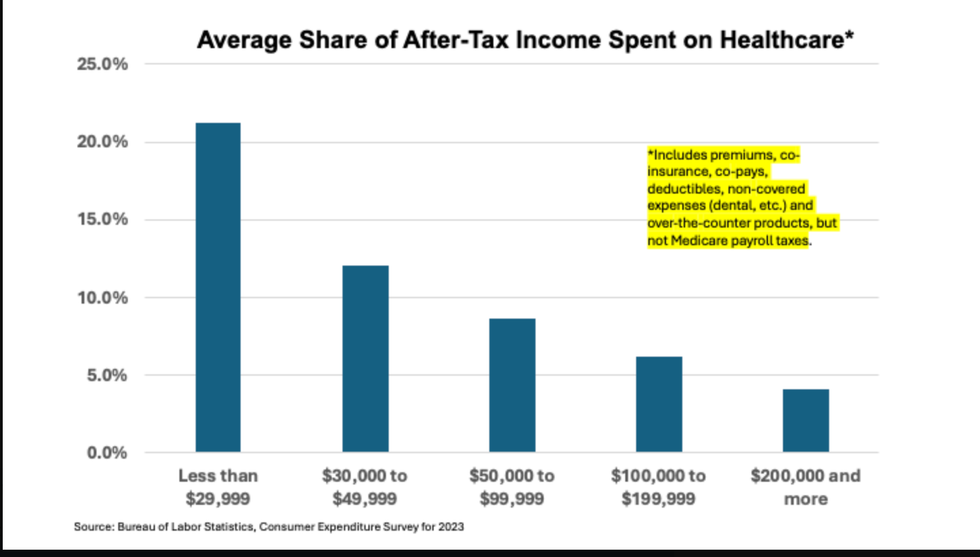
There is definitely a health care affordability crisis. It is being made worse by the Trump regime. I spent some time this morning looking at how out-of-pocket health care expenses are affecting different classes of Americans. Here’s what I found:

...

It’s time for the politicians to start coming up with real solutions to the affordability crisis that is hitting not just people on ACA plans or on Medicaid, but on the broader population. The Trump regime is only making things worse.

Merrill Goozner, the former editor of Modern Healthcare, writes about health care and politics at GoozNews.substack.com, where this column first appeared. Please consider subscribing to support his work.

Reprinted with permission from Gooz News

Comparing Trump Family Wealth Accumulation To The Cost Of SNAP Benefits

Comparing Trump Family Wealth Accumulation To The Cost Of SNAP Benefits

I have harangued reporters for decades over their failure to express big numbers in a context that would make them meaningful to their audiences. For example, when they report that we will spend roughly $100 billion this year on SNAP, relatively few people know that this is around 1.4 percent of total spending. They just hear a REALLY BIG NUMBER; to most of them the number would probably mean the same thing if it would $50 billion or $200 billion.

It would be a very simple matter for reporters to make a habit of including four or five words of context so that these really big numbers would be meaningful to their audience. I considered it a big victory when I worked with several groups to persuade Margaret Sullivan, who was the New York Times public editor, to write a piece arguing exactly this point. She also got a strong endorsement for this view by then Washington editor David Leonhardt.

This seemed like a huge victory, since if the New York Times made a practice of presenting big budget numbers in a context that made them meaningful, it is likely most other publications would follow. This would have led to a far better-informed electorate who would know that they did not have a high tax bill because of the 0.008 percent of the budget that went to public broadcasting.

Unfortunately, nothing changed. Even though I have never heard and literally cannot imagine an argument on the other side (it takes 10 seconds to do the calculation on a spreadsheet), it is still standard practice for reporters to write numbers in the millions, billions, or trillions that they know are meaningless to almost their entire audience.

And informing the public would make a difference. Elon Musk probably would not have been so proud to shut down PEPFAR, the AIDS program for Africa started by George W. Bush, if he knew he was sentencing millions of people to death in order to reduce federal spending by 0.09 percent (nine cents on $100).

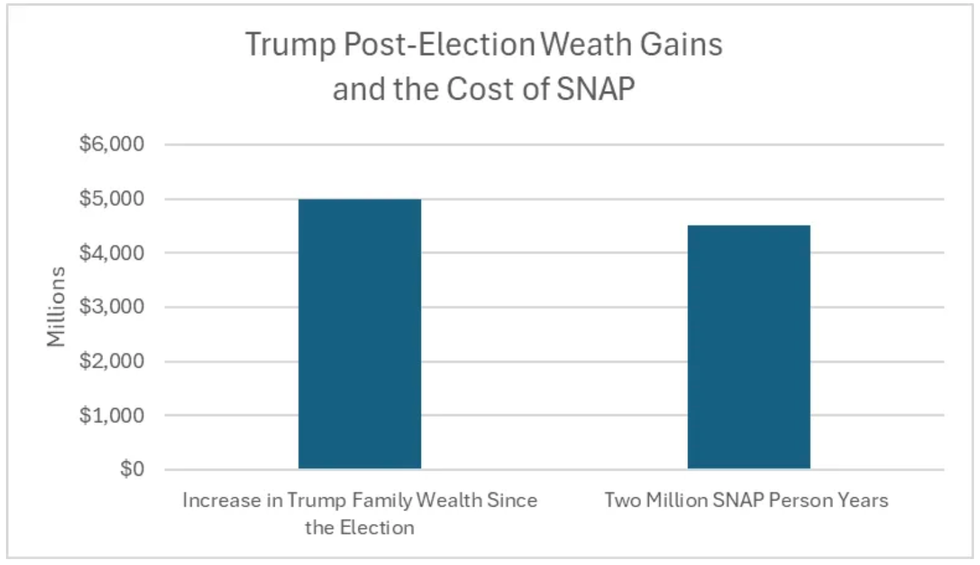
In the interest of putting numbers in context in terms of the current budget shutdown, we can think about how much money Donald Trump and his family have gained since he was elected compared to the cost of SNAP. According to Forbes, the Trump family has increased their wealth by roughly $5 billion since the election, effectively doubling their prior fortune.

By comparison, the average monthly SNAP benefit is a bit less than $190 a month, or roughly $2,250 a year. If we compare the Trump family’s post-election windfall to the average SNAP benefit, it comes to more than 2 million SNAP-person years.

Source: Forbes magazine and USDA

This comparison is useful since we can see that even while millions of people might be suffering from the loss of SNAP benefits due to the shutdown, at least Donald Trump and his family are doing well.

Dean Baker is a senior economist at the Center for Economic and Policy Research and the author of the 2016 book Rigged: How Globalization and the Rules of the Modern Economy Were Structured to Make the Rich Richer. Please consider subscribing to his Substack.

Reprinted with permission from Dean Baker.

Boasting Of  Bathroom's 'Statuary Marble' During Shutdown, Trump Provokes Fury

Boasting Of  Bathroom's 'Statuary Marble' During Shutdown, Trump Provokes Fury

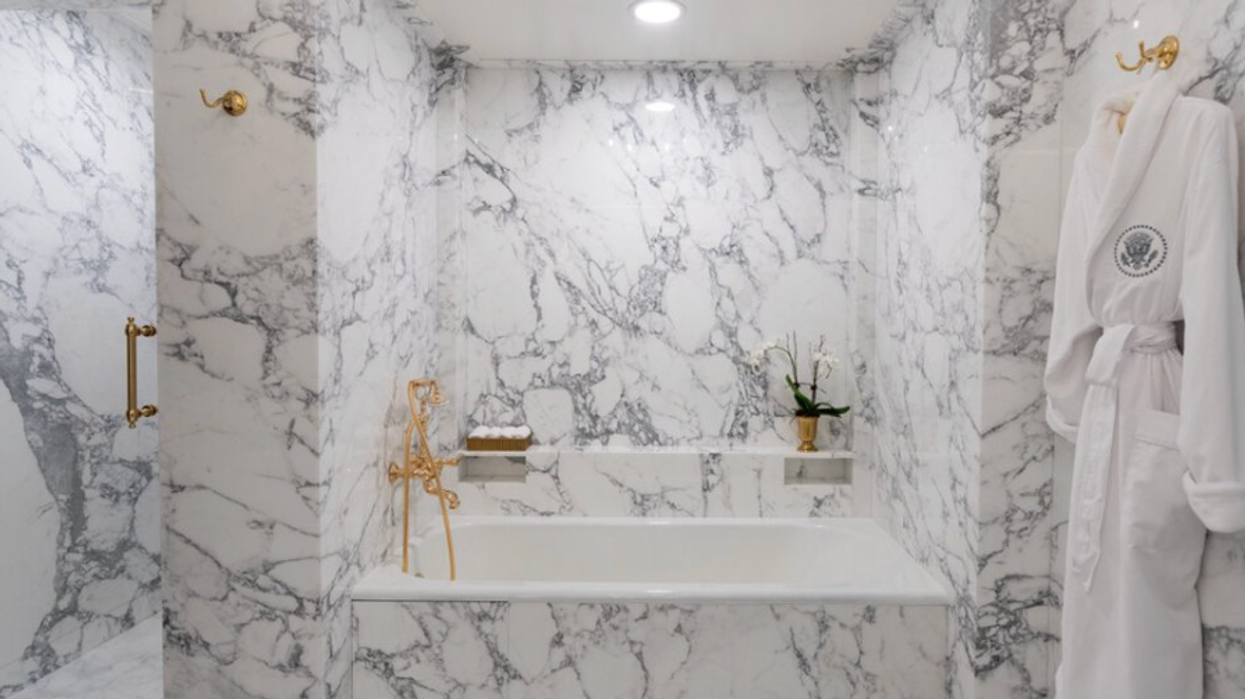
As millions of families across the US are about to lose their access to food aid over the weekend, President Donald Trump on Friday decided to show off photos of a White House bathroom that he boasted had been refurbished in “highly polished, statuary marble.”

Trump posted photos of the bathroom on his Truth Social platform, and he explained that he decided to remodel it because he was dissatisfied with the “art deco green tile style” that had been implemented during a previous renovation, which he described as “totally inappropriate for the Lincoln Era.”“I did it in black and white polished Statuary marble,” Trump continued. “This was very appropriate for the time of Abraham Lincoln and, in fact, could be the marble that was originally there!”

Trump’s critics were quick to pan the remodeled bathroom, especially since it came at a time when Americans are suffering from numerous policies the president and the Republican Party are enacting, including tariffs that are raising the cost of food and clothing; expiring subsidies for Americans who buy health insurance through Affordable Care Act exchanges; and cuts to Medicaid and Supplemental Nutrition Assistance (SNAP) programs in the One Big Beautiful Bill Act.

“Sure, you might not be able to eat or go to the doctor, but check out how nice Trump’s new marble shitter is,” remarked independent journalist Aaron Rupar on Bluesky.Joe Walsh, a former Republican congressman who has become a critic of Trump, ripped the president for displaying such tone deafness in the middle of a federal government shutdown.

“Government still shutdown, Americans not getting paid, food assistance for low-income families and children about to be cut off, and this is what he cares about,” he wrote on X. “He’s a psychopath, humanly incapable of caring about anyone or anything but himself.”

Don Moynihan, a political scientist at the University of Michigan, expressed extreme skepticism that the White House bathroom during Abraham Lincoln’s tenure was decked out in marble and gold.

“Fact check based on no research but with a high degree of confidence: This is not the marble that was originally in the Lincoln Bedroom,” he wrote. “It is more likely to the be retrieved from a Trump casino before it was demolished.”

Fashion critic Derek Guy, meanwhile, mostly left politics out of his criticisms of the remodeled bathroom, instead simply observing that “White House renovations are currently being spearheaded by someone with famously bad interior design taste.”

Earlier this month, Trump sparked outrage when he demolished the entire East Wing of the White House to make way for a massive White House ballroom financed by donations from some of America’s wealthiest corporations—including several with government contracts and interests in deregulation—such as Apple, Lockheed Martin, Microsoft, Meta, Google, Amazon, and Palantir.

Reprinted with permission from Alternet

Shop our Store

Headlines

Editor's Blog

Corona Virus

Trending

World