Tag: tech oligarchs
Andreessen

From Sea To Shining Sea, America Smacked Down The Billionaire Oligarchs

It was a bad night for the oligarchs.

Voters delivered a brutal and historic repudiation to Elon Musk, who spent upward of $450 million of his absurd fortune to purchase elections in Texas and elsewhere – and failed. Having moved his businesses and his residence to the Lone Star state from California, which he disparaged as too liberal, the world’s richest man now faces the prospect of skeptical regulation both there and in Washington.

We might have anticipated a defeat for Musk because he has tried to buy an election before, when he poured millions into a Wisconsin Supreme Court contest in early 2025. He declared then that the fate of Western civilization was at stake – and lost that election to a liberal woman judge by 11 points.

As the stock prices of Tesla and Spacex fell in early morning hours, the blustering mega-billionaire was reduced to wisecracking that data centers really do belong in outer space. The outcome of 41 data center moratorium referenda across the country suggest that isn’t a joke. Musk and his fellow techlords, who spent billions to oppose those ballot initiatives and elect pliable Republicans, got their asses whupped everywhere. Despite all their lavish spending (and lying), the results weren’t close, with majorities well over 60 percent, and as high as 80 percent, supporting restrictions.

In Texas Musk’s spending could do nothing to save the worthless hide of crooked Ken Paxton, beaten soundly by the compassionate but tough seminarian James Talarico. Nor could his millions preserve three-term Gov. Greg Abbott, cast out by Gina Hinojosa, a Latina whose unprecedented victory is a rejection of the misogyny and bigotry that Musk elevates every day, along with his tech supremacy and corrupt approach to politics.

Hinojosa campaigned against Musk’s election-buying, while Talarico delivered a superbly generous election night speech that detoured for a moment to mock the failure of the “trillionaire.”

While the smashing of Musk was surely a thrill for Democrats, he wasn’t the only oligarch who watched his million-dollar donations go up in flames. Among the usual MAGA billionaire suspects who lost big were the Uihlein family of Wisconsin, who joined Musk in losing there last year and dropped $150 million in the midterm. Miriam Adelson, the gambling widow and Likudnik bankroller, torched $67 million. Marc Andreessen and his partner Ben Horowitz, among the more obnoxious tech capitalists, spent $92 million and Jeff Yass, much the same sort, spent $110 million. (Unfortunately they can afford it.)

Next to Texas, the most satisfying smackdown – and one of the most consequential – occurred in formerly red Ohio. The magnificent gubernatorial victory of Democrat Amy Acton was a rejection of Republican Vivek Ramaswamy’s sickening ad campaign, to be sure, and of that bent billionaire’s preening ambition. But even more delightful than Vivek's vivisection was the revenge of former and future Sen. Sherrod Brown, whose comeback signaled triumph over the crypto industry (the tech sector that produces nothing useful to anyone except money-laundering criminals).

The crypto gang spent upward of $63 million this year trying to beat back Brown -- who lost his longtime Ohio seat in 2024 largely because of an avalanche of advertising financed by their political action committees. Those same crypto interests spent roughly $176 million on more than 100 midterm races this year, some of it on Democrats. We can hope that Brown and other honest Democrats will insist on sharpened regulation for this “industry” as the new Congress considers legislation still in committee.

Oligarchy won’t go away – its beneficiaries are too rich, too morally depraved and too hostile to democracy to desist. Last night was merely an early battle in a long war. And they lost.
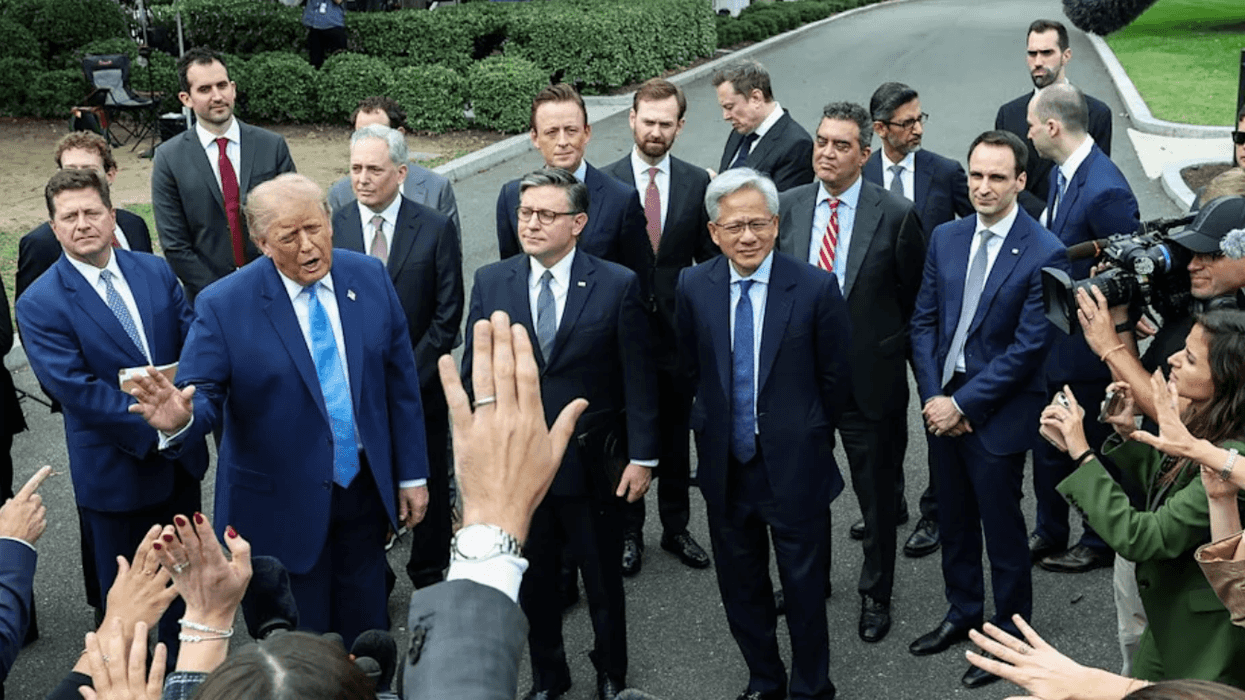
Trump at superintelligence press conference

One More Reason Why Americans Hate Oligarchs' AI: It Does Nothing For Us

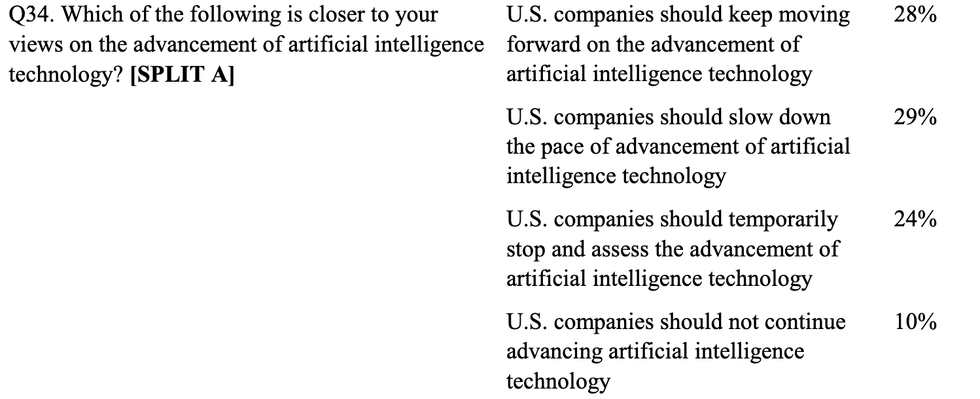
One unifying dynamic in America today: Americans really, really hate artificial intelligence. What began as a form of NIMBYism — no one wants a data center in their neighborhood — has broadened into severe doubts about the technology as a whole. For those of us who remember the giddy optimism that greeted the tech boom of the 1990s, the widespread negativity toward AI is astonishing. Here are the results of a new Wall Street Journal poll:

Only 28 percent of Americans believe that AI technology should move full speed ahead. Everyone else wants it slowed down or stopped, temporarily or permanently.

Of course, Donald Trump remains a huge booster. He believes that the public’s antipathy towards AI is just a marketing problem — and that he can solve that problem by forcing everyone to call it “super intelligence”. But the Journal poll also says that only 7 percent of Americans trust Trump’s leadership in regulating AI. Given Trump’s abysmal approval ratings, his advocacy of AI — err, super intelligence — probably taints the technology even further in the eyes of Americans.

Historically, Americans have been technology enthusiasts. As a nation, we’re not Luddites. So what explains Americans’ dislike of AI?

Obviously, there are near-daily prominent warnings that AI will destroy the human race or, failing that, destroy everyone’s job. And these warnings aren’t coming from left-wing cranks — they’re coming from the AI industry itself.

And we should be afraid – very afraid. The power of AI models to hack into supposedly secure systems — and to do so on their own, without prompting and against their owners’ intentions, and to lie to the humans about it — is truly shocking. Moreover, there is surely an element of financially motivated hype: “Our technology is so powerful that it can destroy the world, so you’d better invest in our IPO.” And there is more than a little bit of karma here: the race by the AI giants to reach the holy grail of AGI – artificial general intelligence – was surely a strategy to make vast riches from Wall Street, in contrast to the much more modest (and probably more successful) Chinese strategy of building modest, cost-effective models.

There is also, however, a more prosaic reasons for the public’s dislike of AI: This is a technology of, by and for oligarchs, with hardly any of the benefits trickling down to regular Americans.

Or to put it a different way, never before in history have corporations spent so much money — playing a major role in soaring interest rates — to create so few jobs.

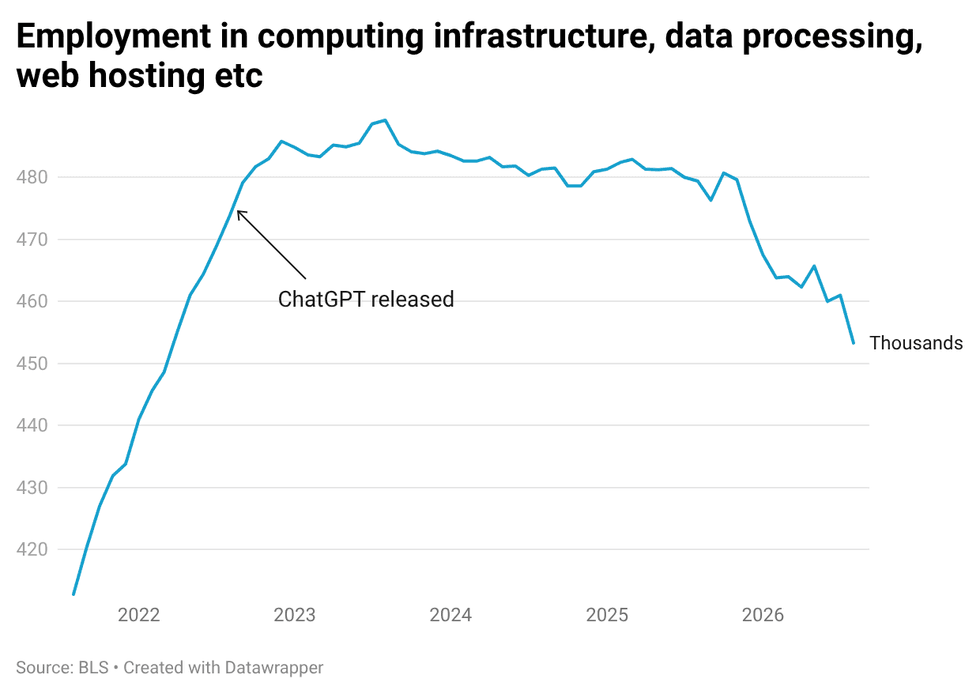
Data centers themselves are basically banks of blinking servers that employ hardly any workers. Here’s data from the Bureau of Labor Statistics on a category that includes data centers as well as a number of other activities. Employment in that category has declined since November 2022, often cited as the start of the AI boom because it’s the month ChatGPT was released to the public:

Source: Bureau of Labor Statistics/Created with Datawrapper
Still, won’t the AI boom at least temporarily create a lot of construction jobs? It will create some, and Jared Bernstein has a good post on how to ensure that these are good jobs. But all indications are that AI investment will create far fewer jobs, even in construction, than expected.

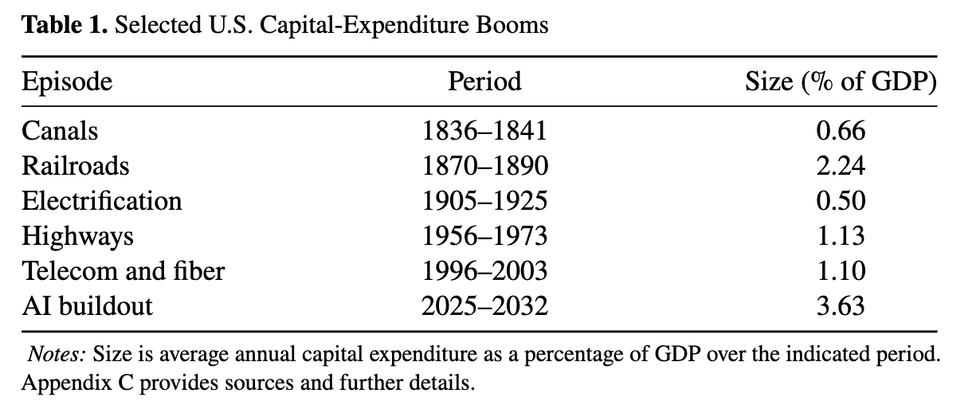
Bear in mind that we are talking about a truly huge investment boom. In Sunday’s primer I cited estimates by Stijn van Nieuwerburgh suggesting that we’re entering by far the biggest capital-expenditure boom in U.S. history, dwarfing even the huge railroad boom that followed the Civil War:

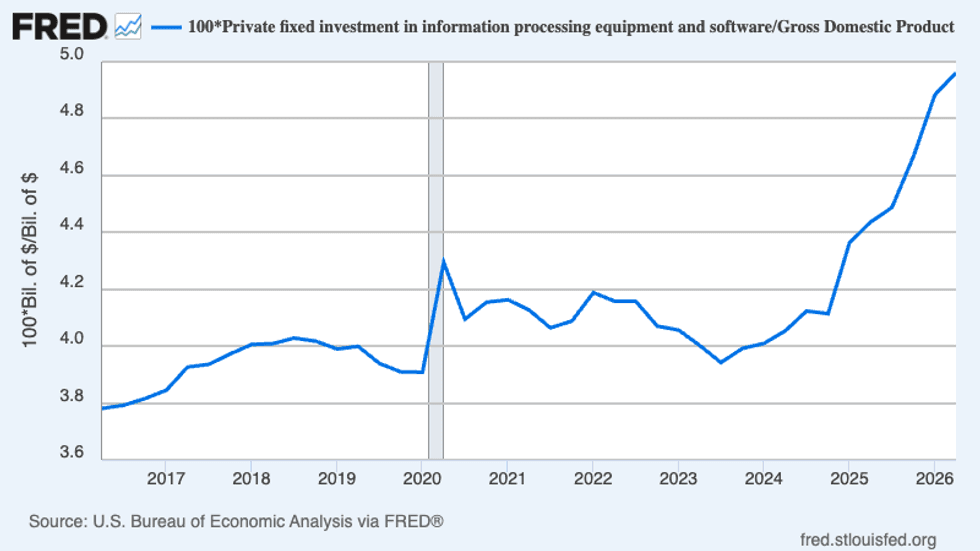
These are projections rather than spending that has already happened. But the AI investment boom is already well underway. Here’s IT investment as a percentage of GDP, which really took off in late 2024 and is already well above its level during the 1990s tech boom:

Source: US Bureau of Economic Analysis via St. Louis Federal Reserve (FRED)
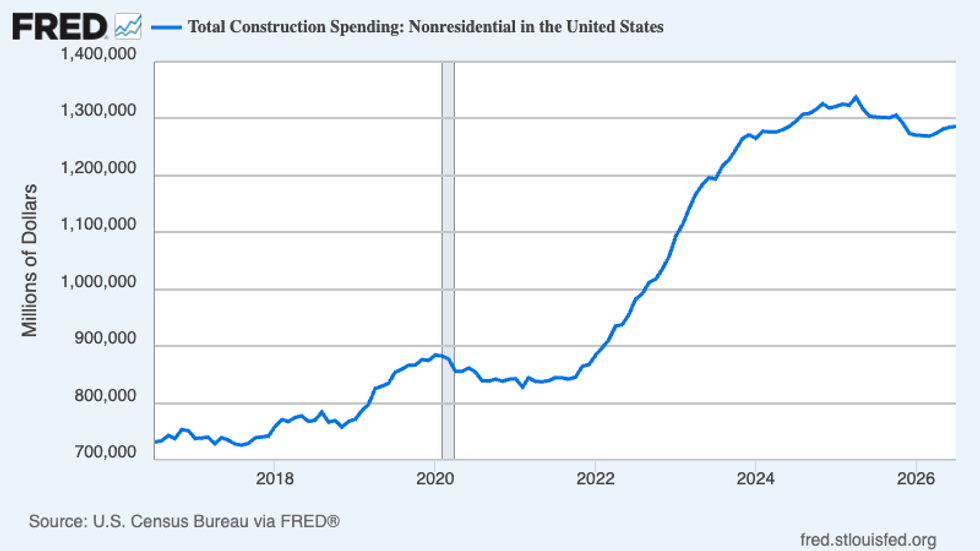
Given this spending surge, one should expect a sharp rise in nonresidential construction spending — basically construction for businesses rather than housing.

But that’s not what we actually see. Nonresidential construction rose rapidly during the Biden years, largely thanks to that administration’s promotion of clean energy. But nonresidential construction has basically flatlined under Trump, despite the immense AI investment boom:

How is this possible? Because even the physical construction of a data center involves relatively little construction. According to Van Nieuwerburgh, when a multi-billion-dollar AI training campus is built,

About one-third [of the investment spending] reflects the facility and power infrastructure, while roughly two-thirds consists of compute hardware and related IT systems.

So not a lot of conventional construction. And most of the “compute hardware” etc. is imported!

Overall, then, the deep unpopularity of AI isn’t hard to explain. Here we have a technology that is enriching a small number of people, but whose creators warn may destroy millions of jobs if not the world. And even the usual argument for pro-oligarch policies — job creation! — falls flat because hardly any jobs are being created even in the short run.

Will AI’s unpopularity matter? Indicators are that it will. So many things are going wrong for Republicans right now that it’s hard to single out any one issue, but Chris Caldwell has an interesting recent article arguing that the deep unpopularity of data centers may be the tipping point that turns Ohio blue this year, possibly deciding control of the Senate.

Thus there are good reasons, even beyond possible apocalypse, for the public backlash against AI. And that backlash is so strong, and has emerged so quickly, that it may have important political consequences.

Isn’t that super?

Paul Krugman is a Nobel Prize-winning economist and former professor at MIT and Princeton who now teaches at the City University of New York's Graduate Center. From 2000 to 2024, he wrote a column for The New York Times. Please consider subscribing to his Substack.


Shop our Store

Headlines

Editor's Blog

Trending

World