Have Medicare for All (M4A) proponents become pragmatists, at least for the next two years?
In the wake of the Democrats’ mid-term triumph, Sen. Bernie Sanders (I-VT) did not demand an immediate push for M4A. The Vermont socialist/independent, who will chair the Senate’s Health Education Labor and Pensions committee, pledged to pass reforms that lead in that direction.
He included immediately lowering the Medicare eligibility age to 55; adding dental and vision care to the program; and guaranteeing coverage for all children up to age 19. In a video released last week, Sanders even expressed hopes the president might sign it.
Clearly, the long-time M4A advocate recognizes the ideological diversity within the Democratic Party’s expanded ranks. While Michigan Senator-elect and M4A champion Abdul El-Sayed draws more attention, newcomers like James Talarico of Texas, Annie Andrews of South Carolina, Adam Hamilton of Kansas and Josh Turek of Iowa didn’t back M4A on the campaign trail. They want universal coverage. But they favor creating a public option that would give the uninsured and employers the ability to buy into a government-run plan.
On the House side, post-election analyses of the incoming majority showed centrists won at least 140 seats while progressives backing M4A won about 110. Rep. Richard Neal of Massachusetts, the likely chairman of the House Ways and Means Committee, actively opposes M4A, as does Rep. Brad Schneider of Illinois, an influential member of the committee. He also heads the centrist New Democrat Coalition.
Unfortunately, pragmatism, whether among M4A advocates or centrists, has two major downsides. First, it sidelines efforts to educate the public about why far-reaching payment reform is necessary to accomplish what most Americans want and voted for: a health care system they can afford that provides universal coverage and delivers better care. Second, it provides an opening for opponents of payment reform to claim any major change – whether it’s M4A or incremental reforms such as a public option, capped out-of-pocket expenses, single-pricing, or global budgets (the latter three being reforms I’ve been pushing) – isn’t affordable.
This is the traditional charge leveled against M4A by well-paid ideologues ensconced in right wing think tanks like the Paragon Institute and the Heritage Foundation, who claim it would cost as much as $40 trillion over its first decade. The deficit hawk-driven Committee for a Responsible Federal Budget, which offers a more realistic $30 trillion figure or about $2 trillion in the first year, suggests the only way to pay for that is through massive increases in the payroll tax, higher income taxes or imposition of a value-added (national sales) tax. They also say that without significant cuts in the program, M4A will drive the federal deficit to unsustainable levels.
Sad to say, even some liberal health care economists like David Cutler of Harvard are jumping on the “it can’t be financed” bandwagon. He argued in an article in JAMA Health Forum last month (headline: "Medicare for All Gets a Budget Check") that “the federal budget is likely to be a significant barrier to reform… Some combination of tax increases and reductions in spending will likely be required for single-payer health care, each of which has been a major stumbling block in the past.”
This is hogwash, pure and simple. That’s why I chose to delve into this topic this week even though I count myself among the ones pushing for incremental reforms.
Financing isn’t the problem
There are many reasons why half of the support for M4A (it’s now two-thirds of the population) evaporates when people are told it will result in higher taxes and they will lose what they have. A universal federal program poses an existential threat to the insurance industry. It has repeatedly wielded its considerable political clout and advertising prowess to defeat far-reaching payment reform. Ditto for most of the medical-industrial complex, whose excess profitability will wither under federal price controls. Then there is the economic concept known as path dependency, where past decisions constrain future choices even when those original choices no longer make sense (like the fact this is being written on a QWERTY keyboard).
But the one thing you can’t say about the impracticability of M4A is that it is unaffordable. It not only affordable, but it will save most businesses and taxpayers money. It also can be achieved in a budget neutral manner.
Let’s take a close look at the numbers.
The U.S. poured $5 trillion into health care in 2024 with about 90% of the total going for medical services, according to the Center for Medicare and Medicaid Services. The nation collectively will spend $71 trillion over the next decade, according to the most recent projections by the agency.
In the most recent year for which we have definitive number (2024), nearly half of that came from private businesses and householders in the form of insurance premiums and out-of-pocket expenses. This is private sector money that is already being paid into the system. Governments (federal, state and local) paid the other half. This, it should be noted, makes the U.S. an extreme outlier among advanced industrial countries, most of which depend almost entirely on taxes to finance their much less expensive health care systems.
So, scare headlines tying federalization of health care to the deficit are irrelevant. Moving to M4A or any other major health care payment reform isn’t about affordability. It’s about who pays and how much and whether what we have to pay tomorrow is more or less than what we pay now. Whether you are a householder or a business, a dollar paid in taxes for health care is no different than a dollar paid out of pocket.
Unfortunately, the question that M4A advocates consistently fail to address in their public statements (Senator-elect El-Sayed’s book on the topic is a notable exception) is how to recapture most of the private money paid for health care after relieving businesses and householders of their current obligations. Not all the money has to be recouped since the Congressional Budget Office estimates federalizing health care would save at least $250 billion a year in reduced administrative costs.
Moreover, the latest iteration of Sanders’ M4A bill includes putting provider organizations on global budgets. This would over time reduce the share of the economy devoted to health care and lower the projected needs to finance the system. I make no provision for these savings in the following calculations.
The $2 trillion question
Let’s assume the federal government will need to raise about $2 trillion in M4A’s first year to keep it budget neutral. Sounds overwhelming, right?
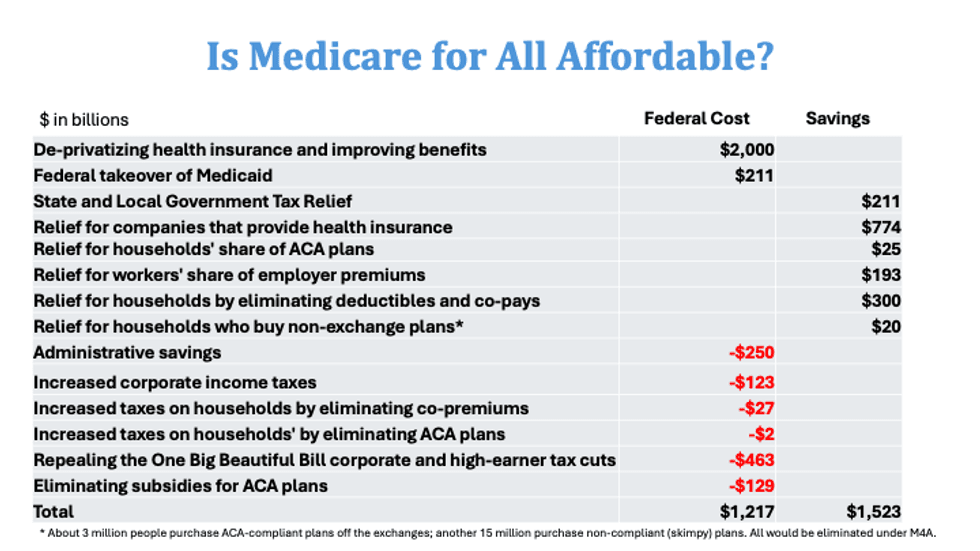
To put that scary number in perspective, let’s first take a look who will be relieved of their current financial burdens by moving to M4A. Let’s start with the tax relief given state and local governments, which will no longer have to pay for their share of Medicaid that goes for health care (they would still pay for long-term services and supports for the disabled). Those savings would be about $211 billion a year (all my calculations in this article use 2024 data unless indicated otherwise).
Federalizing Medicaid would amount to a huge revenue sharing program. That’s money states could use for education, housing, transportation and/or tax relief for their citizens.
Private businesses that now provide health insurance would be the biggest winners, saving about $774 billion a year. Unless recaptured by the federal government in some way, this would increase total U.S. corporate profits by about 20% and raise an additional $123 billion in corporate income taxes (the effective tax rate for all corporations in the U.S. in 2024 was 16%). To put those savings in perspective, the $651 billion post-tax dividend for corporations would exceed the Trump-era corporate and high earner tax breaks by about $200 billion.
Eliminating employees’ co-premiums for private insurance would save households $193 billion since they pick up on average about 20% of the total cost of insurance. Since this is money that is not taxed now, eliminating co-premiums would raise about $27 billion in new federal income taxes, given that the blended tax rate for all wage and salary income is about 14%.
(I should point out here that my combined total of $150 billion in new corporate and personal income taxes from eliminating employer-provided health care is less than the $211 billion the Senate’s Joint Committee on Taxation estimated the tax exclusion for employer-provided health benefits cost the federal treasury in 2024; a number that rose to $240 billion in 2026.)
If the M4A plan also eliminated most deductibles and co-pays (including for seniors), it would save householders a significant portion of the $556 billion they currently pay in out-of-pocket expenses. Unlike the premiums taken out of paychecks, these are paid with after-tax dollars. It is difficult to estimate with precision how much householders will save because the total includes over the counter drugs and other medical supplies not covered by insurance. I picked $300 billion as a reasonable estimate for the deductibles, co-pays and other out-of-pocket expenses that would be picked up by M4A.
Even after the administrative savings and higher income taxes, the federal government will still need to raise $1.2 trillion in new revenue to pay for M4A as long as it simultaneously repeals the irresponsible tax cuts handed out by the Trump I and Trump II administrations. At the same time, it will reduce corporate, household and state government expenses by about $1.5 trillion, only $152 billion of which will be taxed away by the IRS.
Why employer-based health coverage is unfair
Before I discuss one way to raise that much money in an equitable, budgetary neutral fashion, let’s take a closer look at the inequities of the current employer-based system. These are rarely discussed by M4A advocates but should be.
Every time a new attempt is made at health care reform, the private insurance industry uses the slogan “you’ll lose what you have” to scare people away from backing a universal, government-run plan. If people knew how unfair their employer-based plans are and how they undermine U.S. competitiveness, they might be more willing to join the ranks of those calling for an end to employer-based coverage.
First, the U.S. is supposedly an employer-based system for the non-elderly, non-poor population. Yet it allows companies that don’t offer coverage to get away nearly scot-free. Employers with fewer than 50 workers are exempt from the ACA’s employer mandate. The penalties for larger firms are only a fraction of what individual or family plans cost. It’s no wonder that just 49% of employers offered health insurance in 2024, down from 56% before the ACA passed, according to the Employee Benefits Research Institute. Even the good guys, who employed 79% of all workers, saw only two-thirds of their employees accept the offer, usually because of its high co-premium cost. The rest were either covered by a spouse’s plan or went without coverage.
Second, the premiums employers charge their workers are regressive. Almost all employers charge each worker the same amount for the same plan without regard for their ability to pay. The average employee premium for a family plan this year was $7,471, according to KFF’s annual employer survey. For the worker in the warehouse earning $50,000 a year after tax, that’s 15% of his or her take home pay. For the engineer in the front office earning $150,000 a year after tax, that’s 5% of his or her take home pay. For the lowest-paid official in the C-suite earning $300,000 a year after tax, that’s 2.5% of their take home pay. That’s not fair. Layer on top of that the fact all employees pay the same deductibles and co-pays up to a cap when accessing medical services, it is even more unfair.
Third, employer-based coverage fragments the risk pool and makes firms with older, sicker workers pay more. The average employer-based family plan costs $28,303 a year (with employers picking up three-quarters of the cost). But employers with a younger, healthier workforce (like firms in Silicon Valley) pay substantially less; those with an older, sicker workforce (like old line manufacturers) pay substantially more. Eliminating employer-based coverage would do far more than raising tariffs to promote domestic manufacturing.
Moreover, unifying the risk pool will end the job-lock that inhibits labor force mobility. It will increase many firms’ competitiveness by basing payments for health care on ability to pay or total payroll rather than the relative health of a company’s workforce.
Raising taxes is inevitable, but not more expensive
Let us now return to the issue of how to pay for the additional $1.2 trillion needed at the federal level to pay for M4A. Progressive income taxes? A value-added tax? Let’s use the simplest option to get a sense of what it would cost individuals and the firms they work for even without accounting for their savings as outlined above. Let’s use the current Medicare payroll tax.
Here, at least, we have precise numbers from the Social Security Administration. The Medicare payroll tax is levied at a 1.45% rate on workers and matched by employers. It raised $351 billion in 2023. Let’s raise that total by 4.8% (the SSA’s National Wage Index increase in 2024) to $367 billion.
Those current collections plus $1.2 trillion would require raising $1.567 trillion to fund M4A. If Medicare kept the same 1:1 ratio, the rate would have to be 4.3 times higher to finance the transition. That would be a 6.2% payroll tax on employees matched by their employers – a 12.4% total.
But, wait. Does a 1:1 ratio make sense when the current ratio for employer-provided health care is 4:1 and 80% of the savings from eliminating that cost flow to employers who provide coverage? A fairer ratio would be to increase the employer payroll tax rate to 10% and the worker payroll tax rate to 2.5%, which is only a 1.05 percentage point increase over the current rate. The slightly higher-than-necessary level on employers should be sufficient to give small businesses either an exemption or reduced rate, a small price to pay for having a workforce with guaranteed, government-funded health care coverage.
I’m not saying the payroll tax is the fairest or best way to go. I only use it as an example to show that, given all the tax relief and health care expense relief provided non-federal governments, private employers and households, the extra payroll taxes would wind up costing most people and many firms less.
There would be a shifting of burden within each group. Those with higher incomes would pay more; those with moderate or lower incomes less. Firms providing high-cost insurance because of the age and illness profile of their workers would pay less; those with younger, healthier and often better paid workers would pay more. Firms that never provided health insurance would pay more, but far less than the cost of private insurance for each of their workers.
Such a system would be immediately universal, provide better coverage and be financed with fairer taxes. As I said at the outset of this exercise, the idea that M4A is unaffordable is hogwash. It’s only our politics that stands in the way of a better system, one that pragmatists like me recognize and why we push for incremental reforms that lead in the direction of far better way to go.
Merrill Goozner, the former editor of Modern Healthcare, writes about health care and politics at GoozNews.substack.com, where this column first appeared. Please consider subscribing to support his work.
Reprinted with permission from GoozNews