
Gov.-elect Gina Hinojosa
A number of interesting things have occurred in AI-Econ-Political-Economy space in recent days:
—There was a national election where AI, and especially the building of data centers to power AI, didn’t fare so well.
—We published an oped in the NYT on how if there’s an AI bubble, as we believe there is, and if that bubble should pop, the damage will spillover into the broader economy.
—Both Paul Krugman and Jason Furman tackled this same question of how a bursting AI bubble might play out in the broader economy. (In short order, we’ll summarize these three takes up in here.)
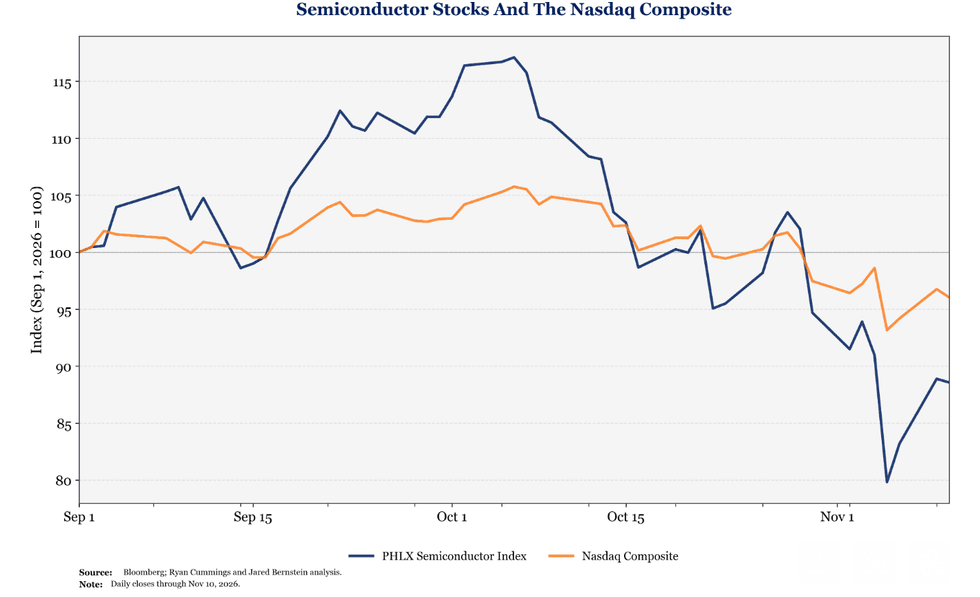
—The market for tech stocks has been posting large swings around a declining trend.
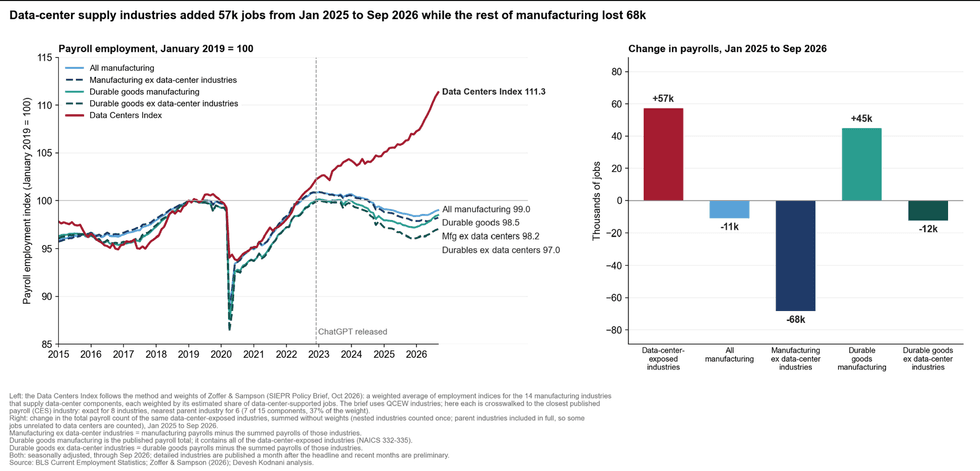
—I published a great Dev Kodnani chart in my jobs day post showing how recent manufacturing job gains are largely driven by the data center buildout.
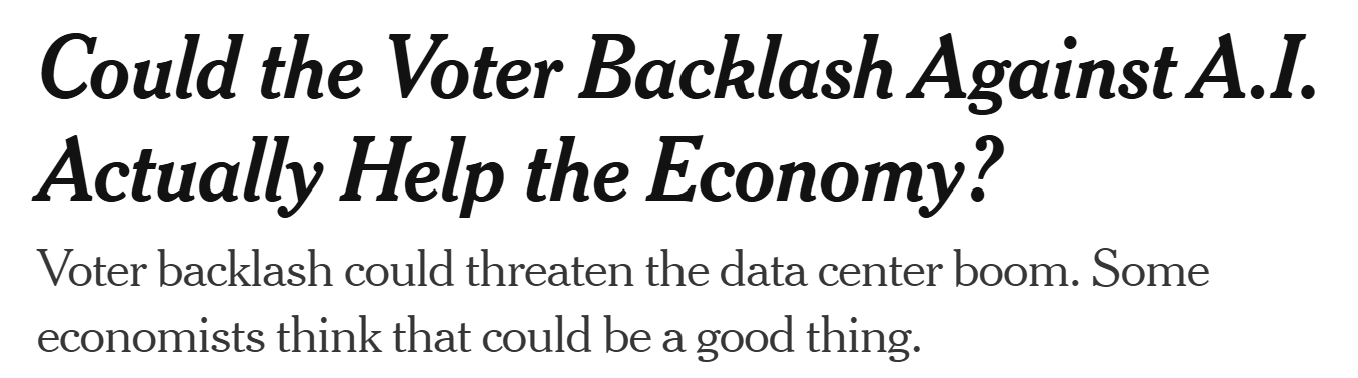
—Which helped inspire this New York Times article from a couple of days ago:
Let us explain how all these threads coalesce.
There’s of course a great deal of anger and angst among regular folks re the impact of AI in their lives. For many, its most prominent features are not agentic coders doing remarkable—or even mundane—tasks for them. It’s the threat to their jobs, their utility bills, and perhaps their existence, all of which, ftr, tech billionaires assure them are legit concerns. Clearly, many communities are up-in-arms given the lack of consultation about building out the hyperscalers’ compute resources. These voters have, to our minds, understandable concerns as to whether the costs are worth the benefits, and a new crop of successful candidates channeled these concerns in last week’s election.
Now, let’s turn to the bubble. We argue that should it pop, the damage could be considerably worse than the dot-com bubble (we go through why in the piece, but both the investment and the asset-growth magnitudes are bigger now). The extent to which both markets and overall growth are disproportionately dependent on this one sector is an underlying economic fragility.
As the Times noted, and as Dev’s manufacturing jobs chart shows:
Such dependence on one sector is risky…and some moderation in the pace of the A.I. build out would be welcomed…slowing the frenetic pace of the A.I. build out could make it more sustainable, even if it causes some short-term hardship. Some of the A.I. skeptics who won office last week, including Gina Hinojosa, the newly elected Democratic governor of Texas, have said they want to ensure data center projects benefit their communities, not stop them entirely.
That’s the way to go and while it’s not costless, it could yield numerous important benefits. First, as we’ve written in numerous posts, AI finance is pretty far over its skis, as actual and planned spending are way ahead of plausible revenue expectations. That’s a classic bubble dynamic and one that could lead investors to eventually lose patience, head for the exits, and set off the bubble’s deflation.
We’ve certainly seen market moves in that direction, though to be fair, often followed by large moves in the other direction. Should public policy enforce a slowing of the buildout, that could, as the New York Times notes, help better realign spending and earnings.
Second, it would represent democracy in action, a dynamic that’s been in short supply in the Trump years, but one the election results presage more of. Here’s Gov-elect Hinojosa’s position on the centers built going forward in Texas once she moves into the Governors Mansion:

That certainly looks right to us. Now, as Dev’s chart shows, there’s a lot of jobs at stake building out these centers (a lot more than are required to staff them, to be sure), so pausing is not costless to local economies. In this regard, and to continue to pursue the nation’s edge in this critical technology, we hope these pauses don’t go on for too long. Less than a year, perhaps even six months, seems doable.
But out bottom line is that data center moratoria could be useful on various levels: giving voters a critical say in their communities but also helping to restrain financial and buildout excesses that, should they continue apace, threaten to spillover to the rest of us.
Jared Bernstein is a former chair of the White House Council of Economic Advisers under President Joe Biden. He is a senior fellow at the Council on Budget and Policy Priorities. Please subscribe to his Substack, from which this is reprinted with permission.
- As Big Tech Imposes A New Feudalism On America, Let's Fight Back ›
- From Sea To Shining Sea, America Smacked Down The Billionaire Oligarchs ›
- Governor-elect Gina Hinojosa vows to pause future data centers until new regulations are in place - ABC13 Houston ›
- Gina Hinojosa’s plans for Texas: $1,500 checks, data centers and medicaid ›
- AI data center stocks and Musk's SpaceX decline as Texas governor result raises risks of a slowdown ›
- Texas Democrats see data centers as a winning issue - ABC News ›
- Under Hinojosa, Texas data center approvals could stay paused ›