How Trump's Mail Ballot Gambit Could Lay Groundwork For A Stolen Election
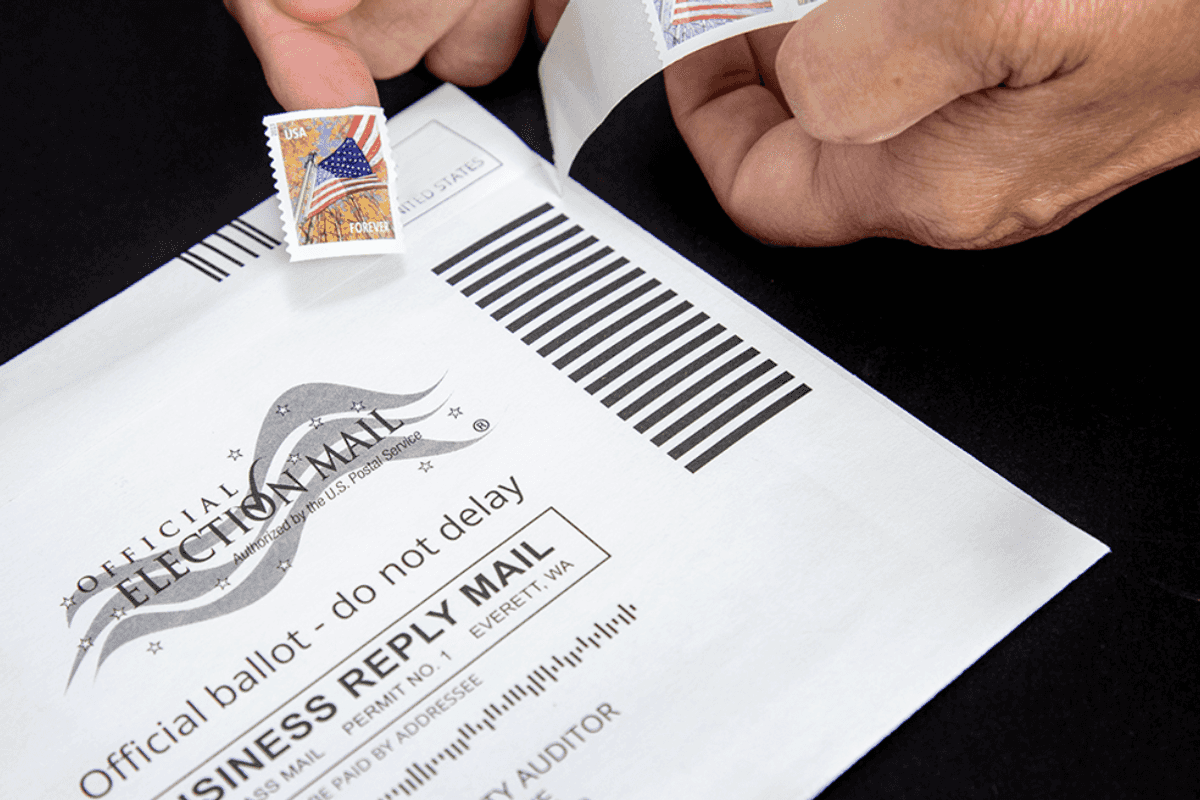
Last Monday, the Trump administration asked the Supreme Court, by emergency application, to lift a lower-court order blocking its executive order on mail-in voting—clearing the way for it to operate in November.
The request has the elements of a potential perfect storm: a likely unconstitutional executive order on mail-in voting, brought up on an emergency appeal, to this Supreme Court.
In an inexhaustible effort to secure unfair advantage in advance of the election, the administration has been throwing everything against the wall. Not much has stuck.
And through all of it, win or lose, it had never once asked the Supreme Court, its preferred port in a storm, to review any of these efforts. When courts struck them down, again and again, the Solicitor General stayed home. Monday’s application broke that pattern—the first time the administration has taken one of its voting orders to the Court.
Take just its parallel campaign to bully states into handing over their voter rolls: there, it has gone to district court eighteen times and lost every single one—a record of 0 and 18, the latest defeat coming Wednesday, when Judge Zahid Quraishi dismissed the suit against New Jersey.
The mail-voting suit now before the Court is a separate front. It was brought by 23 states and the District of Columbia, most of them Democratic-led. On Wednesday, a dozen red states that had intervened to defend the order filed a related application of their own to the High Court.
The battle will play out in short order.
The presidential order in play, Executive Order 14399, signed March 31, directs the Department of Homeland Security to compile state-by-state lists of citizens deemed eligible to vote, and directs the Postal Service to refuse to send a mail-in ballot to any voter whose name does not appear on the list.
Many commentators have explained why such a maneuver—which Trump tries to justify on the tired canard of widespread voting by non-citizens—would be revolutionary and cataclysmic. There never has been a federal citizenship roster, much less one assembled and policed by the executive branch, and all indications are that the upshot would be the disenfranchisement of millions of eligible voters, and of course, disproportionately Democratic.
The lower courts have invalidated the order on multiple grounds, most importantly as a violation of the separation of powers. The Constitution accords the primary role in running elections to the States, who decide who is eligible and the “Times, Places, and Manner” of voting; Congress has a limited, secondary role, the power to “make or alter” those rules by statute. The president has no role whatsoever. That is the brick wall that the Executive Order, and other Trumpian efforts, continually run into.
The same principle drives the administration’s losing streak in the voter-roll fight. Every one of those defeats turned on the same defect—the Trump administration’s reaching for a power the Constitution never gave it. The mail-voting order is that same defect, with a stamp on it.
And here is the critical point: in its emergency application, the government has not tried to defend the order’s legality. It is mounting a narrow procedural argument.
As always, the “emergency” shadow docket appeal asks the Supreme Court not for a final ruling on the merits, but for a provisional decision vacating Judge Talwani’s injunction. So we’re in the by-now-familiar territory of the four-part test to vacate and stay, a domain in which the Court’s performance has been, to say the least, inconsistent.
The first and most important factor is likelihood of success on the merits: is the government likely to win the case?
The distinctive point here is that the administration is not even trying to argue that it is likely to succeed because Trump in fact does have the power that court after court has denied him.
The administration’s argument for likelihood of success—its only such argument—is that the case is not ripe. The states sued too soon, the argument runs, before any agency “finalized” a rule or a list, so there is no concrete injury and nothing to enjoin. The Solicitor General avers that, as of now, Trump’s order is a mere “intra-Branch directive,” something the agencies are still “deliberating over how (if at all) to implement.” Nothing has happened yet. Come back later.
Both courts below rejected that story, and on a summary-judgment record the government did not dispute. They found the states already injured, in three distinct ways. First, the states must divert staff and money now to plan for the order’s demands. Connecticut, for one, has pulled election officials off legally required work to build a compliance plan. Second, they face certain and imminent pocketbook harm: several states have already bought mail-ballot envelopes the coming Postal Service rule would render useless, with Massachusetts alone out roughly $3 million. Third, and most ominous, the order threatens the states’ own officials with criminal prosecution for issuing ballots to eligible voters who happen to be missing from a federal list the government concedes will be incomplete. Those injuries are happening now, on the calendar the election runs on, not the one the litigation runs on.
The administration’s “premature” pitch subsumes a genuinely sly and sinister scenario. Were it to prevail, the administration would be freed up to implement the order, only to suddenly spring it on the states in, say, October. At that point, with ballots going out and little runway left for litigation, the machinery comes down: the lists go to the states, the Postal Service starts refusing to mail ballots to voters whose names don’t appear on them, and a criminal-referral threat hangs over any election official who sends one anyway. The states can fight back, but it’s an uphill battle to a stay with the clock running out before the midterms.
It would be an October ambush, if not quite an October surprise. The Court endorses the administration’s current view that the suit is premature, and by the time it isn’t premature, it’s quite late—perhaps too late to restore order and lawfulness. And as we well know, Trump’s hole card in election chicanery has always been chaos.
There is a more sanguine view, and the sharpest chronicler of the shadow docket, Steve Vladeck, has laid it out.
Professor Vladeck emphasizes that the administration has not asked the Court to bless the order on the merits. So even a ruling in its favor would not settle the president’s authority over mail-in voting. It would only put off the merits, perhaps by a matter of weeks.
And he presses the same pressure point from the other side. Either the administration takes meaningful steps to implement before the election, in which case the standing and ripeness problems it is hiding behind necessarily go away and the challengers can come back to court on a ripe record; or it doesn’t, in which case we needn’t fear the consequences of the order. Heads the states have a case; tails the government has no emergency.
I lean the other way, toward worry. The administration filed this application now—on an emergency basis—for the first time, after two years of losing these election-regulation fights. The Solicitor General did not break a two-year pattern of staying home and rolling the dice on the ripeness issue to win a mere procedural delay in a merits fight. He must be calculating that the emergency application buys something—some more favorable angle in the administration’s paramount goal of tilting the election.
The Trump administration’s application talks out of both sides of its mouth, and not subtly. Its sole argument on the primary factor of likelihood of success is that the case is premature—nothing has yet happened to injure the plaintiffs. It’s too early.
But on the next factor, irreparable harm—why they need the stay right now—the position is that it’s getting too late. Time is short. Implementation “will need to begin well before November—indeed, as soon as early to mid-August.” Every day of delay makes it harder to get the machinery running before the election; unless the Court acts immediately, the harm will be “effectively unreviewable.”
So: too early for the states to sue, and too late for the government to wait. Not ripe enough to be a real case, but so urgent it can’t survive an ordinary appeal.
And the irreparable-harm claim collapses on its own terms, because of how narrow the injunction is. It stops the administration nowhere but in the 23 plaintiff states and Washington DC, and for no election but this one. The government stays free to build its lists and its Postal Service rule in 38 other states, and everywhere for the elections to come. Asked what irreparable harm all that residual freedom leaves it suffering, the government offered the First Circuit only that running a two-tiered mail system would be “confusing”—a claim the panel found entirely conclusory.
There is, by contrast, nothing conjectural about the harm to the states, which brings us back to the criminal threat. The government’s own lawyer, asked in district court whether he’d have probable cause to prosecute an official for mailing a ballot to someone the federal list omitted, answered, “I don’t know the answer to that question, Your Honor.” That is not a mere conjectural harm. It’s a gun on the table.
Monday’s filing was the 35th emergency application of the second Trump administration—more than four times as many as the Bush and Obama administrations combined filed over sixteen years. It has treated the emergency docket as its express lane, filing application after application to a Court that has granted relief in case after case, often provisionally, often without explanation, always fast.
It’s a bad way to make important constitutional law. Speaking last year to the Ninth Circuit’s lawyers and judges, Justice Kagan advised the Court to “be cautious about acting on the emergency docket”—where cases arrive “without full briefing or a robust lower court record,” and where the justices “sometimes rule . . . without explaining their reasoning.” Last Thursday, to the same conference, she allowed things had improved “by a fair bit,” but conceded the Court was still “granting too many of these applications,” creating a “kind of momentum” that only invites more.
The administration is not seeking an emergency ruling that its order is lawful. If and when it does, the odds are long: the courts have overwhelmingly rejected its attempts to muscle in on the authority of the states and Congress, and this Supreme Court’s recent election decisions give it little to build on.
The danger is subtler than that, and worse. It is the chain of events in which the Court accepts the “premature” story and vacates the injunction; the administration then fully readies the order and deploys it when the states are relatively flat-footed, and the calendar is greatly compressed.
And it would be of a piece with this administration’s brazen maneuvers to game the midterms: each depends on a combustible mix of law, politics, and the opportunistic exploitation of chaos—and chaos, as we have learned, is Trump’s stock in trade for end runs around the Constitution. As Trump told his own Justice Department in the last days of 2020, “just say that the election was corrupt and leave the rest to me and the R. Congressmen,.”
That’s our lookout as this emergency application plays out. What looks at first glance like a technical squabble over ripeness may wind up landing a far heavier practical blow. If the Court buys the “premature” story and the order comes online when it’s too late to stop, this dry procedural footnote is what the histories will circle: the day “too soon” became too late, and a technicality became a prelude to a stolen election.
Harry Litman is a former United States Attorney and the executive producer and host of the Talking Feds podcast. He has taught law at UCLA, Berkeley, and Georgetown and served as a deputy assistant attorney general in the Clinton Administration. Please consider subscribing to Talking Feds on Substack.
Reprinted with permission from Talking Feds.
- Trump's Stooge: Tainted Federal Prosecutor Stirs California Election Conspiracies ›
- Trump Called Out For Hypocrisy After Voting By Mail In Florida Special Election ›
- Nevada Governor Who Voted By Mail Three Times Wants To Abolish Mail Ballots ›
- Despite Zero Fraud, Trump's MAGA Candidates Demand End Of Mail Voting ›
- Election Deniers -- Led By Tina Peters -- Pitch A Midterm 'Security Plan' To White House ›
- Enraged By Supreme Court Mail Ballot Decision, Trump Blames Amy Coney Barrett ›
- Hey, Mr. President! Please Hit The Campaign Trail (Where You Can Only Help Democrats) - National Memo ›
- Danziger Draws - National Memo ›
- Danziger Draws - National Memo ›
- USPS mail ballot proposal could add new hurdles for voters and election officials - Votebeat ›
- Stop President Trump's unconstitutional attacks on our elections | American Civil Liberties Union ›
- Analyzing the President’s Executive Order on Mail Voting | Brennan Center for Justice ›
- Trump administration swiftly moves ahead on plans to restrict voting by mail in the states | League of Women Voters ›
- Ensuring Citizenship Verification and Integrity in Federal Elections – The White House ›
- Supreme Court Protects Mail Voting and Preserves States’ Authority Over Ballot Receipt Rules | American Civil Liberties Union ›
- Federal Court Hears Challenge to Trump Executive Order Restricting Mail-in Ballots | Brennan Center for Justice ›