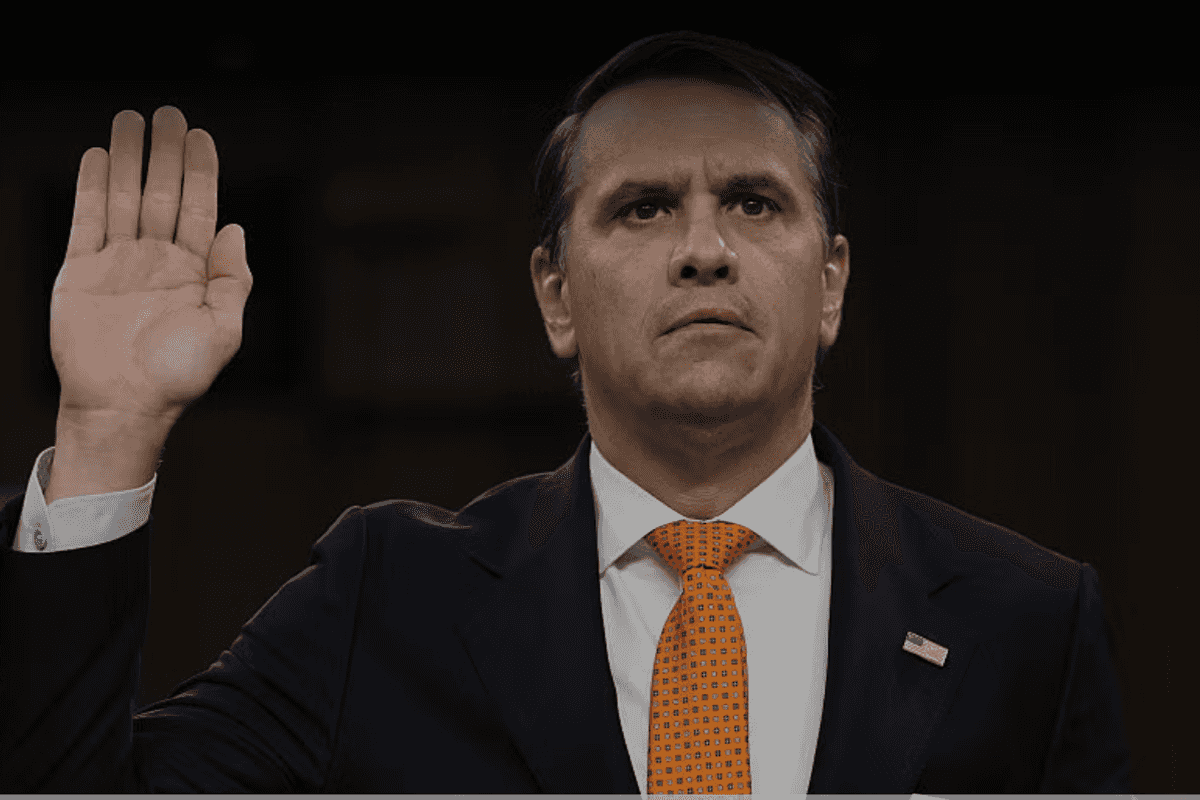
Attorney General Todd Blanche
Todd Blanche got his job by moving further and faster than his predecessor to indict Trump’s enemies, and his signature moves in office have been political prosecutions of presidential antagonists, which he insists Trump has a “right” and “duty” to order up.
I have argued that Blanche’s embrace of criminal cases against innocent people because they are Trump’s enemies is the quintessence of authoritarianism, and that it warrants his impeachment on that ground alone.
Trump’s wish for prosecutions of his enemies has virtually always been Blanche’s command—until last week. The president ordered up nakedly political prosecutions of members of the new Democratic majority, and Blanche reflexively seconded the ugly idea. But at a press conference a few days later, the bulldog AG, who normally has only a forward gear, reversed ground.
Meanwhile, Aaron Reitz, the U.S. attorney for the Southern District of Texas, has sent nastygrams to Senators Richard Blumenthal and Elizabeth Warren, suggesting that their oversight might be a crime, apparently with Blanche’s tacit blessing.
It amounts to a Department of Justice talking out of two or more sides of its mouth. But at least Blanche has sought to distance himself from the indefensible practice of threatening Congress for investigating.
The suggestion that has made even Blanche blanch is that aggressive oversight by the new Democratic majority is not only illegitimate but a federal crime. The notion is preposterous, not to mention breathtakingly disrespectful of Congress’s oversight power.
Trump first advanced it on Saturday, November 7, four days after voters handed Democrats both chambers. On Truth Social, he called the Democrats who had sent “threatening letters” to his officials “EXTORTIONISTS,” adding, “[t]hese SLEAZEBAGS should go to jail for what they are doing.” He coupled it with the sort of direct order the AG characteristically hops to: “By copy of this statement, I am ordering the Department of Justice to look into this criminal act, immediately!”
Blanche saluted the next day on CNN, calling the Democrats’ statements “outright threats” and saying “yes, there could be” criminal conduct in them.
The drumbeat spread through the administration. On November 9, White House counsel Will Scharf warned Representative Robert Garcia, the incoming House Oversight chair, that the Democrats’ threatened subpoenas and hearings “may cross the line into blatant criminality” as a threat within the meaning of the federal criminal code.
Scharf’s intervention, while legally cockamamie, at least was of a piece with the historic role of the White House counsel, who represents the president and isn’t bound by DOJ guidelines.
Not so for Reitz’s gratuitous meddling. He has sent similar letters to Blumenthal and Warren citing 18 U.S.C. §§ 241 and 242, the criminal civil rights statutes. His lunatic and deeply obnoxious idea is that investigating private parties’ dealings with Trump could amount to purposeful infringement of their right of association. He coupled that ⅛-cocked theory with sweeping demands to preserve every possibly relevant document.
Blumenthal, himself a former U.S. attorney, fired back the same day, calling the implied threat “baseless” and directing Reitz to preserve his own records.
Reitz has stepped in it to his thighs. First, he oversees federal criminal law enforcement in South Texas, and nothing in the public record ties Blumenthal’s or Warren’s conduct to his district. Second, a preservation demand should issue only in an open case, which in turn requires a bona fide factual basis to suspect a crime.
Late yesterday, Reitz said that “we don’t have to wait for them to commit a crime for us to begin investigating whether there’s a basis to escalate or indict or prosecute.” Guess again. By his own account, he has no basis, and none will ripen, because the conduct he wants to go after isn’t a crime and can’t become one.
Third, investigative steps involving senators require prior consultation with the DOJ’s Public Integrity Section. There is no indication Reitz has done so.
Reitz’s overreach has already drawn a bar complaint. On Monday, the nonpartisan watchdog Campaign for Accountability asked the State Bar of Texas to investigate him. The grievance invokes the Texas rule barring a prosecutor from “threatening to prosecute a charge that the prosecutor knows is not supported by probable cause,” and argues that Reitz’s letters may themselves violate 18 U.S.C. § 1505, which criminalizes obstructing a congressional inquiry “by any threatening letter or communication.” The prosecutor who accused senators of crimes for conducting oversight may have committed one trying to stop it.
Before turning to Blanche’s backpedaling, let’s dispel any idea that the Trump, Scharf, and Reitz salvos have the slightest legitimacy.
As we know from the butchery of the second Comey indictment, the “8647 seashell” case, the First Amendment tightly limits what counts as a criminal threat, to give wide berth to political rhetoric. The speech must be, to a reasonable observer, a “serious expression“ of intent to commit a specific unlawful harm.
Some Democrats, chuffed at the prospect of power after years of taking it in the teeth from Trump, previewed their accountability agenda colorfully. Representative Emily Randall promised to pass out subpoenas “like candy”; Representative Analilia Mejia, “like Mardi Gras beads.” Senator Ed Markey quipped that they would need to “plant new forests for all of the subpoenas.” Representative Robert Garcia posted “LAWYER UP.” Others went further: Representative-elect Richard Ojeda tweeted “First Hegseth... Then Homan. Belt to ass,” and Representative Yassamin Ansari said accountability means “eventually go[ing] to jail.”
Much of the gleeful bluster was foolishly swashbuckling, and Democrats would do well to lose the bravado. But every word concerns lawful process—subpoenas, hearings and cameras, the stuff of oversight. There is no universe outside of Trump’s febrile imagination in which a reasonable person would see it as a serious expression of intent to commit unlawful harm.
Then there’s the Speech or Debate Clause, which provides that members of Congress “shall not be questioned in any other Place” for their legislative work. Its very point is to stop the executive from prosecuting legislators. It descends from the English Bill of Rights of 1689, which answered a long history of monarchs jailing members of Parliament who crossed them. In 1629, Charles I imprisoned Sir John Eliot for seditious libel over his conduct in the Commons; Eliot died in the Tower of London.
The Supreme Court has said that “the instigation of criminal charges against critical or disfavored legislators by the executive” was “the chief fear” behind the privilege and remains “the predominate thrust” of the clause. And the Court has held that investigating, including issuing subpoenas, falls squarely within its protection. So the very oversight that Trump calls extortion could never ground a prosecution.
Blanche has made his bones with Trump partly through pugnacious, chest-out press conferences defending untenable positions. But last Thursday, he was halting and conciliatory, with none of his usual combativeness.
Having previously echoed Trump on CNN by calling the Democrats’ statements “outright threats” and possibly criminal, Blanche slammed on the brakes. He assured reporters there were no criminal investigations into any of the statements. Asked to identify a Democratic statement that had crossed into criminality, he disavowed the whole idea: “I never said that that point has been crossed. I haven’t said that.”
Blanche also more or less hung Reitz out to dry. Asked whether Main Justice signed off, he dodged but implied he hadn’t: “I’m the attorney general, so I don’t oversee every single thing that’s done.”
That supposition falls of its own weight now that Reitz has sent the second letter to Senator Warren—three days after Blanche was grilled about the first, on department letterhead, and posted on Reitz’s official X account. Once the first letter had stirred a public controversy, the second had to entail some coordination with headquarters.
Most important, Blanche mounted a strong defense of the very oversight Trump, Scharf and Reitz had tried to criminalize. “The Congress has an extremely important oversight function,” he said, one “that allows them and actually requires them to do their jobs in conducting oversight.” He even spoke of “a relationship with Congress that is productive”—a 180-degree reversal from the attacks from Trump and his minions.
Nothing in the law has changed since Trump’s edict. Blanche seems to have realized that come January, he will be under a congressional microscope, and it will do him no favors to have accused his constitutional overseers of crimes for doing their jobs. So it’s no small thing that Trump called for the heads of Democratic investigators, and Blanche demurred.
We shouldn’t expect Blanche to disavow Trump generally, or the administration to offer anything but obstreperous resistance to oversight, including an arrogant insouciance about contempt of Congress.
But the past week suggests we may see, at least from the attorney general, fewer gratuitous insults of the new majorities and, on occasion, a grown-up respect for a coordinate branch. His volte-face may also signal hesitation about green-lighting more reprisal prosecutions—though his caginess about Reitz suggests he’ll keep trying to have it both ways.
It took a Democratic Congress with subpoena power to get Todd Blanche to call oversight a duty rather than a crime. That itself is a measure of what the midterms changed.
Harry Litman is a former United States Attorney and the executive producer and host of the Talking Feds podcast. He has taught law at UCLA, Berkeley, and Georgetown and served as a deputy assistant attorney general in the Clinton Administration. Please consider subscribing to Talking Feds on Substack.
- The Most Urgent Impeachment Target Is Todd Blanche, Not Pete Hegseth ›
- “Chaos” in the Air: Five Ways Voting Could Be Disrupted on Election Day ›
- Conservative Paper Mocks Trump's 'Obsolete' And 'Blame-Shifting' Lameduck Blather ›
- White House threatens criminal investigation into Democrats’ oversight efforts - Live Updates - POLITICO ›
- White House Threatens Congress, Saying Aggressive Investigations Could Be Crime - The New York Times ›
- Donald Trump Attacks 'Evil' Democrats in Early Morning Truth Social Post ›
- Trump threatens Democrats who want to launch administration investigations with jail time in fiery rant ›
- Trump orders DOJ to probe Democrats for 'threatening letters' to GOP ›
- Trump Orders DOJ Probe as Democrats Plan Investigations Into His Administration - Bloomberg ›
- Trump White House threatens Democrats on way to Congress: ‘Blatant criminality’ | The Independent ›