Tag: north carolina republicans
In North Carolina, Republicans Activate Trump's Voter Suppression Scheme

In North Carolina, Republicans Activate Trump's Voter Suppression Scheme

What’s next? Asking how many jelly beans are in the jar?

That was a question election workers, particularly in the South, used to ask voters. Not surprisingly, Black voters, who wanted simply to exercise their rights as American citizens to cast a ballot, always managed to guess wrong.

How many bubbles in a bar of soap was another favorite riddle, an example of Jim Crow at its finest, using an impossible, ridiculous yet on the surface neutral test to weed out those the powerful felt did not deserve to choose the politicians who would represent them.

The Voting Rights Act of 1965 outlawed such practices, insidious tactics employed with an obvious though unstated intent. The current Supreme Court in the session that just ended suggested the impact of such policies cannot be considered, unless you come right out and state that race is the reason you’re asking about those jelly beans.

An exaggeration? Maybe. But the majority on the current court did say that voting policies that intended to remedy discrimination were themselves discriminatory.That the Supreme Court has been chipping away at what was once called the “crown jewel” of the civil rights movement should come as no surprise. Chief Justice John G. Roberts Jr. wrote as a young lawyer in the Reagan administration that the law represents “the most intrusive interference imaginable by federal courts into state and local processes.”

Now, in North Carolina, which trends a reddish purple but because of redistricting and a defanged Democratic governor looks crimson much of the time, Republicans are gazing backward.

The GOP majority on the State Board of Elections feels secure in its spots since the state Supreme Court blessed Republican lawmakers’ move to shift appointment power from Democratic Gov. Josh Stein to the Republican state auditor. The vote-restricting schemes they’ve come up with make the Trump administration’s push for a federal law largely unnecessary, at least in North Carolina.While the president’s SAVE Act meets obstacles in Congress and his recent speech rehashing disproven assertions about vote-rigging in 2020 fell flat, Republican-controlled states are sending a different signal: That’s OK, we’ve got this.

In South Carolina, a Trump-backed redistricting plan that probably would have cost Democratic U.S. House member James E. Clyburn his seat failed in the state legislature for now because of self-interest and, one hopes, a sense of decency.

In North Carolina, the elections board has proven neither of those reasons is a deal-breaker.

New rules would make it easier to toss ballots during the 2026 midterms and beyond if a voter’s stated reason for requesting an exemption to the state’s photo ID rules was judged false. It previously required unanimous agreement of a bipartisan election board before someone’s vote was not counted. With the shift, a simple majority would make the call, and Republicans hold majorities on each board in every one of North Carolina’s 100 counties.

A GOP-controlled Rules Review Commission isn’t likely to object.

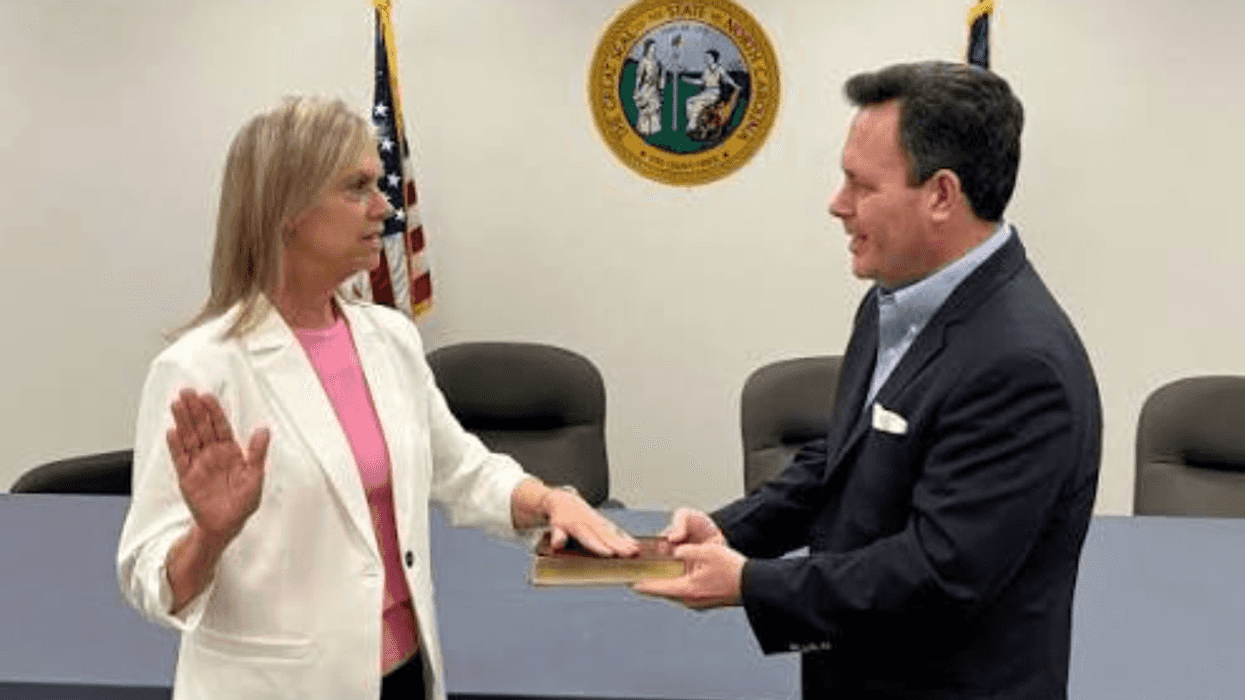
Republican board member Angela Hawkins seems to think a lot of people lie. As reported by WRAL, “she supported lowering the threshold and allowing boards to throw out people’s votes even if there’s disagreement over their eligibility.”

“It’s very difficult to find falsity in what someone says,” Hawkins said.

Furthermore, if your excuse for requesting an ID exemption is judged a lie when you try to cast a ballot and you complain about it, you’d better keep the ruckus down. Another rules change would allow volunteers to remove any voter, campaigner, politician or protester judged too noisy.

Hawkins sounded absolutely giddy at the thought of giving a thumbs-up or thumbs-down to voters who believe it’s more important than ever to be heard.

There is pushback, however toothless it may prove to be. “Partisanship has no business in the counting of eligible voters’ ballots,” Common Cause NC said in a statement and a warning about the latest moves by an elections board that has mail-in ballots next in its sights.

Of course, the board’s answer is that any new rules would apply to anyone of any party.

But if you don’t believe having a “D” or “R” after your name will matter in a state with a close U.S. Senate race that might determine control of Congress, in a state with a history of being sued over voting restrictions that a federal court said targeted African American voters “with almost surgical precision,” then you don’t know North Carolina.

If it seems like the fix is in, it’s because no one is hiding.

After the president’s evidence-free speech about fraudulent elections that seemed a warm-up for 2026 election denialism, Homeland Security Secretary Markwayne Mullin’s follow-up doubled down on Trump’s delusions, threatening local election officials with prison time if they did not comply with the administration’s meddling efforts.

Clearly Mullin’s not familiar with the U.S. Constitution, which gives Congress and the states, not the federal government, the power to govern elections. As administration officials and their lackeys across the country try to undo the will and voice of “we the people,” Mullin should brush up on that document, the same one that Black prospective voters in some states in pre-Voting Rights Act days had to quote, from memory, only to be rejected for a misplaced “a” or forgotten “the.”

The arbitrary tests imposed by clerks and bureaucrats making a mockery of the voting process are not ancient history and seem as unsavory as present-day North Carolina election officials telling someone who loves America enough to make their way to the polls that they’re noisy liars before ushering them out.

A country determined to live up to the ideals of its founding documents should not have to worry about a comeback of the worst policies of the past.

But here we are.

My advice? Election officials thinking of bringing back the soap test instead need to use it to scrub away the dishonor, if they can find a bar big enough.

Mary C. Curtis has worked at The New York Times, The Baltimore Sun, The Charlotte Observer, as national correspondent for Politics Daily, and is a senior facilitator with The OpEd Project. She is host of the CQ Roll Call “Equal Time with Mary C. Curtis” podcast. Follow her on X @mcurtisnc3.

Reprinted with permission from Roll Call

Transgender pride flag

Why Republicans Are Turning Transgender Children Into Political Scapegoats

The GOP's latest culture war is focused squarely on the nation's transgender community, specifically transgender youth. It isn't a new war, simply a new front in an old war that can be traced back to the famed "bathroom bills" from some years ago that spread across dozens of states. Those bills were introduced in tandem with former President Donald Trump's targeted federal government-led attacks that included the overturning of anti-discrimination statutes protecting trans people and an outright transgender ban in the U.S. military.

Now, in the wake of Trump's humiliating electoral loss, Republicans have accelerated the state-level attacks to a breathtaking level. In just the first three months of 2021, GOP-led state legislatures introduced more bills aimed at transgender people, especially youth, than they did over the entire previous year. There are now more than 80 bills introduced this year alone that, according to Alphonso David, president of the Human Rights Campaign, "are not addressing any real problem, and they're not being requested by constituents. Rather, this effort is being driven by national far-right organizations attempting to score political points by sowing fear and hate."

I recently spoke with Jules Gill-Peterson, an associate professor at the University of Pittsburgh and the author of the award-winning book Histories of the Transgender Child, in an interview, and she echoed this claim, saying, "A lot of authoritarian political movements are using trans people as their scapegoats." She called the latest wave of anti-trans legislation "an unprecedented assault in terms of just the magnitude of the bills and the severity of what they propose to do in terms of criminalizing basic access to health care and equal access to education."

She explained that "due to perhaps their general political incompetency, a lot of [Trump's attacks on transgender people] didn't really end up making it into practice." However, "on the state level, as is often the case, the GOP is much more successful at pursuing an anti-trans agenda than they ever are at the federal level." Gill-Peterson sees this as a culmination of efforts that can be traced back to North Carolina's 2016 passage of a bill banning transgender people from using facilities of the gender they identify with.

On April 5, North Carolina Republicans continued what they began five years ago, introducing a bill called the "Youth Health Protection Act," which blocks transgender minors from accessing the health care they need upon deciding to transition. Just as the GOP has often couched its attacks on communities under the guise of protecting them (think of anti-abortion legislation presented as "fetal personhood" bills), this bill, like several others in states like Arkansas, purports to protect trans youth.

Republicans also claim they want to protect "fair competition," in the words of Tennessee Gov. Bill Lee, by banning transgender kids from sports. Lee, along with the governors of Arkansas and Mississippi, signed bills into law this year banning trans youth from playing sports in school. These transphobic bills are based on a theory that transgender kids, especially girls, have an unfair biological advantage over non-transgender girls.

Just as the GOP's stated war on voter fraud is based on an imagined assault on the nation's democracy in order to disguise the real war on voting, the conservative party's stated reason for going after transgender children's access to health care or participation in sports is based on an imagined crisis. Gill-Peterson said, "most of these lawmakers will admit they've never heard of any issue with transgender participation in sports in their state, and they've never heard of any issue around trans health care in their state, and they don't actually know any trans children."

The GOP's war on voting offers another analogue. If the GOP really cared about democracy, they would make voting easier, not harder. Similarly, if the party were truly interested in the safety of girls, it would offer up bills that protect transgender girls in particular, who face very real dangers. Gill-Peterson said, "young trans girls and trans women are extremely vulnerable to sexual harassment and violence because it's not taken seriously." Instead, the bills banning access to health care and sports only fuel greater violence against them. Every year, dozens of trans women are killed, and more transgender people were killed in the U.S. in the first seven months of 2020 than all of the previous year. It's no surprise that the spike in violence has coincided with legislative attempts to dehumanize the community.

Just as with anti-voter and anti-abortion bills, the GOP's tactic of pursuing transphobic legislation involves wasting legislative time and money by passing clearly unconstitutional bills that are invariably legally challenged, remain tied up in the courts for years, and ultimately end up at the Supreme Court. Last summer, justices ruled against an attempt to legalize workplace discrimination against transgender employees, and then in the winter, they left in place a public school's accommodation of transgender students to use the bathroom of their choice.

Whether the GOP wins or loses on this issue in the nation's highest court is almost beside the point because the party's goal is to distract its anxious base from the fact that their leaders do little to nothing about pervasive problems around inequality and depressed wages, a stagnant job market, and the ever-rising cost of living.

Moreover, the GOP's anti-trans bills fulfill part of a larger conservative agenda to create ever more exceptions to government-provided services such as health care and education, whittling away at the state's responsibility for resources to be available to all and rights to be respected universally. If hormone treatments, abortions, and medical treatments for immigrants are exceptions to government-provided health care; if public education is for everyone but transgender kids; then those services are weakened in service of libertarian fantasies of how society should function.

How to combat this brutality and inhumanity? Gill-Peterson pointed out, "the folks who are on the same side of this debate as the Republican legislators include a wide swath of extremist groups: white nationalists, anti-vaxxers, anti-maskers, anti-immigrant groups." To meet this threat will require an equally broad coalition of progressives to stand guard against attacks on transgender people.

The state of South Dakota has been a testing ground for state-level legislation aimed at trans rights. Bill after bill has failed in that state, thanks largely to a coalition that has stood firm at every turn to protest them. Alongside transgender activists are parents, teachers, and doctors as well as national organizations like the ACLU and the National Center for Transgender Equality. Having a president like Joe Biden who has reaffirmed the humanity and dignity of transgender people, rather than targeting them for violence as Trump did, is also a huge help. "We need to see trans rights as integral to a broader agenda for democracy, justice, and public good in this country," said Gill-Peterson.

Sonali Kolhatkar is the founder, host, and executive producer of "Rising Up With Sonali," a television and radio show that airs on Free Speech TV and Pacifica stations. She is a writing fellow for the Economy for All project at the Independent Media Institute.

This article was produced by Economy for All, a project of the Independent Media Institute.

GOP Rigged Rules To Ensure Only A Republican Can Replace Burr

GOP Rigged Rules To Ensure Only A Republican Can Replace Burr

Sen. Richard Burr (R-NC) is facing calls to resign after news broke that he dumped as much as $1.7 million in stock ahead of the market’s steep downturn following the coronavirus outbreak.

Burr chairs the Senate Intelligence Committee — which was receiving daily classified briefings about the virus at the time of his sale.

Critics say that makes Burr’s sale unethical, as he possibly used information the rest of the public did not have in order to save himself money amid the stock market slide.

It’s unclear whether Burr will resign — or face any consequences for his actions.

In trying to excuse Burr’s actions, his spokesperson said in a statement to Politico, “Senator Burr filed a financial disclosure form for personal transactions made several weeks before the U.S. and financial markets showed signs of volatility due to the growing coronavirus outbreak.”

Of course, that explanation is exactly what is drawing criticism.

A poll from the progressive organization Data for Progress showed that 50 percent of North Carolina voters want Burr to resign.

If Burr resigned, Democratic Gov. Roy Cooper would pick his replacement. But unlike many states, where the governor is free to choose whomever they want to fill the vacancy, Cooper would be forced to pick a Republican.

That’s because in 2018, the state’s GOP-controlled legislature changed the law to tie Cooper’s hand.

According to the law:

The governor shall appoint from a list of three persons recommended by the state executive committee of the political party with which the vacating member was affiliated when elected if that party executive committee makes recommendations within 30 days of the occurrence of the vacancy.

That means that Cooper would be given a list of three Republicans to choose from.

The law change was one of a handful of ways the state’s Republican legislators tried to strip Cooper of power after he won in 2016.

Among other things, the legislature weakened Cooper’s control of state elections, including trying to ensure that Republicans would chair state elections boards in every election year. That law in particular was ruled unconstitutional.

Published with permission of The American Independent Foundation.

New Election Fraud Charges Filed Against NC GOP Operative

New Election Fraud Charges Filed Against NC GOP Operative

A long-running election fraud saga took another turn Tuesday when North Carolina prosecutors filed several new felony charges against Republican political operative Leslie McCrae Dowless.

Dowless, who helped mastermind a ballot tampering scheme in North Carolina’s 9th Congressional District, faces two counts of felony obstruction of justice, and single counts of illegal possession of absentee ballots, conspiracy to obstruct justice, perjury, and solicitation to commit perjury.

These charges are separate from the other seven charges he was indicted on in February. Those charges related only to the 2016 general election and the 2018 primary. The new charges are the first ones to come out of the 2018 general election.

House of Representatives GOP candidate Mark Harris hired Dowless as a consultant for the 2018 midterm race despite the fact that he’d been warned Dowless had a history of past election fraud.

While working for Harris, Dowless allegedly engaged in widespread absentee ballot fraud. Seven other people were also charged, but the indictment alleges that Dowless was the mastermind, “instructing his co-conspirators to sign certifications that falsely stated they had seen a voter vote by absentee ballot,” and then mailing in absentee ballots for people who didn’t send it in themselves.

In this fashion, absentee ballots that should not have been counted were. Earlier allegations involved questions as to whether Dowless also oversaw the illegal discarding of absentee ballots, but it is unclear if Tuesday’s indictment is meant to encompass that as well.

The fraud was working for a while. Harris was up by about 900 votes until the state overturned the election results amid an investigation into Dowless’ actions on behalf of Harris. This damaged Harris enough that he’s not going to be the GOP candidate in the new election this fall.

The GOP — which is usually so eager to insist voter fraud is a massive problem — has been conspicuously silent here. The head of the National Republican Congressional Committee (NRCC) vaguely tried to blame Democrats. Trump pivoted to complaining about voting in California.

State and federal authorities are both still investigating, so things could get even worse for Dowless — and perhaps for the North Carolina GOP — depending on what is unearthed.

Published with permission of The American Independent.

Shop our Store

Headlines

Editor's Blog

Trending

World