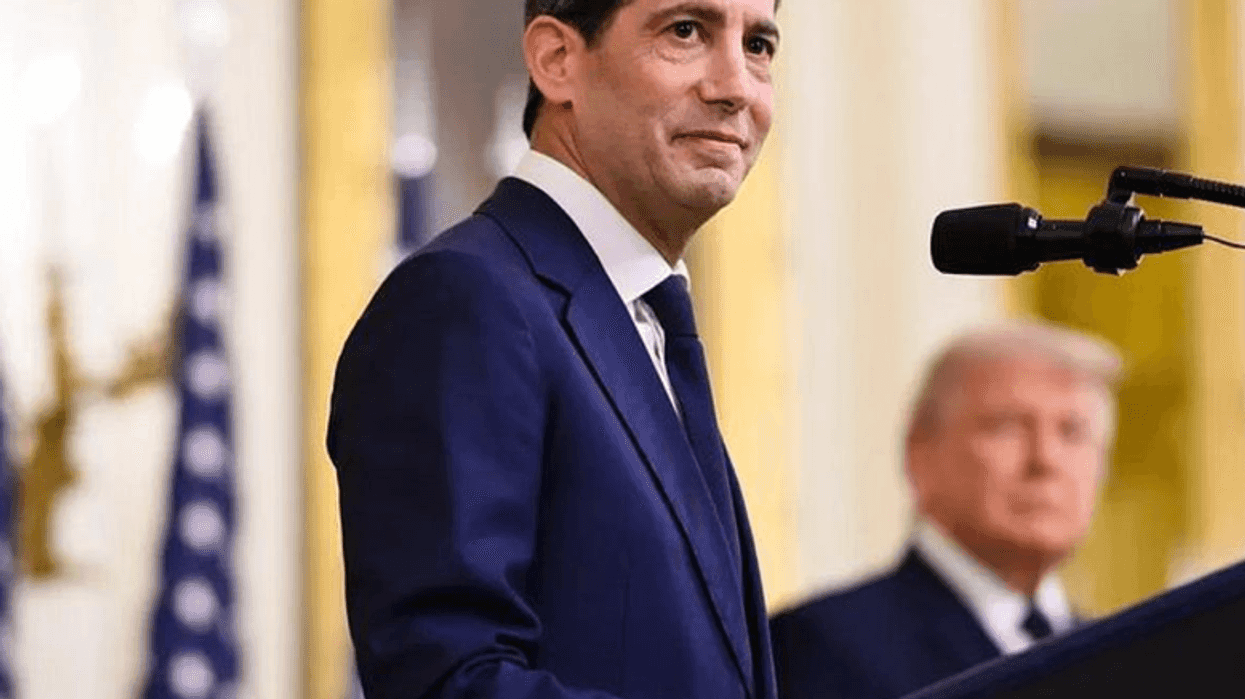
Trump Adds His Newly Appointed Fed Chair To His (Long) Enemies List
I had intended to write on the Fed’s decision to raise rates, but I don’t have much to add to what I wrote last week. I do think inflation is high, and for the moment the labor market seems reasonably healthy. But I don’t see higher rates as being a useful way to combat inflation caused by tariffs and Trump’s war on Iran.
As I noted, there is no case for the sort of wage-price spiral we saw in the 1970s. Wage growth has actually slowed sharply over the last two years. Wages had been growing at over a 4.0 percent annual rate in 2023 and 2024. The year-over-year rate has fallen to 3.1 percent. The annualized rate, comparing the average for the last three months (June-August) with the prior three (March-May), is just 2.7 percent. And this comes as inflation has accelerated from just over 2.0 percent to more than 3.0 percent.
Given little risk of accelerating inflation, at least from excessive demand, there seems little point in pushing rates higher. The one qualification I would make to this assessment is that expectations of a rate hike had become so embedded, especially following Fed Chair Kevin Warsh’s comments at the annual Jackson Hole conference, that it is likely long-term rates would go up more if the Fed held rates unchanged than if they hiked. Given that situation, I guess I would have gone with the hike.
But the bigger news yesterday was President Trump’s response. For some time, Trump has been pushing a bizarre theory that because we have the hottest economy (we don’t), we should have the lowest interest rates. This makes no sense, because the normal practice is to lower rates when the economy is weak, and raise them when it’s strong.
Apart from Trump’s confusion on the economics, the bigger story was that he immediately added the Fed to his enemies list, saying the rate hike was part of a grand conspiracy to make him look bad. This is more than a bit incredible, first and foremost because Trump had just appointed Kevin Warsh as Fed chair this spring. Apparently, Trump believes that his pick has already turned on him and joined the enemy.
And it wasn’t just Warsh; the vote was unanimous. That means that all four of the people who Trump appointed to the Fed, including his previous pick as Fed chair, Jerome Powell, lined up against him.
This follows Trump’s loss at the Supreme Court on his plan to have the Postal Service screen voter lists for mail-in ballots in the November elections. In that case, all three of Trump’s picks to the Court lined up against him, upholding a stay from a lower court that prohibited Trump’s plan from going into effect.
Trump complained that the justices “are not the people I interviewed.” He said that the court was giving in to crazy liberal influence.
It’s not new that Trump sees anyone who disagrees with him as part of a conspiracy. He’s long accused judges on lower courts of conspiring to undermine his agenda. And Trump regularly accuses any reporter who writes a critical story or asks a tough question as being “fake news.” And when polls show his popularity falling, Trump denounces them as “fake polls.”
But it seems a step further that Trump says people that he appointed, in some cases recently, have now joined the grand anti-Trump conspiracy. If Trump were not the president of the United States, we could just see this as part of an over-the-top comedy. Unfortunately, we don’t have that option.
In fact, the revenge Trump is floating for the Fed’s rate hike is pretty scary. He suggested that he will simply stop trading with arbitrarily chosen countries with whom we have a trade deficit. Trump seems to have a theory whereby we are losing money with a country, if we run a trade deficit with them. This makes as much sense as saying I lose money every time I go to the grocery store and pay them for the food.
But Trump is a reality TV show star, not someone who has even the most basic understanding of economics. Shutting down trade with a major trading partner would be a further jolt to the high prices that people are already upset over. It’s pretty horrible economics and doesn’t sound like very good politics, but I guess it will make Donald Trump feel tough.
It’s not clear Trump has the authority to arbitrarily impose trade embargos on other countries. But if the Supreme Court follows its recent path with tariffs, it will let Trump impose his embargo and then maybe wait a year or so before deciding it’s unconstitutional.
That will be bad news for families paying higher prices and the countries that have to reorient their economies, but at least it should further convince those who are still unconvinced that our president is completely out of his gourd. Other countries need to plan economic and defense relationships that do not involve the United States. At this point, we are not a credible country.
Dean Baker is a senior economist at the Center for Economic and Policy Research and the author of the 2016 book Rigged: How Globalization and the Rules of the Modern Economy Were Structured to Make the Rich Richer. Please consider subscribing to his Substack, from which this is reprinted with permission.