Tag: unemployment rate
Unemployment Surges As Jobs Report Flops, But Trump Boasts Of 'Phenomenal Job'

Unemployment Surges As Jobs Report Flops, But Trump Boasts Of 'Phenomenal Job'

Just hours after President Donald Trump praised himself for supposedly doing a near-perfect job with the economy, the monthly jobs report was released—showing an increase in unemployment and fewer jobs than analysts had expected.

The Labor Department revealed Friday that the unemployment rate has risen to 4.2% and that only 29,000 jobs were added in September—a far cry from the 90,000 jobs that experts anticipated.

Jobs numbers were also revised downward for previous months.

During a rally in Texas Thursday night for failing Senate candidate Ken Paxton, Trump declared success on the economy.

“The only thing we’re doing badly at is public relations,” he said. “In other words, we’re doing a phenomenal job.”


Public opinion polling has consistently shown that voters blame Trump and the GOP for the bad economy. Since retaking office, Trump has put in place terrible policies like tariffs—which have increased prices—and launched a war in Iran—which has restricted the fuel supply, causing gas prices to surge.

But Trump argued at his rally, as he has in the past, that these concerns are fake and that the concept of affordability is simply made up by the left.

“Remember they came up with the word ‘affordability,’” Trump said. “They always come up with these words: ‘Affordability.’ So the fake news starts using it, because they’re partners with the Democrats.”


This is, of course, a completely false conspiracy theory.

Trump has spent most of his time as a public figure espousing a host of fake conspiracies, often with racist messages.

But despite his rhetoric, the location of Trump’s reality-defying speech probably says more about the precarious state of his political future than anything else.

Texas, one of the GOP’s most loyal states, is where his handpicked candidate Paxton has been flailing for months. Despite Trump’s comfortable wins in Texas in 2024, 2020, and 2016—as well as GOP dominance of the state for decades—Paxton is trailing Democratic candidate James Talarico.

That Texas is in play is a testament to how Trump’s poor economic performance is resonating with voters.

During his first term, Trump became the only president since the statistic has been recorded to see a net job loss. And in his second term, he has fulfilled the long-standing GOP tradition of underperforming on the economy.

Trump can pat himself on the back and pretend that affordability is made up all he wants. But the data paints a far more accurate picture—and that is what Americans are paying attention to.

Reprinted with permission from Daily Kos


Employment Report: Beneath July's Mixed Numbers, Job Market Shows Fragility

Employment Report: Beneath July's Mixed Numbers, Job Market Shows Fragility

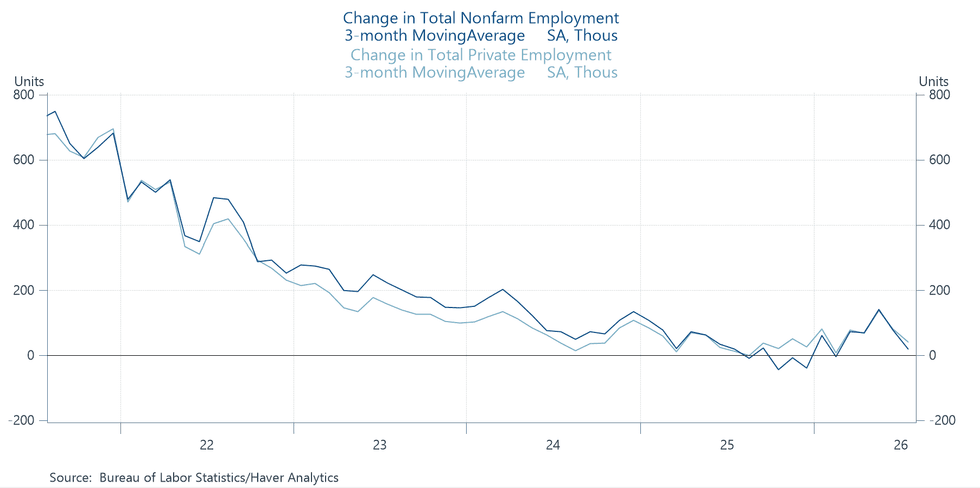
The nation’s payrolls surprisingly fell last month, down 23,000, driven by large losses in government jobs (and not federal, as you might expect, but local education). Revisions to payroll jobs were also negative, down 103,000 cumulatively for May and June, taking the average monthly job gains over the last three months down to a flimsy 20,000 jobs per month. That’s well below most estimates of the “breakeven” rate—the number of jobs needed to keep the jobless rate from rising.

And yet the unemployment rate ticked down to 4.1 percent. Whassup with that? First, this is a noisy indicator, and the breakeven mechanics requires averaging over numerous months to pull signal from noise. But re the monthly tick down, it happened for the wrong reasons: in the survey which tracks unemployment, both jobs and the labor force contracted in July. So that tenth-of-a-point tick down is not a sign of a tighter labor market.

My main message, however, is do not panic! Especially regarding the negative payroll number, the fact that it was partially driven by a 50,000 decline in local government education jobs, in a summer month, makes me wonder if there’s a seasonal adjustment problem here.

On the other hand—I haven’t used up my hands yet, have I?—as a long-time job-market-data whisperer, I’m not dismissing this report. It adds a data point to some longer-term trends that reveal fragility under the surface of what looks like a fairly tight labor market.

First, taking out the government sector and looking only at private-sector, three-month averages show flat job gains for about year, interrupted by a few better months earlier this year.

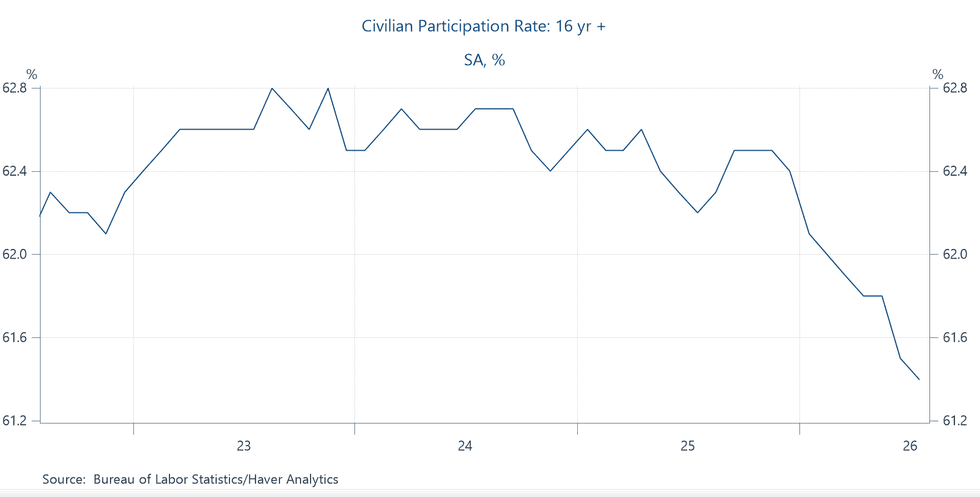
Second, labor force participation, which as noted, ticked down last month, is down by 0.8 percent over the past year. Yes, that series includes aging boomers and much weaker immigration, but it also reflects weaker underlying labor demand.

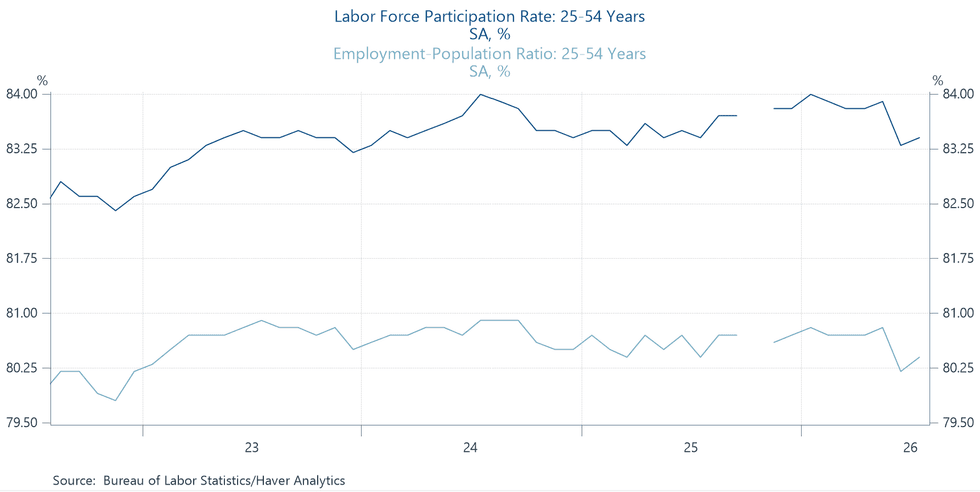
If we shift to prime-age workers (25-54), this labor force indicator along with the employment rate looks better, but there was a big dip in June that only slightly reversed in July.

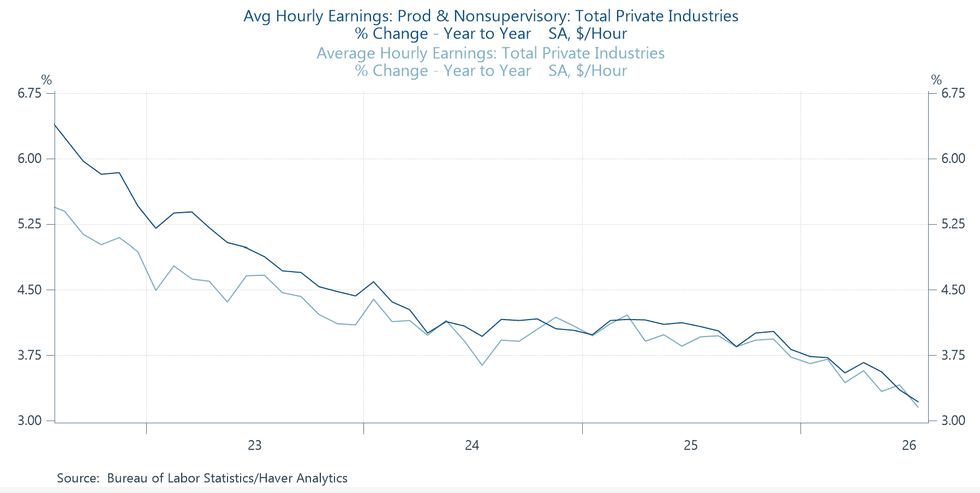
Third, wage growth has decelerated. These monthly jobs report contain hundreds of statistics from two different surveys. As noted, trends in the key, high-level stats, like jobs added and movements in the unemployment rate, give one a decent sense of the tightness or slack the job market.

But nominal wage growth is also a helpful indicator in that regard. It’s by no means fully a function of labor market conditions—it reflects underlying productivity growth, employer versus worker bargaining clout, discrimination by race, gender, age, etc., minimum wages, tax policy, non-wage benefits, and more. But it definitely has a cyclical component as well, wherein less slack tends to correlate with faster nominal growth.

In July, private wages were flat on a monthly basis and up 3.2 percent, year over year. That’s the lowest yearly growth rate since the pandemic. Here’s both all private hourly wages and mid/low-wage.

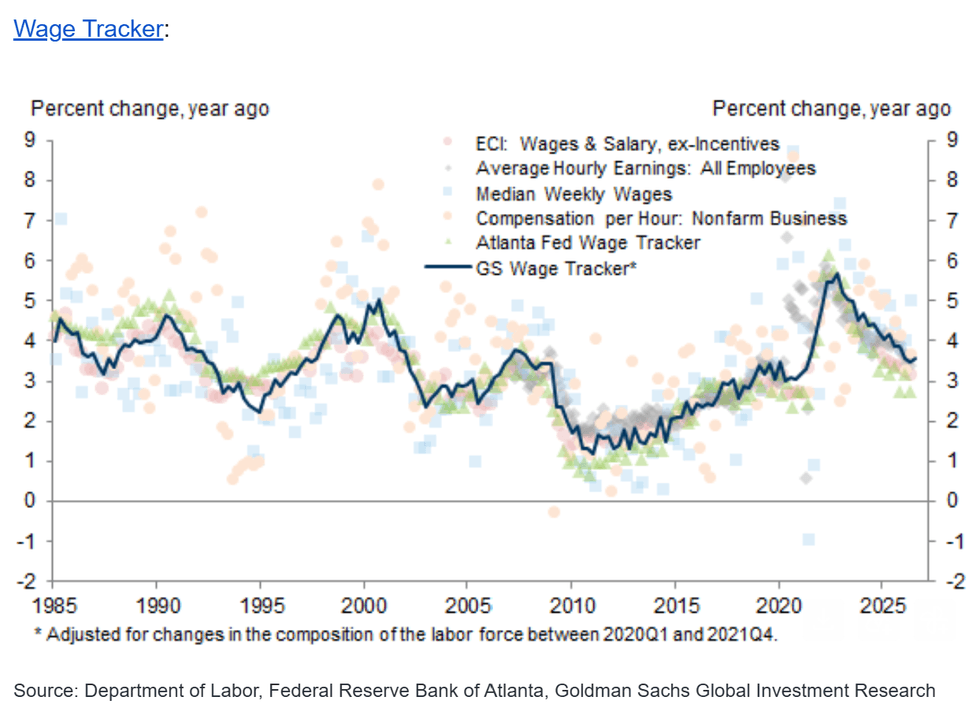
So as not to be overly dependent on one survey, I also like to gaze at this wage tracker from Goldman Sachs Research, a mash-up of many different wage series (this doesn’t include today’s data). The deceleration is clear here as well, , as well as the above-noted cyclicality.

Perhaps most importantly from the perspective of consumers, these wage rates are not reliably outpacing inflation, which has been jumping around a lot due to energy prices and the war, but continue to growth at yearly rates well north of 3%.

Bottom line, 4.1 percent unemployment is low unemployment, any way you cut it, and that’s good. But the job market is more fragile than is usually the case at such an unemployment rate. As best we can tell, employment growth is not great—low-hire, low-fire prevails. Labor force participation looks a bit saggy, and wage growth shows little of the pressure I’d expect if things were all that solid in this space.

Sorry to be the many-handed economist, but it’s a somewhat foggy picture.

Jared Bernstein is a former chair of the White House Council of Economic Advisers under President Joe Biden. He is a senior fellow at the Council on Budget and Policy Priorities. Please subscribe to his Substack, from which this is reprinted with permission.


Despite Strong May Jobs Report, Wages Aren't Keeping Pace With Inflation

Despite Strong May Jobs Report, Wages Aren't Keeping Pace With Inflation

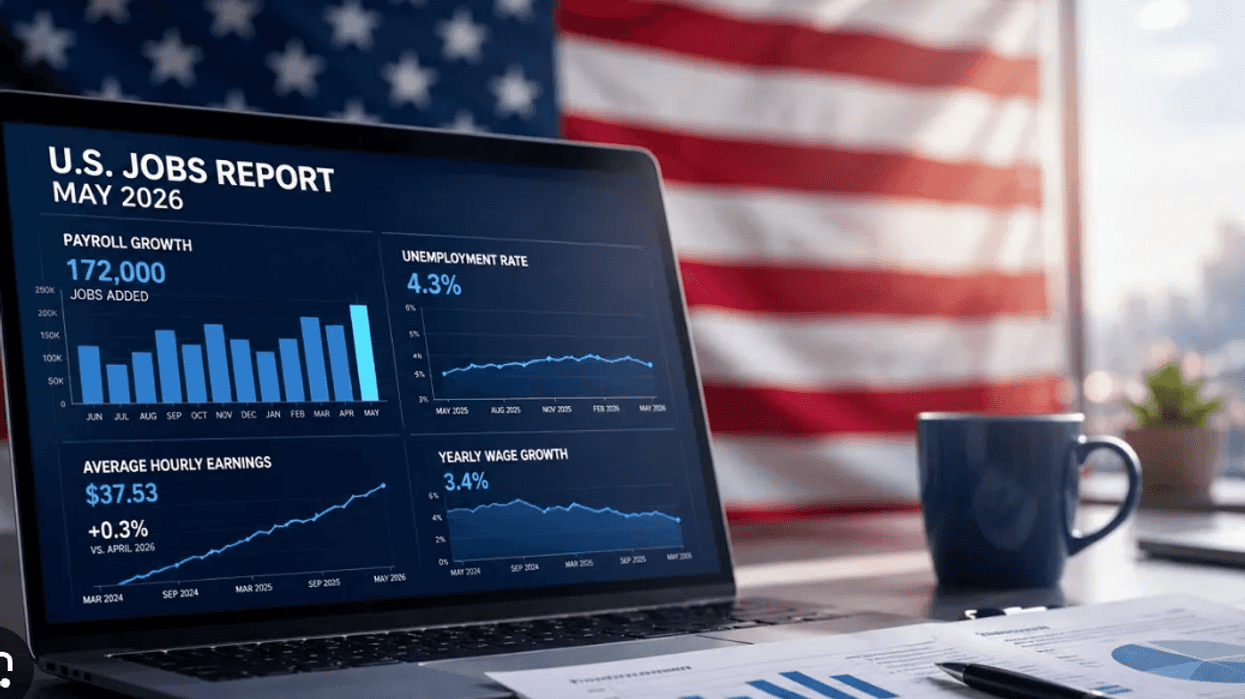
The May Jobs report was stronger than most people, including me, had expected. The 172,000 jobs created is not exactly earth-shattering, but in a context where immigration has been largely shut off and the labor force is barely growing, it is a lot. Plus, the two prior months’ data was revised up, so the average over the last three months is 188,000.

That looks pretty good, but the separate household survey looks less good. The unemployment rate held steady at 4.3 percent, which by historical standards is low, but it’s almost a full percentage point higher than the 3.4 percen t low hit in the spring of 2023.

More striking is that the rate did not fall, given the rapid job growth reported in the establishment survey. As the establishment data has shown strong job growth, the household survey actually showed a small drop in employment from the February level. To be clear, the surveys often are not aligned, so this discrepancy is not especially striking, but it is worth noting.

Anyhow, I have five main takeaways from the May report.

1) Jobs are growing far faster than the breakeven rate

2) Wages are not keeping pace with inflation

3) Workers are still reluctant to leave jobs

4) Job-killing AI is not visible in the data

5) Self-employment is lagging

Good Job Growth, but Heavily Concentrated

The entire 172,000 job growth came from three sectors: leisure and hospitality, local governments, and healthcare and social services. These sectors added 70,000 jobs, 55,000 jobs, and 47,200 jobs, respectively. To be clear, other sectors added some jobs. Construction added 17,000 jobs, manufacturing added 7,000 jobs, but with sectors like finance and wholesale trade losing jobs, the net outside of these sectors was zero.

The job growth in the healthcare and social services sector was not surprising. It has been adding jobs at a rapid pace throughout the recovery. This is the story of aging baby boomers needing more care. Most of the growth in the social service category is home healthcare aides. This growth will likely continue.

The growth in local government employment is a surprise. Most local governments are facing financial problems as funding from the federal government has been curtailed in many areas. It is unlikely this growth will continue and may be reversed in future months.

The leisure and hospitality story is the hardest to explain. Most of this growth (48,000) was in restaurants. This doesn’t seem to fit the data on spending. According to the Commerce Department, inflation-adjusted spending in restaurants is down by 1.0 percent since September. Yet employment is up by 154,000 or 1.2 percent. These changes will never match up precisely, but this is a large divergence. Maybe restaurant workers are getting less productive for some reason.

There are some interesting stories in construction and manufacturing. Construction has added 65,000 since December, an average of 13,000 a month. That is not exactly earth-shattering, but the sector lost 4,000 jobs in 2025.

Similarly, manufacturing is showing modest job gains this year, adding 25,000 jobs since December. The durable goods sector has been doing even better, adding 46,000 jobs. Again, this is not exactly a great story, but at this pace the sector could get back the jobs lost in 2025, sometime next year.

In any case, with immigration likely near zero, the number of jobs needed to keep pace with the growth of the labor force is in the 30,000-60,000 range. We are well above that pace in the last three months.

Wages Are Falling Behind Inflation

Wage growth is continuing to slow, with the year-over-year increase at just 3.4 percent. That is down from being slightly above 4.0 percent in 2023 and 2024. Tariffs and the war-related surge in energy prices have pushed inflation higher. It had been slowing toward 2.0 percent in 2024, but it now is at 3.8 percent and likely to hit 4.0 percent when we get the May Consumer Price Index next week.

Slowing wage growth in the face of rising inflation seems hard to reconcile with strong job growth and relatively low unemployment. Workers should be in a position to get higher wages, but that does not seem to be the case.

Workers Are Reluctant to Leave Their Jobs

One factor that can help to explain weak wage growth is the reluctance of workers to leave their jobs. We know from the Job Openings and Labor Turnover Survey (JOLTS) that both quits and hires are very low. This is also reflected in the relatively low share of unemployment due to voluntary quits. This rose from 11.3 percent in April to 12.5 percent in May, but that is still below the 13.2% average in the 2018-19 period of comparably low unemployment. The fact that the duration measures of unemployment are all relatively high, and rose last month, suggests that workers are right to be wary.

The Job-Killing AI is Still Hiding from the Statistical Agencies

If AI is allowing us to do more with fewer workers, it should show up in more rapid productivity growth. We are not seeing this in the data. Productivity growth was just 1.6 percent in the fourth quarter and 0.3 percent in the first quarter. We had been seeing growth in excess of 1.5 percent earlier in the recovery. And we had growth of just under 3.0 percent annually in the long post-war boom from 1947-1973.

Based on the April and May data, it looks like hours will grow at close to a 2.0 percent rate in the second quarter. Unless we get some blockbuster growth numbers for output in June, we will have another quarter of weak productivity growth. Either the story of job-killing AI is yet another economic myth, or the AI is much smarter than we think, and is hiding from the statistical agencies.

Self-Employment is Weak

One story of AI is that it is supposed to make it easier for people to start businesses. We are in fact seeing a strong uptick in new business formation. However, this is not showing up in the data on self-employment.

Taking an average of the last three months, incorporated self-employment is down by 1.0 percent from the year ago, while unincorporated self-employment is down by 4.2 percent. This is a contrast from earlier in the recovery when self-employment was rising rapidly. Incorporated self-employment in the months from March to May was 10.8 percent higher than it had been in 2019, before the pandemic. Unincorporated self-employment was 6.0% higher. This story could change, but for now, it doesn’t look like AI is leading to a boom in self-employment.

Questions for Next Month

The May report definitely had some good news, but also raises many questions. What good jobs report doesn’t?

Some of the things I will be looking for is what happens to local government employment, is wage growth picking up, are people quitting their jobs? But we have a month to worry about these things.

Dean Baker is a senior economist at the Center for Economic and Policy Research and the author of the 2016 book Rigged: How Globalization and the Rules of the Modern Economy Were Structured to Make the Rich Richer. Please consider subscribing to his Substack.



Federal Reserve's Rate Cut Won't Do Harm, But Its Next Chair May Be Ruinous

Federal Reserve's Rate Cut Won't Do Harm, But Its Next Chair May Be Ruinous

Yesterday the Federal Reserve cut the federal funds rate — the interest rate on overnight loans between banks, which the Fed effectively controls — by a quarter point. There are four things you should know about that cut:

· Although Donald Trump has been screaming at the Fed, demanding big rate cuts, there isn’t actually a compelling case for cuts right now

· On the other hand, this cut is unlikely to do any harm

· In fact, Fed policy over the next few months barely matters

· The important questions now are political: Will Trump destroy the Fed’s independence, and do to monetary policy what he has done to health policy — put it in the hands of charlatans and cranks?

Why do I say that there isn’t a compelling case for a rate cut? The Fed has a “dual mandate”: It’s supposed to seek both price stability and full employment. To fulfil this mandate as best it can, the Fed normally cuts interest rates when the job market is weak, raises rates when inflation is running hot.

Right now, however, the job market and the inflation rate are giving conflicting signals. Unemployment is somewhat elevated — 4.4 percent compared with an average of four percent last year — and other indicators, like the time it takes workers to find jobs, are showing weakness. On the other hand, inflation is running at around three percent, above the Fed’s target of two percent. So you can make the case either for or against yesterday’s cut.

Indeed, the Fed’s official statement about the interest rate decision highlighted the ambiguity, noting the risks on both sides and justifying its move with a guarded reference to rising “downside risks to employment.”

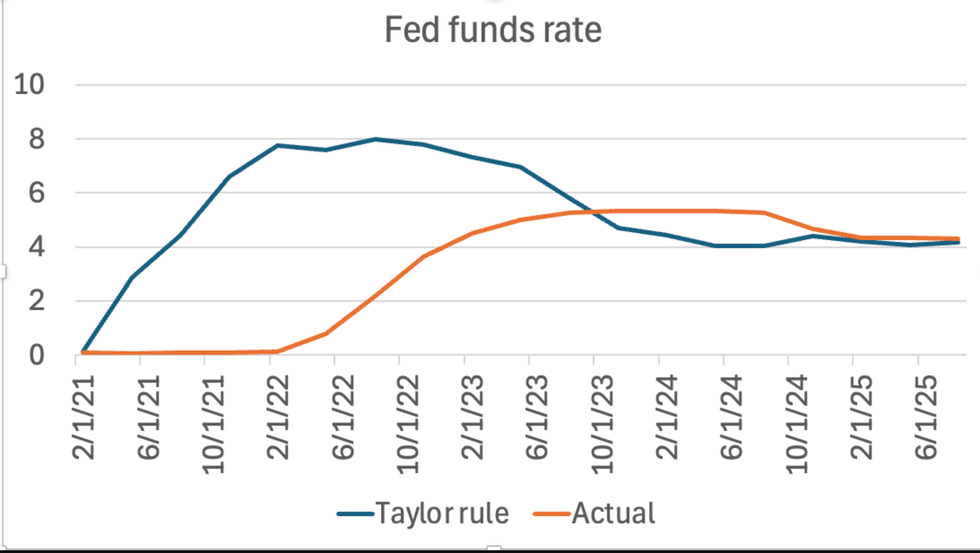
For the wonkishly inclined: We can get more specific about the dual mandate by invoking the Taylor Rule, devised by the economist John Taylor in the 1990s, which offers a formula for setting the fed funds rate based on unemployment and inflation. Or actually I should say Taylor Rules, plural, since there are a number of variants. The Atlanta Fed offers a “Taylor rule utility,” which lets you pick among the variants or roll your own. But most versions say that the current level of rates is more or less right. Here’s what one comparison looks like:

Source: Version FOMCTaylor93UR

On the other hand, nobody thinks these estimates are precise, and as the Fed statement suggested, there are hints in the data that the labor market is weakening. So a 25 basis point cut is defensible too.

And none of this matters very much. Short-term interest rates, like the fed funds rate, have very little impact on the real economy.

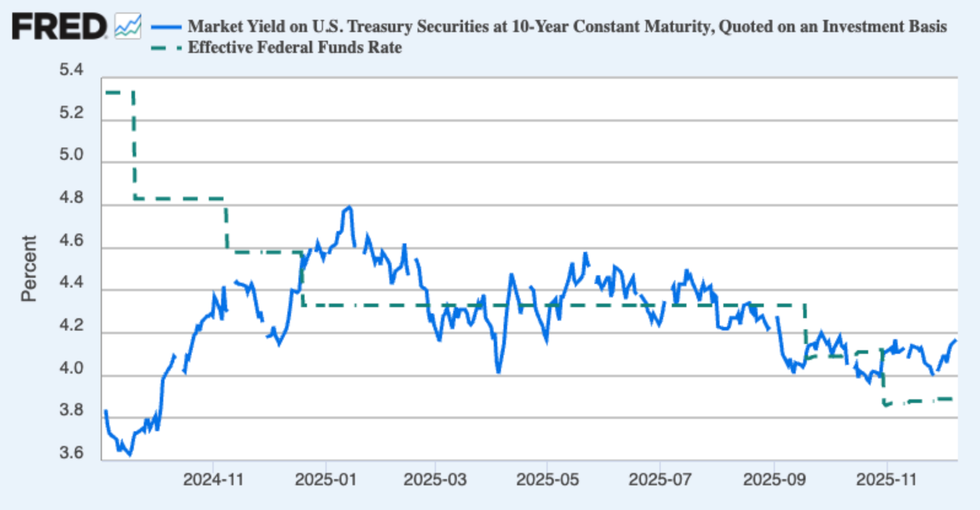
And long-term rates, which matter a lot more than short-term rates, especially for housing, mostly reflect market expectations of Fed policy over the next few years, not the next few months. As a result, long-term rates and short-term rates can diverge. They can even move in opposite directions. The Fed began its current cycle of rate-cutting in September 2024. Since then the fed funds rate has come down significantly but the benchmark 10-year interest rate has gone up from a low of 3.6 percent to the current level of just under 4.2 percent:

Sources: Board of Governors of the Federal Reserve System, New York Federal Reserve, St. Louis Federal Reserve

What’s that about? Because the Fed tries to fulfil its dual mandate, it normally tries to set interest rates neither too high, which can lead to unnecessary unemployment, nor too low, which can lead to excessive inflation. If you ask me, the Fed should call its target the “Goldilocks rate.” Sadly, however, it’s usually referred to, unpoetically, as r* or r-star.

R-star can’t be observed directly, only estimated. And what has happened since last year is that many estimates of r-star have been marked up, for at least two reasons. First, the tax cuts in the One Big Beautiful Bill will lead to larger budget deficits — no, tariff revenues won’t make up the difference, even if the Supreme Court lets Trump’s clearly illegal tariffs stand. And these deficits will put upward pressure on long-term rates. Second, the AI boom has led to huge spending by tech companies, especially on data centers, which also puts upward pressure on long rates.

So if the Fed continues to operate normally – that is, without political interference -- movements in r-star will be the main driver of future interest rates. In particular, long rates will come down if AI is a bubble and that bubble bursts.

But will the Fed continue to operate normally? Or will monetary policy, like so much else in America these days, end up being ruled by Donald Trump’s whims?

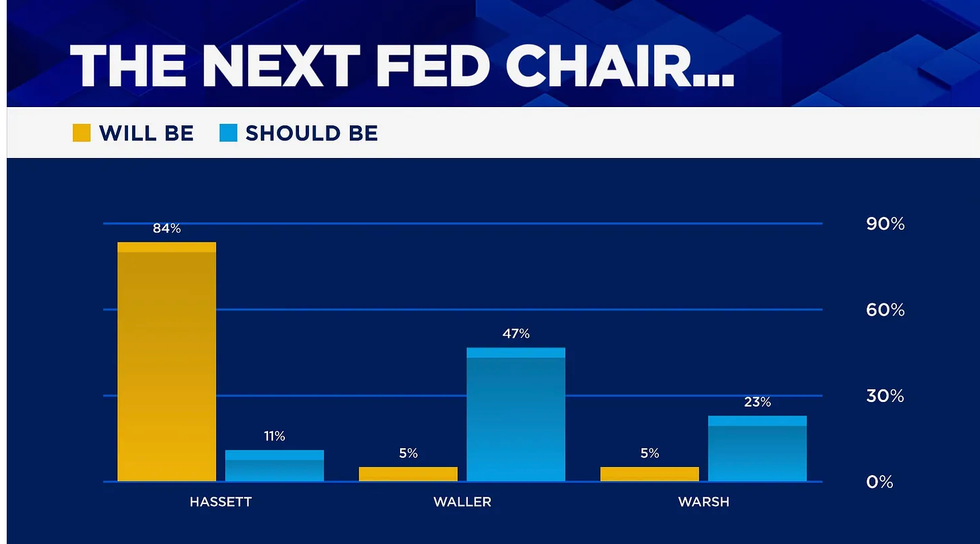
I wrote last week about Kevin Hassett, Trump’s likely pick as the next Federal Reserve chairman, whom I described as an “ideological DEI hire” who is intellectually and morally unqualified for the job. It turns out that I’m not alone in that assessment, although I may be using unusually blunt language. CNBC regularly surveys financial experts for their views on Fed-related matters. According to their latest survey, featured in the chart below, almost all their experts believe that Hassett will get the job, but almost none of them think he should.

And even if Hassett doesn’t get the job, whoever does is almost certain to be totally subservient to Trump. And this will be a negative for the economy. First, if Trump succeeds in controlling monetary policy, he can exact a policy according to his whims, which are both incoherent and dangerous. He is demanding massive interest rate cuts even as he insists that the economy is A+++++ — in which case why does it need these cuts? Nor can we expect him to show proper concern about the inflationary consequences of big rate cuts given that he keeps claiming that overall prices are falling, which is simply false.

And second, even if Trump isn’t able to capture full control over monetary policy through his pick for Fed chair, the effects will still be negative. Because as I pointed out in my critique of Hassett, in times of crisis the Fed chair has to be capable of showing leadership and gravitas, as well as garnering trust. Given that the Fed’s future task has been made especially difficult by Trump’s chaotic policies, higher-than-desired inflation, a weakening job market, very high future deficits, and a falling dollar, installing a Trump sycophant as Fed chair would mean facing any future crisis without any of the reserves of credibility that got us through the global financial crisis in 2008 and the COVID crisis in 2020.

So however this turns out, politics is now what matters for the future of the Fed — not whether we have one or two rate cuts in 2026.

Paul Krugman is a Nobel Prize-winning economist and former professor at MIT and Princeton who now teaches at the City University of New York's Graduate Center. From 2000 to 2024, he wrote a column for The New York Times. Please consider subscribing to his Substack.
Reprinted with permission from Paul Krugman.

Shop our Store

Headlines

Editor's Blog

Trending

World