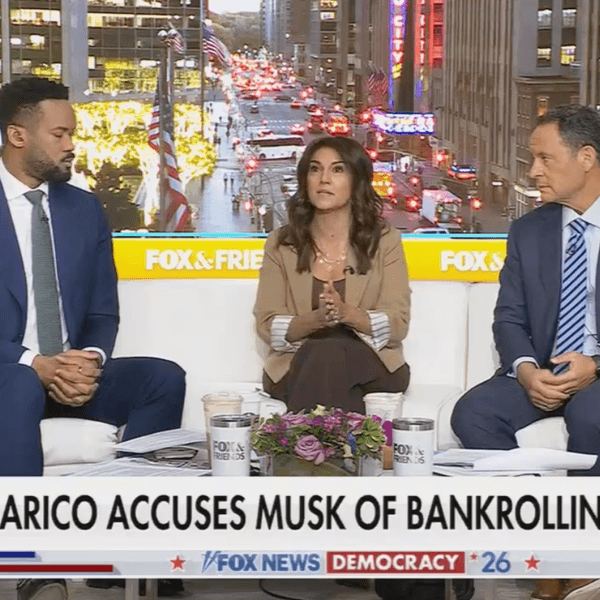
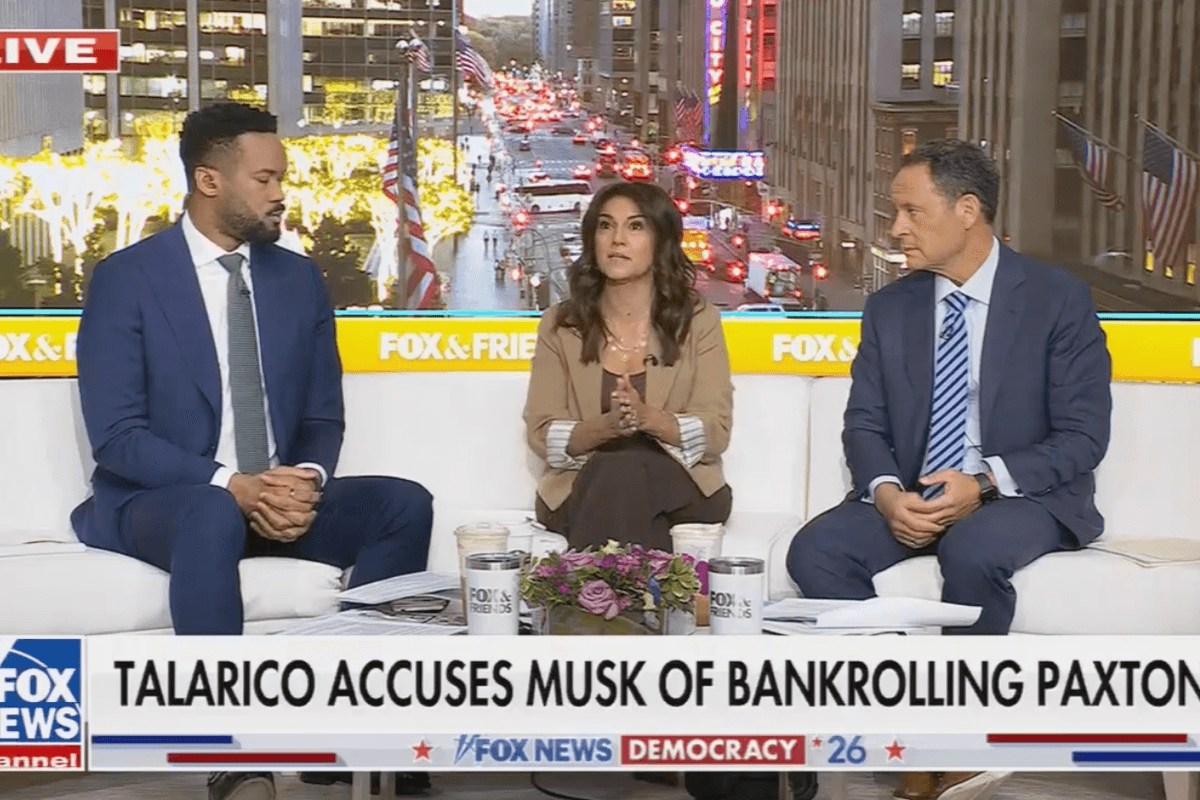
Lawrence Jones, Rachel Campos-Duffy and Brian Kilmeade
Rachel Campos-Duffy had harsh words on Monday morning for family members of Republican politicians who insert themselves into the public discourse, lamenting that James Talarico, the Democratic nominee for the U.S. Senate seat in Texas, “has also gotten support, unfortunately, of prominent members of the Bush family, which is really unfortunate.”
The Fox News host’s criticism of the Bush family as insufficiently loyal to the GOP carries extra weight because Campos-Duffy’s own husband, Sean Duffy, serves President Donald Trump as secretary of transportation. (Duffy is himself a former Fox host, one of more than two dozen former Foxers to join the administration.)
Campos-Duffy’s ongoing role at Fox is an ethical calamity — one that means that when the network’s executives subbed her in as a Fox & Friends co-host on Friday and Monday, just days before the midterm elections, they knew exactly what to expect: The North-Korea-style propaganda that Trump desperately wants Fox to provide at all times. (Campos-Duffy was filling in for Ainsley Earhardt, who over the weekend wed longtime Fox host and Trump propagandist Sean Hannity. They celebrated at Mar-A-Lago on Friday night, with the president in attendance.)
The host rose to the occasion, using the Fox & Friends platform to tout the “incredible” future prospects of the economy under her husband’s boss and the federal government’s probe of Rep. Ilhan Omar (D-MN) as reasons for Republican voters to stream to the polls, while fearmongering about Democratic candidates “transing their children.”
Campos-Duffy on why to vote Republican: The Trump economy and Omar probe
With Republicans facing dismal prospects in next week’s midterm elections, Campos-Duffy has attempted to offer an antidote to voter concerns over Trump’s job performance and rising costs triggered in part by his war in Iran.
She acknowledged on Monday that “the gas situation is real,” which she attributed to the Iran war (without acknowledging that her husband’s boss was responsible for starting it), and said it would be fixed once the war ends.
“And so it's unfortunate that this war — that we're in this war, and that this war is doing what it's doing to the gas prices,” she said. “But if you had removed the war, the economic blooming that would have happened in April and the place we would be at right now would be incredible.”
She added, “My idea — and it's not just my idea, the president says it and economists say it — the second this war is over, because the president has continued to make investments in gas and oil and freeing it up in terms of regulation, the prices are going to come down and the economy is going to boom again. We just have to end this war.”
Campos-Duffy went on to claim “the foundation of this economy is incredible."
On Friday she praised Trump for “working his tail off” to lower prices, including by “helping out farmers” through the importation of Russian diesel. “He understands he is hurting with these people, and he is trying to find ways to make it right because the war just went longer than he thought it was going to be,” she explained.
The Fox host also repeatedly highlighted the Trump administration’s probe of Omar’s citizenship on Friday as a reason for recalcitrant Republican voters to back the GOP. Campos-Duffy called the Democrat “the most ungrateful, anti-American congresswoman I have ever seen enter those halls” and told viewers “when you are going to the polls, you think about somebody who can expose this kind of stuff, only President Trump would have done that.”
“Make no mistake, this is the reason why people elected President Trump,” she later added. “If you believe it matters that your member of Congress, any member of Congress who has access to classified information and other sensitive information, actually be a U.S. citizen, there is no other DOJ other than Donald J. Trump's DOJ who would be willing to take on a case like this.”
“It’s a much bigger story because our country is going through an identity crisis, and we want people who represent us — who care about Americans, America, our land, our laws, our Constitution,” she concluded.
Campos-Duffy ramps up “fear porn” about Democratic candidates
When Campos-Duffy wasn’t singing the praises of the president and his administration, she was denouncing Democratic candidates for Congress. Much of her commentary fell into the category of what fellow Fox host Jesse Watters described as “fear porn,” overwrought commentary designed to convince voters that they need to go vote for Republicans because Democrats are “scary and dangerous.”
Campos-Duffy offered up some campaign advice to Texas Republicans on Friday, arguing they should target Hispanic voters by telling them Talarico wants to “mess with their kids.”
“If I was a Republican running in that state, I would focus on the Hispanic community, letting them know what he has said about God and what he has said about transing their children,” she said. “Because as soon as these people get power, they're going to go back to who they really are.”
Likewise, Campos-Duffy described Abdul El-Sayed, the Democratic nominee for U.S. Senate in Michigan, as an “out and proud commie that Obama always wanted to be” (El-Sayed has repeatedly said he is a capitalist). She also echoed Trump’s bigoted and deceptive claims that El-Sayed, who is Muslim, might become a threat to “national security” because of his “access to national secrets” and suggested on Friday that he prefers “sharia law.”
Reprinted with permission from Media Matters
- You Won't Believe...What Trump's Fluffers Once Said About January 6 ›
- American Manufacturers Debunk Fox News Defense Of Trump Tariffs ›
- State-Run Media Or Media-Run State? On Fox & Friends, The Answer Is Yes ›
- Fox Hosts Ignore Arrest Of Biden Informant Whose False Charges They Hyped ›
- Fox Hosts Reject Reality On Crime, Inflation, Energy And Migration ›
Start your day with National Memo Newsletter
Know first.
The opinions that matter. Delivered to your inbox every morning