Bring Me The Head Of Cassidy Hutchinson! Why Trump's Vendetta Will Fail
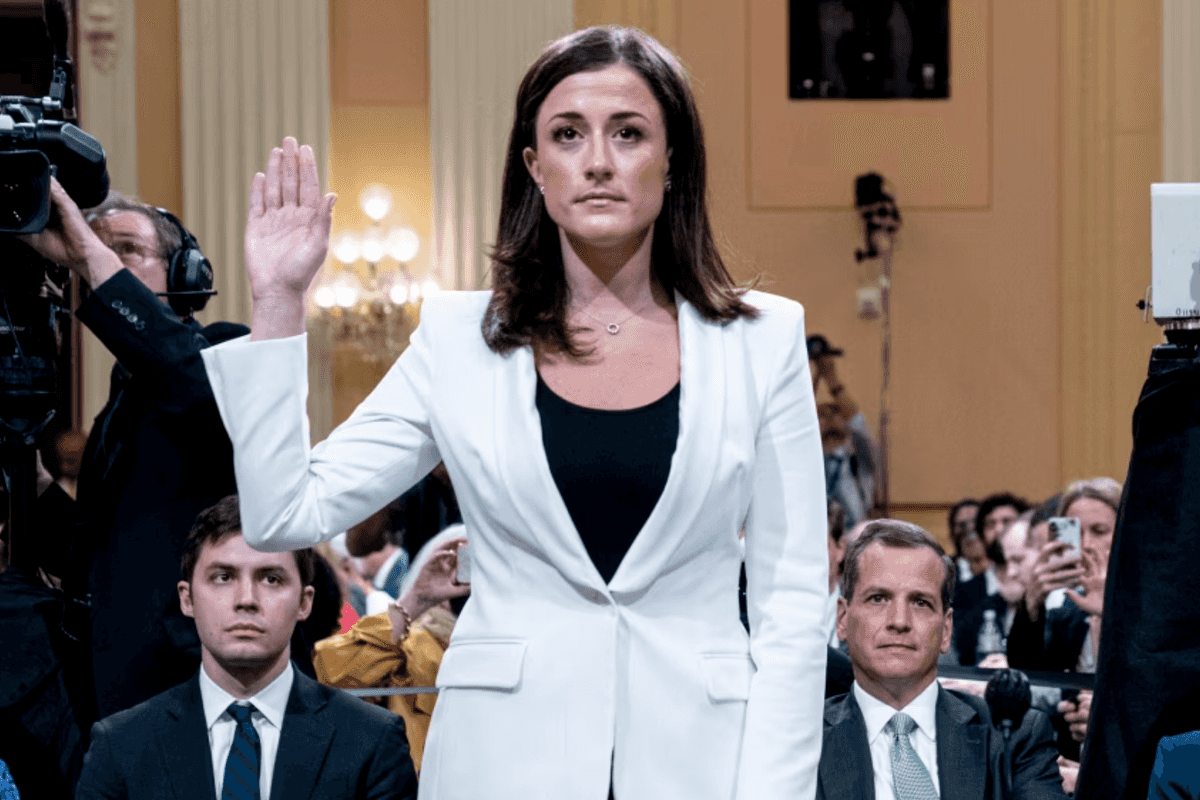
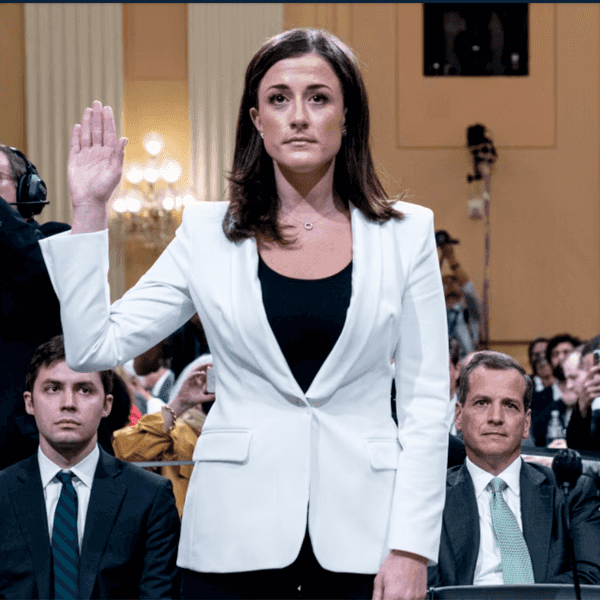
Cassidy Hutchinson preparing to testify before House Select Committee on January 6
There’s an unsurpassed ugliness in watching the full might of the federal government bear down on a young woman whose offense was bravely telling the nation the truth about the president. Even by the standards of this administration’s long campaign of reprisal, the pursuit of Cassidy Hutchinson may be its nastiest and most repulsive move yet.
In June 2022, some 20 million Americans watched the 25-year-old aide to White House chief of staff Mark Meadows tell the House January 6 committee what she had seen unfold inside the Trump White House during the Insurrection. She had every reason to stay quiet: a career in Republican politics ahead of her and, by her account, a Trump-world lawyer who steered her toward saying less than she knew while dangling jobs in exchange for loyalty. She broke with him and spoke up anyway, at enormous personal cost. Her testimony was riveting and, to me and I think to the country, completely credible.
Now the villains she stood up to have seized power, and the president wants to see her in the dock. Prosecutors presented evidence against her to a D.C. grand jury. The Department of Justice is reportedly weighing perjury and obstruction charges, with an indictment request expected after the midterms.
Three points stand out: First, the investigation’s assignment to the Civil Rights Division is bizarre and a reflection of its political genesis. Second, it will never produce a conviction, as Hutchinson’s tormentors almost surely recognize. Third, if it ever sees the light of day, it likely will boomerang, with considerable damage to Trump and his administration.
The clearest indication of the political impetus is that the Civil Rights Division is running the case. For a DOJ alum, that detail leaps off the page.
The division, traditionally one of the crown jewels of the Department, is now a hollowed-out hackery run by Harmeet Dhillon, a Trump loyalist through and through. And it has no business near this case: the division oversees, or used to, a discrete set of offenses, and lying to Congress isn’t among them. The assignment smacks of a delivery to a hand-picked loyalist who makes up in devotion what she lacks in prudence and experience.
A perjury or false-statements case would normally run out of the U.S. Attorney’s Office in D.C., headed by Jeanine Pirro. But Pirro has suffered an astonishing run of grand jury defeats, from the “sandwich guy“ to six Democratic lawmakers whose only offense was reminding troops not to follow illegal orders to would-be fall-man for the Reflecting Pool debacle, David Hearn. Had this case landed on her desk, she probably would have been found hiding under it. So the case went to Dhillon, and it seems likely that the order came from Todd Blanche or someone above him.
We know what that someone wants. The Atlantic’s Sarah Fitzpatrick reported last week that Blanche’s and FBI Director Kash Patel’s jobs may ride on delivering indictments of Trump’s enemies, Hutchinson among them. One former official put it plainly: “The president wants indictments. He wants people in handcuffs. He wants the headlines.” Trump already fired one attorney general, Pam Bondi, in part for failing to jail his adversaries. The Hutchinson investigation, prompted by a referral from Trump allies Jim Jordan and Barry Loudermilk, began on Bondi’s watch. Blanche and Dhillon saw what happened to Bondi, and they can see Pirro hanging by a thread. More heads, more scalps. Get me Cassidy Hutchinson.
A president in political free fall weeks before the midterms might have better uses for his energy than pumping his legs in midair like Wile E. Coyote. But the reprisal agenda seems to matter more to Trump than anything, including his party’s fortunes.
Second, the case is a stone-cold loser, and any experienced prosecutor knows it.
Robert Jackson warned that the gravest danger in federal prosecution is the prosecutor who picks the person first and then goes looking for a crime. The corollary is maybe the most sacrosanct rule a federal prosecutor lives by: you don’t indict unless you’ve concluded the person is guilty and that 12 jurors will likely convict. Here, as with Comey, forget about it.
The geniuses in MAGA-land have fixed on Hutchinson’s testimony that deputy chief of staff Tony Ornato told her a story—in the presence of Bobby Engel, the head of Trump’s detail—that captured Trump’s crazed determination to join the marauders at the Capitol. According to that account, Trump said “something to the effect of, ‘I’m the f----ing president, take me up to the Capitol now.” He then reached for the steering wheel and, when Engel stopped him, lunged at Engel.
The supposed contradiction is that the Secret Service driver, in an interview months later, said he never saw Trump grab the wheel. That says nothing about whether Ornato told Hutchinson the story—in front of Engel, who said nothing to contradict it. And when the committee later questioned Ornato, he reportedly said not that the conversation never happened, but that he didn’t recall it. That’s the well-known dodge of a witness caught between a rock and a hard place, à la Emil Bove professing not to recall saying the Department might have to tell the courts “fuck you.”
What about building a case on the differences between what she told the committee early on, under the guidance of the Trump-supplied lawyer, and her later testimony? It won’t work. Federal law permits that theory—that one of two contradictory sworn statements must be false—for court and grand jury testimony, but not for congressional testimony. The DOJ would have to pick a specific lie and prove it. And for political reasons, the statement it picks has to be her truthful public testimony to the committee.
The same goes for prosecutors’ reported interest in who wrote a notecard for Trump during the riot. Hutchinson says she did; former White House counsel Eric Herschmann says he did. I’d bet on Hutchinson’s memory. But in any event, that’s what we’re talking about: a difference in memory, nowhere remotely near a crime.
Finally, we know what the prosecution would look like, and the likely jury reaction to it, because we have seen it before with our own eyes: a young woman under enormous pressure, inviting total ostracism in Trump-land, stepping forward to tell the truth. It’s doubtful a single juror, much less all 12, would vote to convict. And that is assuming the Grand Jury agrees to the prosecutors’ request to indict. That’s typically a layup, but with the office’s record and the weakness of the case, it looks more like a half-court heave.
Third, a prosecution would dredge up some of the most forceful evidence of the nature and gravity of Trump’s crimes, pushing back against his Orwellian project of erasing January 6.
That begins with Hutchinson’s boss. Meadows was by Trump’s side most of January 6, acting as the switchboard for the panicked calls from the Hill—including from senators like Ted Cruz and Josh Hawley who now profess outrage that Jack Smith obtained their toll records (a catalog of numbers dialed and duration of calls, and notably not the content of the calls), a completely routine and necessary move. Nobody knows more about Trump’s conduct that day. And most of what Hutchinson knows, she knows through him.
Meadows defied the committee’s subpoena, and the Garland Justice Department declined to prosecute him for contempt, a responsible call given his non-meritorious but plausible executive privilege defense. He cooperated in part with the Jack Smith investigation, a development that must have unnerved Team Trump. Since then, the administration has dodged that cannonball. A Hutchinson trial would put Meadows and his panoramic knowledge of Trump’s doings on January 6 at the center of the proceeding.
It would also resurrect the rest of her testimony: Trump hurling his lunch at the wall after Bill Barr told the AP there was no widespread fraud, ketchup dripping down the wallpaper; Trump urging the crowd toward the Capitol knowing many were armed.
Hutchinson herself would likely testify, a rarity for federal defendants but a natural move for her. And if the government called Ornato and Engel to contradict her, the cross-examination would be brutal. A jury, and the country, would get a fuller account than ever of what people inside the White House saw and thought that day.
Finally, the hounding of Hutchinson has an outsize moral dimension that lays bare the rot at the heart of the administration. James Comey, John Brennan, and Letitia James were all formidable figures, seasoned combatants with platforms, résumés, and the means to fight back against their reprisal prosecutions. Hutchinson was a brave 25-year-old junior aide who literally spoke truth to power.
It’s a contemporary-life version of timeless stories of dishonest and decrepit powers that be tormenting a young and righteous hero: Les Misérables, Joan of Arc, The Crucible, The Hunchback of Notre Dame. The moral chasm between the hunters and the hunted is oceanic.
They’d have to be blind with bloodlust, or terrified of Trump, to pursue this case. But as we know, that describes them precisely.
Harry Litman is a former United States Attorney and the executive producer and host of the Talking Feds podcast. He has taught law at UCLA, Berkeley, and Georgetown and served as a deputy assistant attorney general in the Clinton Administration. Please consider subscribing to Talking Feds on Substack.
- Former Trump Aide Cassidy Hutchinson: 'Everybody Vote For Biden' (VIDEO) ›
- Justice Department Seeks Indictment Of Ex-Trump Aide Cassidy Hutchinson ›
- Yes, Cassidy Hutchinson Is A Hero ›