Parachuting Into The Slush Fund Case, Blanche Proves DOJ Colluded With Trump
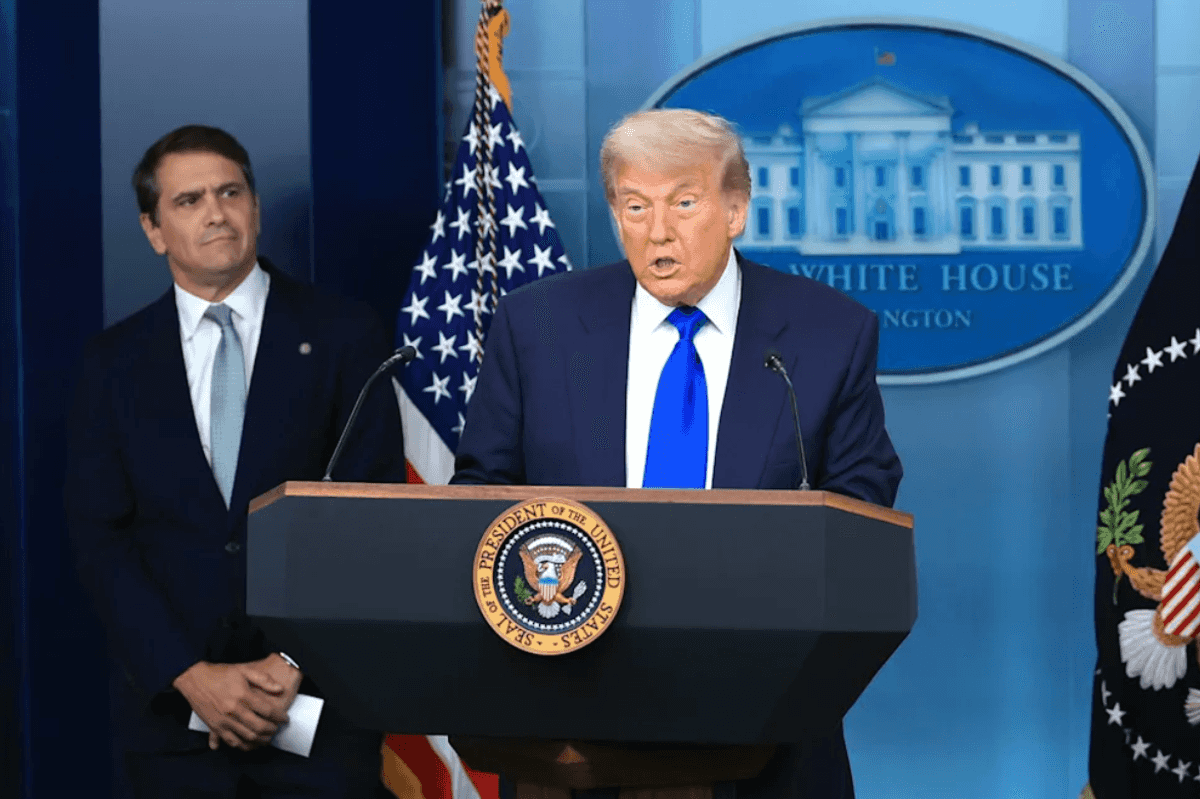
Attorney General Todd Blanche and President Donald Trump
After studiously avoiding any role in the litigation of Trump’s IRS lawsuit—the one that gave rise to the bogus settlement agreement—the Department of Justice has suddenly parachuted into the Court of Appeals, where Trump is challenging the district court’s finding that the parties colluded and executed a fraud on the court.
The DOJ’s belated brief is plainly designed to argue that Judge Williams was mistaken in finding there was no real case or controversy because Trump controlled all sides. Its filing was designed to demonstrate that everything in the case was on the up and up, and in particular, the DOJ and Trump were not colluding with one another.
Instead, the filing shows the opposite. It reinforces the conclusion that the case was choreographed by the parties for DOJ to take a dive and Trump to emerge with the $1.776 billion slush fund and tax amnesty, ostensibly in return for the dismissal of his worthless and unconstitutional lawsuit.
Before Blanche’s confirmation, the Department had not even made an appearance in Trump’s lawsuit, one of the signal facts that Judge Kathleen Williams cited in concluding that the whole arrangement was a collusive fraud on the court. It spent 109 days on the sidelines. Meanwhile, the former federal judges who had advised Judge Williams responded to Trump in defense of Judge Williams’s ruling. At this point, the Ninth Circuit clerk recaptioned the case Trump v. 25 Former Federal Judges, underscoring DOJ’s absence.
The department’s plunge into the pool last Friday seems clearly to have been choreographed. First, Trump filed a motion styled “time-sensitive motion for stay,” which is not a thing. It also was not germane since Trump’s stay motion was being adjudicated in the district court.
Later that day, the DOJ dropped its filing, which it called “Defendants’ (not Appellants’) Response (not Opposition) to Appellant’s Time-Sensitive Motion for Stay.”
The DOJ attempts to support Trump and argue for the viability of the settlement, but challenges Williams while still arguing that it’s not on the same side as the president. It fails.
Recall the basics of this tangled and tawdry tale. Trump sued the IRS in his personal capacity over the Littlejohn leak, demanding $10 billion, then voluntarily dismissed his case under Rule 41. The very morning of the dismissal, the Department announced the settlement: in supposed return for the dismissal of Trump’s 100% worthless lawsuit, the Department bestowed the $1.776B “Anti-Weaponization Fund,” followed up with a gratuitous tax amnesty for Trump and family, conservatively worth another $100 million.
So the Department never lifted a finger to contest Trump’s claims, notwithstanding its successful defense of lawsuits just like Trump’s. Then, in coordination with Trump’s dismissal, it executed an immediate rollover and sweetheart offer, literally worth billions more than Trump’s meritless case.
In her opinion finding that the whole arrangement was a collusive fraud on the court, Judge Kathleen Williams emphasized the Department’s complete passivity. It showed, in essence, that the fix was in.
When Blanche was asked about Judge Williams’s opinion at his confirmation hearing, he was in equal measure insolent and insouciant. Blanche testified that he had read the Eleventh Circuit’s law and disagreed with Judge Williams. The apparent suggestion was that the Attorney General’s personal opinion of appellate precedent justified flouting the court’s order.
Trump too, the supposed adversary on the other side of the case, initially ignored Williams’s ruling entirely. For nearly three weeks after the July 13 order, he did nothing at all. Then, on August 1, he noticed an appeal, which certainly signaled that he doesn’t intend to just let the slush fund and amnesty wither on the vine.
Still no DOJ. The only parties who had shown up to argue the other side were the thirty-five retired federal judges who urged Williams to look hard at the fraud—and so the appeal now travels under the caption Donald J. Trump v. Thirty-Five Former Federal Judges. The caption alone tells the story: the United States, nominal defendant, has vanished from the “v.” entirely.
It was last week that the two bedfellows, Trump and the DOJ, got really cute. First, Trump filed a long and vapid “time-sensitive motion for stay” in the court of appeals. He already had moved for a stay in the district court, and Williams had not yet denied it, so he was plainly jumping the gun.
The reason became clear later that day when the DOJ jumped in with a “response”—not opposition—to Trump’s time-sensitive motion.
A better word might have been “endorsement.” Every argument in the DOJ brief supports Trump. Most notably, the Department insists that there was “adversity” in Trump’s tax lawsuit—i.e., it was a real case or controversy.
The main reason the DOJ claims there was adversity is that Trump had to settle for well less than the $10 billion he had sued for. So, the Eleventh Circuit is supposed to believe that the DOJ pushed hard and forced Trump to take “only” the $1.776 billion slush fund plus tax amnesty in return for the dismissal of his completely worthless lawsuit. That’s the best they’ve got on non-adversity.
The other principal argument is that “a party need not file a lawsuit in order to obtain a full settlement with the federal government.” That has it backwards. The billion-dollar payout runs through the Judgment Fund; the permanent appropriation Congress makes available for court judgments and the settlements of actual or imminent litigation. Subtract the legal mechanism, and what remains is a raw unauthorized raid on the treasury.
On a related note, the Department protests that if it really wanted to collude, it could have arranged it without Trump’s bringing a lawsuit at all. And that’s where the whole mess may be going: to a raw money grab not even disguised as an exchange for settling a lawsuit. Here, Mr. President; I love you and this is my way of showing it. Please help yourself to billions of dollars in taxpayer funds. Of course, this would amount not to a lesser offense than what Williams found, but a graver one, the kind of naked self-dealing the impeachment power exists to reach.
The balance of the brief is no more persuasive. The DOJ argues that the judge lacked jurisdiction because the voluntary dismissal divested her of it. They simply whiff on the point that the rules permit a reopening where there has been fraud on the court. It presents the outlandish settlement agreement as routine, but the implicit comparison is with cases that the Justice Department fought hard on the merits and then settled for a reasonable compromise amount. It pillories the district court for imposing sanctions at all, but the sanctions are the natural response, really the court’s only tool, for addressing the fraud.
Finally, the brief goes one step farther. It argues that Judge Williams should be kicked off the case. Their chief argument here is that the court ordered Trump, but not the DOJ, to answer certain questions going to whether the case was legitimate. That’s rich given that it was the DOJ that was purposely steering well clear of the litigation.
The implication of the argument is that the case was legit and the settlement agreement a fair arms-length exchange. And that means that the settlement is enforceable on its terms: Trump is entitled to both the slush fund and the tax amnesty. Todd Blanche’s empty representations to get confirmed do nothing to change that, as I wrote at the time.
The best way for the department to support Trump while being nominally opposed was to stay out of the fray. It worked for a time, until its very absence became a factor in the determination that the case was a collusive fraud on the court. Now it has to execute an impossible two-step: supporting Trump in every particular while feigning opposition to him. Gamblers call that taking a dive, and it’s done in order to fleece innocent players.
Here the marks are Trump’s usual suckers: the American people he is supposed to be serving.
Harry Litman is a former United States Attorney and the executive producer and host of the Talking Feds podcast. He has taught law at UCLA, Berkeley, and Georgetown and served as a deputy assistant attorney general in the Clinton Administration. Please consider subscribing to Talking Feds on Substack.
Reprinted with permission from Talking Feds.
- Trump Lawyer: We Can Bulldoze The Statue Of Liberty Without Any Public Recourse ›
- Trump 'Settles' Bogus IRS Lawsuit For $1.8B Thug And Crony Slush Fund ›
- Trump Built His Slush Fund 'Settlement' On A Lie -- And An Impeachable Offense ›
- Right-Wing Lawyers Are Already Squabbling Over January 6 'Slush Fund' Spoils ›
- As Trump Retreats From Slush Fund, Judge Must Probe This Bogus Scheme ›
- With Slush Fund, Trump And Blanche Conjured A Metastasizing Scandal ›
- The Only Promise Todd Blanche Can Honestly Make Is Dishonesty - National Memo ›
- ‘Outright theft’: legal experts decry $1.8bn Trump anti-weaponization fund | Trump administration | The Guardian ›
- Judge agrees to review Trump's $1.8 billion 'anti-weaponization' fund ›
- Trump defends $1.8bn slush fund that is holding up Todd Blanche confirmation | Donald Trump | The Guardian ›
- What Can Be Done About President Trump’s Slush Fund? | Cato at Liberty Blog ›
- What’s the Status of Trump’s Anti-Weaponization ‘Slush’ Fund? ›
- President Trump’s New Slush Fund Flagrantly Disregards Law to Serve His Personal Ends at Taxpayer Expense ›