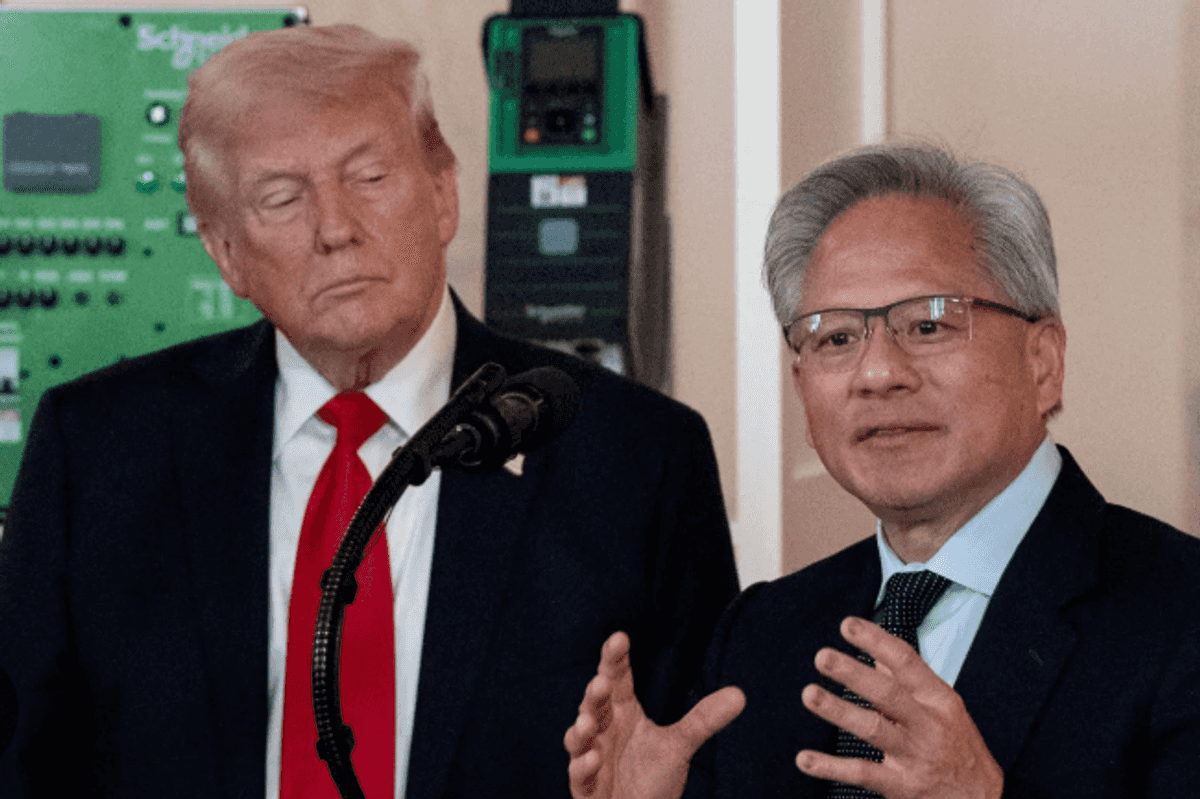
President Donald Trump and Jensen Huang
Deflation is generally bad news for an economy, but a deflating bubble is a great thing. When an economy has a major bubble, it means that money is going to the wrong places. It’s sort of like if we had dogmatic socialist central planners who insisted on funneling massive sums into antiquated factories. However, with a bubble, it is the irrationality of actors in the market that is misdirecting funds.
It is unfortunate that there are innocent victims of the bubble’s deflation. People who have their 401(k) in an index fund will take a big hit because the funds likely had large stakes in AI-related companies. Pension funds will take big hits since they also invested heavily in these companies. And we may find that people with annuity policies from insurance companies are also in trouble, since some of these insurers invested heavily in both the equity and debt of AI-related companies. And if the crash leads to a recession, we all get hit.
But as I’ve argued many times before, the sooner the bubble bursts, the better. The damage and the pain from the eventual correction just get worse as the bubble grows. It would have been better if it burst a year ago, but it’s much better if it is bursting now than if stock prices recover and it goes on for another year.
What’s the Score?
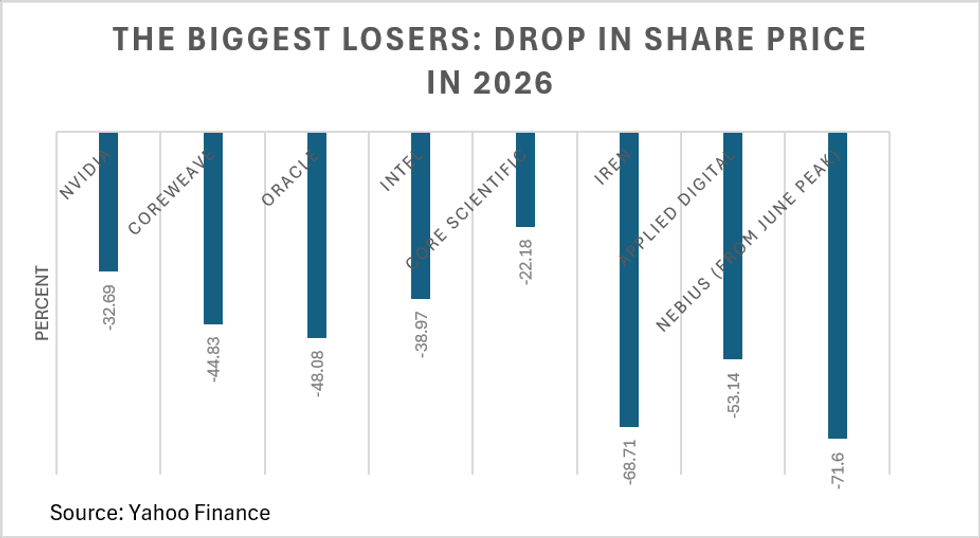
Many of the major AI-related companies have taken serious hits in the last couple of weeks and are now hugely down for the year. At the top of the list is Nvidia, which had been the country’s largest company by capitalization.
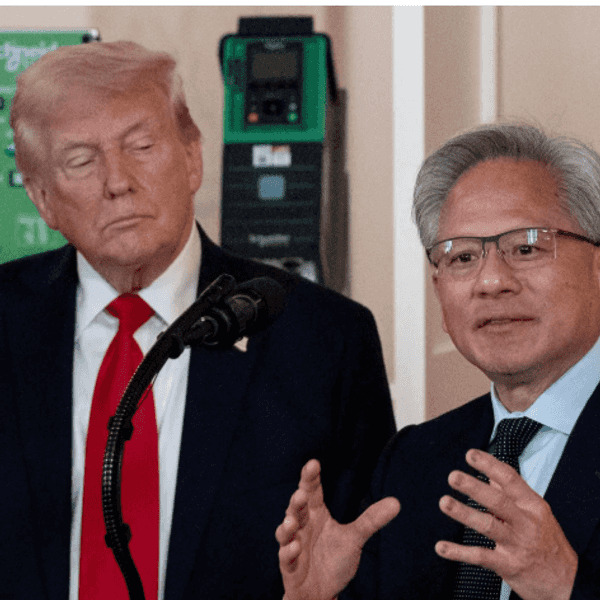
There are several factors at work here, and its former CEO Jensen Huang’s relationship with a possible Chinese spy is the least of them. We now know that Nvidia was selling tens of billions of dollars of its chips, including the most advanced ones, to Chinese front companies. This could expose them to serious legal problems, although they may be saved by the fact that Huang seems to have bought Donald Trump’s favor with a big contribution to his ballroom. Nonetheless, they are likely to lose this major source of revenue going forward.
The other big issue for Nvidia, and the whole AI economy, is that it appears to have been supported by questionable financing deals arranged by Huang. With Huang now gone as CEO, it’s not clear that his successor will want to continue these practices, or even if they will be able to, now that they are in the spotlight and getting scrutiny from the SEC.
Nvidia’s stock is down 32.7 percent for the year. It has lost more than $2.5 trillion in market value from its peak last month.
Next on the biggest losers list is Oracle. Oracle is the smallest of the hyperscalers, and unlike the others, it does not have a massively profitable alternative line of business to support its data center buildout. As a result, its bonds now have junk-level yields. Oracle’s stock is down 48.1 percent in 2026, implying a loss of market value of more than $300 billion.
The other biggest losers are the neoclouds. The stock of CoreWeave, the largest of the neoclouds, has fallen 44.8 percent in 2026. This translates into a loss of almost $20 billion in market value. The other neoclouds have seen comparable declines in value.
One other noteworthy loser here is Intel, the chipmaker. Its stock price is now down 39.0 percent for the year. As folks may recall, Donald Trump bought the country a 10 percent stake in Intel last year. Even with the recent plunge, its stock price is still considerably higher than the price Trump paid. Before celebrating our profit, it is worth noting that Trump steered government contracts to Intel because of the ownership stake. If we paid more for these contracts than would have been the case with competitive bids, the country could still be behind, even if we made money on Intel stock.
The other AI-related companies also took big hits last week. Google lost 10.3 percent of its value, undermining my story that the hyperscalers might still be able to walk away without being badly hurt, since cancelling their big data center buildout plans is likely a good thing for them. Microsoft lost 7.5 percent of its value, while Amazon lost 7.4 percent. Meta was down 12.6 percent, and SpaceX was down 8.4 percent. That all translates into a lot of air leaving the bubble, but there is still much more to go.
California Attorney General Rob Bonta’s Case Against OpenAI
The tanking of the AI stocks should not lead us to overlook a potentially important case brought by California’s Attorney General against OpenAI. AG Bonta is arguing that OpenAI is developing a dangerous product without sufficient safeguards, pointing to the hacks of Hugging Face, the AI startup, and an Australian government website.
This is effectively arguing that OpenAI is driving drunk. They are taking an out-of-control car down the street. The accidents to date have been relatively minor (we actually don’t have a good sense of the damage to Hugging Face, since Nvidia bought up the company before it had an opportunity to file a lawsuit), but there is a clear risk of much greater harm going forward.
I don’t know the law well enough to assess Bonta’s case. It would seem reasonable that if he could establish that OpenAI is acting in an unsafe manner in its development of AI, the court could impose restrictions without waiting for a major accident to occur. But I guess we’ll have to wait on that one. In any case, a strong ruling in the government’s favor could have a major impact on the AI industry.
Dean Baker is a senior economist at the Center for Economic and Policy Research and the author of the 2016 book Rigged: How Globalization and the Rules of the Modern Economy Were Structured to Make the Rich Richer. Please consider subscribing to his Substack, from which this is reprinted with permission.
- Do Musk's Record-Breaking Losses Signal The AI Bubble Is About To Burst? ›
- Boom? If AI Sales In The US Go South, Let's Not Bail Out Big Money Bettors ›
- As Growth Slows, That AI Bubble Just May Burst Into Recession ›
- The $12.5 Trillion-Dollar Question: When Will That AI Bubble Burst? ›
- Expert Warns That AI Bust Is Now Inevitable -- And Will Sink Trump's Economy ›
- AI Bubble Near Bursting? When The Financing Gets Crazy, The End May Be In Sight ›
- Is Claude-maker Anthropic going public just as the AI bubble bursts? ›
- Is the AI Bubble Finally Popping? Nvidia Crashes 48% as Wall Street Experts Sound the Alarm ›
- US tech stock rout: is the AI bubble bursting? | Stock markets | The Guardian ›
- The AI Bubble Burst Has Three Phases: We Are At Phase One (SP500) | Seeking Alpha ›
- AI bubble will likely burst and cause a recession by 2028 election, Wall Street’s former top cop says | CNN Business ›