Tag: honduras
Trump's 'War On Drugs' Is Either Personal Lunacy -- Or Political Distraction

Trump's 'War On Drugs' Is Either Personal Lunacy -- Or Political Distraction

Since President Richard Nixon declared a "War on Drugs" in 1971, federal, state and local governments have spent an estimated $1 trillion fighting it — and losing. Donald Trump now seems fully engaged in that futile conflict, adding his own twisted brand of violence.

It's not enough to bomb boats "suspected" of ferrying drugs to the United States. Defense Secretary Pete Hegseth has ordered the military, after the initial strike, to "kill" survivors clinging to life rafts on the waters below.

Shocked lawmakers, both Republican and Democratic, are calling such actions "war crimes." The law of war authorizes the use of deadly force against enemy combatants. But once they're no longer a threat, the obligation is to care for the wounded.

That's beside the matter of whether the targets were, in fact, drug boats. Some may be, but the U.S. military is fully capable of stopping, boarding and interviewing the crew of a little vessel sailing through the Caribbean or Pacific.

And even if the boats are carrying drugs, there's no easy way of knowing how many of their passengers were traffickers and how many were the traffickers' hostages. Drug gangs are known to threaten innocents and their children to force participation in the ferrying business.

How well has this "war" been working out? Not well.

Fentanyl, a synthetic opioid, has killed more Americans than the wars in Vietnam, Iraq and Afghanistan combined. And lined up behind it are still more vicious street drugs.

In 2023, about 110,000 Americans died from drug overdoses, nearly 10 times the number in 1999. The death toll fell in 2024, due mostly to the availability of naloxone, which can reverse overdoses. But it was still seven times the drug-related fatalities of a quarter century prior.

This is counting deaths from both opioids and stimulants, the category for cocaine. Deadly synthetic opioids such as fentanyl are now often added to the cocaine. A recent CDC report found that nearly 80% of cocaine-related deaths involved drugs with opioids mixed in, especially fentanyl.

You can't stop fentanyl from entering this or any other country. Fentanyl the size of a pencil eraser can kill dozens of people. How hard is it to hide that tiny amount sewn in a teddy bear's nose? Not hard at all.

A kilogram of fentanyl contains up to half a million potentially lethal doses. A kilogram is only 2.2 pounds. A quart of milk weighs about that.

In fiscal 2025, the Coast Guard seized almost 510,000 pounds of cocaine. That was the most in its history but a fraction of the cocaine that got past our borders — drugs arriving by land, sea and air.

Go ahead and keep trying to prevent these drugs from coming in, but let's not pretend that this bombing of unidentified boats is anything more than another Trump performance. Perhaps it's another way to divert attention from the Epstein files.

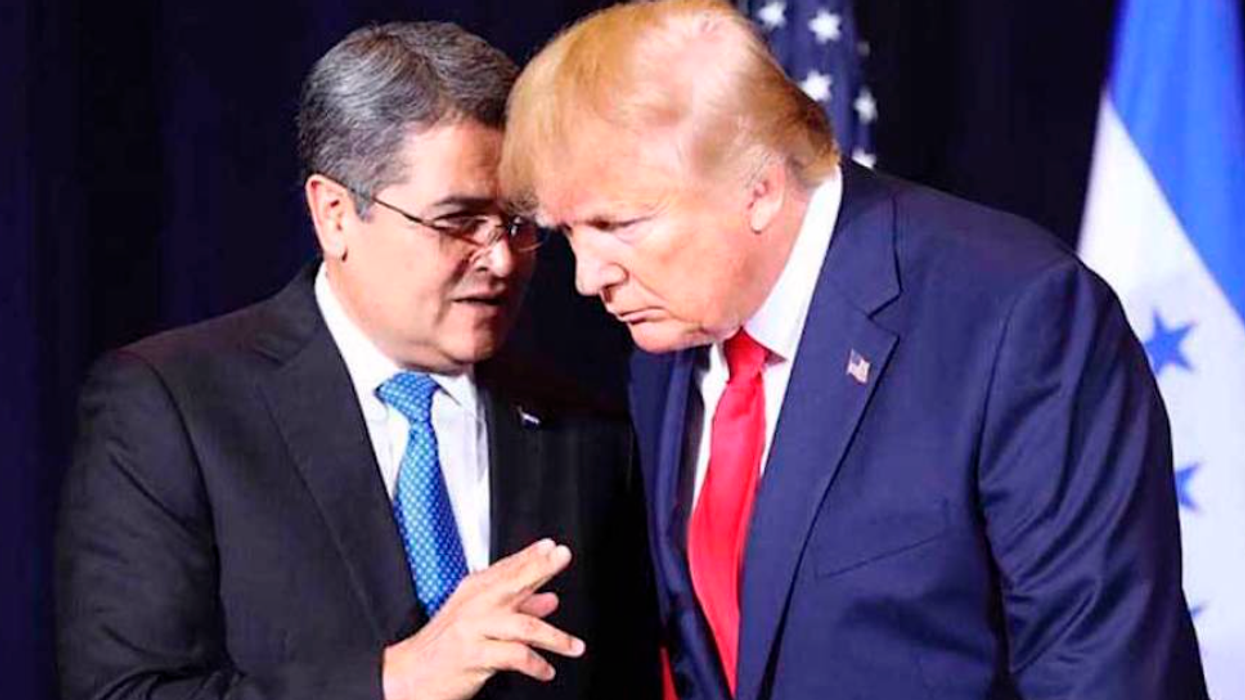
If this were really about punishing drug lords, Trump wouldn't have just issued a full pardon to Honduran ex-President Juan Orlando Hernandez. Convicted last year of partnering with traffickers, Hernandez is credited with helping flood the U.S. with hundreds of thousands of kilograms of cocaine.

A Drug Enforcement Administration agent, who worked on the Hernandez case but was not allowed to comment publicly, called the pardon "lunacy."

That show of inconsistency was so crashing, you can't help but suspect Trump's motive was to even further distract the public from the investigation into the sex trafficking of underaged girls. It was piled right onto the macabre videos of the U.S. military dropping bombs on small boats.

That would seem the best explanation for these bizarre Trump orders — short of lunacy, that is.
Rights Groups Chide Honduras Inquiry Into Activist Murder

Rights Groups Chide Honduras Inquiry Into Activist Murder

TEGUCIGALPA (Reuters) – Amnesty International and other non-governmental organizations on Tuesday criticized the official investigation into the murder of an environmental rights activist in Honduras, urging foreign experts to intervene.

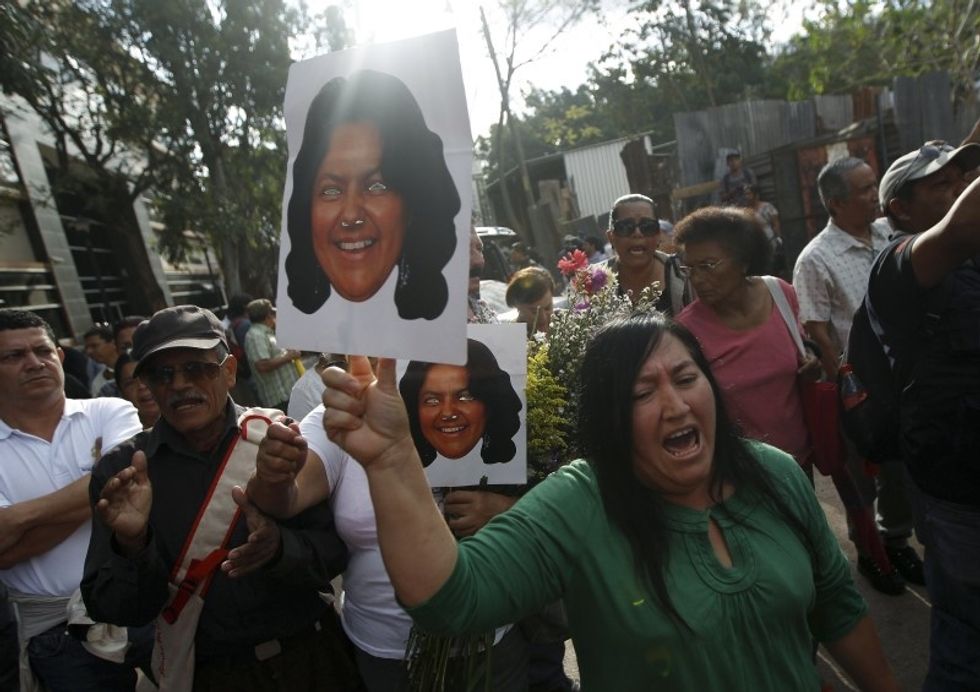
Five days after Berta Caceres was shot and killed in her home, the police have not presented an official hypothesis and are still considering labeling the murder a common crime, to the consternation of family and friends who believe the death was tied to her fight against large-scale hydroelectric plants and mines.

“Amnesty International demands that this investigation be done with the help of independent forensic experts and with an international commission that will guarantee its impartiality,” Erika Guevara, Amnesty’s Americas director, said at a press conference with other local NGOs.

Caceres, who had received death threats, won the Goldman Environmental Prize last year for her struggle to prevent the construction of a $50 million dam that threatened to displace hundreds of indigenous people.

“We don’t have confidence in the government’s investigations and its security forces,” Olivia Zuniga, Caceres’s daughter, told Reuters. “They were the (same) officials that awarded the concession for the dam that my mother fought against.”

The police have released the only suspect arrested after the murder, Caceres’s former partner and colleague, a police source said, speaking on condition of anonymity.


(Reporting by Gustavo Palencia; Writing by Anna Yukhananov; Editing by Robert Birsel)

Photo: Activists hold photos of slain environmental rights activist Berta Caceres after her body was released from the morgue in Tegucigalpa, Honduras, March 3, 2016. REUTERS/Jorge Cabrera

Cuban Migrants Get Unfair Advantage Over Other Latinos

Cuban Migrants Get Unfair Advantage Over Other Latinos

The Cold War is over, but it still deeply distorts U.S. immigration policy.

Consider the bizarre situation at our southern border. A wave of migrants is expected to appear there, hoping for safe passage into the U.S. and an expedited path to legal status and eventually full citizenship. They will get it.

These lucky migrants won’t be Mexicans fleeing drug cartels. They won’t be Hondurans, who must endure the world’s highest murder rate. And they won’t be citizens of El Salvador, where the Peace Corps just suspended operations due to the increasing violence.

No, we deport those people.

They will be Cubans. In recent months, increasing numbers of Cubans have been leaving their island country, flying to Ecuador first and then traveling northward through Central America. They wish to migrate to the U.S., fearful that thawing diplomatic relations will end the special treatment that Cubans who leave the island have long received.

That special treatment needs to end.

The hypocrisy that is embedded in U.S. immigration law will be on full display as the Cubans begin arriving, which could happen within the next few weeks.

Since 1966, the Cuban Adjustment Act has given Cuban people an extraordinary advantage over other migrants wishing to enter the U.S. The law was originally intended as a political and humanitarian reply to communism and the oppression of Fidel Castro. No proof that a person has suffered persecution. Where he or she arrives from is enough.

When people attempt to arrive through the Florida Straits, the policy that developed was dubbed “wet foot, dry foot.” If a Cuban can get one foot on dry U.S. soil, they can stay and are offered permanent legal status in a year and many other benefits of welfare and help to restart their lives.

The benevolence of the law made sense in decades past. But a good argument can be made that many of the migrating Cubans are fleeing not persecution but economic turmoil. And in doing so, they are not any more desperate, perhaps even less so, than those fleeing the violence and poverty of Mexico, Guatemala, Honduras and El Salvador.

Thousands of Central Americans arrived and asked for asylum in the summer of 2014. But those people are the wrong type of Latino for our policies. Many of them are indigenous, poor and have little formal schooling. So they were held for months in detention camps at the border. Many were eventually released, free to stay the U.S. at least until their pleas for asylum status or legal residency can be assessed by an immigration judge. Raids and deportations of undocumented immigrants continue.

Meanwhile, as many as 8,000 Cubans who have been stranded in Costa Rica will soon be making their way northward through Mexico, after agreements were worked out by several Latin American governments. The Obama administration plans to open refugee screening centers in Central America, an attempt to stem the flow of non-Cuban migrants.

In this election year, especially in light of the GOP’s appeals to anti-immigrant sentiment, the migrant Cubans will present a political test.

GOP presidential contender Sen. Marco Rubio, whose parents left Cuba before Castro took over, has introduced legislation to curb abuses of the American generosity toward Cubans. The Sun Sentinel of South Florida in 2015 documented cases in which Cubans claiming to be exiles were taking U.S. government benefits or committing other types of fraud, even after returning to Cuba.

How far Rubio’s legislation and the companion bill in the House will advance remains to be seen. And there is virtually no appetite in an election year to overhaul immigration for the benefit of more than just Cubans.

Amnesty is still a curse word in most GOP circles. In decades past, that didn’t matter in the case of Cubans, who could be counted on to become Republicans.

If the GOP is to have any hope of salvaging the Latino vote this presidential cycle it will have to traverse this sticky thicket, also acknowledging the needs of other Latino migrants. They have to beat back the anti-immigrant bleating of Donald Trump, as South Carolina Gov. Nikki Haley did in her response to the State of the Union speech.

They must vow to be just. They must promise to rewrite immigration law to weigh all humans’ needs equally and fairly, with no favor based on country of origin or likely partisan affinity. And they must not bow to nativist screeds.

(Mary Sanchez is an opinion-page columnist for The Kansas City Star. Readers may write to her at: Kansas City Star, 1729 Grand Blvd., Kansas City, Mo. 64108-1413, or via e-mail at msanchez@kcstar.com.) (c) 2016, THE KANSAS CITY STAR. DISTRIBUTED BY TRIBUNE CONTENT AGENCY, LLC

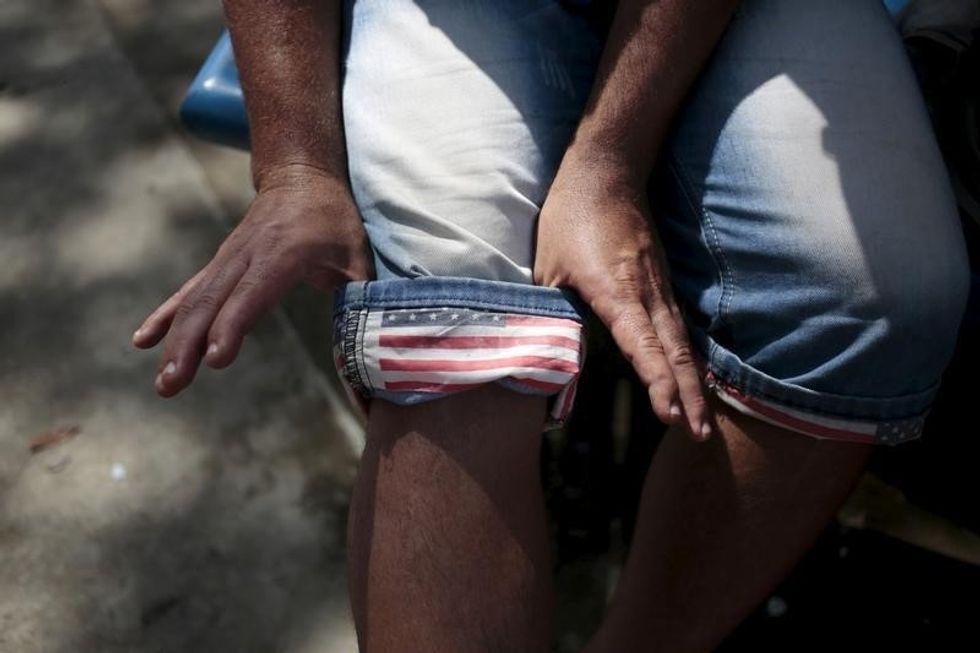
Photo: A Cuban migrant shows a U.S. flag design on the cuffs of his pants at the Costa Rican border with Nicaragua, November 18, 2015. REUTERS/Oswaldo Rivas

Harrowing Journey Turns Into U.S. Deportation Nightmare

Harrowing Journey Turns Into U.S. Deportation Nightmare

New York (AFP) – Evelin’s two daughters — who just arrived in the United States illegally from Central America — are facing deportation and so the concerned mother recently trekked across New York City to seek free legal advice.

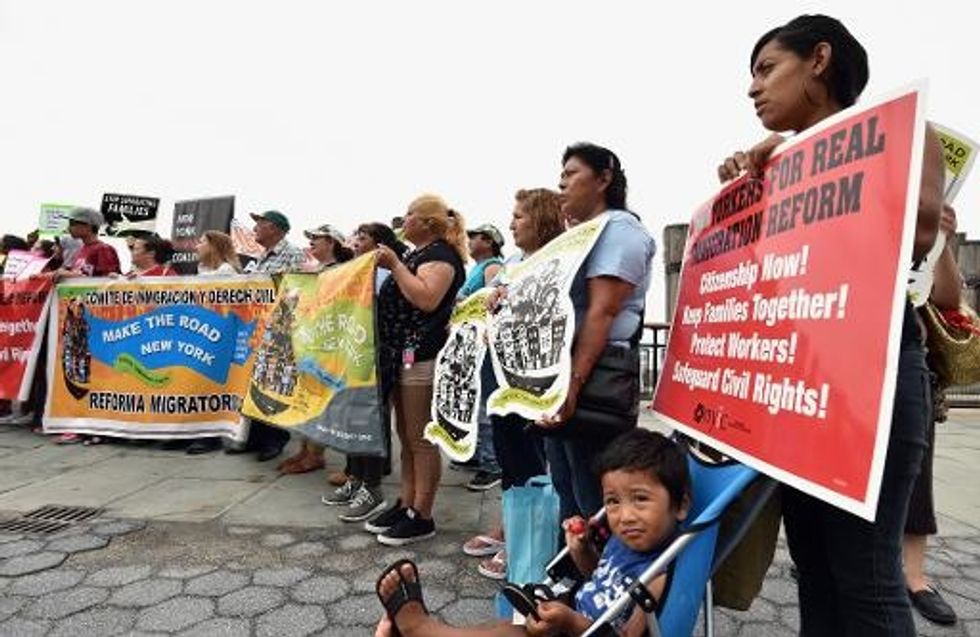
Evelin, who is 35 and undocumented herself, joined 200 others, including 100 unaccompanied minors, at an event hosted by the New York Immigration Coalition last weekend.

“I have two girls, 15 and 18, who just got here with their kids. One was sent home to me with a hearing date for August 4. But the other one is still in Texas,” said the young Honduran grandmother, declining to give her full name due to her own illegal status.

The “Immigrant Youth Fair,” which took place in Manhattan July 26 and 27, provided free legal help, as well as information about jobs, schools, health insurance and English-language classes, to children and adults of all ages.

“This is really what we need,” said Evelin, who left Central America well over a decade ago, shortly after her youngest daughter was born.

Camille Mackler, the coalition’s director of legal initiatives, noted that most of the workshops’ attendees came from Honduras.

“The majority were 13 to 18 years old, but we saw five to 10 kids who were 12 and under,” Mackler said.

Honduras has the world’s highest murder rate, with the United Nations recording more than 90 homicides per 100,000 people in 2012.

Evelin’s daughters are two of more than 57,000 unaccompanied minors — most from El Salvador, Guatemala and Honduras — who have been detained crossing the U.S.-Mexico border since October, the majority fleeing gangs, violence and poverty.

U.S. President Barack Obama — who has called the situation a humanitarian crisis — met with his counterparts from those three Central American countries last month, warning against false hope that unaccompanied children will be allowed to stay in the United States.

But the problem remains unresolved and with political wrangling over how to handle the crisis showing little signs of abating, the focus is on what to do with the thousands of minors in the meantime.

In New York, authorities and community groups said they would work together to help welcome about 3,000 of the children to the state in the near future, and another 7,000 in the coming months.

Legal experts say that many could seek asylum or some other type of protection from the US government.

Yet others find that hard to believe, and hard to act on.

“It’s a mixture of surprise and skepticism, because people are very unsure about their position and they are all afraid that it will not work out for them,” said Samuel Palmer-Simon, staff attorney with the Immigrant Protection Unit of New York Legal Assistance Group.

His boss, Irina Matiychenko, said the group had just taken on the case of a Honduran boy who had to leave home because he witnessed his uncle being killed.

Matiychenko, herself once an asylum recipient, said Washington needed to act quickly to resolve the crisis.

“There has not been a constructive response from the federal government,” she said.

“It’s not the American way if these kids are sent back. They will be victims of violence — or killed.”

In the case of Evelin’s daughters, the reasons why they left their homeland are grim: the youngest got pregnant after being raped, and both sisters were victims of violent crime.

“So many terrible things have happened down there,” Evelin said.

“They traveled together, and that’s all I know about their trip,” she added in reference to how her girls made it into the United States.

“When they got here, they separated them. And I have not been able to talk to the one who is in Texas.”

AFP Photo/Stan Honda

Shop our Store

Headlines

Editor's Blog

Corona Virus

Trending

World