Tag: canada
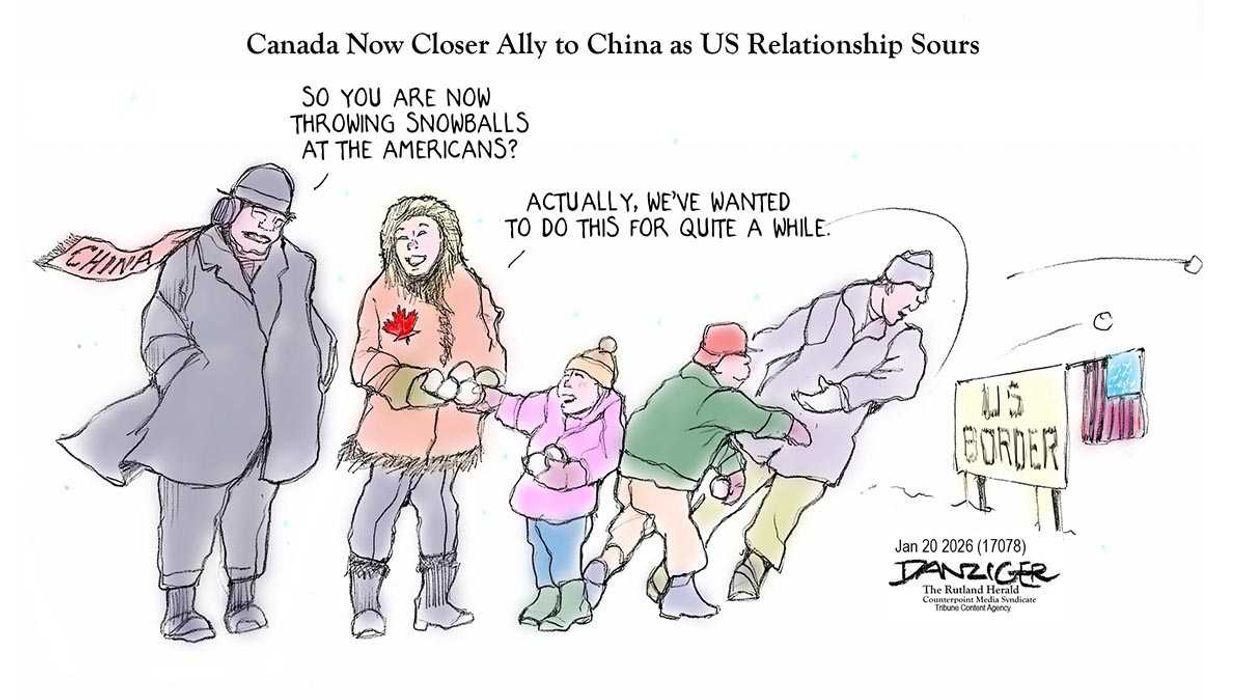
Danziger Draws

Danziger Draws

Jeff Danziger lives in New York City and Vermont. He is a long time cartoonist for The Rutland Herald and is represented by Counterpoint Syndicate. He is a recipient of the Herblock Prize and the Thomas Nast (Landau) Prize. He served in the US Army in Vietnam and was awarded the Bronze Star and the Air Medal. He has published eleven books of cartoons, a novel and a memoir. Visit him at jeffdanziger.com.

Why Trump Is Driving Our Allies Closer And Closer To China

Why Trump Is Driving Our Allies Closer And Closer To China

In World War II, the United States allied with Stalin to defeat Hitler. No one had any illusions about Stalin being a great supporter of democracy. The reason for the alliance is that the Soviet Union had one of the most powerful militaries on the planet and the United States desperately needed its help to defeat Hitler and the other Axis powers.

The European Union, Canada, and every other country interested in preserving democracy in the age of Trump needs to think in the same way about allying with China. No one would mistake China for a being beacon of democracy, but it does have the largest economy in the world, and its manufacturing capacity, especially in the areas of clean energy and electric vehicles, can be a huge benefit to the rest of the world as it tries to break free of its reliance on the United States.

At this point, it should be apparent to anyone other than the rear-end kissers in Trump’s cabinet that being in any way dependent on Donald Trump is a route to disaster. Trump could not care less about even the mid-term future (he’s 79-years-old and in bad health), much less the longer-term future for the United States and the world. He wants to shake everyone down as much as he can for as long as he can.

That was the story of his “Liberation Day” tariffs. There was no coherence to the various tariff rates imposed on U.S. imports from different countries. He came up with a formula that made zero sense and used this as a starting point. Countries that were nice to him saw some reductions. Countries that Trump felt were being mean, like Brazil, India, and China, saw higher rates.

But the big problem with Trump was not the initial tariffs, it’s that he always wants more. He doesn’t like the tax on digital commerce that the EU has, so he is threatening more tariffs. He doesn’t like their value-added taxes, again more tariffs. And he wants them to join his crusade to wreck the planet by burning more fossil fuels and is threatening more tariffs for countries that won’t go along.

As long as the EU, Canada, and anyone else is prepared to give in to Trump’s demands, he will keep asking for more. In this context, the only strategy that makes any sense is for the rest of the world to integrate as quickly as possible, with the goal of reducing its dependence on the United States as much as possible.

Closer ties with China should feature front and center in this picture. China has cutting edge technology in many areas. The EU and other countries should look to take advantage of this technology, both in getting high quality and low-cost imports, and also by arranging for technology transfers.

The latter is something that would have to be negotiated, but China already has many arrangements with trading partners where it agrees to establish factories there in exchange for access to their markets. Surely the EU, Canada, and other major countries could negotiate the same sorts of deals that Thailand has formally with EVs, and countries like Mexico and Indonesia have informally.

This could lead to a situation where EU consumers could get access to a limited number of high quality Chinese EVs for around $10,000 a piece, while they develop their own production facilities to quickly supply their own markets with EVs. It should be possible to ramp up quickly so that EVs rapidly replace conventional internal combustion cars. EVs already account for more than half of new car sales in China. There is no reason the EU, Canada, and rest of the world, outside of the U.S., can’t do the same in a relatively short period of time.

There is a similar story with wind and solar energy. China’s installations of wind and solar are roughly equal to the rest of the world combined, and growing rapidly. And the cost of electricity generated through these sources is half the cost of energy from coal or gas. The EU, Canada, and the rest can look to quickly build up both their power generation from these sources, as well as their domestic production of wind turbines and solar panels through technology transfers.

Cheap EVs and low-cost electricity should go far towards sustaining living standards through a transition away from dependence on U.S. trade. There will undoubtedly be many issues to iron out in working through trade deals, but at this point it should be clear that closer economic ties to China are preferable to being dependent on the whims of the five-year-old in the White House.

Dean Baker is an economist, author, and co-founder of the Center for Economic Policy and Research. His writing has appeared in many major publications, including The Atlantic, The Washington Post, and The Financial Times. Please consider subscribing to his Substack.

Reprinted with permission from Substack.

'Trump Slump': Tariffs And Imperial Attitude Are Killing Tourism Industry

'Trump Slump': Tariffs And Imperial Attitude Are Killing Tourism Industry

President Donald Trump is so disastrously incompetent he once managed to bankrupt a casino in Atlantic City. Now, from the Oval Office, he’s trying to do it again—in Las Vegas.

In June 2025, Las Vegas welcomed 400,000 fewer visitors than in June 2024—a more than 11 percent nosedive. International arrivals plunged, as did hotel occupancy.

This didn’t happen by accident. Trump has spent months antagonizing America’s northern neighbor—and a key Vegas tourism source. He suggested Canada should become the 51st U.S. state and called its prime minister at the time “Governor Justin Trudeau of the Great State of Canada.” He later claimed he wasn’t “trolling,” doubling down that statehood would make Trump’s tariffs “totally disappear.”

Canada’s new Prime Minister Mark Carney fired back, saying his country “is not for sale” and dismissing Trump’s fantasy as laughable and offensive. Even Trump’s own ambassador to Canada warned the rhetoric was unprecedentedly toxic for relations. And in tourism, words have consequences. Canada is America’s No. 1 source of foreign visitors. Insult them enough, and they stop coming.

Trump’s near-blanket tariffs on Canadian goods turned the insults into policy, triggering a full-blown trade war. The result: Car crossings were down 37 percent year-over-year in July, and air arrivals dropped 26 percent. Duty-free sales along the border have been cut nearly in half, wiping out millions in spending. Indeed, each one percent drop in international travel costs the U.S. $1.8 billion in export revenue per year—money that fuels jobs and generates tax revenues. July 2025 marked the seventh straight month of plunging traffic, with surveys showing Canadians now feel distinctly unwelcome.

And when the biggest slice of your foreign tourism market dries up, the ripple is felt everywhere. In July, arrivals from Germany were down 14.7 percent compared with last July. Arrivals from China dropped by 13.8 percent and from Switzerland by 12.7 percent. Tour operators abroad now steer customers toward anywhere but Trump’s America. Tourism revenue is projected to fall from $181 billion in 2024 to $169 billion in 2025, a $12.5 billion-hit to the economy.

And that might just be the tip of the iceberg. A Reuters analysis of the underlying data suggests the tourism slump could cost up to $71 billion in the United States’ gross domestic product.

In Las Vegas, the damage is personal. Empty casinos mean shorter shifts, slashed hours, and layoffs. Ted Pappageorge, secretary-treasurer of the Culinary Union, calls the city’s waning tourism the “Trump slump.”

“If you tell the whole world that they’re not welcome, they’re not going to come,” he told Time magazine. “The lifeblood for Las Vegas is Southern California. What folks are telling our members is that the raids and crazy tariffs and this uncertainty, [are causing] people to pull back.”

In a late July post on Truth Social, Trump called the U.S. “the ‘hottest’ and most respected Country anywhere in the World.”

The numbers tell a different story. From struggling casinos to struggling cities, his legacy is the same: reckless mismanagement, xenophobia, and empty chairs where excitement used to sit. The lights on the Vegas Strip still flicker, but thanks to Trump, the seats are getting empty.

Reprinted with permission from Daily Kos

Meeting With Canada's New Prime Minister, Trump Displays Mental Decay

Meeting With Canada's New Prime Minister, Trump Displays Mental Decay

President Donald Trump hosted newly minted Canadian Prime Minister Mark Carney at the White House Tuesday—and in the process showed that his 78-year-old brain has completely turned to mush.

He incorrectly said that a Russian hockey player is from Canada and baselessly claimed to have solved California's drought problems. But let’s break down Trump’s idiotic claims point by point.

In one exchange, a reporter asked Trump about his punishing 145% tariffs on Chinese imports, which for all intents and purposes is a trade embargo on a major U.S. trade partner.

"By not trading, we're losing nothing. So we're saving a trillion dollars. That's a lot,” he said.

- YouTubeyoutu.be

Of course, since China manufactures trillions of dollars worth of goods, not trading with them means we are losing quite a lot. Many of the products made in China cannot be manufactured in the United States, so shortages are about to hit. And with shortages come higher prices, since demand will outstrip supply. And that will hurt U.S. consumers.

“Trading with others generates gains for both sides of the transaction. Trump's tariffs prevent trade, destroying the gains both for Americans and our trading partners. Recognize that symmetry and you'll see how much he's hurting Americans,” Justin Wolfers, University of Michigan economics professor, wrote on X.

In yet another head-scratching moment, Trump claimed that the United States doesn't do much business with Canada, which is absurdly incorrect.

“We don’t do much business with Canada from our standpoint,” Trump said, as a very shocked Carney sat beside him. “They do a lot of business with us.”The United States imported $412.7 billion worth of goods from Canada in 2024, according to U.S. Trade Representative Jamieson Greer. Meanwhile, the United States exported $349.4 billion to Canada in 2024, meaning that we take in more from Canada than we export.

- YouTubeyoutu.be

In 2023, the United States imported $122.9 billion worth of fuel; $64.7 billion in transportation equipment; and billions in metals, machinery, and fertilizers from Canada.

In fact, farmers have been warning against Trump’s tariffs on Canada, saying that the increase in fertilizer prices will cause painful inflation to U.S. consumers.

As Trump continued his meeting with Carney, he tried to bully the newly elected prime minister into making Canada the 51st state.

"I love Canada. I have a lot of respect for the Canadians. … You happen to have a very, very good hockey player right here on the Capitals, he is a big tough cookie too, just broke the record,” Trump said.

He was referring to Alex Ovechkin, who is Russian—not Canadian. Surely if former President Joe Biden had made a similar comment, questions about his mental fitness would blanket corporate media airwaves.

Trump also spoke of his moronic belief that he somehow saved California from droughts, bragging about how he gave Democratic Gov. Gavin Newsom “a lot of water.”

“If they would've had that water and done what I said to do, they wouldn't have had the fires in Los Angeles,” he said.

- YouTubeyoutu.be

In fact, Trump's water gambit of opening dams ended up wasting billions of gallons of water that California farmers needed for crops—and it didn’t even end up going to Los Angeles.

“They were holding extra water in those reservoirs because of the risk that it would be a dry summer. This puts agriculture at risk of insufficient water during the summer months,” Heather Cooley, Pacific Institute director of research, told CNN. “It’s providing zero benefit and putting California farmers at risk of water supply constraints in the coming months.”

Well, at least Canadian voters saw through Trump’s bullshit.

Shop our Store

Headlines

Editor's Blog

Corona Virus

Trending

World