Tag: immigration
Why Are Population Alarmists So Troubled By Our Stabilizing Birth Rate?

Why Are Population Alarmists So Troubled By Our Stabilizing Birth Rate?

Back in 1969, President Richard Nixon warned Congress against the rapid growth of the American population: "When future generations evaluate the record of our time, one of the most important factors in their judgment will be the way in which we responded to population growth."

If the American headcount continued rising at the current rate, Nixon said, the nation's "social supplies — the capacity to educate youth, to provide privacy and living space, to maintain the processes of open, democratic government — may be grievously strained."

Since 1969, America's population has boomed by about 202 million to today's 343 million, a 69 percent jump. But today's most prominent discussions on population trends rarely focus on the loss of "social supplies." Quite the contrary. Even though the country is still adding people at about replacement level, population alarmists are painting falling birthrates as an economic disaster in the making.

As economist Nicholas Eberstadt, a leading advocate for higher birthrates, wrote in Foreign Affairs magazine, "For the first time since the Black Death in the 1300s, the planetary population will decline."

There is precious little to be said in defense of a plague that wiped out one-third of Europe's population. But it did sharply raise workers' wages as landowners had to compete for muscle in a much-reduced workforce.

As for today's concerns, a drop in the numbers could ease the housing crunch for obvious supply-demand reasons. And as artificial intelligence takes over thinking jobs and autonomous vehicles end the need for taxi and truck drivers, our economy may demand fewer far workers.

Let's be clear about one thing: Children are a joy. May Americans continue to build families. We certainly don't want a population collapse as seen in Russia. At the same time, we don't have to measure a nation's well-being by how crowded it can get.

Furthermore, a stable or modestly falling population could take pressure off our natural world. "Anyone who believes in indefinite growth on a physically finite planet," said nature filmmaker David Attenborough, "is either mad or an economist."

When Nixon established the Environmental Protection Agency, he explained that federal programs were needed to guard "the air we breathe, the water we drink, and the land that grows our food."

Leading environmental groups back then made "zero population growth" their rallying cry with a focus on birthrates. The massive baby boom generation was in its childbearing years, so the specter of its launching another baby boom seemed plausible. By 1970, however, birthrates were already falling. They had dropped to about 18 per 1,000 people, down from about 24 births per 1,000 people in 1950.

Much of the population growth in the '70s was driven by immigration. But environmental groups, the Sierra Club, for example, steered clear of advocating reduced immigration for fear that could be read as hostile to Latinos.

It seems a bit hysterical to use the term "population crash" or even the loaded word "depopulation" regarding today's birthrates. A major factor in our growing population was Americans having longer, healthier lives. That's a positive development, right?

In any event, things change. Americans might decide to have more children. IVF treatments — fertilizing eggs outside the womb — are now routine. And the prospect of growing babies in the lab from start to finish now seems a matter of time. There already exists artificial wombs for very premature babies.

Meanwhile, I don't recall thinking, as my car crawled in traffic through Rocky Mountain National Park, "Gosh, I wish there were more people on this road."

Was America a sad place in 1958, when it had half as many inhabitants as now? Historians refer to its decade as the "Fabulous Fifties." Think about it.
Unprecedented: Prosecutors Resign Over Trump's ICE Shooting Coverup

Unprecedented: Prosecutors Resign Over Trump's ICE Shooting Coverup

The stunning resignations on Monday of four senior career officials from the Criminal Section of the Justice Department’s Civil Rights Division confirm that DOJ has gone profoundly off the rails in its handling of what increasingly appears to be one of the gravest excessive-force cases in decades.

The resignations, an ultimate eloquent gesture, reportedly had multiple causes. The central one was the sidelining of the Criminal Section from the investigation of the January 7 fatal shooting of Renee Nicole Good by Immigration and Customs Enforcement (ICE) agent Jonathan Ross.

In any normal, professionally run Department of Justice—Democratic or Republican—a shooting that looks this serious on its face would trigger a searching civil-rights investigation by the Criminal Section, the Department’s longstanding unit for prosecuting unlawful uses of force. That has been true whether the assailant was a state officer, as in Rodney King, or—more rarely—a federal one, as at Ruby Ridge. (I served in the Department during both and worked on the King case, and I’ll be writing about some of the lessons from that case in coming Substack pieces.)

ICE has steadfastly maintained that the shooting was justified because Ross reasonably believed that Good was attempting to run him over. But multiple bystander videos and visual analyses have seriously undermined that self-serving account. I put the point in that lawyerly, hedged way because, for present purposes, it is more than enough to establish beyond any cavil that this case demands the most thorough investigation the federal government can muster.

That is the very opposite of what happened here.

First, the highest government officials circled the wagons around Ross. Donald Trump and Vice President J.D. Vance defended the agent’s actions and suggested that Good bore responsibility for her own death. Homeland Security Secretary Kristi Noem labeled the incident “domestic terrorism,” a characterization that has been widely questioned. Trump himself made inaccurate claims that Good had “run over” the ICE officer, which video evidence contradicts.

At the same time, leadership of the Civil Rights Division, under Assistant Attorney General Harmeet Dhillon, informed the Criminal Section that it would not be investigating the case at all—a spectacular departure from past practice. Multiple career prosecutors offered to go to the scene but were told not to.

It was like a fire chief watching smoke pour from a burning building and ordering the crew not to respond, even as firefighters volunteered to go in.

The resigning officials, then, were not merely objecting to a particular judgment call. In effect, they were saying that if the Criminal Section does not have jurisdiction over a case like this, its role has been reduced to near irrelevance.

DOJ instead assigned the investigation to the U.S. Attorney’s Office for the District of Minnesota. But that office lacks the expertise, experience, and institutional stature to undertake an inquiry that goes to ICE’s core mission and legitimacy.

Nor is the broader context hard to discern. A serious civil-rights investigation—or worse, a criminal prosecution—would cut directly against the administration’s signature priority: an aggressive, high-visibility immigration enforcement campaign in which forceful tactics are treated as proof of resolve rather than excess. Calling this shooting into question would not merely implicate one agent; it would threaten the legitimacy of a brute-force enforcement regime that is Trump’s pride and joy. And it would come at a moment when the president is reportedly already furious with Attorney General Pam Bondi and senior immigration officials over perceived softness and setbacks.

There is also a more calculating dimension to the assignment. Even if toothless, a federal investigation provides a ready rationale for declining parallel inquiries and resisting cooperation.

That concern is not theoretical. Federal authorities reversed an initial plan for a joint investigation with Minnesota officials, shifting the probe to exclusive FBI control and cutting off the Minnesota Bureau of Criminal Apprehension from evidence and access. State officials—including Attorney General Keith Ellison and Hennepin County Attorney Mary Moriarty—have said publicly that this move hamstrung their ability to conduct an independent investigation.

Minnesota responded Monday with a lawsuit against the Department of Homeland Security, ICE, and senior federal officials seeking to block the massive immigration enforcement surge in the Twin Cities. The complaint characterizes the deployment of more than 2,000 armed agents as an “invasion” and alleges unlawful tactics—warrantless stops and arrests in sensitive locations, racial profiling, and unconstitutional conduct that has disrupted daily life and eroded public safety. It further asserts that the campaign bears no genuine connection to its stated goals and instead reflects a retaliatory pattern of federal action aimed at Minnesota because of its political leadership and demographics.

This case is shaping up to be a scandal along the lines of the January 6 pardons and the reprisal prosecutions. Wherever its investigation is housed, it cannot be credible while it remains under the political control of an administration that has already pre-judged the case—publicly, loudly, and at the highest levels.

The feds’ normal response in a case of this gravity would be to assign the Criminal Section to conduct a vigorous, independent investigation, working in cooperation with state authorities and following the facts wherever they lead. The second defensible option would be to step aside in favor of the state, which has its own compelling interest in enforcing criminal law and protecting its citizens. Instead of either option, federal authorities are choosing to hamstring meaningful scrutiny and insulate possibly grave criminal conduct from accountability. That path is unprecedented and indefensible.

Excessive force by officers is not new. What is novel for the United States is the use of federal power afterward to stifle investigation and shield wrongdoing. That turn—from lethal force to enforced impunity—is an abuse of authority and a hallmark of authoritarian governance.

Harry Litman is a former United States Attorney and the executive producer and host of the Talking Feds podcast. He has taught law at UCLA, Berkeley, and Georgetown and served as a deputy assistant attorney general in the Clinton Administration. Please consider subscribing to Talking Feds on Substack.

Reprinted with permission from Talking Feds.

New Pew Poll Shows Latino Voters Turning Heavily Against Trump

New Pew Poll Shows Latino Voters Turning Heavily Against Trump

A new Pew Research Center poll shows that 70 percent of Latinos disapprove of President Donald Trump's job performance, sending a loud warning to Trump and Republicans ahead of next year's much-anticipated midterm elections, The Daily Beast reports.

"The Pew poll is a damning indicator of how voters could turn on Trump in his turbulent second term as immigration raids and inflation play out across the country," The Daily Beast notes.

Mark Lopez, director of Pew’s Race and Ethnicity Research, says this poll portends major red flags for Republicans.

“There’s no doubt that if people draw the connections to a particular administration or political party, this could have some political implications in coming elections,” Lopez tells Reuters.

Latinos comprise roughly one in five Americans — approximately 20 percent of the U.S. population, and their disapproval, The Daily Beast notes, "may signal problems ahead for the GOP."

In the 2024 election, Trump received approximately 46 percent to 48 percent of the Latino vote, which was a significant increase from his 2020 performance.

"But the new poll, of 4,923 Latino adults, shows that even among Trump-voting Latinos, his approval dropped from 93 percent in February to 81 percent," The Daily Beast explains. "A total of 61 percent believe Trump’s economic policies have made conditions worse for Latinos, and 68 percent of Latinos say their situation in the U.S. has gotten worse since last year."

This is a devastating development for Trump, The Daily Beast notes.

"It is the first time in nearly two decades of Pew’s Hispanic surveys that a majority say their situation has deteriorated," they explain.

The poll also shows that "more than three-quarters, 78 percent, also believe the Trump administration’s policies — including mass deportation plans — harm Hispanics, with 55 percent expressing grave concern about their place in the U.S. because of the president’s agenda."

With the GOP's razor-thin majority, these numbers could haunt them next November.

The poll also found that 52 percent of respondents worry “a lot” or “some” that the Trump administration could deport them, a family member, or a close friend. This is up from 42 percent in March, The Daily Beast explains.

"Whatever Donald Trump is doing in office in the minds of Latinos, it is not working. They have turned against him in massive, massive numbers," CNN's data analyst Harry Enten said last week.

Reprinted with permission from Alternet

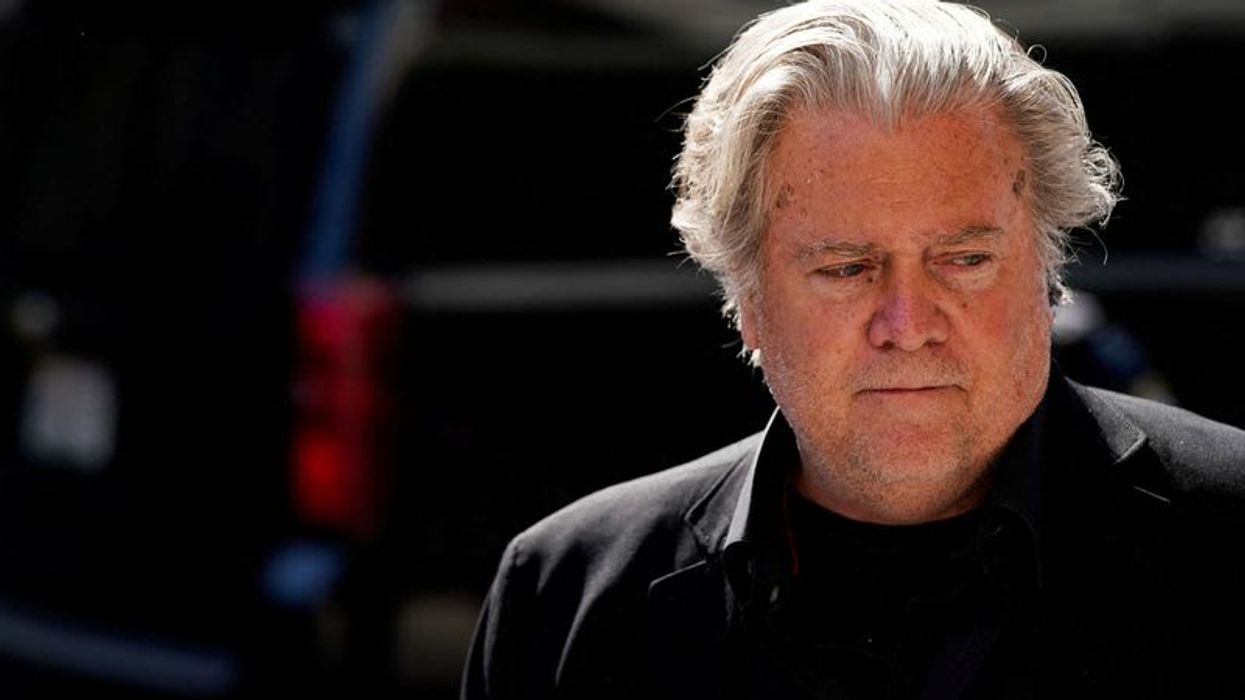
Steve Bannon

Bannon Outlines MAGA Plan To Suppress Votes And Subvert 2026  Elections

War Room host and former Trump adviser Steve Bannon this week spelled out a vision of how MAGA media could attempt to subvert the 2026 midterm elections, including by advocating for the presence of Immigration and Customs Enforcement agents at polling places, extreme Congressional redistricting, and a mail-in voting ban.

Bannon’s proposed playbook is an evolution of the MAGA movement’s central ideological myth, which asserts that the 2020 election was stolen from President Donald Trump. This load-bearing fantasy supports any number of related policies, including MAGA media’s oft-repeated threat that every immigrant who came to the United States without authorization during the Biden administration must be deported.

It’s only a matter of time before election denial again becomes ubiquitous in right-wing media, as it did in the run-up to the 2022 midterms and prior to the 2024 general election. Beyond false claims about noncitizen voting, right-wing pundits also spread conspiracy theories in 2020 about Dominion voting machines and wrongly asserted that some votes had been flipped in 2024.

This history is key to understanding the moves that the Trump White House and MAGA media are making in anticipation of the 2026 midterms with the goal of cementing power through a host of anti-democratic means, including:

  • Sending federal police, the National Guard, and Immigration and Customs Enforcement agents to occupy liberal cities like an invading army.
  • Seeking to ban mail-in voting.
  • Pushing for unprecedented, mid-decade Congressional redistricting efforts.
  • Attempting to purge voter rolls and suppress turnout by requiring proof of citizenship to register to vote in federal elections.
  • Calling for a mid-decade census that would exclude people in the United States without authorization, which experts have argued would be unconstitutional.

Bannon laid out MAGA media’s theory of the case during his Tuesday morning show.

The Trump administration must “get these elections squared away, for once and all,” Bannon said, adding, “No mail-in ballots.”

A day earlier, Trump posted on Truth Social that he would “lead a movement to get rid of MAIL-IN BALLOTS, and also, while we're at it, Highly 'Inaccurate,' Very Expensive, and Seriously Controversial VOTING MACHINES.” (Trump’s claim that voting machines are unreliable is false.)

Bannon then escalated his rhetoric, demanding that ICE agents enforce voter ID measures in cities throughout the country, seemingly without regard to local and state laws.

“They're petrified over at MSNBC and CNN that, hey, since we're taking control of the cities, there's going to be ICE officers near polling places,” Bannon said. “You damn right.”

“If you don't have an ID — if you're not a citizen — you're not voting,” he said.

Bannon’s threat is not idle, given the Trump administration’s posture toward some of the country’s biggest cities. In June, Trump deployed ICE agents to Los Angeles to carry out workplace raids, subsequently calling in the National Guard for additional repressive power. Then in August, Trump took over Washington’s local police department and surged federal police on the city’s streets. Once again, Trump sent in the National Guard; Republican governors lined up to provide their state’s troops to serve his ends. Trump has also threatened to deploy National Guard troops to New York City, Chicago, Baltimore, and Oakland, and has directed ICE to ramp up deportations in cities run by Democrats.

Some of Bannon’s allies have attempted to suppress voter turnout by monitoring ballot drop boxes and otherwise harassing election workers. Now, as the Trump administration prepares to hire an additional 10,000 ICE agents thanks to a newly passed Republican budget, Bannon’s demand that immigration cops stalk polling places doesn’t seem far-fetched.

Already, election denial activist Jenny Beth Martin and her group, Tea Party Patriots, are going on tour to promote the SAVE Act, an anti-voting rights bill that would require proof of citizenship to register to vote in federal elections. Martin’s group sponsored a rally on January 6, 2021, and in 2024 she bragged that she was helping to train poll watchers for the election that year.

In his Tuesday morning monologue, Bannon also called for a “maximalist policy” on redrawing Congressional maps ahead of next year’s midterms instead of waiting until the end of the decade for the completion of the census. Trump initiated the fight, calling for Texas to redraw its maps to produce five more Republican seats in the House of Representatives. Some Democratic governors have matched Trump’s gambit, saying they’ll attempt to do the same in their own states.

In addition to Texas, Bannon called for “Indiana, Missouri, South Carolina, Florida, [and] Ohio,” to create new Republican seats through extreme gerrymandering in order to protect Trump from possible impeachment should Democrats win back the House. Trump has “a lot more than a year and a half's worth of work left,” Bannon said. “He's got more than this term and beyond.”

Bannon reiterated his threats on Wednesday, tying them explicitly to the midterms.

“Remember, for 2026, the mid-decade census that has to be right this time,” Bannon said. “No illegal aliens. You’ve got to get the algorithms right. And the collection — all the mistakes that we had. Also, the redistricting.”

“The last is the mail-in ballots,” Bannon said.

“And the left is sitting there going, well gosh, they take away mail-in ballots, people are going to have to show up, they’re going to have ICE agents around, people are going to be so afraid, intimidated, they’re going to be arrested,” Bannon added. “Well, hey, if you’re an illegal alien you shouldn’t be going to the polls anyway.”

On Wednesday, the Texas House passed a new redistricting map expected to yield an additional five Republican seats. Trump celebrated the result in a post on Truth Social, adding that if Republicans “STOP MAIL-IN VOTING” and “go to PAPER BALLOTS,” Republicans will “will pick up 100 more seats, and the CROOKED game of politics is over.”

The MAGA movement’s attacks on immigrants, voting rights, and cities they don’t control are all attempts to further entrench Trump’s political power and eliminate any possible checks or balances on it. Right-wing media figures are salivating at the opportunity to punish their opponents. It’s incumbent on legacy media to tell the whole story and draw these connections. After all, Bannon and his fellow travelers in MAGA media are very open about their playbook.

Reprinted with permission from Media Matters.

Shop our Store

Headlines

Editor's Blog

Corona Virus

Trending

World