Tag: martin o'malley
Late Night Roundup: The Colbert Presidential Candidate Town Hall

Late Night Roundup: The Colbert Presidential Candidate Town Hall

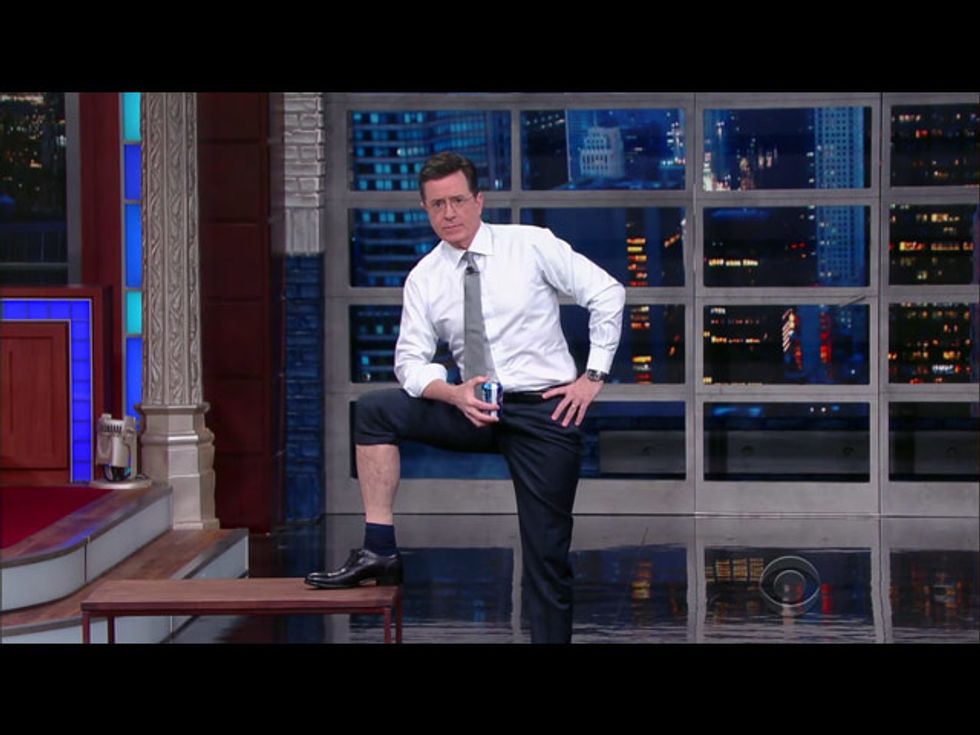
Stephen Colbert pivoted off this week’s Democratic town hall event on CNN, to hold his own town hall meeting with his audience. Stephen got in all the typical candidate remarks and poses, like rolling up his sleeves — and his pants leg.

Larry Wilmore celebrated the indictment in Texas of those anti-Planned Parenthood activists who produced the fraudulent videos alleging that the organization sells fetal body parts. But Larry pointed out the damage has been done: “Here’s the thing about bull@#$t, people remember it a lot more than telling the truth.”

Seth Meyers highlighted the many times Republican presidential candidates have been citing the deceptively edited videos to accuse Planned Parenthood of criminal wrongdoing — with perhaps the worst offender being Carly Fiorina.

Jimmy Kimmel played a fun little game based on the presidential race: Sending a crew down the street, and asking random people if they can recognize a photo of Martin O’Malley. Ouch. (It took them a while, but they finally found one person.)

Democratic Presidential Candidates Get Chance For Seventh Debate

Democratic Presidential Candidates Get Chance For Seventh Debate

By Jonathan Allen

NEW YORK (Reuters) – A U.S. news channel and a newspaper will host a debate for the Democratic presidential contenders in New Hampshire a few days before the state’s primary election – but it remained unclear whether the party will relax its rule banning candidates from non-sanctioned debates.

The news channel MSNBC and the New Hampshire Union Leader will hold the debate on Feb. 4 in New Hampshire, the second state in the nation to vote for parties’ presidential nominees following the Iowa caucuses on Monday, the Union Leader said on its website on Tuesday.

The Democratic National Committee (DNC) has been criticized by two of the three contenders, U.S. Senator Bernie Sanders of Vermont and former Maryland Governor Martin O’Malley, for its relatively skimpy debate schedule.

The DNC scheduled only six debates for its 2016 candidates, and, contrary to its practice in previous election years, forbade candidates from taking part in debates not sanctioned by the party. There were 25 Democratic primary debates in 2008 and 15 in 2004, both sanctioned and unsanctioned.

DNC Chairwoman Debbie Wasserman Schultz has dismissed criticisms from within her party that she organized relatively few debates and scheduled them at times when viewership might be lower than average in order to protect former Secretary of State Hillary Clinton’s position as the long-standing front-runner for the nomination.

Sanders has recently been drawing near or even, overtaking Clinton in some opinion polls as the first voting draws near.

“We were always concerned that this would have been the first time in 32 years without a Democratic debate before the New Hampshire primary,” Joseph W. McQuaid, the Union Leader’s publisher, said in an article on the paper’s website, explaining the decision to add an unsanctioned debate.

The paper did not say which candidates were invited or whether any of them had accepted ahead of the Feb. 9 New Hampshire primary. Spokesmen for Sanders, Clinton and the DNC did not respond to a request for comment.

John Bivona, O’Malley’s campaign director in New Hampshire, said in an email to reporters that O’Malley looked forward to participating in the debate.

(Editing by Jonathan Oatis)

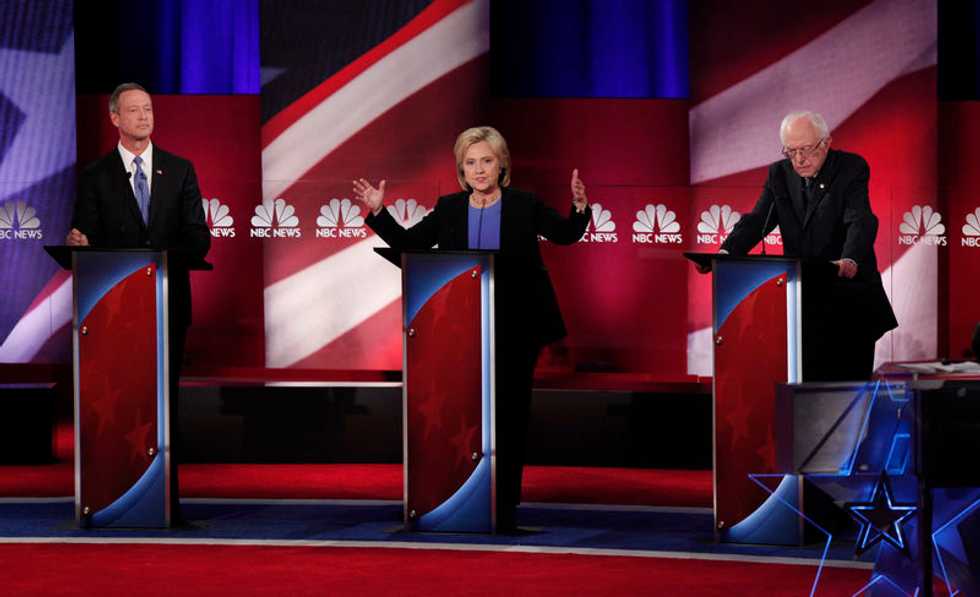
Photo: Democratic U.S. presidential candidate and former Secretary of State Hillary Clinton speaks as she discusses issues with former Governor Martin O’Malley (L) and Senator Bernie Sanders at the NBC News – YouTube Democratic presidential candidates debate in Charleston, South Carolina January 17, 2016. REUTERS/Randall Hill

Here’s A Fact: No Democrat Gets High Marks From NRA

Here’s A Fact: No Democrat Gets High Marks From NRA

By William Douglas, McClatchy Washington Bureau (TNS)

WASHINGTON — The liveliest portions of Sunday’s Democratic debate, the last before Iowa’s caucuses Feb. 1, were sparked by gun control and Wall Street regulation.

The charges and counter-charges, particularly between former Secretary of State Hillary Clinton and Sen. Bernie Sanders, were spirited.

GUN CONTROL

Clinton accused Sanders of flip-flopping on the issue of immunity from lawsuits for gun manufacturers. On the eve of Sunday’s debate, Sanders said he would support a bill introduced by Sen. Richard Blumenthal, D-Conn., and Rep. Adam Schiff, D-Calif., that would reverse a 2005 measure that Sanders voted for that shielded gun manufacturers from liability when their weapons were used in crimes.

“I am pleased to hear that Senator Sanders has reversed his position on immunity and I look forward to him joining with those members of Congress who have already introduced legislation,” Clinton said. “There is no other industry in America that was given the total pass that the gun makers and dealers were and that needs to be reversed.”

Sanders insisted he’s been consistent on the issue.

“What I have said, is that (the) gun manufacturer’s liability bill has some good provisions among other things, we’ve prohibited ammunition that would’ve killed cops who had protection on,” Sanders said. “We have child-safety protection work on guns in that legislation. And what we also said, is a small mom and pop gun shop who sells a gun legally to somebody should not be held liable if somebody does something terrible with that gun.”

Sanders also defended his record on gun control, saying he’d been given a D-minus rating by the National Rifle Association, a rating the lobbying group reserves for “an anti-gun candidate who usually supports restrictive gun control legislation and opposes pro-gun reforms.”

Clinton and former Maryland Gov. Martin O’Malley, the third candidate on the stage, have both been given F grades by the NRA, a rating the NRA says it reserves for a “true enemy of gun owners’ rights.”

RAISING MINIMUM WAGE

O’Malley and Sanders expressed support for the “Fight for $15” movement, which calls for doubling the federal minimum wage. Republican candidates have argued employers can’t afford it, and that it will cost jobs.

But a study published last January by the University of Chicago’s Booth School suggested it would be consumers who would pay for the higher wages in higher prices. Employers in high-cost states or low unemployment states already have workers making above the federal minimum wage of $7.25 an hour.

Clinton didn’t address the topic.

REVAMPING WALL STREET

Clinton went after Sanders for voting for a financial deregulation bill in 2000 that critics believe gave Wall Street the rope it used to hang the economy in the 2008 financial crisis.

The criticism was unfair given that the bill was signed by a Democrat in the White House, her husband, Bill Clinton.

Sanders and O’Malley both criticized the Obama administration’s landmark revamp of financial regulation, called the Dodd-Frank Act.

The two suggested the legislation failed to give regulators the power to break up big banks, and Clinton rightly noted it in fact does.

Clinton defended herself against a charge by Sanders that she had received $600,000 in speaking fees from the Wall Street firm Goldman Sachs, suggesting that GOP strategist Karl Rove and financial firms called hedge funds are teaming up to run ads against her. In blasting hedge funds, she failed to mention that her son-in-law, Marc Mezvinsky, runs one. He also worked at Goldman Sachs for more than eight years.

FOREIGN POLICY

Foreign policy and national security issues didn’t come up until well over an hour into the debate, and even then the moderators spent only about 10 minutes on the issues, skimming over the Syrian conflict, the fight against Islamic State extremists, diplomacy with Iran and relations with Russia.

Only O’Malley, in his closing statement, mentioned the wave of migrants fleeing violence in Central America. There was no mention at all of the United States’ gradually warming relations with Cuba.

There was also no discussion of Libya, where chaos has reigned since a Clinton-backed intervention helped to topple leader Moammar Gadhafi, and scant mention of Yemen. Clinton referred to Yemen only as a place where the Iranians were meddling, but she failed to note the merciless bombing campaign that U.S. ally Saudi Arabia has waged there, to the outrage of international human rights groups.

BALTIMORE HOMICIDE RATE

O’Malley was pressed by NBC’s Lester Holt about tough-on-crime measures he implemented as mayor of Baltimore, measures that several critics said contributed to rioting following the death of Freddie Gray while in Baltimore police custody.

O’Malley said, “When I ran for mayor in 1999, Lester, it was not because our city was doing well. It was because we were burying over 300 young, poor, black men every single year. And that’s why I ran. Because black lives matter.”

O’Malley added: “We were able to save a lot of lives, doing things that actually work to improve police and community relations.”

The Baltimore Sun reported in November that the city had more than 300 homicides before the end of 2015, its deadliest year, per capita, in history.

©2016 McClatchy Washington Bureau. Distributed by Tribune Content Agency, LLC.

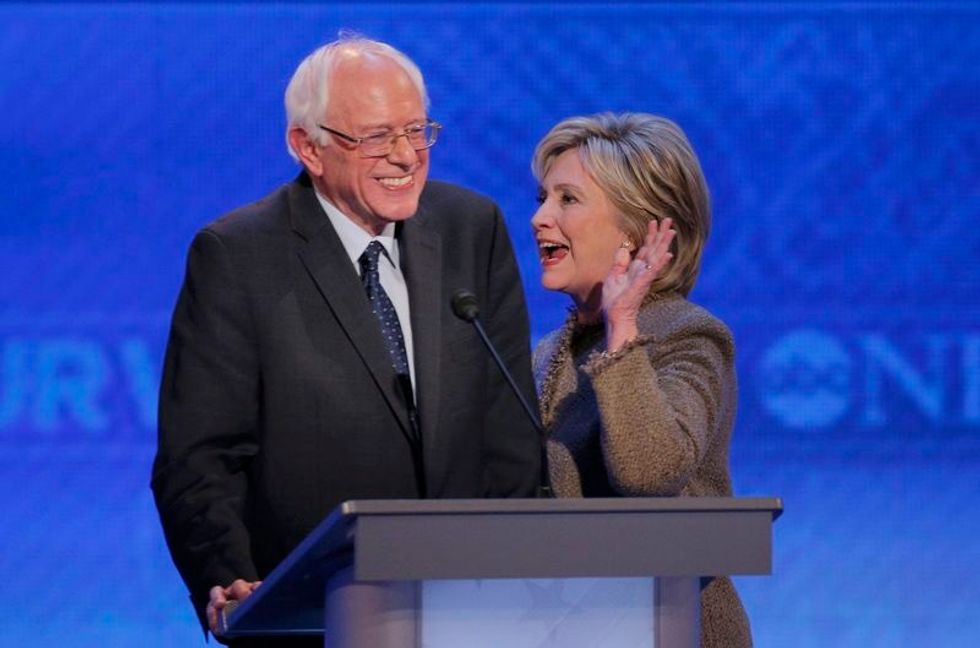
Photo: Democratic U.S. presidential candidates U.S. Senator Bernie Sanders and former Secretary of State Hillary Clinton share a laugh at the start of a commercial break during the Democratic presidential candidates debate at St. Anselm College in Manchester, New Hampshire December 19, 2015.  REUTERS/Brian Snyder

The ‘Dreamers’: They Anger The GOP And Power Democratic Campaigns

The ‘Dreamers’: They Anger The GOP And Power Democratic Campaigns

By Kate Linthicum, Los Angeles Times (TNS)

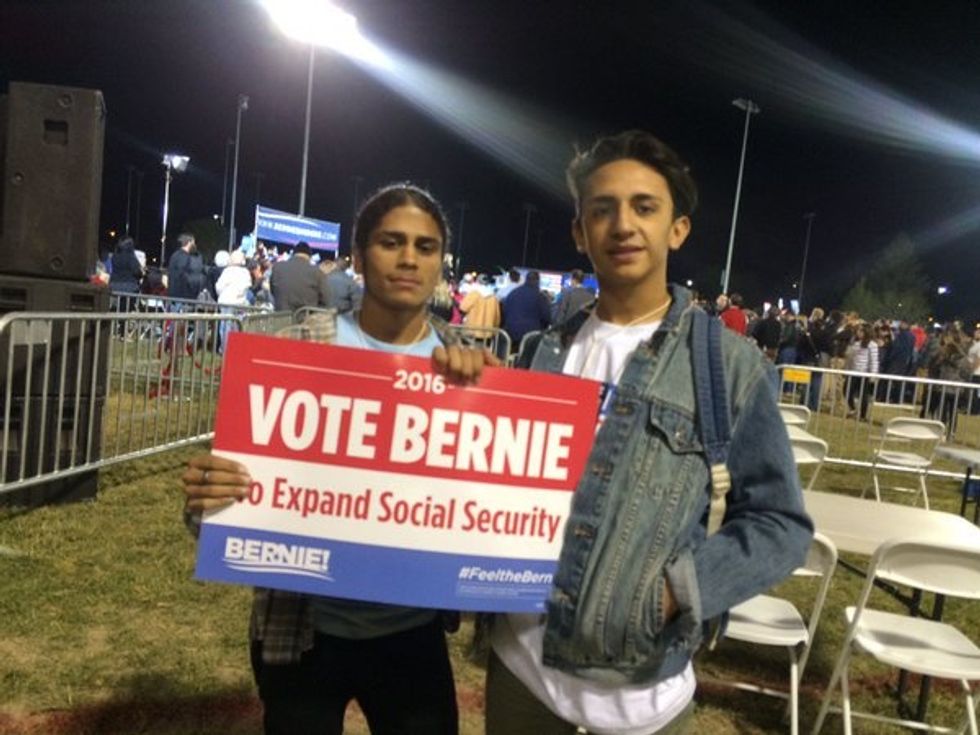
LOS ANGELES — When he’s not at school, 18-year-old Pedro Duran often can be found dialing voters from the threadbare Las Vegas campaign headquarters of presidential candidate Bernie Sanders.

Or he might be handing out Sanders buttons at a nearby Latino grocery store, or promoting Sanders to members of his extended family.

An Ecuadorian who was brought to the U.S. illegally as a child, Duran isn’t eligible to vote in Nevada’s Democratic caucuses next month. But that hasn’t stopped him from doing everything he can to support his favored candidate.

“I’m kind of fighting the fact that I’m excluded,” said Duran, who believes Sanders will do the most to protect immigrants like him from deportation. “I have to be a part of this.”

Immigrants lacking legal status are increasingly involved in this year’s presidential race, working as volunteers, campaign advisers and, in some cases, as paid staffers for Sanders and his Democratic rivals, Hillary Clinton and Martin O’Malley.

While illegal immigration has stirred anger on the Republican side, with GOP front-runner Donald Trump calling for mass deportations, Democrats are leaning the other way, with all three candidates pledging to do more than President Barack Obama has done to curb deportations.

Sanders and Clinton have assigned key Latino outreach efforts to young “Dreamer” activists who were brought to the country illegally as children. Clinton’s campaign has organized teams of mothers in the country illegally to operate phone banks on her behalf.

O’Malley has touted endorsements from immigrants in the country illegally in important primary states such as Iowa. He has met frequently with such immigrants on the campaign trail and recently held a defiant rally outside a jail operated by Sheriff Joe Arpaio, an immigration hard-liner in Arizona.

Political analysts say Democrats have embraced immigrants and their cause because they are seen as a key to the Latino vote, a growing and increasingly crucial demographic in presidential elections.

The immigrant rights movement, with young Dreamers leading the charge, has won several victories in recent years, even as Republicans in Congress and the courts have blocked legalization efforts.

“What other social movement within the Latino community has been as smart and influential?” asked Marisa Abrajano, a political scientist at the University of California, San Diego. “They’re tapping into this pre-existing movement. It’s very smart and strategic.”

O’Malley’s team consulted with day laborers, farm workers and other immigrants in the country illegally while drafting his immigration plan.

It calls for an end to a program that stations immigration agents in local jails, and for immigrants fleeing gang violence in Central America to be granted a designation known as Temporary Protected Status and allowed to stay.

“At every stage of the process, undocumented voices have literally written our platform,” said O’Malley adviser Gabriela Domenzain.

Clinton’s immigration stance was similarly shaped by a May roundtable discussion at a Las Vegas high school in which she hosted several young immigrants in the country without authorization.

Shortly after, Clinton put her Latino program in the hands of Lorella Praeli, a leading Dreamer activist who at one time lacked legal status but who recently obtained citizenship through marriage.

Cheska Perez, 18, said she started knocking on doors for Clinton last summer after several Republican candidates for president vowed to end Obama’s Deferred Action for Childhood Arrivals program, which protects more than 600,000 immigrants brought to the U.S. as children from deportation.

Obama created the program in 2012 after considerable pressure from immigrant activists, who used sit-ins and street protests to persuade the president to act on his own when a proposed overhaul of immigration law died in Congress.

An immigrant from the Philippines who has deferred action status, Perez spends most afternoons canvassing for Clinton in the largely Latino neighborhoods of East Las Vegas.

“I may not have a vote, but I have a voice,” she said.

For immigrants, having a say in presidential politics is seen as critically important.

“I don’t have the luxury of doing nothing,” said Astrid Silva, a Mexican-born activist who introduced Sanders at a recent Las Vegas immigration forum, although she has not yet endorsed a candidate.

“My dad has a deportation order against him,” she said. “If I don’t do something, my family will be separated.”

Some immigrant activists say they are watching the presidential process warily, pointing out that Obama also pledged to pass immigration reform, but later was stymied by congressional opposition.

“Every four years, we get these candidates with their pretty immigration plans that are going to make my life easier, and every four years, we get disappointed,” said Kenia Calderon, an activist in Iowa.

After asking questions of all three Democrats at campaign forums, Calderon decided to endorse O’Malley, who she said has the best record on immigration issues, as well as the best proposals.

Others say that after years of watching politicians decide their fate, they have come to recognize that politics is the only way to bring change.

“We’ve been Americanized,” said Gaby Pacheco, an immigrant who grew up in Miami and is now director of the Bridge Project, which seeks to bring Republicans and Democrats together to pass immigration policy.

“We learned American history,” Pacheco said. “We know that the only way we can make change happen is by being diligent and vigilant in this process, and not just sitting at home.”

©2016 Los Angeles Times. Distributed by Tribune Content Agency, LLC.

Photo: Pedro Duran, a volunteer for Bernie Sanders. Kate Linthicum via Twitter

Shop our Store

Headlines

Editor's Blog

Corona Virus

Trending

World